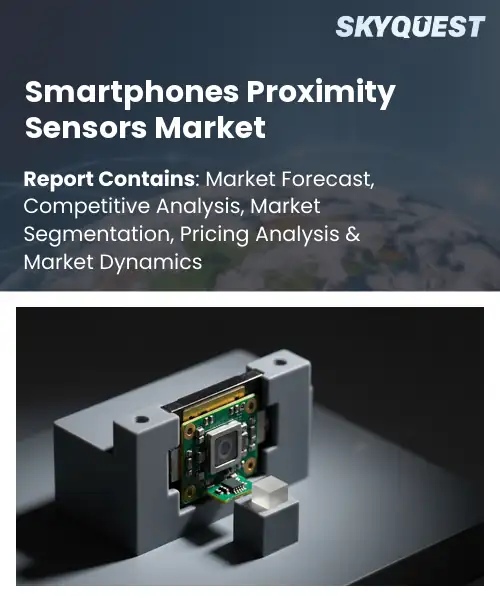
Smartphones Proximity Sensors Market
Report ID: SQMIG45O2132
Report ID: SQMIG45O2132
[email protected]
USA +1 351-333-4748
Report ID:
SQMIG45O2132 |
Region:
Global |
Published Date: February, 2026
Pages:
157
|Tables:
149
|Figures:
78


Global Smartphones Proximity Sensors Market size was valued at USD 1.23 Billion in 2024 and is poised to grow from USD 1.31 Billion in 2025 to USD 2.17 Billion by 2033, growing at a CAGR of 6.5% during the forecast period (2026-2033).
High demand for seamless user interaction, improved power efficiency, compact smartphone designs, growing smartphone sales, and rising investments in smartphone R&D is supporting steady sales of smartphones proximity sensors going forward.
Advances in sensor fusion and the integration of AI are further influencing the market's development with the ability of proximity sensors to support various applications such as facial recognition, under-display authentication, and power management. This has created the need for highly accurate and compact sensors and firmware with the ability to minimize false trigger issues. This has prompted various suppliers in the market to develop innovations such as stacked optics, MEMS, and VCSELs in the future with the aim of reducing costs. Applications such as gesture control and the development of augmented reality features are further influencing the development of collaborations between various component suppliers and smartphone manufacturers. Growing smartphone penetration and increasing consumer expectations for enhanced user experience are expected to primarily drive smartphone proximity sensors market growth.
On the contrary, high development costs, challenges in maintaining sensor precision across diverse smartphone designs, risks of performance inconsistencies, and increasing integration complexity are anticipated to slow down smartphone proximity sensors market penetration over the coming years.
How is AI Improving Accuracy in the Smartphones Proximity Sensors Market?
Artificial intelligence is enhancing the precision of proximity detection using smartphones by replacing conventional hardware-based approaches with intelligent sensor fusion and local learning. It is using adaptive machine learning algorithms that can interpret how a user normally holds their phone, filtering out noises caused by reflections or a user’s pocket. It is also using edge processing to minimize latency and preserve user privacy. Software-based virtual sensors and sophisticated optical and time-of-flight solutions are increasingly popular among end-users.
Market snapshot - (2026-2033)
Global Market Size
USD 1.23 Billion
Largest Segment
Infrared Sensors
Fastest Growth
Capacitive Sensors
Growth Rate
6.5% CAGR
To get more insights on this market click here to Request a Free Sample Report
Global smartphones proximity sensors market is segmented by sensor type, smartphone category, application, technology, sales channel, and region. Based on sensor type, the market is segmented into infrared sensors, ultrasonic sensors, and capacitive sensors. Based on smartphone category, the market is segmented into entry-level smartphones, mid-range smartphones, and premium. Based on application, the market is segmented into screen activation, proximity detection, screen auto-off / on during calls, gesture recognition, call management, power optimization, and others. Based on technology, the market is segmented into infrared (IR) proximity sensors, optical proximity sensors, capacitive proximity sensors, ultrasonic proximity sensors, and others. Based on sales channel, the market is segmented into OEM (Original Equipment Manufacturers) and aftermarket. Based on region, the market is segmented into North America, Europe, Asia Pacific, Latin America, and Middle East & Africa.
The infrared sensors segment is [projected to lead the global smartphones proximity sensors market revenue generation in the future. High preference for compact form factor, low power consumption, and easy integration into existing handset optical stacks. Their simple emitter and detector combination provides reliable near-field occlusion detection in a variety of lighting conditions, thus minimizing false touch events and calibration of firmware. Familiarity of suppliers and well-established production cycles ensure design reuse across models, thus minimizing development hurdles in bringing proximity-related features to market.
However, ultrasonic sensors are emerging as the fastest growing segment as per this smartphones proximity sensors industry analysis. Superior performance in detecting through varied materials and challenging lighting creates a new business scope going forward. The improvements in miniaturized transducers and signal processing not only expand the possibilities beyond the detection of presence but also into the realm of fine proximity gradients and air gesture recognition, providing opportunities for product differentiation.
The screen activation segment is slated to account for the largest global smartphones proximity sensors market share in the long run. The most ubiquitous and user visible application of proximity sensors is expected to help this segment maintain its dominant stance. The need for immediate availability of wake detection and ambient occlusion detection results in a standardized requirement across various handsets. This also results in cross-functional coordination between sensor and system software teams and reconfirms the need for investing in proven sensor solutions.
On the other hand, gesture recognition is emerging as the fastest expanding application as manufacturers strive towards touchless experience and richer user experience. Improvements in sensor fusion and machine learning have made it possible to detect gestures in air reliably. This has enabled new opportunities in accessibility, gaming, and hands-free control for smartphone manufacturers.
To get detailed segments analysis, Request a Free Sample Report
Presence of an interlinked ecosystem of manufacturing strength, specialized component suppliers, and deep collaboration between OEMs and research institutions support consistent smartphones proximity sensors demand in this region. Moreover, the presence of massive smartphone and sensor assembly hubs and a high density of suppliers who specialize in semiconductor-based components and miniaturization also create new opportunities. There is also a strong cultural emphasis on innovation in consumer electronics and a high rate of adoption of these products in this region. In addition, this region offers a competitive advantage in terms of cost and logistical advantages that allow for competitive pricing and quality. There are also close strategic partnerships between research institutions and consumer electronics manufacturers that accelerate research and validation efforts, making this region a major contributor to cutting-edge and quality proximity sensor technology and modules that are used in these devices.
Longstanding heritage of precision engineering and sensor innovation driven by established electronics manufacturers shapes smartphones proximity sensors procurement in Japan. Local test infrastructure and brand recognition help in the adoption of sophisticated proximity sensors. Focus on miniaturization, high-fidelity sensors, and high-end smartphone design is beneficial for a quality-focused market. Strong relationships between component makers and smartphone designers facilitate rapid prototyping and rigorous validation.
High concentration of global device manufacturers and advanced component suppliers make South Korea a key market for smartphones proximity sensors vendors in this region. Emphasis on end-user experience and miniaturized, highly advanced sensor modules is also beneficial. Localized industry structures and strategic partnerships help support advancement and availability for domestic and international smartphone programs. Collaborations between chipset developers and OEMs are also boosting the R&D of novel sensor architectures.
A unique mix of startup agility, large technology firms, and leading research institutions focused on sensor fusion are creating new opportunities for smartphones proximity sensors companies in this region. In terms of both infrastructure and investment, there are many opportunities available in this area. In addition, companies are working closely together to create an integrated end-to-end solution, meaning that the sensor technology information being developed will ultimately be validated through the various stages of development. Partnerships with large corporations located globally are providing access and funding to support the growth of the technologies as well as the partnerships to bring their innovative ideas to market. These partnerships and collaborative nature of the region will continue to support the rapid growth of the commercialization process of more innovative sensor technologies and their resulting growth as a major source of innovation within the sensor-oriented market.
High emphasis on innovation from chipset firms, sensor startups, and major device brands are helping boost sales of smartphones proximity sensors in the United States. Emphasis is placed on algorithm development, system-level integration, and comprehensive testing in support of sophisticated proximity applications. Collaborative links between universities, research labs, and manufacturers facilitate the rapid translation of prototypes into commercial modules. Software-driven optimization and strategic ecosystem partnerships ensure sensor performance meets platform objectives.
Strong research capabilities, expertise in sensor algorithms, and system integration focused on software driven performance helps boost smartphones proximity sensors demand in Canada. While manufacturing volume may not be as high, the market has access to unique strengths in image processing and machine learning, making it an attractive partner for international device development initiatives with high-level requirements for sophisticated proximity sensing.
Focus on quality component development, regulations, and industry associations are the major drivers in the European region for the sales of proximity sensors used in smartphones. Established engineering bases ensure the necessary infrastructure for exact manufacturing processes and working with the automotive and industrial sectors ensures the transfer of knowledge and development of new technologiesin the areas of materials and integration. Consortiums and private working groups are also dedicated to interoperability, certification, and system-level performance, which further adds to the credibility of the European industry in the eyes of international OEMs. The support for niche manufacturing and the heavy emphasis on compliance and supplier relations are also beneficial in creating a reliable industry that can deliver differentiated proximity sensing solutions in the premium and niche device market.
Robust industrial engineering heritage, precision manufacturing capabilities, and close links between research institutions and component suppliers support consistent smartphones proximity sensorsadoption in Germany. Cooperation between specialized suppliers, testing institutions, and device makers enables the creation of dependable proximity sensors regarding performance and regulatory requirements. smartphones proximity sensors companies in the country are focused on design, manufacturing quality, and compatibility with other sensor technologies like those in the automotive and industrial sectors.
smartphones proximity sensors demand in the United Kingdom is backed by advanced research, sensor algorithm development, and software driven system integration. Collaborations for prototyping and proof of concept validation are popular in the country, despite mass production being carried out in other locations. Companies focusing on machine learning-based proximity sensing, privacy-preserving techniques, and user experience optimization are expected to succeed in the country through 2033.
A blend of electronics research, specialized component manufacturing, and an emphasis on design for quality and user ergonomics supports demand for smartphones proximity sensors in France. The research focus is on the development of sensor packaging solutions and the development of low power systems and products that can be integrated with various mobile device structures. National initiatives in industrial partnership and export-oriented relationships enable local industries to interact with international original equipment manufacturers who require special sensor technology.
To know more about the market opportunities by region and country, click here to
Buy The Complete Report
Increasing Sensor Integration in Devices
Proximity sensors are being integrated into the design of the smartphone, thereby allowing the manufacturer to further refine the interface of the device, thereby increasing the convenience of the user experience. Proximity sensors are increasingly integrated into the design of the smartphone, thereby allowing the manufacturer to further refine the interface of the device, thereby increasing the convenience of the user experience. This has resulted in the increasing adoption of advanced proximity sensor modules, thereby increasing the miniaturization of the device.
Rising Demand for Enhanced Features
High consumer demand for a seamless and context-aware experience on their smartphones, the importance of proximity sensing in delivering features such as smart wake, display behavior, and hands-free controls increases, leading manufacturers to increase the emphasis on the quality of their proximity sensors in delivering the desired user experience, thereby increasing the adoption of more advanced proximity sensors in the smartphone market. This synergy between the needs of the end user and the product development response has a positive impact on the global smartphones proximity sensors market outlook through 2033.
Technical Limitations in Miniaturization
The difficulty in miniaturizing the proximity sensor component without affecting the sensitivity and efficiency of the device also acts as a constraint in the integration of the proximity sensor in slim smartphone designs. Such design-related issues may delay the development of new devices, thereby affecting the adoption of new proximity sensor technology in the market. This may also influence the rate at which innovative proximity sensor technology is integrated in the devices in the future.
Regulatory and Environmental Compliance
Changing regulations and environmental compliance for electronic components add further certification, material, and manufacturing process restrictions to the existing ones faced by proximity sensor vendors, thereby increasing the time taken to develop proximity sensors and the overall complexity involved in the development process. Proximity sensor vendors need to ensure that the products comply with substance restrictions, end-of-life recycling directives, and regional certification directives, thereby increasing the cost of development and making the development process more complicated, which in turn may affect the investment in new types of smartphone variants equipped with advanced proximity technology.
Request Free Customization of this report to help us to meet your business objectives.
Competition in the global smartphones proximity sensors market is marked by supplier consolidation and chip vendor alliances that prioritize miniaturized time of flight modules and VCSEL supply to win OEM design slots. Recent strategic moves include the Velodyne Ouster consolidation, partnerships such as STMicroelectronics with MobilePhysics to embed dToF capabilities, and Scantinel Photonics scaling FMCW lidar chip development to challenge legacy ToF suppliers.
Top Player’s Company Profile
AI-driven Context Awareness: Sensors are offering contextual inputs for on-device artificial intelligence, enabling more intuitive user experiences. The use of proximity sensors is creating an intelligent user interface by enabling algorithms to distinguish between user engagement, hand orientation, and conditions. Hence, growing demand for intelligent user interface for call management, screen interactions, and gesture recognition is emerging as a popular smartphones proximity sensors market trend over the coming years.
Immersive AR Interaction: High consumer preference for richer augmented and mixed reality experiences boosts proximity sensor integration in smartphones. This can help in the development of more immersive experiences and safer handling of the device. Development of more varied user interfaces and the development of ecosystems and partnerships with hardware and content providers is also highlighting the importance of this smartphones proximity sensors industry trend.
SkyQuest’s ABIRAW (Advanced Business Intelligence, Research & Analysis Wing) is our Business Information Services team that Collects, Collates, Correlates, and Analyses the Data collected by means ofPrimary Exploratory Research backed by robust Secondary Desk research.
As per SkyQuest analysis, rising demand for enhanced user experience, improved power efficiency, and compact smartphone designs is anticipated to drive the demand for smartphone proximity sensors going forward. However, challenges related to sensor accuracy, false triggering, and increasing integration complexity are slated to slow down the adoption of smartphone proximity sensors in the future. Asia Pacific is slated to spearhead the demand for smartphone proximity sensors owing to high smartphone manufacturing activity, strong presence of leading OEMs, and growing consumer electronics adoption. Development of AI-based virtual proximity sensing solutions and integration with sensor fusion technologies are anticipated to be key trends driving the smartphone proximity sensors sector across the study period.
| Report Metric | Details |
|---|---|
| Market size value in 2024 | USD 1.23 Billion |
| Market size value in 2033 | USD 2.17 Billion |
| Growth Rate | 6.5% |
| Base year | 2024 |
| Forecast period | (2026-2033) |
| Forecast Unit (Value) | USD Billion |
| Segments covered |
|
| Regions covered | North America (US, Canada), Europe (Germany, France, United Kingdom, Italy, Spain, Rest of Europe), Asia Pacific (China, India, Japan, Rest of Asia-Pacific), Latin America (Brazil, Rest of Latin America), Middle East & Africa (South Africa, GCC Countries, Rest of MEA) |
| Companies covered |
|
| Customization scope | Free report customization with purchase. Customization includes:-
|
To get a free trial access to our platform which is a one stop solution for all your data requirements for quicker decision making. This platform allows you to compare markets, competitors who are prominent in the market, and mega trends that are influencing the dynamics in the market. Also, get access to detailed SkyQuest exclusive matrix.
Table Of Content
Executive Summary
Market overview
Parent Market Analysis
Market overview
Market size
KEY MARKET INSIGHTS
COVID IMPACT
MARKET DYNAMICS & OUTLOOK
Market Size by Region
KEY COMPANY PROFILES
Methodology
For the Smartphones Proximity Sensors Market, our research methodology involved a mixture of primary and secondary data sources. Key steps involved in the research process are listed below:
1. Information Procurement: This stage involved the procurement of Market data or related information via primary and secondary sources. The various secondary sources used included various company websites, annual reports, trade databases, and paid databases such as Hoover's, Bloomberg Business, Factiva, and Avention. Our team did 45 primary interactions Globally which included several stakeholders such as manufacturers, customers, key opinion leaders, etc. Overall, information procurement was one of the most extensive stages in our research process.
2. Information Analysis: This step involved triangulation of data through bottom-up and top-down approaches to estimate and validate the total size and future estimate of the Smartphones Proximity Sensors Market.
3. Report Formulation: The final step entailed the placement of data points in appropriate Market spaces in an attempt to deduce viable conclusions.
4. Validation & Publishing: Validation is the most important step in the process. Validation & re-validation via an intricately designed process helped us finalize data points to be used for final calculations. The final Market estimates and forecasts were then aligned and sent to our panel of industry experts for validation of data. Once the validation was done the report was sent to our Quality Assurance team to ensure adherence to style guides, consistency & design.
Analyst Support
Customization Options
With the given market data, our dedicated team of analysts can offer you the following customization options are available for the Smartphones Proximity Sensors Market:
Product Analysis: Product matrix, which offers a detailed comparison of the product portfolio of companies.
Regional Analysis: Further analysis of the Smartphones Proximity Sensors Market for additional countries.
Competitive Analysis: Detailed analysis and profiling of additional Market players & comparative analysis of competitive products.
Go to Market Strategy: Find the high-growth channels to invest your marketing efforts and increase your customer base.
Innovation Mapping: Identify racial solutions and innovation, connected to deep ecosystems of innovators, start-ups, academics, and strategic partners.
Category Intelligence: Customized intelligence that is relevant to their supply Markets will enable them to make smarter sourcing decisions and improve their category management.
Public Company Transcript Analysis: To improve the investment performance by generating new alpha and making better-informed decisions.
Social Media Listening: To analyze the conversations and trends happening not just around your brand, but around your industry as a whole, and use those insights to make better Marketing decisions.
REQUEST FOR SAMPLE
 REQUEST FREE CUSTOMIZATION
Global Smartphones Proximity Sensors Market size was valued at USD 1.23 Billion in 2024 and is poised to grow from USD 1.31 Billion in 2025 to USD 2.17 Billion by 2033, growing at a CAGR of 6.5% during the forecast period (2026-2033).
Competition in the global smartphones proximity sensors market is marked by supplier consolidation and chip vendor alliances that prioritize miniaturized time of flight modules and VCSEL supply to win OEM design slots. Recent strategic moves include the Velodyne Ouster consolidation, partnerships such as STMicroelectronics with MobilePhysics to embed dToF capabilities, and Scantinel Photonics scaling FMCW lidar chip development to challenge legacy ToF suppliers. 'Qualcomm', 'STMicroelectronics', 'Texas Instruments', 'Panasonic', 'Infineon Technologies', 'NXP Semiconductors', 'ON Semiconductor', 'Bosch Sensortec', 'Broadcom', 'Sony Semiconductor Solutions', 'Analog Devices', 'Maxim Integrated', 'Omron', 'Vishay Intertechnology', 'Microchip Technology', 'Lite-On Technology', 'Cypress Semiconductor', 'Renesas Electronics', 'Ams AG', 'SiLabs'
Proximity sensors are being integrated more deeply into smartphone designs, enabling manufacturers to streamline device interfaces and enhance user convenience. By supporting features such as screen lock during calls, gesture detection, and contextual power management, closer integration encourages OEMs to adopt advanced sensor modules to differentiate products. This trend drives demand for compact, low-power, and highly accurate proximity components that fit modern slim form factors. In turn, suppliers invest in miniaturization and compatibility improvements, reinforcing a cycle of adoption and product evolution across the market.
Ai Driven Context Awareness: Sensors are increasingly leveraged within smartphone platforms to provide contextual inputs for on device artificial intelligence, enabling more intuitive user experiences and adaptive power management. Proximity data helps algorithms discern user engagement, hand position, and environmental conditions, improving call handling, screen behavior, and gesture recognition. This trend supports personalized interaction models and enhances privacy by enabling local inference rather than cloud processing. Vendors prioritizing tight hardware and software codesign gain competitive advantage through differentiated user experiences, reduced latency, and efficiency.
Why does Asia Pacific Dominate the Global Smartphones Proximity Sensors Market? |@12


Want to customize this report? This report can be personalized according to your needs. Our analysts and industry experts will work directly with you to understand your requirements and provide you with customized data in a short amount of time. We offer $1000 worth of FREE customization at the time of purchase.
Feedback From Our Clients


 USA (+1) 351-333-4748

