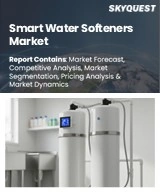
Smart Water Softeners Market
Report ID: SQMIG20B2112
Report ID: SQMIG20B2112
[email protected]
USA +1 351-333-4748
Report ID:
SQMIG20B2112 |
Region:
Global |
Published Date: December, 2025
Pages:
177
|Tables:
36
|Figures:
65


Global Smart Water Softeners Market size was valued at USD 12.1 billion in 2024 and is poised to grow from USD 14.99 billion in 2025 to USD 83.26 billion by 2033, growing at a CAGR of 23.9% during the forecast period (2026-2033).
The global smart water softeners market growth is being fuelled by consistent with the end-user concerns regarding water quality, the acceptance of IoT-enabled devices, and the demand for energy-efficient solutions. The efficiencies derived from AI-based monitoring, as well as the smart sensors for convenience, appears to supplement demand for smart water softeners. Government initiatives related to sustainable water management and urbanization further support consumer demand, while disposable income increases in many countries increases demand as consumer awareness of waterborne diseases increases as well. Key players are notably pumping in lots of resources into R&D innovations in commercial and residential sectors under what keeps increasing the craving for intelligent water softening appliance.
For instance, EcoWater Systems, a leader in the smart water softener market. The EcoWater ECR3700R is an IoT-based and Wi-Fi-enabled water softener system. It monitors the usage of water and salt through AI, avoiding waste by conserving both water and resources. It is hence unique in that it provides the user with real-time water quality information via a mobile app, particularly as consumers are now more concerned about the quality of water.
What Makes AI Integration Crucial for Smart Water Softeners Market?
The integration of artificial intelligence in the smart water softeners market is critical as it improves efficiency, lowers maintenance costs, and optimizes water softening. Algorithms of machine learning can analyze the water consumption of the home or business setting, adjust regeneration cycles with the goal of minimizing salt and energy costs, and cut down waste. Diagnostics can be AI-enabled to forecast possible system malfunctions before they take place such that there is no interruption of service. Real-time monitoring, especially when paired with Internet of Things (IoT) connectivity, adds convenience for the user and can maximize tracking of overall water quality. These developments also correlate with sustainability efforts, making AI-powered smart water softeners more attractive to environmentally conscious consumers and businesses, which in turn drives market growth.
Market snapshot - 2026-2033
Global Market Size
USD 11.22 Billion
Largest Segment
Residential
Fastest Growth
Commercial
Growth Rate
23.3% CAGR
To get more insights on this market click here to Request a Free Sample Report
Global Smart Water Softeners Market is segmented by Product Type, Grain Capacity, End User, Distribution Channel and region. Based on Product Type, the market is segmented into Wall Mounted and Floor. Based on Grain Capacity, the market is segmented into Up to 40,000, Up to 60,000 and Up to 80,000. Based on End User, the market is segmented into Residential and Institute. Based on Distribution Channel, the market is segmented into Supermarket & Hypermarket, Specialty Store, Convenience Store and Online Sales Channel. Based on region, the market is segmented into North America, Europe, Asia Pacific, Latin America and Middle East & Africa.
Why Do Residential Dominate the Smart Water Softeners Market?
As per the global smart water softeners market analysis, residential sectors dominate the smart water softeners market due to increased consumer awareness around water quality, health, and longevity of appliances. As disposable incomes rise, many homeowners will likely be able to afford to pay for IoT enabled, energy-efficient, and environmentally sustainable options. On a government level, they can encourage people to be more efficient with their water. Living in cities also means a need for easy and efficient solutions. Residential use of IoT devices for water softening is the strongest growth opportunity since most smart water softeners operate in the residential market and focus on enhancing convenience with features like remote monitoring through a smartphone.
Whereas the demand for commercial segment is expected to grow due to a better understanding of water efficiency and conservation, increasing regulations controlling the use of industrial water, and the need for safeguard large infrastructures around plumbing systems. Hotels, hospitals and manufacturing plants are using IoT-enabled softeners to minimize maintenance costs and ensure reliable and consistent water quality, which will fuel development across the wider market.
What Makes Ion Exchange to Lead in Smart Water Softeners Market?
Based on the global smart water softeners market forecast, the market is dominated by ion exchange due to proven success for hardness-causing minerals like Calcium and Magnesium. Ion exchange’s compatibility with smart technologies (IoT sensors, AI-based regeneration) surface as a great advantage that can enhance efficiency, reduce salt waste, and minimize operational costs. This proven, scalable technology remains a clearly articulated choice for residential and commercial consumers alike, helping to maintain its market dominance.
The salt-free water softening segment is expected to have the largest global smart water softeners market share, the salt-free water softening segment is expected to control the global smart water softeners market due to increasing environmental concerns, legislative regulations on water conservation, and chemical-free water treatment methods, and is a maintenance-free option that can be larger than tradition systems, and is more suitable for health-conscious consumers; salt-free water conditioners are likely to outpace growth of traditional or ion exchange systems.
To get detailed segments analysis, Request a Free Sample Report
Why Does North America Lead the Smart Water Softeners Market?
The smart water softeners market belongs to North America because consumers are more aware, strict water quality regulations, and have embraced IoT-enabled home solutions more than other markets. The demand for smart water softeners continues to benefit from rising hard water damage and government incentives to use technology to conserve water. The U.S. and Canada lead in the development of water-efficient smart technologies, including smart water softeners.
U.S. Smart Water Softeners Market
The U.S. dominates the smart water softeners market, driven by the country's extreme hard water problems, the population's remote access to technology, and a high level of access to IoT. Demand for smart water softeners has also increased because of government subsidies to buy water efficient appliances and growing awareness about health and wellness. Innovations that include AI-powered automated smart water softeners further enhance the U.S. smart water softeners market.
Canada Smart Water Softeners Market
Canada has a fast-growing market for smart water softeners because of the very hard water in regions like Alberta and Ontario. Rising environmental consciousness has led to better energy- and water-efficient solutions. This means more people are using them in homes and offices across the nation.
What Makes Asia-Pacific Fast-Growing Region in Smart Water Softeners Market?
The major driver of smart water softeners market growth globally is the Asia-Pacific region due to ongoing urbanization, declining water quality, and higher health consciousness. Demand growth is fueling to further demand in the smart water softeners market by increasing government initiatives related to water sustainability, rising disposable income of the middle class, and faster uptake and buy-in of smart home technology throughout the region, notably in China and India.
Japan Smart Water Softeners Market
The market for smart water softeners in Japan is booming because of the country's stringent water purity regulations and aging infrastructure. While households in hard-water areas use these systems, tech integration (IoT/AI) is in line with Society 5.0 initiatives. Compact, salt-free models from TOTO and Panasonic are the most popular in cities.
China Smart Water Softeners Market
The market for smart water softeners is booming in China due to smart city regulations and poisonous groundwater for human consumption. IoT systems supported by Alibaba are dominant, and AI models have grown 200% year over year. Demand is driven by government subsidies and growing health concerns, particularly in megacities like Beijing and Shanghai.
How Does Europe Contribute to Smart Water Softeners Market?
The smart water softeners market benefits from Europe due to rigorous EU water regulations and high environmental awareness. Europe has an emphasis on living sustainably, and an upward trend of smart home adoption, absolute leaders in new smart technologies are Germany and the UK and their demand for smart water softening systems that are energy efficient and IoT-enabled, they are also some of the largest consumers of this technology along with being a key to innovating in the market.
Germany Smart Water Softeners Market
Due to stringent EU water regulations and a 70% prevalence of hard water, Germany is leading the European market for smart water softeners. With tax rebates for eco-certified systems, energy-efficient IoT models, like Grünbeck/BWT dominate. To reach the sustainability goals of 2025, 40% of the industrial sector uses AI solutions.
France Smart Water Softeners Market
The smart water softener market in France is booming as the hard water syndrome effects of the households in the state, along with the Water Savings Technology Law provisions of 2024. Leading brands like Culligan offer these IoT-enabled salt-free systems.
UK Smart Water Softeners Market
The market for smart water softeners has undergone substantial growth in UK, predominantly on account of the presence of hard water in around 85% of households and the upcoming laws, that mandate the installation of water-efficient technology. Salt-free intelligent devices are already in the market from smart water softener brand leaders such as Culligan.
To know more about the market opportunities by region and country, click here to
Buy The Complete Report
Smart Water Softeners Market Drivers
Increasing Water Quality Awareness
Regulatory Support and Environmental Policies
Smart Water Softeners Market Restraints
High Initial Costs Deter Mass Adoption
Lack of Universal Standards and Awareness
Request Free Customization of this report to help us to meet your business objectives.
Smart water softeners are an important segment of the water treatment industry, with increasing demand for solutions that tackle hard water problems. Competitors in this market include established brands and newcomers alike, competing for a share of the market based on diverse consumer needs from improved water quality or appliance efficiency to improved life of plumbing systems. Factors that have recently emerged concerning two changes/redefinition of the marketplace include technology developments, a favorable policy shift towards greener alternatives, and an increased knowledge of water softeners among consumers.
SkyQuest’s ABIRAW (Advanced Business Intelligence, Research & Analysis Wing) is our Business Information Services team that Collects, Collates, Correlates, and Analyses the Data collected by means of Primary Exploratory Research backed by robust Secondary Desk research.
As per SkyQuest analysis, as the use of smart water softeners increases in more residential and business establishments, with more people becoming water quality conscious, the market for such appliances is burgeoning faster due to the IoT-enabled monitoring systems that continue to be integrated into their use. Good austere features aimed at making life easier for consumers and saving the environment include remote control, automated regeneration, and actions for effectiveness analytics. Nevertheless, consumers could meet expenses at the initiation that would be too high, and infrastructure in some places may offer hindrance. Overall, with the water conservation ministries set up by governments and adding technological advancements to that, a boom in the smart-home sector is expected soon.
| Report Metric | Details |
|---|---|
| Market size value in 2024 | USD 12.1 billion |
| Market size value in 2033 | USD 83.26 billion |
| Growth Rate | 23.9% |
| Base year | 2024 |
| Forecast period | 2026-2033 |
| Forecast Unit (Value) | USD Billion |
| Segments covered |
|
| Regions covered | North America (US, Canada), Europe (Germany, France, United Kingdom, Italy, Spain, Rest of Europe), Asia Pacific (China, India, Japan, Rest of Asia-Pacific), Latin America (Brazil, Rest of Latin America), Middle East & Africa (South Africa, GCC Countries, Rest of MEA) |
| Companies covered |
|
| Customization scope | Free report customization with purchase. Customization includes:-
|
To get a free trial access to our platform which is a one stop solution for all your data requirements for quicker decision making. This platform allows you to compare markets, competitors who are prominent in the market, and mega trends that are influencing the dynamics in the market. Also, get access to detailed SkyQuest exclusive matrix.
Table Of Content
Executive Summary
Market overview
Parent Market Analysis
Market overview
Market size
KEY MARKET INSIGHTS
COVID IMPACT
MARKET DYNAMICS & OUTLOOK
Market Size by Region
KEY COMPANY PROFILES
Methodology
For the Smart Water Softeners Market, our research methodology involved a mixture of primary and secondary data sources. Key steps involved in the research process are listed below:
1. Information Procurement: This stage involved the procurement of Market data or related information via primary and secondary sources. The various secondary sources used included various company websites, annual reports, trade databases, and paid databases such as Hoover's, Bloomberg Business, Factiva, and Avention. Our team did 45 primary interactions Globally which included several stakeholders such as manufacturers, customers, key opinion leaders, etc. Overall, information procurement was one of the most extensive stages in our research process.
2. Information Analysis: This step involved triangulation of data through bottom-up and top-down approaches to estimate and validate the total size and future estimate of the Smart Water Softeners Market.
3. Report Formulation: The final step entailed the placement of data points in appropriate Market spaces in an attempt to deduce viable conclusions.
4. Validation & Publishing: Validation is the most important step in the process. Validation & re-validation via an intricately designed process helped us finalize data points to be used for final calculations. The final Market estimates and forecasts were then aligned and sent to our panel of industry experts for validation of data. Once the validation was done the report was sent to our Quality Assurance team to ensure adherence to style guides, consistency & design.
Analyst Support
Customization Options
With the given market data, our dedicated team of analysts can offer you the following customization options are available for the Smart Water Softeners Market:
Product Analysis: Product matrix, which offers a detailed comparison of the product portfolio of companies.
Regional Analysis: Further analysis of the Smart Water Softeners Market for additional countries.
Competitive Analysis: Detailed analysis and profiling of additional Market players & comparative analysis of competitive products.
Go to Market Strategy: Find the high-growth channels to invest your marketing efforts and increase your customer base.
Innovation Mapping: Identify racial solutions and innovation, connected to deep ecosystems of innovators, start-ups, academics, and strategic partners.
Category Intelligence: Customized intelligence that is relevant to their supply Markets will enable them to make smarter sourcing decisions and improve their category management.
Public Company Transcript Analysis: To improve the investment performance by generating new alpha and making better-informed decisions.
Social Media Listening: To analyze the conversations and trends happening not just around your brand, but around your industry as a whole, and use those insights to make better Marketing decisions.
REQUEST FOR SAMPLE
 REQUEST FREE CUSTOMIZATION
Global Smart Water Softeners Market size was valued at USD 11.22 Billion in 2023 and is poised to grow from USD 13.83 Billion in 2024 to USD 90.83 Billion by 2032, at a CAGR of 23.3% over the forecast period (2025–2032).
Smart water softeners are an important segment of the water treatment industry, with increasing demand for solutions that tackle hard water problems. Competitors in this market include established brands and newcomers alike, competing for a share of the market based on diverse consumer needs from improved water quality or appliance efficiency to improved life of plumbing systems. Factors that have recently emerged concerning two changes/redefinition of the marketplace include technology developments, a favorable policy shift towards greener alternatives, and an increased knowledge of water softeners among consumers. 'GE Appliances', 'Pentair', 'Morton Salt', 'Kinetico', 'Watts Water Technologies', 'RainSoft', 'Aquasana', 'EcoWater Systems', 'Culligan', 'WaterRight', 'Harvey Water Softeners'
The global market for smart water softeners is undergoing a rise in demand due mostly to increased consumer awareness regarding water quality. Over 80% of those living in urbanized settings are somewhat alarmed about the contaminants within their water supply, states the Global Water Quality Monitoring Network, concluding that the demand for water softening systems, which effectively remove the troublesome minerals endowed from the water supply such as calcium and magnesium, will rise further. The importance of clean water for health is reiterated by organizations like the World Health Organization (WHO), which also states that poor water quality leads to serious health challenges, thus motivating consumers to leverage water-softening technologies.
Rapid Adoption of AI and IoT Integration: The smart water softeners market trends, is seeing an increased adoption of AI technology for predictive maintenance and remote monitoring via IoT. For example, Sophisticated systems are now able to optimize salt and make predictions about resin bed failures, while providing real-time alerts regarding water quality through mobile apps, overall improving convenience and efficiency.
Why Does North America Lead the Smart Water Softeners Market?


Want to customize this report? This report can be personalized according to your needs. Our analysts and industry experts will work directly with you to understand your requirements and provide you with customized data in a short amount of time. We offer $1000 worth of FREE customization at the time of purchase.
Feedback From Our Clients


 USA (+1) 351-333-4748

