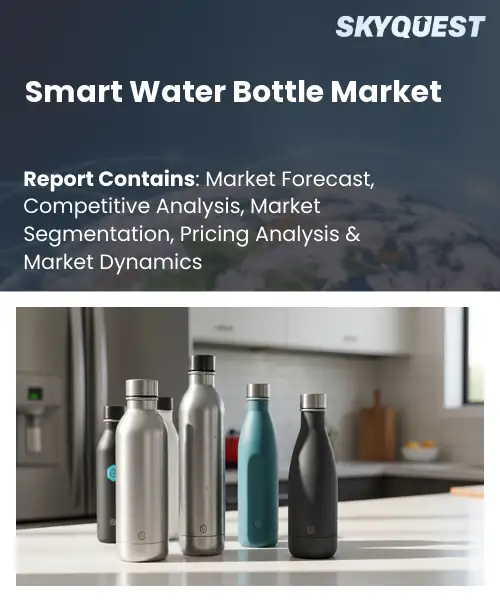
Smart Water Bottle Market
Report ID: SQMIG30L2410
Report ID: SQMIG30L2410
[email protected]
USA +1 351-333-4748
Report ID:
SQMIG30L2410 |
Region:
Global |
Published Date: June, 2026
Pages:
157
|Tables:
147
|Figures:
78


Global Smart Water Bottle Market size was valued at USD 2.2 Billion in 2024 and is poised to grow from USD 2.46 Billion in 2025 to USD 6.1 Billion by 2033, growing at a CAGR of 12.0% during the forecast period (2026-2033).
The primary driver of the smart water bottle market is increasing consumer emphasis on personalized health monitoring and hydration adherence, which transforms a simple container into a data-enabled wellness device. The importance of the features listed above can be attributed to how hydration relates to athletic performance as well as how hydration affects brain performance and how to manage chronic diseases. As smartphones became widely available and as the cost of low power sensors decreased and their size decreased, the adoption curve for these connected products has increased, with both startups and legacy manufacturers like HidrateSpark and Thermos Intelligent Feed registering new products for their business through their corporate wellness programs.
Building on consumer demand and technological maturity, a key trend driving the global smart water bottle sector is interoperability with health ecosystems, because seamless data sharing with apps, fitness trackers and telehealth platforms increases perceived value and drives purchase intent. Open application programming interfaces (APIs) and standard data formats utilized by Manufacturers create opportunities for caregivers to monitor hydration levels for older people, provide athletes with customized alerts to assist in maximizing performance, and allow employers to collect aggregated wellness metrics for incentive programs. As a result, manufacturers that invest in secure cloud service providers, longer-lasting batteries, and compliance with federal regulations have an opportunity to differentiate themselves from competitors, expand into clinical environments, & secure long-term, recurring revenue.
How is IoT Enhancing User Engagement in the Smart Water Bottle Market?
IoT is raising engagement in the smart water bottle market by turning passive containers into connected coaching tools. Key aspects include sensors that detect sips and water quality, wireless connectivity that delivers real time feedback, and companion apps that translate raw data into simple prompts and habit nudges. The current state shows vendors focusing on seamless syncing, gentle reminders and social features that make hydration part of daily routines. In this context products that reduce friction between action and insight win consumer attention. Instances include devices that glow to prompt drinking and bottles that share hydration status with health ecosystems for richer context.
In June 2026, BRITA introduced the BRITA LARQ iQ bottle with app linked hydration tracking and maintenance features. By using IoT for continuous syncing and contextual reminders this innovation strengthens user habits and raises perceived value which supports market growth and operational efficiency.
Market snapshot - (2026-2033)
Global Market Size
USD 2.2 Billion
Largest Segment
Stainless Steel Bottles
Fastest Growth
Stainless Steel Bottles
Growth Rate
12.0% CAGR
To get more insights on this market click here to Request a Free Sample Report
Global smart water bottle market is segmented by product type, technology, application, distribution channel, end-user and region. Based on product type, the market is segmented into stainless steel bottles, plastic bottles, glass bottles and others. Based on technology, the market is segmented into bluetooth-enabled, sensor-based (hydration tracking), app-integrated bottles and others. Based on application, the market is segmented into fitness & wellness, healthcare, sports and others. Based on distribution channel, the market is segmented into online stores, supermarkets/hypermarkets and specialty stores. Based on end-user, the market is segmented into adults, children and elderly. Based on region, the market is segmented into North America, Europe, Asia Pacific, Latin America and Middle East & Africa.
Based on the global smart water bottle market growth, stainless steel bottles segment dominates because their durability, insulation performance and perceived hygiene align with buyer priorities for premium connected bottles. By using solid material characteristics, brands can incorporate integrated electronics into their products as well as have durable lids without changing the actual product's shape. This allows brands to promote their products to retailers as reliable lifestyle and fitness products, therefore leading to more support for these brands and increased acceptance by shoppers, resulting in further acceptance of connected stainless steel products from main-stream retailers.
However, glass bottles are emerging as the most rapidly expanding choice as consumers seek clean taste, premium aesthetics and sustainability credentials. Their visual appeal supports lifestyle marketing and social sharing, while integration with smart lids enables premium modular offers, creating new niche opportunities and partnerships with wellness and eco-conscious brands.
App integrated Bottles segment leads because seamless connectivity to mobile platforms turns hydration tools into personalized health companions that sustain long-term engagement. Apps that are part of a larger ecosystem offer customized notifications, insights into behaviors and opportunities to utilize entire ecosystems of services, which creates more value for users and helps them develop repeat usage habits. Relationships with wellness providers and other third-party vendors, enhance the long-term use of the app; promote monetizing solutions driven by the app's capabilities; and push manufacturers to develop interoperable designs and continuously add features.
Meanwhile, sensor-based (hydration tracking) bottles are witnessing the strongest growth momentum as miniaturized sensors and improved algorithms deliver reliable real-time hydration feedback. Demand from fitness and clinical users for objective hydration metrics accelerates adoption, and the resulting data enables new analytics services and partnerships, creating expanded product offerings and commercial pathways.
To get detailed segments analysis, Request a Free Sample Report
As per the global smart water bottle market share, North America dominates the industry due to a combination of advanced technology infrastructure, strong consumer affinity for connected health devices, and well established channels for product discovery and distribution. A large ecosystem for device makers, app developers, and fitness service providers creates a conducive environment to expedite the development of devices that include sensors, connectivity, and software. By focusing on personalized wellness and premium experiences, consumers are pushing manufacturers to produce feature-rich products that differentiate through design. Fitness service providers, corporate wellness programs, boutique fitness businesses, and lifestyle brands are partnering with technology vendors to offer combined services for both organizations and individual consumers. Established and growing retail networks, as well as direct to consumer sales, serve to enhance the maturity of these markets.
Smart water bottle market in United States benefits from a mature technology ecosystem, strong consumer interest in personalized wellness, and integration between device manufacturers and popular fitness platforms. Retail and direct to consumer channels support rapid product discovery while corporate wellness initiatives create institutional demand. Emphasis on user experience and premium features drives differentiation. Collaborations with healthcare providers and sports organizations reinforce credibility and stimulate adoption among diverse user segments in urban markets.
Smart water bottle market in Canada reflects a balance between health conscious consumers and a supportive retail ecosystem that embraces connected lifestyle products. Local and international brands compete on design, sustainability credentials and interoperability with leading wellness apps. Emphasis on user privacy and aftersales support strengthens buyer confidence. Partnerships with fitness studios and workplace wellness programs broaden reach while attention to durable materials and recyclable packaging aligns with consumer expectations.
Based on global smart water bottle regional forecast, rapid expansion in Asia Pacific is driven by a convergence of health focused consumer behavior, widespread mobile centric lifestyles, and strong adoption of wearable and connected home technologies. Manufacturing companies and nimble start-ups across the region are using small sensors along with greater efficiency in how power is managed, as well as software that will enable operations across all manufacturers to create solutions that meet the many preferences found in our regional marketplace. By creating strategic partnerships with beverage companies, fitness platforms, and corporate wellness providers, manufacturers and retailers will work together to develop customized distribution and marketing strategies to increase visibility within the market. Preventative health continues to be emphasized across different cultures; combined with the increasing sophistication of the retail marketplace and a strong interest in premium lifestyle products, this creates a very dynamic and agile marketplace for innovative smart hydration products across our region.
Smart water bottle market in Japan is shaped by discerning consumers who prioritize meticulous design, reliable engineering, and smooth integration with health ecosystems. Brands compete on refined user interfaces, quiet operation, and material quality that aligns with local preferences. Alliances with fitness centers and technology partners foster trust and practical use. Emphasis on compact, energy efficient designs and timely firmware updates supports expectations for durability and understated product stewardship standards.
Smart water bottle market in South Korea benefits from a tech savvy consumer base that embraces innovative features, seamless app experiences, product refresh cycles. Local manufacturers emphasize connectivity, sleek design, and compatibility with fitness and lifestyle platforms. Retail channels enable swift product discovery while collaborations with wellness influencers, corporate programs help raise awareness. Focus on compact form factors, intuitive user journeys, and prompt software support sustains acceptance among urban consumers.
As per global smart water bottle regional outlook, Europe is strengthening its position through a distinct focus on sustainability, regulatory coherence, and interoperability within broader digital health initiatives. Manufacturers are focusing on using eco-friendly materials, making their products easier to repair, and being open about how they can be disposed of when the product no longer works. They are doing this to meet the increased demand for eco-friendly products from consumers. Also, they are integrating their products with telehealth services and local wellness programs so that consumers feel that their products are clinically relevant and useful to their everyday lives. In retail, various types of stores are providing different ways of positioning products and creating branding stories. Specifically, retailers (i.e., specialized stores vs. high-end online retailers) are providing opportunities for the development of new brand stories and creating product positioning.
Smart water bottle market in Germany reflects a pragmatic consumer focus on engineering quality, product longevity, and verified sustainability. Local brands emphasize recyclable materials, robust construction, and modular components that enable repair. Integration with health tracking platforms and ties to sports enhance credibility. Retail channels favor certified claims and documentation, while partnerships with health initiatives and fitness clubs increase institutional uptake and reinforce a reputation for dependable, responsibly produced offerings.
Smart water bottle market in United Kingdom is driven by demand for devices that combine lifestyle appeal with health utility. Brands focus on elegant design, seamless app integration, and robust privacy practices to meet consumer expectations. Retail and subscription channels support targeted introductions and premium positioning. Partnerships with fitness influencers, healthcare practitioners, and workplace wellness schemes boost visibility. Emphasis on recyclable materials and circular design appeals to environmentally conscious professionals.
Smart water bottle market in France favors products that blend refined aesthetics with practical functionality. Consumers value elegant materials, tactile finishes, and intuitive interfaces complemented by localized app content. Partnerships with lifestyle brands and boutique fitness studios create curated experiences that build loyalty. In store demonstrations and knowledgeable retail staff help communicate benefits, while clear sustainability messaging and repairable design attributes resonate with environmentally conscious buyers seeking durable hydration solutions.
To know more about the market opportunities by region and country, click here to
Buy The Complete Report
Rising Health And Wellness Focus
Advancements In Sensor Technology
High Product Cost Concerns
Data Privacy And Security Concerns
Request Free Customization of this report to help us to meet your business objectives.
Competition in the global smart water bottle market outlook is driven by consolidation and tech differentiation, with incumbents using acquisitions and startups securing industrial partnerships to win retail reach and data assets; for example Brita acquired LARQ to add UV purification and retail scale, while REBO partnered with Aptar and secured investment from GELLIFY to commercialize a blockchain linked reusable bottle.
Top Player’s Company Profile
Recent Developments
SkyQuest’s ABIRAW (Advanced Business Intelligence, Research & Analysis Wing) is our Business Information Services team that Collects, Collates, Correlates, and Analyses the Data collected by means of Primary Exploratory Research backed by robust Secondary Desk research.
As per SkyQuest analysis, the global smart water bottle market is driven by increasing consumer emphasis on personalized health monitoring and hydration adherence, supported by advancements in sensor technology that enable accurate tracking and seamless app integration. However, high product costs remain a restraint, limiting adoption in price-sensitive markets. North America leads the market thanks to strong tech infrastructure, wellness culture and retail channels, while stainless steel bottles dominate the product mix due to durability and suitability for integrating electronics. Manufacturers focusing on interoperability, improved battery life and sustainable design are best positioned to capture growth as consumer demand for connected, health-focused hydration solutions rises.
| Report Metric | Details |
|---|---|
| Market size value in 2024 | USD 2.2 Billion |
| Market size value in 2033 | USD 6.1 Billion |
| Growth Rate | 12.0% |
| Base year | 2024 |
| Forecast period | (2026-2033) |
| Forecast Unit (Value) | USD Billion |
| Segments covered |
|
| Regions covered | North America (US, Canada), Europe (Germany, France, United Kingdom, Italy, Spain, Rest of Europe), Asia Pacific (China, India, Japan, Rest of Asia-Pacific), Latin America (Brazil, Rest of Latin America), Middle East & Africa (South Africa, GCC Countries, Rest of MEA) |
| Companies covered |
|
| Customization scope | Free report customization with purchase. Customization includes:-
|
To get a free trial access to our platform which is a one stop solution for all your data requirements for quicker decision making. This platform allows you to compare markets, competitors who are prominent in the market, and mega trends that are influencing the dynamics in the market. Also, get access to detailed SkyQuest exclusive matrix.
Table Of Content
Executive Summary
Market overview
Parent Market Analysis
Market overview
Market size
KEY MARKET INSIGHTS
COVID IMPACT
MARKET DYNAMICS & OUTLOOK
Market Size by Region
KEY COMPANY PROFILES
Methodology
For the Smart Water Bottle Market, our research methodology involved a mixture of primary and secondary data sources. Key steps involved in the research process are listed below:
1. Information Procurement: This stage involved the procurement of Market data or related information via primary and secondary sources. The various secondary sources used included various company websites, annual reports, trade databases, and paid databases such as Hoover's, Bloomberg Business, Factiva, and Avention. Our team did 45 primary interactions Globally which included several stakeholders such as manufacturers, customers, key opinion leaders, etc. Overall, information procurement was one of the most extensive stages in our research process.
2. Information Analysis: This step involved triangulation of data through bottom-up and top-down approaches to estimate and validate the total size and future estimate of the Smart Water Bottle Market.
3. Report Formulation: The final step entailed the placement of data points in appropriate Market spaces in an attempt to deduce viable conclusions.
4. Validation & Publishing: Validation is the most important step in the process. Validation & re-validation via an intricately designed process helped us finalize data points to be used for final calculations. The final Market estimates and forecasts were then aligned and sent to our panel of industry experts for validation of data. Once the validation was done the report was sent to our Quality Assurance team to ensure adherence to style guides, consistency & design.
Analyst Support
Customization Options
With the given market data, our dedicated team of analysts can offer you the following customization options are available for the Smart Water Bottle Market:
Product Analysis: Product matrix, which offers a detailed comparison of the product portfolio of companies.
Regional Analysis: Further analysis of the Smart Water Bottle Market for additional countries.
Competitive Analysis: Detailed analysis and profiling of additional Market players & comparative analysis of competitive products.
Go to Market Strategy: Find the high-growth channels to invest your marketing efforts and increase your customer base.
Innovation Mapping: Identify racial solutions and innovation, connected to deep ecosystems of innovators, start-ups, academics, and strategic partners.
Category Intelligence: Customized intelligence that is relevant to their supply Markets will enable them to make smarter sourcing decisions and improve their category management.
Public Company Transcript Analysis: To improve the investment performance by generating new alpha and making better-informed decisions.
Social Media Listening: To analyze the conversations and trends happening not just around your brand, but around your industry as a whole, and use those insights to make better Marketing decisions.
REQUEST FOR SAMPLE
 REQUEST FREE CUSTOMIZATION
Global Smart Water Bottle Market size was valued at USD 2.2 Billion in 2024 and is poised to grow from USD 2.46 Billion in 2025 to USD 6.1 Billion by 2033, growing at a CAGR of 12.0% during the forecast period (2026-2033).
Competition in the global smart water bottle market is driven by consolidation and tech differentiation, with incumbents using acquisitions and startups securing industrial partnerships to win retail reach and data assets; for example Brita acquired LARQ to add UV purification and retail scale, while REBO partnered with Aptar and secured investment from GELLIFY to commercialize a blockchain linked reusable bottle. 'HidrateSpark', 'Thermos LLC', 'HydraCoach', 'Gululu', 'Ozmo (Groking Lab)', 'Trago', 'Bellabeat', 'EQUA', 'ICEWATER', 'Moikit', 'LifeFuels', 'Noerden', 'H2OPal', 'Sippo', 'Aquagen', 'iHome (SDI Technologies)', 'Pryme Vessyl', 'Ecomo', 'MyHydrate', 'Caktus Inc.'
Consumers placing greater emphasis on personal hydration and overall wellness are seeking tools that simplify healthy routines, and smart water bottles meet this demand by integrating reminders and tracking capabilities. By reinforcing daily hydration goals and enabling easier habit formation through tangible feedback, these products increase perceived utility and motivate continued use. This enhanced user engagement encourages manufacturers to innovate and retailers to promote smart bottles as essential wellness accessories, thereby expanding market visibility and fostering broader adoption among health-conscious segments.
Personalized Hydration Experiences: Smart bottle vendors are shifting from basic tracking to personalized hydration experiences that adapt to individual routines, activity levels, and environmental conditions. Integration with health platforms and AI driven insights enables tailored reminders, recommendations, and adaptive goals that reflect user preferences. This personalization enhances engagement and builds consumer loyalty by making the device a lifestyle companion rather than a gadget. Manufacturers and app developers collaborate to refine user journeys, emphasizing data sharing, contextual relevance, and customizable interfaces to increase value.
Why does North America Dominate the Global Smart Water Bottle Market? |@12


Want to customize this report? This report can be personalized according to your needs. Our analysts and industry experts will work directly with you to understand your requirements and provide you with customized data in a short amount of time. We offer $1000 worth of FREE customization at the time of purchase.
Feedback From Our Clients


 USA (+1) 351-333-4748

