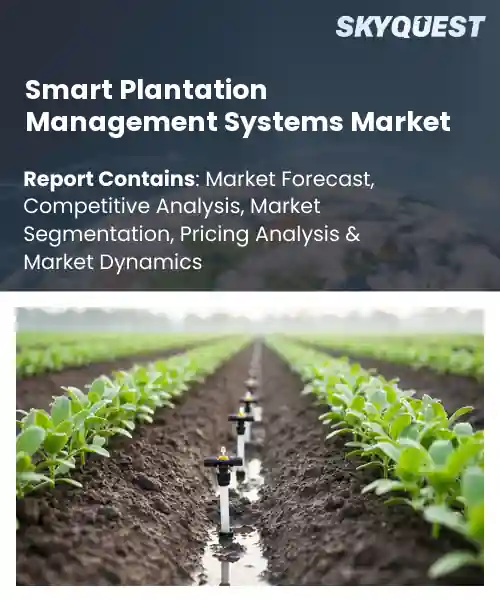
Smart Plantation Management Systems Market
Report ID: SQMIG20I2814
Report ID: SQMIG20I2814
[email protected]
USA +1 351-333-4748
Report ID:
SQMIG20I2814 |
Region:
Global |
Published Date: April, 2026
Pages:
157
|Tables:
122
|Figures:
77


Global Smart Plantation Management Systems Market size was valued at USD 1.32 Billion in 2024 and is poised to grow from USD 1.48 Billion in 2025 to USD 1.3 Billion by 2033, growing at a CAGR of 12.1% during the forecast period (2026-2033).
An accelerating shortage of resources and the pressure to increase yields sustainably acts as the primary driver of the smart plantation management systems market. The market brings together sensors in soil and on plants, satellite and drone imagery, automated irrigation and nutrient delivery, and advanced analytics to convert fragmented farm data into operational decisions. It matters because it boosts productivity, lowers input costs, improves supply chain traceability, and buffers farms against weather variability. Development moved from manual tending and mechanization to precision agriculture and to connected digital farms, exemplified by Israeli drip systems, Californian vineyard sensors, and Brazilian drone scouting.A decisive factor shaping global market expansion is the rapid fall in sensor prices and improved affordability of connectivity, which lower the barrier to adoption across farm sizes. As low-cost soil probes and LPWAN networks became available, smallholders in South Asia began using smartphone apps to schedule irrigation and achieve savings. Larger estates adopted satellite monitoring and automated fertigation to reduce input costs and satisfy sustainability criteria from buyers, driving sustained demand for scalable platforms. Those efficiency gains raise margins, attract capital from agtech and ESG investors, and unlock revenue from traceability premiums and carbon credits, fueling further market growth.
How is AI-driven automation improving yield prediction in smart plantation management systems?
AI driven automation is improving yield prediction by fusing continuous sensor data with remote imagery and machine learning models that learn crop responses to weather and management. Key aspects include multisource data capture, feature extraction, adaptive model training, and feedback loops that handle local variability. The current state sees platforms delivering near real time forecasts that guide irrigation timing and harvesting decisions. Market context shows plantation operators shifting toward precision solutions to improve resource efficiency and reduce crop loss while vendors and startups expand offerings. For instance drone surveys feeding edge analytics and satellite time series enable more granular actionable forecasts across large estates making adoption more compelling for managers.DroneDash and GEODNET April 2026, the joint venture introduced RTK enabled AI vision drones and an integrated backend that aligns high resolution imagery with soil and weather telemetry to refine yield models and enable scalable automated predictions that speed decisions and improve operational efficiency.
Market snapshot - (2026-2033)
Global Market Size
USD 1.32 Billion
Largest Segment
Automated Irrigation & Variable Rate Technology (VRT)
Fastest Growth
AI-driven Harvest Forecasting Software
Growth Rate
12.1% CAGR
To get more insights on this market click here to Request a Free Sample Report
Global smart plantation management systems market is segmented by technology component, deployment model, application vertical, functional scope and region. Based on technology component, the market is segmented into IoT Sensor Networks (Soil, Weather, Leaf), Satellite Imagery & Drone/UAV Monitoring, Automated Irrigation & Variable Rate Technology (VRT) and AI-driven Harvest Forecasting Software. Based on deployment model, the market is segmented into Cloud-based Plantation Management (SaaS) and On-premise/Edge Farm Infrastructure. Based on application vertical, the market is segmented into High-Value Perennial Crops (Tea, Coffee, Rubber), Orchard & Vineyard Management, Forestry & Timber Plantations and Large-scale Oil Palm & Sugarcane Estates. Based on functional scope, the market is segmented into Precision Nutrient & Pest Management, Workforce & Labor Logistics Tracking and Supply Chain & Traceability Integration. Based on region, the market is segmented into North America, Europe, Asia Pacific, Latin America and Middle East & Africa.
IoT Sensor Networks (Soil, Weather, Leaf) segment dominates because it provides continuous, high resolution field data that enables real time decision making across plantation operations. Persistent sensing of moisture, microclimate and canopy conditions directly informs irrigation, fertilization and pest interventions, creating a clear causal link between visibility and improved agronomic outcomes. Broad interoperability with controllers and analytics platforms, combined with declining sensor costs and ease of deployment, drives widespread adoption by estate managers.
However, Satellite Imagery & Drone/UAV Monitoring is emerging as the fastest growing area, driven by affordable aerial platforms and improved imaging. Frequent, scalable canopy surveys enable early disease detection, vigor mapping and targeted scouting, fueling demand for analytics services and creating new operational efficiency and revenue opportunities for plantation management providers.
Automated Irrigation & Variable Rate Technology (VRT) segment dominates because it directly links data driven prescriptions to actionable water and input application, delivering measurable resource efficiency and yield stability across plantations. The ability to modulate flow and nutrient delivery at zone level reduces waste and supports tailored agronomy, prompting operators to prioritize retrofit and integration efforts. Strong vendor ecosystems offering controllers, pumps and VRT enabled machinery further accelerate deployment and operational reliance.
However, AI-driven Harvest Forecasting Software is the fastest growing area as machine learning turns multisource data into actionable yield predictions. Demand for improved inventory planning, labor scheduling and market timing spurs adoption, and ongoing advances in model accuracy and API integration expand commercial applications and revenue opportunities for plantation management platforms.
To get detailed segments analysis, Request a Free Sample Report
North America dominates the global smart plantation management systems market through a combination of advanced technological capabilities, mature agricultural infrastructure, and strong alignment between industry, research institutions, and service providers. High levels of technology adoption among commercial producers enable rapid deployment of integrated sensor networks, automation, and data analytics across large operational footprints. A well developed vendor ecosystem supports end to end implementation, covering hardware, software, system integration, and after sales support. Collaborative pilots and commercial partnerships accelerate refinement of solutions for diverse crop and soil conditions. Focus on sustainability, traceability, and productivity improvement creates consistent demand for sophisticated systems, while availability of financing and professional advisory services reduces barriers to scaling complex deployments.
Smart Plantation Management Systems Market in United States benefits from extensive vendor networks, active research to commercialization pathways, and a high rate of technology adoption among commercial producers. Solutions are tailored for large operations with an emphasis on integration with existing mechanization and supply chain systems. Service models that combine analytics, field support, and financing options improve implementation success. Close cooperation between equipment manufacturers, software developers, and system integrators supports a mature landscape for advanced plantation management.
Smart Plantation Management Systems Market in Canada is influenced by a strong focus on sustainability, adaptation to diverse and often remote growing conditions, and collaborative extension services that facilitate technology uptake. Providers emphasize remote monitoring, resilient connectivity, and solutions optimized for variable climates. Public private partnerships and regional support networks help translate pilots into operational systems. Emphasis on traceability and export quality further stimulates interest among producers across a wide range of agricultural contexts.
Europe is experiencing rapid expansion in the smart plantation management systems market driven by regulatory emphasis on sustainable agriculture, strong demand for supply chain transparency, and a dynamic ecosystem of technology innovators. Interoperability standards and data governance frameworks encourage modular solutions that integrate with existing farm machinery and enterprise systems. Collaboration between startups, established agribusinesses, and research institutions accelerates development of sensors, autonomous equipment, and advanced analytics tailored to regional cropping systems. Programs that support demonstration projects and knowledge exchange lower adoption barriers for producers of varying scales. Growing interest in precision input use, labor saving automation, and enhanced product traceability aligns market offerings with both regulatory drivers and commercial priorities, fostering widespread deployment across diverse agricultural landscapes.
Smart Plantation Management Systems Market Germany is anchored by strong engineering capabilities, a dense supplier ecosystem, and deep integration between industrial automation expertise and agricultural needs. Providers focus on robust, interoperable systems suited to regional mechanization practices and regulatory expectations. Emphasis on energy efficiency, reliability, and data governance shapes solution design. Established distribution channels and service networks enable scalable adoption among commercial growers seeking productivity gains and operational resilience through integrated plantation management offerings.
Smart Plantation Management Systems Market United Kingdom is marked by rapid adoption propelled by an active agritech startup scene, widespread pilot activity, and engagement from progressive producers. Focus areas include digital traceability, precision nutrient and pest management, and automation adapted to mixed farm sizes. Strong linkages between academic centers, industry consortia, and commercial operators help translate innovations into practical, market ready solutions. Service oriented business models and accessible analytics encourage movement beyond early adopters toward broader operational uptake.
Smart Plantation Management Systems Market France is emerging through targeted modernization efforts that blend precision tools, localized sensor networks, and cooperative advisory services. Solutions are often tailored for regional specialties and high value crops, reflecting a focus on quality and terroir. Collaboration among cooperatives, technology providers, and research institutes supports pilot scaling and knowledge transfer. Growing availability of integrators and support services helps make complex systems more accessible to a wider spectrum of producers seeking efficiency and traceability.
Asia Pacific is strengthening its position in the smart plantation management systems market through a combination of rapid agricultural modernization, expanding domestic technology capabilities, and tailored solutions for diverse agro climatic zones. Regional vendors offer cost competitive hardware and software that address both smallholder realities and commercial operations. Emphasis on mobile enabled analytics, remote sensing, and automation helps mitigate labor constraints and logistical complexities. Government led pilot initiatives and public private collaborations accelerate field validation and early commercialization. Cross border partnerships and knowledge exchange enable faster diffusion of mature solutions, while localized customization ensures relevance to distinct cropping systems, reinforcing the region as an increasingly strategic contributor to global market dynamics.
Smart Plantation Management Systems Market Japan leverages precision engineering, robotics expertise, and dense sensor deployments to deliver highly automated plantation solutions adapted to intensive cultivation and compact land use. Providers focus on compact, efficient systems that integrate with advanced analytics and quality control processes to support premium crop production. Close collaboration between manufacturers, research institutions, and growers fosters continuous refinement and niche innovations aimed at addressing labor shortages and ensuring consistent output quality.
Smart Plantation Management Systems Market South Korea benefits from rapid digital infrastructure development, strong ICT capabilities, and domestic firms that integrate sensors, connectivity, and analytics into cohesive offerings. Adoption is driven by interest in vertical farming, greenhouse optimization, and controlled environment agriculture tailored to urban and peri urban production. Public private collaborations and pilot programs support validation and commercialization, while user centric platforms and service models help producers manage complexity and realize tangible improvements in efficiency and product quality.
To know more about the market opportunities by region and country, click here to
Buy The Complete Report
Integration Of IoT Sensors
Advances In Data Analytics
High Initial Deployment Costs
Limited Rural Connectivity Infrastructure
Request Free Customization of this report to help us to meet your business objectives.
Competition in smart plantation management is shaped by consolidation, cloud partnerships and sensor-led product differentiation, with regulatory traceability requirements and demand for plant-level data driving competitive moves. Incumbents pursue targeted acquisitions in autonomy and robotics while irrigation and platform vendors form cloud alliances to scale IoT offerings. Startups introducing direct plant sensing and palm supply platforms are forcing service bundling and vertical integration across the value chain.
Top Player’s Company Profile
Recent Developments
SkyQuest’s ABIRAW (Advanced Business Intelligence, Research & Analysis Wing) is our Business Information Services team that Collects, Collates, Correlates, and Analyses the Data collected by means of Primary Exploratory Research backed by robust Secondary Desk research. As per SkyQuest analysis, the global smart plantation management systems market is propelled by a key driver — the rapid fall in sensor prices and improved connectivity that lower adoption barriers, while a restraint is the high initial deployment costs and limited rural connectivity that can slow uptake. Dominating region is North America thanks to mature infrastructure and vendor ecosystems, and the dominating segment is IoT sensor networks which provide continuous field data for real time decisions. A second driver is growing demand for sustainability and traceability that unlocks premiums and investment, favoring scalable platforms that deliver measurable efficiency and supply chain assurance.
| Report Metric | Details |
|---|---|
| Market size value in 2024 | USD 1.32 Billion |
| Market size value in 2033 | USD 1.3 Billion |
| Growth Rate | 12.1% |
| Base year | 2024 |
| Forecast period | (2026-2033) |
| Forecast Unit (Value) | USD Billion |
| Segments covered |
|
| Regions covered | North America (US, Canada), Europe (Germany, France, United Kingdom, Italy, Spain, Rest of Europe), Asia Pacific (China, India, Japan, Rest of Asia-Pacific), Latin America (Brazil, Rest of Latin America), Middle East & Africa (South Africa, GCC Countries, Rest of MEA) |
| Companies covered |
|
| Customization scope | Free report customization with purchase. Customization includes:-
|
To get a free trial access to our platform which is a one stop solution for all your data requirements for quicker decision making. This platform allows you to compare markets, competitors who are prominent in the market, and mega trends that are influencing the dynamics in the market. Also, get access to detailed SkyQuest exclusive matrix.
Table Of Content
Executive Summary
Market overview
Parent Market Analysis
Market overview
Market size
KEY MARKET INSIGHTS
COVID IMPACT
MARKET DYNAMICS & OUTLOOK
Market Size by Region
KEY COMPANY PROFILES
Methodology
For the Smart Plantation Management Systems Market, our research methodology involved a mixture of primary and secondary data sources. Key steps involved in the research process are listed below:
1. Information Procurement: This stage involved the procurement of Market data or related information via primary and secondary sources. The various secondary sources used included various company websites, annual reports, trade databases, and paid databases such as Hoover's, Bloomberg Business, Factiva, and Avention. Our team did 45 primary interactions Globally which included several stakeholders such as manufacturers, customers, key opinion leaders, etc. Overall, information procurement was one of the most extensive stages in our research process.
2. Information Analysis: This step involved triangulation of data through bottom-up and top-down approaches to estimate and validate the total size and future estimate of the Smart Plantation Management Systems Market.
3. Report Formulation: The final step entailed the placement of data points in appropriate Market spaces in an attempt to deduce viable conclusions.
4. Validation & Publishing: Validation is the most important step in the process. Validation & re-validation via an intricately designed process helped us finalize data points to be used for final calculations. The final Market estimates and forecasts were then aligned and sent to our panel of industry experts for validation of data. Once the validation was done the report was sent to our Quality Assurance team to ensure adherence to style guides, consistency & design.
Analyst Support
Customization Options
With the given market data, our dedicated team of analysts can offer you the following customization options are available for the Smart Plantation Management Systems Market:
Product Analysis: Product matrix, which offers a detailed comparison of the product portfolio of companies.
Regional Analysis: Further analysis of the Smart Plantation Management Systems Market for additional countries.
Competitive Analysis: Detailed analysis and profiling of additional Market players & comparative analysis of competitive products.
Go to Market Strategy: Find the high-growth channels to invest your marketing efforts and increase your customer base.
Innovation Mapping: Identify racial solutions and innovation, connected to deep ecosystems of innovators, start-ups, academics, and strategic partners.
Category Intelligence: Customized intelligence that is relevant to their supply Markets will enable them to make smarter sourcing decisions and improve their category management.
Public Company Transcript Analysis: To improve the investment performance by generating new alpha and making better-informed decisions.
Social Media Listening: To analyze the conversations and trends happening not just around your brand, but around your industry as a whole, and use those insights to make better Marketing decisions.
REQUEST FOR SAMPLE
 REQUEST FREE CUSTOMIZATION


Want to customize this report? This report can be personalized according to your needs. Our analysts and industry experts will work directly with you to understand your requirements and provide you with customized data in a short amount of time. We offer $1000 worth of FREE customization at the time of purchase.
Feedback From Our Clients


 USA (+1) 351-333-4748

