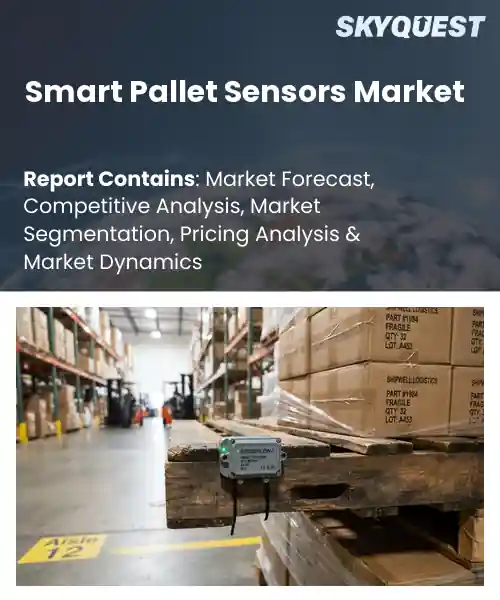
Smart Pallet Sensors Market
Report ID: SQMIG45J2971
Report ID: SQMIG45J2971
[email protected]
USA +1 351-333-4748
Report ID:
SQMIG45J2971 |
Region:
Global |
Published Date: September, 2026
Pages:
157
|Tables:
157
|Figures:
78


Global Smart Pallet Sensors Market size was valued at USD 37.9 Billion in 2024 and is poised to grow from USD 39.61 Billion in 2025 to USD 56.33 Billion by 2033, growing at a CAGR of 4.5% during the forecast period (2026-2033).
The Smart Pallet Sensors market comprises wireless devices that attach to pallets and continuously transmit temperature, humidity, vibration, and location data to cloud platforms, enabling real‑time visibility across supply chains. Its significance stems from the rising need for perishable‑goods safety, regulatory compliance, and lean inventory management. Historically, manual RFID tags offered only identification, but the integration of IoT connectivity in the early 2010s transformed pallets into active data sources. Major logistics firms such as Maersk adopted sensor‑enabled pallets to monitor refrigerated containers, reducing spoilage by 15 % in a single year. This evolution illustrates how traceability has become a competitive differentiator. The principal growth engine for the global Smart Pallet Sensors market is the expansion of e‑commerce and the accompanying demand for cold‑chain integrity, which forces shippers to adopt predictive monitoring to avoid costly disruptions. When sensors detect temperature excursions early, automated alerts trigger refrigeration adjustments or route re‑planning, thereby preventing product loss and preserving brand reputation. Companies such as Walmart have piloted sensor‑linked pallets for fresh produce, achieving a 12 % reduction in waste and unlocking new contracts with premium suppliers. This success fuels investment in Bluetooth and satellite modules, opening opportunities in emerging markets where infrastructure constraints limited IoT deployment.
How are AI and IoT enhancing real-time tracking in the smart pallet sensors market?
AI and IoT are reshaping the smart pallet sensor market by merging data analytics with continuous connectivity. Sensors now capture temperature, humidity, motion and location, while edge processors filter noise before sending insights to cloud platforms. Machine learning models predict deviations and trigger alerts before spoilage or loss occurs. The integration of low power wide area networks ensures coverage across warehouses and long haul routes. Companies combine these capabilities to offer dashboards that display pallet status in a single view, enabling operators to act instantly. This convergence creates a more transparent supply chain and drives demand for smarter, interoperable devices.In April 2024, Samsara introduced an AI enabled pallet sensor, linking each crate to a cloud dashboard that learns handling patterns and warns of temperature spikes. The rollout shortens response time, cuts waste and showcases how AI and IoT together accelerate global market adoption across supply chains efficiently.
Market snapshot - (2026-2033)
Global Market Size
USD 37.9 Billion
Largest Segment
Temperature Sensors
Fastest Growth
Location and Tracking Sensors
Growth Rate
4.5% CAGR
To get more insights on this market click here to Request a Free Sample Report
Global smart pallet sensors market is segmented by sensor type, connectivity, pallet type, application, end user and region. Based on sensor type, the market is segmented into Temperature Sensors, Humidity Sensors, Pressure Sensors, Shock and Vibration Sensors, Location and Tracking Sensors, Light Sensors and Others. Based on connectivity, the market is segmented into Bluetooth, RFID, Cellular, LoRaWAN, Wi-Fi and Others. Based on pallet type, the market is segmented into Wooden Pallets, Plastic Pallets, Metal Pallets and Composite Pallets. Based on application, the market is segmented into Cold Chain Monitoring, Asset Tracking, Supply Chain Monitoring, Warehouse Management and Others. Based on end user, the market is segmented into Food and Beverage, Pharmaceuticals, Retail and E-Commerce, Manufacturing, Logistics and Transportation and Others. Based on region, the market is segmented into North America, Europe, Asia Pacific, Latin America and Middle East & Africa.
Temperature sensors segment dominates because they directly address the core requirement of preserving product integrity across temperature‑sensitive supply chains. Their ability to provide real‑time thermal data enables proactive cooling adjustments, reducing spoilage and compliance risks. Manufacturers and logistics providers prioritize these sensors to meet stringent quality standards, and the widespread need for temperature control in perishable goods drives consistent demand, cementing their leading position in the market today’s logistics operations across industries globally.
However, shock and vibration sensors segment is the most rapidly expanding because heightened awareness of product damage during handling spurs adoption of impact monitoring solutions. Emerging analytics that translate vibration data into actionable insights attract manufacturers seeking to minimize losses, and integration with IoT platforms accelerates deployment, fueling growth momentum.
Bluetooth segment leads because it offers low‑power, short‑range communication that seamlessly integrates with existing warehouse devices and mobile terminals. Its ease of pairing and widespread compatibility reduce implementation complexity, making it the preferred choice for real‑time pallet monitoring. The technology’s reliability in dense indoor environments and its support for firmware updates further reinforce its adoption, establishing Bluetooth as the cornerstone connectivity solution in the market today’s logistics operations across industries globally.
Meanwhile, LoRaWAN segment is emerging as the key high‑growth area because its long‑range, low‑energy characteristics enable pallet sensors to transmit data over warehouse and outdoor yards without extensive infrastructure. Growing demand for scalable networks and regulatory support for unlicensed spectrum drive rapid adoption, unlocking use cases and expanding market potential.
To get detailed segments analysis, Request a Free Sample Report
The region combines a high concentration of advanced manufacturing hubs with forward‑looking logistics networks that prioritize real‑time asset visibility. Extensive integration of IoT platforms, strong engineering expertise, and proactive collaboration between technology providers and pallet producers create an ecosystem conducive to rapid sensor deployment. Additionally, regional trade corridors and densely packed supply chains amplify the need for precise monitoring, encouraging widespread adoption of smart pallet solutions. Robust support from industry associations and a cultural emphasis on efficiency further reinforce the region’s leadership in shaping global standards and driving continuous innovation in pallet sensor technology.
Smart Pallet Sensors Market in Japan benefits from a mature automotive and electronics supply base that demands meticulous tracking of components across complex networks. Manufacturers leverage high‑precision sensor integration to enhance inventory accuracy and reduce downtime, while logistics firms adopt data‑driven strategies to streamline outbound distribution. Collaborative research initiatives between universities and technology firms accelerate the development of sensor algorithms tailored to the country’s stringent quality expectations, fostering a resilient market environment.
Smart Pallet Sensors Market in South Korea is propelled by a dynamic electronics assembly sector that values real‑time monitoring for high‑value parts. The nation’s strong emphasis on digital transformation encourages logistics providers to embed sensors within palletized loads, improving traceability and operational agility. Government incentives for smart factory adoption, combined with a skilled engineering workforce, create a fertile landscape for sensor manufacturers to introduce sophisticated solutions that address the nuanced demands of the country’s export‑focused supply chains.
The United States and Canada exhibit strong appetite for supply‑chain resilience, prompting widespread implementation of intelligent pallet monitoring across diverse industries. Emphasis on sustainability and waste reduction motivates firms to adopt sensors that offer granular insight into load conditions, enabling optimized handling and reduced product loss. Robust e‑commerce growth, coupled with advanced data analytics capabilities, fuels demand for real‑time visibility solutions. Collaboration between technology vendors and major logistics operators accelerates integration of sensor data into broader operational platforms, reinforcing the region’s position as a leading growth engine for smart pallet technologies.
Smart Pallet Sensors Market in the United States is shaped by extensive freight networks that require precise load monitoring to maintain efficiency. Leading retailers and manufacturers deploy sensors to gain actionable intelligence, supporting just‑in‑time inventory practices and minimizing disruptions. Advanced analytics ecosystems and cloud infrastructure enable seamless aggregation of sensor data, fostering predictive maintenance and risk mitigation strategies. The country’s innovative culture and investment in digital supply‑chain solutions continue to expand the relevance of smart pallet sensors across multiple sectors.
Smart Pallet Sensors Market in Canada reflects a logistics landscape that prioritizes reliability across vast geographic distances. Companies incorporate sensors to improve cold‑chain oversight and ensure product integrity during long hauls. Integration with national transportation management systems enhances route optimization and cargo safety. Collaborative efforts between technology providers and regional distributors encourage adoption of sensor‑enabled pallets, supporting the nation’s focus on sustainable and efficient supply‑chain practices.
Europe leverages a combination of stringent regulatory standards, sophisticated manufacturing ecosystems, and a commitment to digitalization to advance its role in the smart pallet arena. Cross‑border trade flows within the continent demand harmonized tracking solutions, prompting adoption of sensors that meet high compliance thresholds. Strong focus on sustainability drives firms to use data‑rich sensors for optimizing load utilization and reducing carbon footprints. Collaborative research programs and industry consortia foster innovation, while mature logistics networks integrate sensor outputs into enterprise resource planning tools, collectively enhancing Europe’s influence in shaping global sensor standards.
Smart Pallet Sensors Market in Germany benefits from a robust automotive and machinery sector that relies on precise inventory control and reliable transport. Manufacturers integrate sensors to monitor load conditions throughout complex production lines, supporting quality assurance and minimizing downtime. The country’s engineering excellence and emphasis on Industry 4.0 facilitate the development of highly interoperable sensor platforms, enabling seamless data exchange across supply‑chain partners. Collaborative industry clusters further accelerate adoption and refinement of smart pallet solutions.
Smart Pallet Sensors Market in the United Kingdom is driven by a strong focus on e‑commerce fulfillment and pharmaceutical distribution, where real‑time pallet monitoring enhances safety and compliance. Companies adopt sensors to gain detailed visibility into temperature, humidity, and handling impacts, ensuring product integrity. Integration with national logistics hubs and advanced analytics platforms enables dynamic response to supply‑chain disruptions. The UK’s strategic investments in digital infrastructure and standards development support ongoing expansion of smart pallet technologies.
Smart Pallet Sensors Market in France is propelled by a vibrant food and beverage industry that values traceability and waste reduction. Sensor deployment on pallets aids in maintaining optimal conditions for perishable goods, while providing data that informs logistic efficiencies. French firms emphasize collaborative initiatives with technology partners to tailor sensor solutions to regulatory and market needs. The nation’s commitment to sustainability and innovation encourages broader adoption across diverse sectors, reinforcing its growing prominence in the smart pallet ecosystem.
To know more about the market opportunities by region and country, click here to
Buy The Complete Report
Real-Time Inventory Visibility
Leveraging IoT Integration
High Initial Implementation Costs
Data Security and Privacy Concerns
Request Free Customization of this report to help us to meet your business objectives.
The global smart pallet sensor market is shaped by intense rivalry as incumbents and new entrants vie for data‑driven logistics advantage; recent M&A activity, such as Zebra Technologies acquiring a sensor‑analytics firm, and strategic partnerships like Sensitech teaming with IBM to integrate AI‑based condition monitoring, underscore competitive pressure and accelerate technology adoption.
Top Player’s Company Profile
Recent Developments
SkyQuest’s ABIRAW (Advanced Business Intelligence, Research & Analysis Wing) is our Business Information Services team that Collects, Collates, Correlates, and Analyses the Data collected by means of Primary Exploratory Research backed by robust Secondary Desk research. As per SkyQuest analysis the global smart pallet sensors market is being propelled primarily by the need for real‑time inventory visibility, which lets shippers instantly track location and condition of loads, while a second strong engine comes from seamless IoT integration that feeds sensor data into enterprise systems for predictive routing and inventory planning. The temperature‑sensor segment remains the clear leader because it directly safeguards perishable goods, and Asia Pacific dominates the market thanks to its dense manufacturing base and advanced logistics networks. However, high initial implementation costs continue to hold back smaller operators and can delay ROI realization for many firms.
| Report Metric | Details |
|---|---|
| Market size value in 2024 | USD 37.9 Billion |
| Market size value in 2033 | USD 56.33 Billion |
| Growth Rate | 4.5% |
| Base year | 2024 |
| Forecast period | (2026-2033) |
| Forecast Unit (Value) | USD Billion |
| Segments covered |
|
| Regions covered | North America (US, Canada), Europe (Germany, France, United Kingdom, Italy, Spain, Rest of Europe), Asia Pacific (China, India, Japan, Rest of Asia-Pacific), Latin America (Brazil, Rest of Latin America), Middle East & Africa (South Africa, GCC Countries, Rest of MEA) |
| Companies covered |
|
| Customization scope | Free report customization with purchase. Customization includes:-
|
To get a free trial access to our platform which is a one stop solution for all your data requirements for quicker decision making. This platform allows you to compare markets, competitors who are prominent in the market, and mega trends that are influencing the dynamics in the market. Also, get access to detailed SkyQuest exclusive matrix.
Table Of Content
Executive Summary
Market overview
Parent Market Analysis
Market overview
Market size
KEY MARKET INSIGHTS
COVID IMPACT
MARKET DYNAMICS & OUTLOOK
Market Size by Region
KEY COMPANY PROFILES
Methodology
For the Smart Pallet Sensors Market, our research methodology involved a mixture of primary and secondary data sources. Key steps involved in the research process are listed below:
1. Information Procurement: This stage involved the procurement of Market data or related information via primary and secondary sources. The various secondary sources used included various company websites, annual reports, trade databases, and paid databases such as Hoover's, Bloomberg Business, Factiva, and Avention. Our team did 45 primary interactions Globally which included several stakeholders such as manufacturers, customers, key opinion leaders, etc. Overall, information procurement was one of the most extensive stages in our research process.
2. Information Analysis: This step involved triangulation of data through bottom-up and top-down approaches to estimate and validate the total size and future estimate of the Smart Pallet Sensors Market.
3. Report Formulation: The final step entailed the placement of data points in appropriate Market spaces in an attempt to deduce viable conclusions.
4. Validation & Publishing: Validation is the most important step in the process. Validation & re-validation via an intricately designed process helped us finalize data points to be used for final calculations. The final Market estimates and forecasts were then aligned and sent to our panel of industry experts for validation of data. Once the validation was done the report was sent to our Quality Assurance team to ensure adherence to style guides, consistency & design.
Analyst Support
Customization Options
With the given market data, our dedicated team of analysts can offer you the following customization options are available for the Smart Pallet Sensors Market:
Product Analysis: Product matrix, which offers a detailed comparison of the product portfolio of companies.
Regional Analysis: Further analysis of the Smart Pallet Sensors Market for additional countries.
Competitive Analysis: Detailed analysis and profiling of additional Market players & comparative analysis of competitive products.
Go to Market Strategy: Find the high-growth channels to invest your marketing efforts and increase your customer base.
Innovation Mapping: Identify racial solutions and innovation, connected to deep ecosystems of innovators, start-ups, academics, and strategic partners.
Category Intelligence: Customized intelligence that is relevant to their supply Markets will enable them to make smarter sourcing decisions and improve their category management.
Public Company Transcript Analysis: To improve the investment performance by generating new alpha and making better-informed decisions.
Social Media Listening: To analyze the conversations and trends happening not just around your brand, but around your industry as a whole, and use those insights to make better Marketing decisions.
REQUEST FOR SAMPLE
 REQUEST FREE CUSTOMIZATION


Want to customize this report? This report can be personalized according to your needs. Our analysts and industry experts will work directly with you to understand your requirements and provide you with customized data in a short amount of time. We offer $1000 worth of FREE customization at the time of purchase.
Feedback From Our Clients


 USA (+1) 351-333-4748

