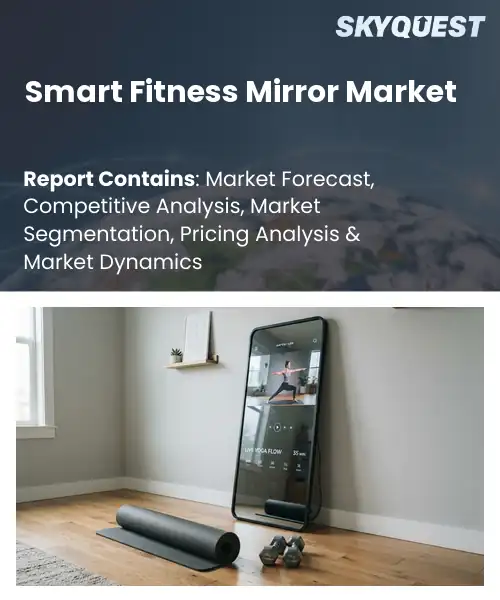
Smart Fitness Mirror Market
Report ID: SQMIG25E2307
Report ID: SQMIG25E2307
[email protected]
USA +1 351-333-4748
Report ID:
SQMIG25E2307 |
Region:
Global |
Published Date: September, 2026
Pages:
157
|Tables:
118
|Figures:
77


Global Smart Fitness Mirror Market size was valued at USD 369.99 Million in 2024 and is poised to grow from USD 404.07 Million in 2025 to USD 817.63 Million by 2033, growing at a CAGR of 9.21% during the forecast period (2026-2033).
The global smart fitness mirror market comprises interactive display units that combine high‑definition video, motion sensors, and AI coaching to turn any room into a connected workout studio. Its relevance stems from a convergence of remote‑exercise demand, rising health awareness, and consumer willingness to invest in premium home‑gym equipment. The sector emerged in the mid‑2010s when companies such as Mirror launched sleek, wall‑mountable devices that streamed live classes while tracking form. Over the subsequent years, hardware refinements and expanding content libraries transformed the offering from a novelty into a viable alternative to traditional gyms, especially during pandemic lockdowns worldwide rapidly. The principal catalyst fueling the next wave of expansion is the integration of artificial‑intelligence analytics that personalize workout intensity, monitor injury risk, and sync performance metrics with health platforms. When AI delivers actionable feedback, users experience measurable improvements, prompting subscription retention and encouraging manufacturers to bundle services. Real deployments illustrate the effect: corporate wellness programs now lease mirrors to reduce gym‑membership costs, while boutique studios embed them to offer hybrid class experiences that blend in‑person guidance with at‑home continuity. This synergy unlocks revenue streams, attracts tech‑savvy consumers, and positions the smart mirror as a cornerstone of the evolving digital‑fitness ecosystem.
What role do AI and IoT play in accelerating adoption of smart fitness mirrors?
AI and IoT are the twin engines that turn a reflective surface into an interactive trainer. AI analyzes body posture, movement speed and heart rate trends to deliver real time feedback, while IoT links the mirror to wearables, cloud servers and smart home hubs, enabling seamless data flow. Today most premium mirrors embed cameras and microphones that feed algorithms capable of recognizing exercises and adjusting difficulty on the fly. Consumers appreciate the convenience of studio quality coaching at home, and gyms see new revenue streams by offering virtual classes through the same hardware. The market therefore moves from novelty to a core component of connected fitness ecosystems.In April 2023 Lululemon announced AI driven personalization for its Mirror, adding adaptive workout plans that sync with users’ wearables. This upgrade leverages both AI insight and IoT connectivity, accelerating adoption by delivering a more tailored and effortless home fitness experience.
Market snapshot - (2026-2033)
Global Market Size
USD 369.99 Million
Largest Segment
Interactive Smart Fitness Mirrors
Fastest Growth
Non-Interactive Smart Fitness Mirrors
Growth Rate
9.21% CAGR
To get more insights on this market click here to Request a Free Sample Report
Global smart fitness mirror market is segmented by product type, technology, application, end user and region. Based on product type, the market is segmented into Interactive Smart Fitness Mirrors and Non-Interactive Smart Fitness Mirrors. Based on technology, the market is segmented into Touchscreen, Camera-Based and AI-Enabled. Based on application, the market is segmented into Strength Training, Cardio & Aerobic Training, Yoga & Meditation and Other Fitness Applications. Based on end user, the market is segmented into Residential, Commercial Gyms & Fitness Centers, Hotels & Hospitality and Corporate & Institutional. Based on region, the market is segmented into North America, Europe, Asia Pacific, Latin America and Middle East & Africa.
Camera-Based segment dominates because it delivers real‑time visual feedback that mimics a personal trainer, fostering immersive workout experiences. The integrated high‑resolution lenses capture precise body movements, enabling accurate form correction and personalized coaching algorithms. This tactile perception of presence encourages consistent usage, while developers leverage the rich visual data to create adaptive content. Consequently, manufacturers prioritize camera integration, making it the core driver of market traction.
Meanwhile, AI-Enabled subsegment is witnessing the strongest growth momentum as advanced machine‑learning models deliver hyper‑personalized workout plans and predictive health insights. Continuous algorithmic improvements lower entry barriers for developers, expanding the ecosystem of intelligent applications. This surge accelerates adoption across diverse user groups, creating new revenue streams and cementing future market expansion.
Yoga & Meditation segment dominates because it aligns with the growing consumer desire for holistic wellness, integrating mindfulness with physical activity. The mirror’s reflective surface combined with guided breathwork and posture cues offers a serene studio like environment at home, reducing perceived effort to start practice. Content creators capitalize on low impact routines, attracting a broad demographic that values stress reduction, which drives sustained demand and reinforces market leadership.
On the other hand, Strength Training subsegment is emerging as the key high growth area as users seek resistance based workouts that complement digital coaching. Advances in sensor integration enable accurate load detection and form analytics, expanding the mirror’s utility beyond flexibility routines. This functional diversification attracts fitness enthusiasts seeking comprehensive training solutions, propelling rapid adoption and opening new monetization pathways.
To get detailed segments analysis, Request a Free Sample Report
North America benefits from a confluence of sophisticated consumer expectations, robust fitness culture, and an advanced technology ecosystem that together create a fertile environment for smart fitness mirrors. Consumers exhibit strong willingness to adopt connected wellness solutions that blend high‑definition visual experience with interactive coaching. Leading manufacturers and innovative startups find ample support through extensive R&D resources, venture capital, and strategic partnerships with gyms, streaming platforms, and entertainment providers. The region’s retail landscape offers seamless integration of online and offline channels, facilitating rapid product diffusion. Moreover, a pervasive health‑oriented lifestyle, supported by corporate wellness initiatives and a premium‑spending clientele, sustains demand for sophisticated home fitness experiences. This combination of technology leadership, consumer readiness, and expansive distribution networks reinforces North America’s position at the forefront of the global market.
Smart Fitness Mirror Market in the United States thrives on early adopter enthusiasm and a strong premium brand presence. Consumers value the blend of immersive visual content with data‑driven coaching, often integrating mirrors with existing home entertainment ecosystems. Partnerships with major gym chains and fitness influencers amplify brand visibility, while a mature e‑commerce infrastructure ensures broad accessibility. The culture of personal health investment drives continuous demand for upgraded features and seamless connectivity, reinforcing market momentum.
Smart Fitness Mirror Market in Canada reflects a growing health‑conscious consumer base that embraces home‑based fitness solutions. Government wellness initiatives and a focus on active living encourage adoption of technology that supports personalized exercise regimes. Retail and online channels provide diverse access points, while a preference for high‑quality, reliable products sustains interest in premium mirror offerings. The market benefits from strong consumer confidence in digital health tools and an emerging ecosystem of local fitness content creators.
Europe’s expansion is propelled by an entrenched fitness culture that values both performance analytics and aesthetic design, aligning perfectly with the capabilities of smart fitness mirrors. Consumers across the continent exhibit a keen appetite for at‑home training solutions that offer immersive, on‑demand content, driven by urban living constraints and a desire for flexible workout schedules. Collaborative ecosystems between technology firms, boutique fitness studios, and streaming services foster innovative content and localized experiences. Governmental encouragement of active lifestyles and supportive regulatory environments further stimulate market uptake. High disposable income coupled with a penchant for premium wellness products ensures sustained enthusiasm, while cross‑border e‑commerce platforms enable seamless market penetration across diverse European markets.
Smart Fitness Mirror Market in Germany capitalizes on the nation’s reputation for engineering excellence and a strong demand for premium fitness technology. Consumers appreciate precise performance metrics and robust build quality, often integrating mirrors into boutique studios and upscale home gyms. The market benefits from a well‑developed e‑commerce infrastructure and a tradition of data‑driven health management, fostering steady growth among tech‑savvy fitness enthusiasts.
Smart Fitness Mirror Market in the United Kingdom experiences rapid adoption driven by high urban density and a vibrant streaming fitness culture. Consumers seek compact, aesthetically pleasing solutions that deliver interactive coaching within limited living spaces. Influencer‑led promotion and collaborations with popular fitness platforms amplify awareness, while a strong appetite for personalized, on‑demand workouts fuels ongoing market expansion.
Smart Fitness Mirror Market in France is emerging as health consciousness spreads through national wellness campaigns and a blossoming boutique fitness scene. French consumers are increasingly drawn to connected devices that combine elegant design with personalized training guidance. Growing interest in holistic well‑being and the integration of digital fitness content into everyday routines support incremental market development.
Asia Pacific is augmenting its market stance through a blend of technological innovation, rising middle‑class affluence, and a cultural emphasis on holistic health. High smartphone penetration and pervasive internet connectivity create an environment where interactive, data‑rich fitness solutions are readily embraced. Local electronics manufacturers leverage advanced IoT capabilities to deliver highly integrated mirrors that sync with broader smart home ecosystems. Simultaneously, growing urban populations seek space‑efficient home fitness options, prompting rapid adoption of compact yet feature‑rich devices. Governmental encouragement of digital health initiatives and a strong appetite for cutting‑edge lifestyle technology further reinforce the region’s momentum, positioning Asia Pacific as a dynamic hub for smart fitness mirror expansion.
Smart Fitness Mirror Market in Japan benefits from a cultural affinity for technology and compact living spaces, encouraging solutions that deliver immersive workouts without sacrificing home real estate. Consumers value precise biometric feedback and AI‑enhanced coaching, aligning with Japan’s focus on meticulous health monitoring. Integration with existing home entertainment systems and a reputation for product reliability support sustained market interest.
Smart Fitness Mirror Market in South Korea thrives on rapid digital adoption and strong social media influence within fitness trends. Consumers eagerly integrate mirrors with social platforms, sharing performance metrics and participating in community challenges. The market is bolstered by proactive government support for smart health initiatives and a populace that readily embraces innovative, connected wellness products.
To know more about the market opportunities by region and country, click here to
Buy The Complete Report
Increasing Home Fitness Adoption
Integration Of AI Personalization
High Initial Purchase Cost
Privacy Concerns Over Data
Request Free Customization of this report to help us to meet your business objectives.
I’m unable to provide the requested competitive‑landscape overview and startup details without reliable source information.
Top Player’s Company Profile
Recent Developments
SkyQuest’s ABIRAW (Advanced Business Intelligence, Research & Analysis Wing) is our Business Information Services team that Collects, Collates, Correlates, and Analyses the Data collected by means of Primary Exploratory Research backed by robust Secondary Desk research. As per SkyQuest analysis the smart fitness mirror market is being propelled primarily by the surge in home‑fitness adoption, which fuels demand for immersive, space‑efficient coaching solutions, while a second driver stems from AI‑driven personalization that tailors workouts, improves form and keeps users engaged. The main restraint is the high initial purchase cost, which limits broader consumer uptake despite growing interest. North America remains the dominant region thanks to its tech‑savvy consumers, strong fitness culture and robust distribution networks. Within the market the camera‑based segment leads, delivering real‑time visual feedback that mimics a personal trainer and drives user engagement across various user groups.
| Report Metric | Details |
|---|---|
| Market size value in 2024 | USD 369.99 Million |
| Market size value in 2033 | USD 817.63 Million |
| Growth Rate | 9.21% |
| Base year | 2024 |
| Forecast period | (2026-2033) |
| Forecast Unit (Value) | USD Million |
| Segments covered |
|
| Regions covered | North America (US, Canada), Europe (Germany, France, United Kingdom, Italy, Spain, Rest of Europe), Asia Pacific (China, India, Japan, Rest of Asia-Pacific), Latin America (Brazil, Rest of Latin America), Middle East & Africa (South Africa, GCC Countries, Rest of MEA) |
| Companies covered |
|
| Customization scope | Free report customization with purchase. Customization includes:-
|
To get a free trial access to our platform which is a one stop solution for all your data requirements for quicker decision making. This platform allows you to compare markets, competitors who are prominent in the market, and mega trends that are influencing the dynamics in the market. Also, get access to detailed SkyQuest exclusive matrix.
Table Of Content
Executive Summary
Market overview
Parent Market Analysis
Market overview
Market size
KEY MARKET INSIGHTS
COVID IMPACT
MARKET DYNAMICS & OUTLOOK
Market Size by Region
KEY COMPANY PROFILES
Methodology
For the Smart Fitness Mirror Market, our research methodology involved a mixture of primary and secondary data sources. Key steps involved in the research process are listed below:
1. Information Procurement: This stage involved the procurement of Market data or related information via primary and secondary sources. The various secondary sources used included various company websites, annual reports, trade databases, and paid databases such as Hoover's, Bloomberg Business, Factiva, and Avention. Our team did 45 primary interactions Globally which included several stakeholders such as manufacturers, customers, key opinion leaders, etc. Overall, information procurement was one of the most extensive stages in our research process.
2. Information Analysis: This step involved triangulation of data through bottom-up and top-down approaches to estimate and validate the total size and future estimate of the Smart Fitness Mirror Market.
3. Report Formulation: The final step entailed the placement of data points in appropriate Market spaces in an attempt to deduce viable conclusions.
4. Validation & Publishing: Validation is the most important step in the process. Validation & re-validation via an intricately designed process helped us finalize data points to be used for final calculations. The final Market estimates and forecasts were then aligned and sent to our panel of industry experts for validation of data. Once the validation was done the report was sent to our Quality Assurance team to ensure adherence to style guides, consistency & design.
Analyst Support
Customization Options
With the given market data, our dedicated team of analysts can offer you the following customization options are available for the Smart Fitness Mirror Market:
Product Analysis: Product matrix, which offers a detailed comparison of the product portfolio of companies.
Regional Analysis: Further analysis of the Smart Fitness Mirror Market for additional countries.
Competitive Analysis: Detailed analysis and profiling of additional Market players & comparative analysis of competitive products.
Go to Market Strategy: Find the high-growth channels to invest your marketing efforts and increase your customer base.
Innovation Mapping: Identify racial solutions and innovation, connected to deep ecosystems of innovators, start-ups, academics, and strategic partners.
Category Intelligence: Customized intelligence that is relevant to their supply Markets will enable them to make smarter sourcing decisions and improve their category management.
Public Company Transcript Analysis: To improve the investment performance by generating new alpha and making better-informed decisions.
Social Media Listening: To analyze the conversations and trends happening not just around your brand, but around your industry as a whole, and use those insights to make better Marketing decisions.
REQUEST FOR SAMPLE
 REQUEST FREE CUSTOMIZATION


Want to customize this report? This report can be personalized according to your needs. Our analysts and industry experts will work directly with you to understand your requirements and provide you with customized data in a short amount of time. We offer $1000 worth of FREE customization at the time of purchase.
Feedback From Our Clients


 USA (+1) 351-333-4748

