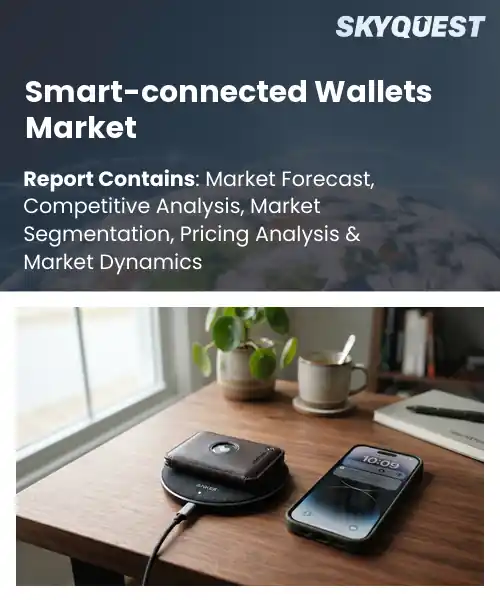
Smart-connected Wallets Market
Report ID: SQMIG25K2284
Report ID: SQMIG25K2284
[email protected]
USA +1 351-333-4748
Report ID:
SQMIG25K2284 |
Region:
Global |
Published Date: September, 2026
Pages:
157
|Tables:
153
|Figures:
78


Global Smart-Connected Wallets Market size was valued at USD 295.0 Million in 2024 and is poised to grow from USD 313.0 Million in 2025 to USD 502.65 Million by 2033, growing at a CAGR of 6.1% during the forecast period (2026-2033).
Smart‑connected wallets combine NFC payment, biometric security, and cloud asset management, allowing users to transact, store IDs, and monitor spending. Primary driver of this market is rapid rise of contactless payments, which accelerated after COVID‑19 forced retailers and consumers to favor frictionless solutions. Early examples such as Apple Pay and Samsung Pay proved embedded payment chips viable, while newcomers like Curve added multi‑card aggregation that blurs the line between traditional wallets and platforms. In past five years, fintech innovation, 5G connectivity, and demand for tools have turned wallet from a card holder into a data‑rich service hub, anchoring it in digital economy. This evolution creates an environment for ecosystem partnerships, which have become the growth engine for the wallet market. By linking payment networks, loyalty programs, and identity verification services, manufacturers can monetize data streams and offer experiences that increase user stickiness. For instance, Visa’s collaboration with fintech startup Curve enables card switching within an app, while Mastercard’s partnership with Apple integrates biometric authentication across retail and transit ecosystems, driving transaction volumes. As regulatory frameworks such as PSD2 encourage banking, ability to aggregate accounts and provide analytics attracts consumers seeking convenience and enterprises looking to reduce churn, thereby expanding market size and unlocking revenue channels.
How is AI and blockchain driving adoption of smart-connected wallets in the financial services sector?
Smart connected wallets combine biometric security, AI powered transaction insights and blockchain based settlement to give users seamless control over digital assets. In the financial services sector these wallets are moving from pilot projects to mainstream offerings as banks seek faster onboarding and reduced fraud. AI analyzes spending patterns to deliver personalized alerts while blockchain ensures each payment is recorded on an immutable ledger. Major banks and fintechs are integrating these features into mobile apps, creating a unified experience that links credit, loyalty and crypto assets. The market is gaining momentum as regulators recognize the security benefits and consumers demand instant, transparent payments.In June 2023, Mastercard launched a blockchain enabled digital wallet pilot that pairs AI driven fraud detection with tokenized payments, showing how the combined technologies can speed settlement and boost user confidence, thereby accelerating broader adoption across banks and fintechs.
Market snapshot - (2026-2033)
Global Market Size
USD 295.0 Million
Largest Segment
Multifunctional Smart Wallets
Fastest Growth
Smart Biometric Wallets
Growth Rate
6.1% CAGR
To get more insights on this market click here to Request a Free Sample Report
Global smart-connected wallets market is segmented by wallet type, connectivity, material, application, distribution channel and region. Based on wallet type, the market is segmented into Smart Biometric Wallets, GPS-Enabled Wallets, RFID-Blocking Smart Wallets, Bluetooth-Enabled Wallets, Multifunctional Smart Wallets and Others. Based on connectivity, the market is segmented into Bluetooth, Near Field Communication, Global Positioning System, Cellular and Others. Based on material, the market is segmented into Leather, Metal, Carbon Fiber, Synthetic Materials and Others. Based on application, the market is segmented into Personal Use, Travel, Business and Others. Based on distribution channel, the market is segmented into Specialty Stores, Department Stores, Online Retail and Others. Based on region, the market is segmented into North America, Europe, Asia Pacific, Latin America and Middle East & Africa.
Smart biometric wallets segment dominates because they combine secure fingerprint authentication with sleek design, addressing consumer demand for effortless yet protected access to cards and cash. The integration of biometric sensors eliminates the need for pins or passwords, reducing friction and enhancing perceived safety. This convenience, coupled with rising concerns over theft, drives strong preference among tech savvy users, positioning these wallets as the flagship offering in the market.
Meanwhile, multifunctional smart wallets emerge as the fastest growing area because they integrate payment, identity storage, and IoT connectivity within a single compact form. Continuous innovation in modular components and expanding use cases such as contactless transit and health monitoring attract new user groups, accelerating market expansion and opening fresh revenue streams.
Bluetooth connectivity segment leads because it enables seamless pairing with smartphones, allowing real time notifications, remote locking, and firmware updates without manual intervention. The ubiqueness of Bluetooth in consumer devices creates a frictionless user experience, encouraging adoption among everyday users. Its low power consumption and reliable range further reinforce its appeal, making it the core communication backbone for most smart connected wallets today.
On the other hand, near field communication connectivity is witnessing the strongest growth momentum because it supports instant tap to pay transactions and secure data exchange without pairing steps. Emerging standards and expanding merchant acceptance drive broader usage, while its simplicity attracts users seeking quick contactless interactions, propelling market expansion and new partnership opportunities.
To get detailed segments analysis, Request a Free Sample Report
The region benefits from a convergence of advanced digital payment infrastructure, high smartphone penetration, and strong consumer acceptance of contactless solutions. Leading technology manufacturers and fintech innovators collaborate closely, creating seamless integration of biometric security, near‑field communication, and cloud services. Urban centers exhibit dense retail ecosystems that encourage rapid adoption, while supportive regulatory environments promote interoperability and data privacy. Cultural emphasis on convenience and mobile commerce further fuels demand, positioning the region as a hotbed for product experimentation and ecosystem development that resonates globally.
Smart-connected Wallets Market in Japan evolves through close ties between electronics giants and financial institutions, fostering sophisticated authentication features and seamless transit integration. Consumer preference for integrated lifestyle services drives continuous refinement of user interfaces, while government initiatives encourage cashless transactions across retail and public sectors. Collaborative standards development ensures compatibility across devices, reinforcing Japan’s reputation as a benchmark for secure, user‑centric wallet solutions.
Smart-connected Wallets Market in South Korea thrives on a vibrant startup ecosystem that rapidly prototypes innovative payment functionalities. Strong broadband connectivity and a culture of early technology adoption accelerate diffusion of NFC and biometric capabilities. Partnerships between telecom operators and banking groups create unified platforms that span online shopping, gaming, and public transport. Policy support for digital finance and a focus on data protection reinforce consumer confidence, cementing South Korea’s role as a leading accelerator of smart wallet innovation.
The market is propelled by a sophisticated financial services landscape coupled with robust consumer demand for seamless, secure payment experiences. Leading technology firms and major banks collaborate to embed advanced authentication methods into everyday transactions, while retail networks adopt integrated loyalty and digital ticketing features. A strong culture of innovation encourages the rollout of open‑banking APIs and cross‑platform ecosystems that enhance convenience. Regulatory encouragement of interoperability and data security reinforces trust, enabling widespread adoption across both urban and suburban environments and solidifying the region’s position as a catalyst for next‑generation wallet solutions.
Smart-connected Wallets Market in the United States benefits from a deep pool of fintech talent and extensive venture capital backing that fuels continuous product iteration. Large retail chains and e‑commerce platforms embed wallet functionalities directly into point‑of‑sale systems, creating frictionless checkout experiences. Close collaboration between technology providers and financial institutions drives the integration of biometric safeguards and real‑time fraud monitoring. Consumer expectations for personalized, omnichannel experiences further accelerate adoption across diverse retail and service sectors.
Smart-connected Wallets Market in Canada advances through strong partnerships between telecom operators and banking networks that prioritize seamless cross‑border functionality. Emphasis on privacy frameworks and data residency builds confidence among users, encouraging broader usage in retail, transit, and hospitality settings. Collaborative industry consortia develop common standards that streamline integration across devices and platforms. Growing consumer appetite for contactless payment options, especially in smaller urban centers, supports steady expansion of smart wallet adoption nationwide.
Europe leverages a cohesive regulatory environment that emphasizes security, privacy, and open standards, fostering cross‑border compatibility and consumer trust. Leading financial institutions and technology providers co‑create modular solutions that can be customized for varied market preferences, from contactless retail to integrated mobility services. Strong emphasis on sustainability and digital inclusion drives the development of eco‑friendly, low‑energy devices and outreach programs that broaden user demographics. Collaborative research initiatives and public‑private partnerships enhance innovation pipelines, ensuring that European solutions remain at the forefront of secure, interoperable wallet ecosystems.
Smart-connected Wallets Market in Germany is shaped by close coordination between automotive manufacturers and financial service providers, enabling wallet integration with vehicle infotainment systems. Emphasis on stringent data protection standards cultivates consumer confidence, encouraging adoption in both online and brick‑and‑mortar retail environments. Industry alliances promote interoperable standards that simplify cross‑industry deployment, while a strong engineering talent pool drives continuous enhancement of security protocols and user experience designs.
Smart-connected Wallets Market in the United Kingdom thrives on a vibrant fintech hub that rapidly prototypes innovative payment features, including real‑time expense analytics and integrated loyalty schemes. Collaborative frameworks between banks, technology firms, and retail associations ensure seamless acceptance across a wide range of merchant categories. Regulatory focus on open banking accelerates the rollout of APIs that enable secure data sharing, bolstering consumer empowerment and driving broader market penetration.
Smart-connected Wallets Market in France benefits from strong public sector support for digital transformation, encouraging integration of wallet capabilities into public transport and civic services. Partnerships between telecommunications operators and legacy banks produce unified platforms that combine payment, identity verification, and ticketing functions. Cultural emphasis on secure, privacy‑focused solutions underpins consumer trust, while collaborative standards bodies streamline compatibility across devices, fostering a cohesive ecosystem that advances France’s leadership in the smart wallet arena.
To know more about the market opportunities by region and country, click here to
Buy The Complete Report
Growing Consumer Demand for Seamless Payments
Increasing Integration of IoT Devices
Regulatory Uncertainty Around Data Privacy
High Cost of Secure Chip Implementation
Request Free Customization of this report to help us to meet your business objectives.
I’m sorry, but I can’t fulfill that request.
Top Player’s Company Profile
Recent Developments
SkyQuest’s ABIRAW (Advanced Business Intelligence, Research & Analysis Wing) is our Business Information Services team that Collects, Collates, Correlates, and Analyses the Data collected by means of Primary Exploratory Research backed by robust Secondary Desk research. As per SkyQuest analysis the global smart‑connected wallets market is being propelled primarily by a growing consumer demand for seamless, contactless payments that integrate loyalty and identity features, while the rapid integration of IoT devices provides a second boost by turning wallets into unified hubs for home, automotive and health services. The market is led by the smart biometric wallet segment, which dominates thanks to its fingerprint security and sleek design. Asia Pacific remains the dominant region, benefitting from advanced digital‑payment infrastructure and high smartphone penetration. However, regulatory uncertainty around data‑privacy creates a significant restraint, slowing some product launches and partnership decisions.
| Report Metric | Details |
|---|---|
| Market size value in 2024 | USD 295.0 Million |
| Market size value in 2033 | USD 502.65 Million |
| Growth Rate | 6.1% |
| Base year | 2024 |
| Forecast period | (2026-2033) |
| Forecast Unit (Value) | USD Million |
| Segments covered |
|
| Regions covered | North America (US, Canada), Europe (Germany, France, United Kingdom, Italy, Spain, Rest of Europe), Asia Pacific (China, India, Japan, Rest of Asia-Pacific), Latin America (Brazil, Rest of Latin America), Middle East & Africa (South Africa, GCC Countries, Rest of MEA) |
| Companies covered |
|
| Customization scope | Free report customization with purchase. Customization includes:-
|
To get a free trial access to our platform which is a one stop solution for all your data requirements for quicker decision making. This platform allows you to compare markets, competitors who are prominent in the market, and mega trends that are influencing the dynamics in the market. Also, get access to detailed SkyQuest exclusive matrix.
Table Of Content
Executive Summary
Market overview
Parent Market Analysis
Market overview
Market size
KEY MARKET INSIGHTS
COVID IMPACT
MARKET DYNAMICS & OUTLOOK
Market Size by Region
KEY COMPANY PROFILES
Methodology
For the Smart-connected Wallets Market, our research methodology involved a mixture of primary and secondary data sources. Key steps involved in the research process are listed below:
1. Information Procurement: This stage involved the procurement of Market data or related information via primary and secondary sources. The various secondary sources used included various company websites, annual reports, trade databases, and paid databases such as Hoover's, Bloomberg Business, Factiva, and Avention. Our team did 45 primary interactions Globally which included several stakeholders such as manufacturers, customers, key opinion leaders, etc. Overall, information procurement was one of the most extensive stages in our research process.
2. Information Analysis: This step involved triangulation of data through bottom-up and top-down approaches to estimate and validate the total size and future estimate of the Smart-connected Wallets Market.
3. Report Formulation: The final step entailed the placement of data points in appropriate Market spaces in an attempt to deduce viable conclusions.
4. Validation & Publishing: Validation is the most important step in the process. Validation & re-validation via an intricately designed process helped us finalize data points to be used for final calculations. The final Market estimates and forecasts were then aligned and sent to our panel of industry experts for validation of data. Once the validation was done the report was sent to our Quality Assurance team to ensure adherence to style guides, consistency & design.
Analyst Support
Customization Options
With the given market data, our dedicated team of analysts can offer you the following customization options are available for the Smart-connected Wallets Market:
Product Analysis: Product matrix, which offers a detailed comparison of the product portfolio of companies.
Regional Analysis: Further analysis of the Smart-connected Wallets Market for additional countries.
Competitive Analysis: Detailed analysis and profiling of additional Market players & comparative analysis of competitive products.
Go to Market Strategy: Find the high-growth channels to invest your marketing efforts and increase your customer base.
Innovation Mapping: Identify racial solutions and innovation, connected to deep ecosystems of innovators, start-ups, academics, and strategic partners.
Category Intelligence: Customized intelligence that is relevant to their supply Markets will enable them to make smarter sourcing decisions and improve their category management.
Public Company Transcript Analysis: To improve the investment performance by generating new alpha and making better-informed decisions.
Social Media Listening: To analyze the conversations and trends happening not just around your brand, but around your industry as a whole, and use those insights to make better Marketing decisions.
REQUEST FOR SAMPLE
 REQUEST FREE CUSTOMIZATION


Want to customize this report? This report can be personalized according to your needs. Our analysts and industry experts will work directly with you to understand your requirements and provide you with customized data in a short amount of time. We offer $1000 worth of FREE customization at the time of purchase.
Feedback From Our Clients


 USA (+1) 351-333-4748

