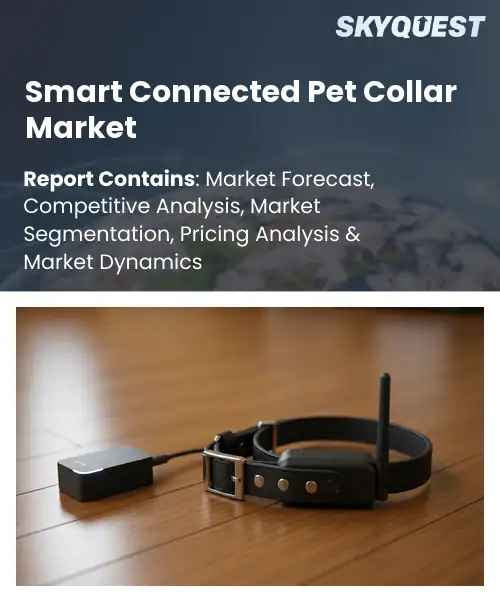
Smart Connected Pet Collar Market
Report ID: SQMIG45J2439
Report ID: SQMIG45J2439
[email protected]
USA +1 351-333-4748
Report ID:
SQMIG45J2439 |
Region:
Global |
Published Date: May, 2026
Pages:
157
|Tables:
240
|Figures:
81


Global Smart Connected Pet Collar Market size was valued at USD 634.9 Million in 2024 and is poised to grow from USD 700.29 Million in 2025 to USD 1534.21 Million by 2033, growing at a CAGR of 10.3% during the forecast period (2026-2033).
The smart connected pet collar market is driven by rapid pet humanization and increasing owner demand for continuous health and location data, which has transformed collars from simple restraints into data platforms. This market encompasses GPS tracking, activity monitoring, veterinary-grade biometric sensing, geofencing, and app ecosystems that integrate with smartphones and cloud analytics. It matters because it reduces lost-animal incidents, enables preventive care through early detection of abnormal activity, and supports behavioral training with real-time feedback. Historically devices evolved from basic radio collars to cellular and Bluetooth enabled products offered by startups and established pet care firms, reflecting connectivity advances.Building on connectivity advances, affordable LPWANs and sensor commoditization constitute a growth factor because they lower device costs, extend battery life, which increases owner adoption and enables continuous monitoring. As a result manufacturers can offer subscription analytics and telehealth integrations that create recurring revenue while providing veterinarians with longitudinal behavior and biometrics for diagnosis. In practice a collar that detects nocturnal restlessness can trigger an app alert and prompt a teleconsult, preventing progression of chronic conditions and justifying insurer partnerships. Consequently market opportunities expand into aging pet care, smart home integration, and recovery services that monetize data-driven outcomes at scale. As such, market opportunities now extend to pet care for the elderly, smart home compatibility and recovery services leveraging data driven monetization of results.
How is AI Enhancing Health Monitoring and Behavior Analysis in the Smart Connected Pet Collar Market?Smart connected collars use a combination of motion sensors, heart rate proxies, temperature and GPS along with AI algorithms working on both the collar and in the cloud to perform sensor fusion, behavior analysis and anomaly detection. AI makes sense of the constant stream of data in order to provide meaningful information for pet owners and veterinarians. From basic tracking solutions, the industry moves towards more complex and clinically oriented health monitoring and management systems. Clinically focused alerts, personalized baseline models and telehealth integration become key elements. For example, there are collar solutions providing access to real time veterinarians and emotion oriented analysis that make the process more actionable and decrease the response time. In March of 2026, Fi introduced Fi Intelligence as an application feature showing how AI can leverage collar data to provide vet grade alerts and personalized care.
Market snapshot - (2026-2033)
Global Market Size
USD 634.9 Million
Largest Segment
Dogs
Fastest Growth
Cats
Growth Rate
10.3% CAGR
To get more insights on this market click here to Request a Free Sample Report
Global smart connected pet collar market is segmented by pet type, connectivity technology, feature type, application, distribution channel, end user, pricing tier, subscription model and region. Based on pet type, the market is segmented into Dogs, Cats and Others. Based on connectivity technology, the market is segmented into GPS, RFID, Bluetooth, Wi-Fi, Cellular/LTE and Multi-Connectivity. Based on feature type, the market is segmented into Tracking & Location Monitoring, Health & Wellness Monitoring, Activity & Fitness Tracking, Behavior Monitoring & Training, Geofencing & Safety Alerts, Temperature & Environmental Monitoring, Integrated Communication Features and Multi-Function Smart Collars. Based on application, the market is segmented into Pet Tracking & Recovery, Health Monitoring, Training & Behavior Management, Safety & Security and Fitness & Activity Monitoring. Based on distribution channel, the market is segmented into Online Retail, Pet Specialty Stores, Consumer Electronics Stores, Veterinary Clinics & Pet Care Centers, Supermarkets & Hypermarkets and Others. Based on end user, the market is segmented into Household Pet Owners, Professional Pet Trainers, Veterinary & Pet Care Service Providers, Animal Shelters & Rescue Organizations and Commercial Breeders & Kennels. Based on pricing tier, the market is segmented into Economy, Mid-Range and Premium. Based on subscription model, the market is segmented into One-Time Purchase, Subscription-Based and Hybrid Model. Based on region, the market is segmented into North America, Europe, Asia Pacific, Latin America and Middle East & Africa.
The GPS Segment leads as customers' preference towards accurate and continuous outdoor positioning is high, and hence GPS is the primary connectivity option for the majority of these devices. Consumer confidence in real-time maps, applications, and the declining cost of GPS modules is fueling manufacturer investments in GPS-first products, which also accelerate collaboration with map providers and safety services as well as providing room for more value-added features.
On the other hand, Multi-Connectivity Segment is growing at the fastest pace as manufacturers leverage multiple connections like cellular, Bluetooth, and short-range links to provide reliable coverage and more functionalities. The need for seamless switching and failover along with advanced analytics is spurring innovation and opening up new markets for both urban and rural pet owners, creating new business models for subscription-based offerings.
The Health & Wellness Monitoring Segment leads as more pet owners are looking for physiological and biometric data to manage their pet's wellness and detect potential conditions in time. This is driving manufacturers to incorporate sensors that can be integrated with veterinarians' services and help diagnose chronic conditions, as sensor technology is becoming smaller and more capable of processing analytics data.
On the other side, the activity & fitness tracking segment represents the major high growth subsegment as consumers become increasingly interested in monitoringtheir pets’ daily activities and understanding the behavioral patterns that will help train their animals and ensure good health. Developments in motion sensors that require less battery capacity, game mechanics, and social media integration make using such devices more convenient and attractive, driving further demand for integrated hardware and software services.
To get detailed segments analysis, Request a Free Sample Report
The dominance of North America is fueled by the combination of innovative consumer electronics adoption rates, the well-developed retail and e commerce industry, and the rich tradition of premium pet care. Close cooperation between consumer electronics companies, producers of pet products, and veterinary organizations facilitates the development process and boosts the rate of adoption. Good access to digital infrastructure and mobile platform integration ensures a smooth user experience. The existence of efficient distribution channels, substantial venture and corporate investments into the field, and a favorable legal framework for IoT solutions contributes to successful commercialization. Branding and marketing efforts attract early adopters who appreciate the functionality and effectiveness of the solutions offered.
The Smart Connected Pet Collar Market in United States exhibits technology-driven innovation and wide retail reach, with large consumer electronics companies and startups contributing to the variety of products available. Linking with pet services, telehealth services, and subscription programs helps in building sustained engagement. Effective e-commerce and specialty retail distribution helps in making such products easily available in urban and suburban markets. Awareness and acceptance of connected technologies and desire for data-based pet management help drive usage, while concerns about privacy and compatibility help shape product offerings.
The Smart Connected Pet Collar Market in Canada enjoys the advantage of being closely aligned with local technology and retail infrastructure, which helps in bringing new products to the market effectively. Multichannel retailing efforts using specialty pet stores and online channels help in reaching out to different consumers. Reliability and after-sales support become important considerations in regions that have lower population densities and where remote monitoring is valued. Collaboration between manufacturers and veterinary clinics/service providers helps in creating localized solutions.
The explosive growth of Europe is due to the regulatory environment, centered on data security, innovative engineering, and higher interest by consumers in high-end pet products. Inter-country trade and harmonized standards increase the chances of interoperability, attracting multinational companies as well. Several entry points exist, through different retail channels, including specialist boutiques and online sales portals. Innovative ecosystems in selected markets enable cooperation between technology providers, veterinarians, and pet products brands, thereby driving product innovation. The consumer demands for devices that monitor health, track activities, and provide safety solutions tailored to their lifestyle are clear, positioning Europe as an interesting continent to grow in.
The smart connected pet collar market in Germany benefits from a well-established manufacturing and engineering environment that focuses on reliability and accuracy. Good distribution networks and high-quality consumers drive demand for products that meet high quality and compliance requirements. Cooperation between local experts in hardware engineering and software design leads to reliable product performance and compliance with data protection regulations. Retail sales channels are represented by specialist retailers and veterinarians.
United Kingdom Smart Connected Pet Collar Market demonstrates high consumer acceptance as a result of active growth in e-commerce and a strong startup culture dedicated to user-centricity and integration. The role of digital marketing and influence marketing is to increase awareness, while that of subscriptions and telehealth is to improve engagement. The flexibility of retail means that new forms of retail and bundling can be tested rapidly. Modern urban pet ownership practices and the preference for convenience make connected products such as those that track and analyze pet activities through mobile apps very appealing.
France Smart Connected Pet Collar Market is developing due to its focus on design, lifestyle, and premiumization of products according to the tastes of consumers. Boutiques and online sellers of niche products provide more options and thus let people enjoy both the functional and aesthetic aspects of products. Cooperation with veterinarians and other health providers enhances the credibility of health monitoring features.
Asia Pacific is enhancing its positioning through rapid technology adoption, electronics manufacturing skills, and heightened consumer awareness about pet health and convenience. The local producers benefit from their knowledge of designing compact hardware, efficient logistics, and integration with the ubiquitous mobile platform. Partnership with telecommunication companies and payments solutions helps ensure an efficient delivery of service, while local startups introduce foreign innovations adjusted to regional consumers' needs. Retailing is being diversified through the development of local online shopping platforms and specialty shops focused on providing after sale services. Different dynamics in local markets make it possible to provide both high end and value based products, thereby reinforcing the role of Asia Pacific in developing new products and increasing scale.
Product Design in Japan Smart Connected Pet Collar Market implies a high level of sophistication, durability, and compatibility with domestic consumer electronics. Customer expectations regarding product build quality and small sizes lead to the use of technology and engineering in creating competitive advantages. Retailing can be done through specialty stores and electronics shops that position the product as a necessity for lifestyle and care purposes. Cooperation with veterinary clinics and integration into mobile technologies attract customers.
South Korea Smart Connected Pet Collar Market is able to benefit from its advanced mobile environment and quick adaptation of consumers towards connected services, leading to rapid innovation and experimentation in terms of integrated features and subscription plans. The country also has an active startup scene and cooperation between technology firms leading to unique service bundles and methods of social commerce. Highly urbanized lifestyle and high levels of digital interaction are conducive to the development of technology which integrates tracking and health monitoring alongside other functionalities, facilitated by efficient logistics and customer service.
To know more about the market opportunities by region and country, click here to
Buy The Complete Report
Rising Pet Owner Tech Adoption
Increasing interest from pet owners to utilize technology in their daily pet care routine has led to an increased demand for smart connected collars. Such devices provide clear added value in terms of remote location tracking and health monitoring, thus making caring for one's pet much easier while reducing any potential concerns regarding losing a pet. As consumers become more aware of the added value provided by such technology, their willingness to invest in more expensive and technologically advanced collars grows.
Advances in Sensor and Connectivity
The ongoing advancement in miniaturized sensors, processors that consume less energy, and wireless communications protocols allows achieving better functionality of smart collars that provides for improved tracking, precise activity identification and non-invasive monitoring of physiological parameters. Improvement in the performance of such components decreases the restrictions in terms of the form factor and increased efficiency of battery usage, thus making devices more convenient and acceptable for long-term use by pets. Such technical progress allows developing and introducing new unique products that would be more valuable for consumers, stimulating retailers and service providers to provide additional services to enhance product value.
Concerns Over Data Privacy
Issues with the collection, storage and possible misusage of sensitive data related to pets and owners' behaviors can be another barrier to the widespread introduction of smart collars. The fear of the possible violation of the privacy of people and their pets may prevent users from purchasing such devices. It should be noted that until manufacturers and service providers introduce additional measures to guarantee secure data handling, fears regarding data privacy will impede the development of the market.
High Product Cost and Affordability
The relatively higher acquisition costs coupled with the recurring subscription costs for the premium analytics or tracking services associated with such products can act as a barrier to cost-conscious pet owners, preventing the adoption of the technology among more consumers. The inability to see clear advantages that surpass the overall costs of owning the product can prompt buyers to seek cheaper substitutes or even opt for normal collars, thus hindering market penetration. Such an issue is especially pronounced in areas where consumers have limited financial means.
Request Free Customization of this report to help us to meet your business objectives.
The competitive trends in the global smart connected pet collar industry are characterized by technology differentiations and consolidations, where the established players are making acquisitions and forming connectivity partnerships, whereas the startup companies are working on AI sensing and veterinary integration technologies. For instance, Tractive's planned acquisition of Whistle for 2025, Halo's connectivity partnership with KORE, and Fi's product innovations and veterinary focused startups like Maven Pet and Petpuls.
Collar Integration with Veterinary Telehealth: The rise of smart collars has enabled continuous remote monitoring that synergizes with telehealth services by delivering information about pet behavior, rest and symptoms, which veterinarians find helpful for developing proactive care protocols. Such integration also helps establish relationships with pet owners built on trust and provides subscription-based medical services and consultations. Enhanced mobile app experience allows better collaboration between pet owners and veterinarians and better adherence to care plans. Anonymous data sharing may prove valuable for improved decision-making and preventative measures. Companies could differentiate themselves using interoperable platforms and care coordination services.
AI-Enabled Behavioral Insights: Using advanced technologies, sensors can now turn data about motion and physiological state into behavior patterns that could be used to recommend personalized care programs. AI-enabled behavioral analysis may assist owners in recognizing changes in pet behavior, which will make it easier for them to develop appropriate training and wellness programs. By employing proprietary algorithms, companies can provide a unique experience for users, create customer loyalty and collaborate with training facilities and veterinary clinics to validate their behavioral models.
SkyQuest’s ABIRAW (Advanced Business Intelligence, Research & Analysis Wing) is our Business Information Services team that Collects, Collates, Correlates, and Analyses the Data collected by means of Primary Exploratory Research backed by robust Secondary Desk research.
According to SkyQuest research, the market growth drivers for the smart connected pet collar industry include fast pet humanization and increasing owner needs for real-time health and location information, while privacy issues are an important limiting factor; North America takes the lead in regional adoption rates, while GPS remains the most prominent market segment, which is also driven by a second market growth driver in the form of further development of sensor and connectivity technologies that reduce costs and allow more advanced functionality, thus offering opportunities for subscription-based services, telemedicine, and artificial intelligence that minimize cases of lost pets and provide preventive care, changing the market value proposition.
| Report Metric | Details |
|---|---|
| Market size value in 2024 | USD 634.9 Million |
| Market size value in 2033 | USD 1534.21 Million |
| Growth Rate | 10.3% |
| Base year | 2024 |
| Forecast period | (2026-2033) |
| Forecast Unit (Value) | USD Million |
| Segments covered |
|
| Regions covered | North America (US, Canada), Europe (Germany, France, United Kingdom, Italy, Spain, Rest of Europe), Asia Pacific (China, India, Japan, Rest of Asia-Pacific), Latin America (Brazil, Rest of Latin America), Middle East & Africa (South Africa, GCC Countries, Rest of MEA) |
| Companies covered |
|
| Customization scope | Free report customization with purchase. Customization includes:-
|
To get a free trial access to our platform which is a one stop solution for all your data requirements for quicker decision making. This platform allows you to compare markets, competitors who are prominent in the market, and mega trends that are influencing the dynamics in the market. Also, get access to detailed SkyQuest exclusive matrix.
Table Of Content
Executive Summary
Market overview
Parent Market Analysis
Market overview
Market size
KEY MARKET INSIGHTS
COVID IMPACT
MARKET DYNAMICS & OUTLOOK
Market Size by Region
KEY COMPANY PROFILES
Methodology
For the Smart Connected Pet Collar Market, our research methodology involved a mixture of primary and secondary data sources. Key steps involved in the research process are listed below:
1. Information Procurement: This stage involved the procurement of Market data or related information via primary and secondary sources. The various secondary sources used included various company websites, annual reports, trade databases, and paid databases such as Hoover's, Bloomberg Business, Factiva, and Avention. Our team did 45 primary interactions Globally which included several stakeholders such as manufacturers, customers, key opinion leaders, etc. Overall, information procurement was one of the most extensive stages in our research process.
2. Information Analysis: This step involved triangulation of data through bottom-up and top-down approaches to estimate and validate the total size and future estimate of the Smart Connected Pet Collar Market.
3. Report Formulation: The final step entailed the placement of data points in appropriate Market spaces in an attempt to deduce viable conclusions.
4. Validation & Publishing: Validation is the most important step in the process. Validation & re-validation via an intricately designed process helped us finalize data points to be used for final calculations. The final Market estimates and forecasts were then aligned and sent to our panel of industry experts for validation of data. Once the validation was done the report was sent to our Quality Assurance team to ensure adherence to style guides, consistency & design.
Analyst Support
Customization Options
With the given market data, our dedicated team of analysts can offer you the following customization options are available for the Smart Connected Pet Collar Market:
Product Analysis: Product matrix, which offers a detailed comparison of the product portfolio of companies.
Regional Analysis: Further analysis of the Smart Connected Pet Collar Market for additional countries.
Competitive Analysis: Detailed analysis and profiling of additional Market players & comparative analysis of competitive products.
Go to Market Strategy: Find the high-growth channels to invest your marketing efforts and increase your customer base.
Innovation Mapping: Identify racial solutions and innovation, connected to deep ecosystems of innovators, start-ups, academics, and strategic partners.
Category Intelligence: Customized intelligence that is relevant to their supply Markets will enable them to make smarter sourcing decisions and improve their category management.
Public Company Transcript Analysis: To improve the investment performance by generating new alpha and making better-informed decisions.
Social Media Listening: To analyze the conversations and trends happening not just around your brand, but around your industry as a whole, and use those insights to make better Marketing decisions.
REQUEST FOR SAMPLE
 REQUEST FREE CUSTOMIZATION
Global Smart Connected Pet Collar Market size was valued at USD 634.9 Million in 2024 and is poised to grow from USD 700.29 Million in 2025 to USD 1534.21 Million by 2033, growing at a CAGR of 10.3% during the forecast period (2026-2033).
Competitive dynamics in the global smart connected pet collar market are driven by technology differentiation and strategic consolidation, with incumbents executing acquisitions and connectivity partnerships while startups pursue AI sensing and vet integrations. Examples include Tractive's 2025 acquisition of Whistle, Halo's connectivity partnership with KORE, and growth through product innovation by Fi and veterinary focused entrants such as Maven Pet and Petpuls. 'Tractive', 'Whistle Labs', 'Fi Smart Collar', 'PetPace', 'Garmin', 'FitBark', 'Pawscout', 'Dogtra', 'SATELLAI', 'Link My Pet', 'Invoxia', 'Findster Technologies', 'PitPat', 'Loc8tor', 'SCOLLAR', 'Gibi Technologies', 'Paby', 'Eureka Technology Partners', 'RAWR', 'Radio Systems Corporation'
Growing willingness among pet owners to incorporate technology into daily care has expanded demand for smart connected collars. These devices deliver clear value by enabling remote location tracking, activity monitoring and health insights that simplify routines and reduce anxiety about lost pets. As more owners recognize practical benefits, willingness to invest in higher priced, feature rich collars increases, encouraging manufacturers to innovate and expand offerings. This positive feedback loop between perceived utility and product availability supports market expansion through broader acceptance and steadier consumer purchase behavior.
Integration With Veterinary Telehealth: Smart collars increasingly enable continuous remote monitoring that complements veterinary telehealth by providing activity, sleep and symptom context to clinicians. This integration supports proactive care pathways and strengthens trusted partnerships between device makers and veterinary services, enabling subscription-based care and consultations. Enhanced mobile interfaces facilitate owner–vet communication and adherence, while anonymized trend sharing bolsters clinical decision making and timely preventive care strategies. Market players can differentiate through certified interoperability and care coordination offerings that extend beyond hardware into service ecosystems.
Why does North America Dominate the Global Smart Connected Pet Collar Market? |@12


Want to customize this report? This report can be personalized according to your needs. Our analysts and industry experts will work directly with you to understand your requirements and provide you with customized data in a short amount of time. We offer $1000 worth of FREE customization at the time of purchase.
Feedback From Our Clients


 USA (+1) 351-333-4748

