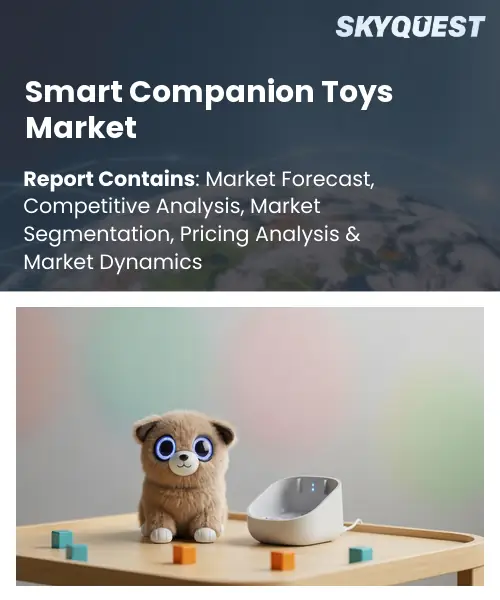
Smart Companion Toys Market
Report ID: SQMIG25J2279
Report ID: SQMIG25J2279
[email protected]
USA +1 351-333-4748
Report ID:
SQMIG25J2279 |
Region:
Global |
Published Date: July, 2026
Pages:
157
|Tables:
146
|Figures:
78


Global Smart Companion Toys Market size was valued at USD 938.6 Million in 2024 and is poised to grow from USD 1114.12 Million in 2025 to USD 4390.73 Million by 2033, growing at a CAGR of 18.7% during the forecast period (2026-2033).
The smart companion toys market growth keeps getting boosted by the growing urge, for interactive and tech- powered play that kids and families can feel good about. As artificial intelligence, machine learning, voice recognition, and connected tech improve, toys start doing more than just a single trick, they can answer back in a more tailored way. Plus there is this whole shift where parents are looking at educational toys not only as “fun”, but also as something that helps with thinking skills, imagination, and social practice. At the same time, smartphone connectivity is spreading faster, IoT is easier to plug in, and app-controlled smart toys keep becoming more available, so adoption expands naturally. And, higher disposable incomes plus urban life plus demand for more premium kids products are supporting growth worldwide. On top of that, businesses are also leaning into better designs, stronger safety parts, and AI-powered companionship concepts, just to stand out and pull in consumers who want play that feels personalized, and more alive.
AI and IoT setups make these toys act like reactive learning buddies that can respond to voice, movement, and whatever’s happening around them. Little sensors pick up a child’s gestures while cloud-based AI reads patterns that look like mood or emotion, then the toy adjusts what it does, stories, games, feedback, all of it can shift in real time. That combination of connectivity plus personalization is a big deal for parents, partly because toys can be refreshed with new content and safety changes over the air, rather than staying stuck. The whole space is being pushed by demand for educational play that mixes entertainment with data-driven insights, so the toy feels more like a responsive friend, not some static gadget.
Market snapshot - (2026-2033)
Global Market Size
USD 938.6 Million
Largest Segment
AI-Powered Companion Toys
Fastest Growth
Educational Companion Toys
Growth Rate
18.7% CAGR
To get more insights on this market click here to Request a Free Sample Report
The global smart companion toys market is segmented by product type, technology, age group, distribution channel, end user and region. Based on product type, the market is segmented into Robotic Pets, Interactive Dolls, Educational Companion Toys and AI-Powered Companion Toys. Based on technology, the market is segmented into Artificial Intelligence (AI), Voice Recognition, Internet of Things (IoT) and Bluetooth & Wi-Fi Connectivity. Based on age group, the market is segmented into Toddlers, Children, Teenagers and Adults. Based on distribution channel, the market is segmented into Online Retail, Toy Stores and Supermarkets & Hypermarkets. Based on end user, the market is segmented into Household and Educational Institutions. Based on region, the market is segmented into North America, Europe, Asia Pacific, Latin America and Middle East & Africa.
As per the smart companion toys market analysis, the artificial intelligence segment seems to dominate because it lets toys learn the user preferences, adapt their behaviors, and then create these personalized moments, which in turn builds a real emotional bond that classic mechanics just can’t reach. Advanced machine learning models also enable real-time replies to voice cues and contextual cues, so engagement keeps going without big gaps. This “cognitive” capability is what sets premium options apart, pushes a higher willingness to pay, and keeps brand loyalty strong, so AI is basically positioned as the main force behind market evolution.
However, the Internet of Things (IoT) segment feels like it’s the fastest growing, mainly due to connectivity. With that, toys can sync with smart home ecosystems, take over the air updates, and share data so the play scenarios feel more enriched. That smooth integration encourages new use cases, pulls in tech savvy families, and lifts overall market growth quickly.
According to the smart companion toys market forecast, Education integration, especially through educational companion toys, tends to lead because these toys combine interactive storytelling with curriculum aligned challenges. It’s like turning playtime into organized learning moments, and somehow it manages to match what parents expect while also feeding child curiosity. When progress tracking and adaptive difficulty are included, skill building becomes stronger, but the experience stays fun, which makes educators and families lean toward these products. And because it delivers educational value that feels measurable, it improves market positioning and keeps demand steady across different households.
Meanwhile, the AI-powered companion toys segment is showing the strongest growth momentum, partly because conversational agents plus emotion recognition algorithms make the companions feel extremely responsive. This appeals a lot to users who are very into technology. Also, ongoing software upgrades keep expanding functionality, which leads to repeat purchases and creates ecosystem lock-in, so the whole segment can scale fast and generate fresh revenue streams.
To get detailed segments analysis, Request a Free Sample Report
As per the smart companion toys market regional forecast, Asia Pacific is leading the market in a way that feels connected to a lot of things at once deep technological skills plus a solid manufacturing setup, and also this real cultural love for hands on interactive play. The region gets helped by advanced semiconductor know how and robotics strengths which makes it easier to drop in artificial intelligence and connectivity into toys, fast. People also like products that feel educational and immersive, so that influences how new models get made. And because the digital infrastructure is already everywhere, updates happen smoothly and cloud services are usable without too much friction. There are partnerships going on between startups, bigger manufacturers and research groups, that speeds up innovation cycles in a noticeable way, so the region ends up being a main supply point for new companion devices for kids and families around the world. On top of that, policy support pushes investment into smart factories and export incentives help global routes, so the leadership keeps getting reinforced. Basically, when entertainment and learning mix together, parents are more willing, and the market spreads quicker in both big cities and newer growth markets too.
Japan Smart Companion Toys Market
In Japan, the Smart Companion Toys sector leans on a history of careful high quality design, plus customers who are open to newer gadgets aimed at child growth. There are strong ties between electronics companies and top toy creators, which helps voice recognition and interactive training features come together cleanly. The cultural focus on educational worth encourages early adoption, and the retail scene is mature enough that it reaches people through specialty shops and also more advanced e commerce platforms, efficiently.
South Korea Smart Companion Toys Market
In South Korea, Smart Companion Toys market share is growing inside an energetic ecosystem that blends robotics skills with a lively entertainment vibe. Government backing for R&D speeds up the buildout of AI powered companion experiences, while local brands tend to focus on smooth connectivity and easy controls that feel natural. Parents here also tend to trust that the tech is safe, and when it is paired with strong online retail networks the uptake climbs. Because of that the country is often seen as a center for fresh companion device ideas.
North America is seeing fast smart companion toys market penetration due to a mix of things like higher consumer spending, early interest in connected devices, and a general push toward educational fun. Big tech players team up with toy manufacturers so they can place smarter voice assistants and adaptive learning logic into products. That design tends to click with tech minded families. The digital setup is also strong enough to handle over the air updates and cloud based personalization, so the user experience feels better and more current. Culturally, many parents like the idea of interactive play that has developmental value, so they start putting these smart companions into everyday routines, not just for occasional use. Retail competition also matters, with both advanced e commerce options and physical experiential stores helping products get seen and adopted across many types of households. And then there’s venture capital ecosystems, which keeps funding flowing and helps newer brands launch quickly and keep iterating.
United States Smart Companion Toys Market
In the United States, the smart companion toys industry momentum comes from a culture that is big on novelty and investing in consumer tech. Collaborations between Silicon Valley teams and older toy studios create devices that feel very interactive, and they often add voice control, augmented reality, plus data driven personalization. Parents usually care about safety and educational results, so they look for toys that blend learning with play, not one or the other. Distribution is also wide, from large online marketplaces to niche retailers, so the products get to more families, and the product cycle stays quick.
Canada Smart Companion Toys Market
In Canada, the Smart Companion Toys market shows a preference for premium interactive products. Joint work between Canadian tech incubators and established toy companies supports companions that lean into adaptive learning and multilingual features, which fits the bilingual setting. Buyers also seem to care about data privacy, so demand grows for devices that explain security in a clear and obvious way. Retail is a mix too, with online shopping alongside a web of child focused specialty stores, making it easier for families to adopt these educational play solutions without too much hassle.
Europe is pushing ahead in the Smart Companion Toys market by stitching together design heritage with very strict safety rules, and then also leaning more into experiential learning. There are collaborations that look like a triangle, with major manufacturers on one side, research universities on another, and creative studios somewhere in the middle. That mix helps them craft toys that bring in sophisticated AI, but still wrap it in stories that feel culturally close and readable for kids. And the whole thing gets nudged by policy-led incentives, so companies are pushed toward sustainable materials, plus ethical ways of handling data. As a result, the products tend to match what consumers are already asking for, which is responsible technology. On top of that, the retail setup feels mature: there are high‑end specialty boutiques, but also bigger online marketplaces. That means access is more spread out than in places where it’s mostly one channel or the other. Plus, cross border trade inside the region makes new features move faster, so Europe keeps building its image as a center for premium, educational companion devices.
Germany Smart Companion Toys Market
In Germany, the Smart Companion Toys market is known for precision engineering, and also for a noticeably strong data security stance. There are partnerships between automotive technology firms and toy designers that bring out products with advanced sensors and connectivity that feels smooth, not awkward. German buyers usually care a lot about durability and educational usefulness, so the demand leans toward companions that can support language development plus problem solving abilities. Distribution is a blend too: the well established retail chains operate alongside more novel digital platforms, which helps the products reach a wider audience without too much delay.
United Kingdom Smart Companion Toys Market
The Smart Companion Toys market in the United Kingdom rides on a lively creative scene, and there’s also a high degree of parental engagement when it comes to tech at home. Local game developers teaming up with toy manufacturers leads to companions that mix interactive storytelling with learning approaches that adapt over time. Regulatory frameworks are strict, especially around safety and privacy, and that seems to lift consumer confidence. Retail options are varied as well, with flagship stores and smaller boutiques, plus e‑commerce that’s strong, so families can find these enriching play experiences with less friction, depending on what they prefer.
France Smart Companion Toys Market
In France, the Smart Companion Toys market outlook is influenced a lot by early childhood development priorities, plus a longer standing tradition of artistic design. Partnerships between French AI research labs and boutique toy makers often yield companions that emphasize creativity, language enrichment, and even music integration. People also expect privacy protections, and they want eco friendly production, so those preferences shape how the products are built and how data is treated. Retail routes in France connect more classic department store style channels with lively online marketplaces, so families get a broad set of innovative educational companion options, without being boxed into one shop only.
To know more about the market opportunities by region and country, click here to
Buy The Complete Report
Rising Demand for Interactive Play
Advancements in Artificial Intelligence Integration
Privacy Concerns Over Data Collection
High Production Costs Limiting Accessibility
Request Free Customization of this report to help us to meet your business objectives.
The competitive landscape is being shaped by rapid product innovation, strategic partnerships, and targeted acquisitions, as firms try to grab the growing demand for interactive AI companions. With recent CES unveilings and seed funded expansions it gets even more intense, especially among the newer emerging players, who are acting like they are already behind.
Top Player’s Company Profile
Recent Developments in the Smart Companion Toys Market
SkyQuest’s ABIRAW (Advanced Business Intelligence, Research & Analysis Wing) is our Business Information Services team that Collects, Collates, Correlates, and Analyses the Data collected by means of Primary Exploratory Research backed by robust Secondary Desk research.
As per SkyQuest analysis, the global smart companion toys market is being driven mostly by a rising demand for interactive play that wants voice responsive, gesture aware toys, while steady progress in artificial intelligence integration serves as the second push by enabling more nuanced conversations and adaptive learning. The AI technology segment currently leads the market, providing the strongest personalized experiences, and Asia Pacific is ahead in the region, due to its solid manufacturing base and also a clear appetite for educational technology. Still, privacy worries about all that data collected from children act as a real brake, making some cautious parents pause before buying. all of this together shapes a market that is moving very fast.
| Report Metric | Details |
|---|---|
| Market size value in 2024 | USD 938.6 Million |
| Market size value in 2033 | USD 4390.73 Million |
| Growth Rate | 18.7% |
| Base year | 2024 |
| Forecast period | (2026-2033) |
| Forecast Unit (Value) | USD Million |
| Segments covered |
|
| Regions covered | North America (US, Canada), Europe (Germany, France, United Kingdom, Italy, Spain, Rest of Europe), Asia Pacific (China, India, Japan, Rest of Asia-Pacific), Latin America (Brazil, Rest of Latin America), Middle East & Africa (South Africa, GCC Countries, Rest of MEA) |
| Companies covered |
|
| Customization scope | Free report customization with purchase. Customization includes:-
|
To get a free trial access to our platform which is a one stop solution for all your data requirements for quicker decision making. This platform allows you to compare markets, competitors who are prominent in the market, and mega trends that are influencing the dynamics in the market. Also, get access to detailed SkyQuest exclusive matrix.
Table Of Content
Executive Summary
Market overview
Parent Market Analysis
Market overview
Market size
KEY MARKET INSIGHTS
COVID IMPACT
MARKET DYNAMICS & OUTLOOK
Market Size by Region
KEY COMPANY PROFILES
Methodology
For the Smart Companion Toys Market, our research methodology involved a mixture of primary and secondary data sources. Key steps involved in the research process are listed below:
1. Information Procurement: This stage involved the procurement of Market data or related information via primary and secondary sources. The various secondary sources used included various company websites, annual reports, trade databases, and paid databases such as Hoover's, Bloomberg Business, Factiva, and Avention. Our team did 45 primary interactions Globally which included several stakeholders such as manufacturers, customers, key opinion leaders, etc. Overall, information procurement was one of the most extensive stages in our research process.
2. Information Analysis: This step involved triangulation of data through bottom-up and top-down approaches to estimate and validate the total size and future estimate of the Smart Companion Toys Market.
3. Report Formulation: The final step entailed the placement of data points in appropriate Market spaces in an attempt to deduce viable conclusions.
4. Validation & Publishing: Validation is the most important step in the process. Validation & re-validation via an intricately designed process helped us finalize data points to be used for final calculations. The final Market estimates and forecasts were then aligned and sent to our panel of industry experts for validation of data. Once the validation was done the report was sent to our Quality Assurance team to ensure adherence to style guides, consistency & design.
Analyst Support
Customization Options
With the given market data, our dedicated team of analysts can offer you the following customization options are available for the Smart Companion Toys Market:
Product Analysis: Product matrix, which offers a detailed comparison of the product portfolio of companies.
Regional Analysis: Further analysis of the Smart Companion Toys Market for additional countries.
Competitive Analysis: Detailed analysis and profiling of additional Market players & comparative analysis of competitive products.
Go to Market Strategy: Find the high-growth channels to invest your marketing efforts and increase your customer base.
Innovation Mapping: Identify racial solutions and innovation, connected to deep ecosystems of innovators, start-ups, academics, and strategic partners.
Category Intelligence: Customized intelligence that is relevant to their supply Markets will enable them to make smarter sourcing decisions and improve their category management.
Public Company Transcript Analysis: To improve the investment performance by generating new alpha and making better-informed decisions.
Social Media Listening: To analyze the conversations and trends happening not just around your brand, but around your industry as a whole, and use those insights to make better Marketing decisions.
REQUEST FOR SAMPLE
 REQUEST FREE CUSTOMIZATION
Global Smart Companion Toys Market size was valued at USD 938.6 Million in 2024 and is poised to grow from USD 1114.12 Million in 2025 to USD 4390.73 Million by 2033, growing at a CAGR of 18.7% during the forecast period (2026-2033).
The competitive landscape is shaped by rapid product innovation, strategic partnerships and targeted acquisitions as companies race to capture the expanding demand for interactive AI companions, with recent CES unveilings and seed‑funded expansions intensifying rivalry among emerging players. 'Mattel, Inc.', 'Hasbro, Inc.', 'Bandai Namco Holdings Inc.', 'TOMY Company, Ltd.', 'Spin Master Corp.', 'VTech Holdings Limited', 'WOWWEE GROUP LIMITED', 'MGA Entertainment, Inc.', 'JAKKS Pacific, Inc.', 'LEGO A/S', 'UBTECH Robotics Corp. Ltd.', 'LivingAI Co., Ltd.', 'Embodied, Inc.', 'KEYi Tech Co., Ltd.', 'Elephant Robotics Technology Co., Ltd.', 'Sony Group Corporation', 'Tencent Holdings Limited', 'Xiaomi Corporation', 'Horizon Robotics, Inc.', 'SoftBank Group Corp.'
The growing preference among families for toys that respond to voice, gestures, and emotional cues creates a strong appetite for smart companion products, as parents seek engaging tools that foster creativity and learning while offering personalized experiences that adapt to each child’s developmental stage, encouraging repeated use and brand loyalty, thereby expanding the market’s consumer base and prompting manufacturers to invest in richer interactive features.
Connected Play Experience: The rise of seamless IoT integration is turning standalone toys into hubs that communicate with smartphones, smart speakers, and home automation systems, allowing parents to monitor interactions, set activity schedules, and receive real‑time feedback on developmental milestones. This connectivity also enables shared multiplayer scenarios across devices, fostering collaborative play among geographically distant children and creating continuous content updates that keep the companion engaging without requiring physical upgrades, or costly hardware replacements, reinforcing brand loyalty and extending product relevance throughout childhood.
Why does Asia Pacific Dominate the Global Smart Companion Toys Market? |@12


Want to customize this report? This report can be personalized according to your needs. Our analysts and industry experts will work directly with you to understand your requirements and provide you with customized data in a short amount of time. We offer $1000 worth of FREE customization at the time of purchase.
Feedback From Our Clients


 USA (+1) 351-333-4748

