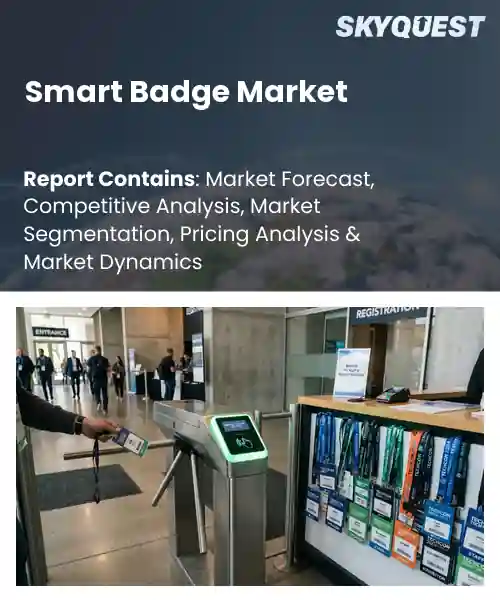
Smart Badge Market
Report ID: SQMIG45K2474
Report ID: SQMIG45K2474
[email protected]
USA +1 351-333-4748
Report ID:
SQMIG45K2474 |
Region:
Global |
Published Date: August, 2026
Pages:
157
|Tables:
188
|Figures:
79


Global Smart Badge Market size was valued at USD 2.13 Billion in 2024 and is poised to grow from USD 2.39 Billion in 2025 to USD 5.95 Billion by 2033, growing at a CAGR of 12.1% during the forecast period (2026-2033).
The global smart badge market revolves around wearable identification devices that embed RFID, Bluetooth Low Energy, or NFC chips to streamline access control, workforce monitoring, and data analytics. Its primary driver is the rising demand for contactless security in corporate campuses, hospitals, and schools, where magnetic stripe cards lack scalability and hygiene. Over the past decade, advances in low‑power microelectronics and cloud analytics have turned simple ID tags into platforms capable of location tracking, health monitoring, and enforcement. A tech firm deployed smart badges to cut unauthorized entry incidents by 42 percent, highlighting the technology’s impact on safety and efficiency.
Another factor shaping the global smart badge market is the integration of biometric authentication, which bridges physical access and identity verification while generating data for resource planning. As organizations pursue zero‑trust frameworks, embedding fingerprint or facial recognition into badges reduces reliance on passwords and mitigates insider threats, prompting firms to allocate budgets toward wearables. This shift unlocks opportunities in sectors such as aerospace, where a manufacturer adopted biometric smart badges to synchronize personnel logs with maintenance schedules, cutting downtime by 18 percent. Consequently, vendors that combine multi‑modal authentication with cloud analytics are positioned to capture expanding demand across regulated industries.
How is AI and IoT integration driving growth in the smart badge market?
AI and IoT integration is reshaping smart badges by turning simple access tools into data‑rich platforms. Sensors collect location, temperature and usage patterns while AI analyzes this stream to predict crowd flow, personalize alerts and automate security protocols. The market now sees badges that sync with building management systems, enabling real‑time occupancy monitoring and energy optimization. Enterprises adopt these intelligent badges to streamline employee onboarding, reduce manual logging and enhance safety during emergencies. This convergence of connectivity and analytics creates a compelling value proposition that fuels demand across corporate campuses, educational institutions and event venues.
Market snapshot - (2026-2033)
Global Market Size
USD 2.13 Billion
Largest Segment
Hardware
Fastest Growth
Software
Growth Rate
12.1% CAGR
To get more insights on this market click here to Request a Free Sample Report
Global smart badge market is segmented by component, technology, form factor, application, end-use industry, deployment type and region. Based on component, the market is segmented into Hardware, Software and Services. Based on technology, the market is segmented into RFID (Radio Frequency Identification), NFC (Near Field Communication), Bluetooth Low Energy (BLE), QR Code / Barcode-Based Smart Badges, Biometric-Enabled Smart Badges and Hybrid Technologies (Multi-Protocol Badges). Based on form factor, the market is segmented into Card-Based Smart Badges, Wearable Badges (Clip-On / Lanyard / ID Holder Integrated), Mobile-Based Digital Badges (App-Enabled Credentials) and Embedded Wearables (Smart Wristbands / Tags). Based on application, the market is segmented into Access Control & Security Management, Time & Attendance Tracking, Visitor Management, Workforce Identification & Authentication, Event Management & Attendee Tracking, Asset & Personnel Tracking, Contactless Payments & Transactions and Others. Based on end-use industry, the market is segmented into Corporate Enterprises, Government & Public Sector, Healthcare Facilities, Education Institutions, Manufacturing & Industrial Facilities, Transportation & Logistics, Events, Hospitality & Entertainment, BFSI (Banking, Financial Services & Insurance) and Others. Based on deployment type, the market is segmented into On-Premises Systems, Cloud-Based Identity Platforms and Hybrid Deployment. Based on region, the market is segmented into North America, Europe, Asia Pacific, Latin America and Middle East & Africa.
NFC segment leads because it offers instant, tap and go interaction that aligns with enterprises’ demand for frictionless entry and contactless experiences. Its mature ecosystem of readers, low power consumption, and seamless integration with mobile devices reduce infrastructure costs, encouraging rapid adoption across corporate campuses and public venues. The technology’s reliability and ease of deployment create a strong value proposition, making it the preferred choice for identity and access management solutions in the smart badge market.
Meanwhile, Biometric Enabled smart badges segment is witnessing the strongest growth momentum as organizations prioritize multi factor authentication to combat sophisticated security threats. Advances in fingerprint and facial recognition sensors enable compact badge designs, while heightened regulatory scrutiny on data protection fuels demand for irrefutable identity verification, accelerating market expansion and opening new vertical opportunities.
Software segment dominates because it supplies the programmable intelligence that converts basic badge hardware into flexible security tools. Customizable authentication algorithms, over the air updates, and integration APIs enable real time policy enforcement and analytics, satisfying evolving compliance demands. By linking badges to enterprise directories and IoT networks, software centralizes access control, monitors usage, and generates insights, making it the pivotal driver of operational efficiency and enhanced protection in the smart badge market.
On the other hand, Services segment is experiencing rapid expansion as organizations outsource badge lifecycle management to specialized providers. Managed enrollment, remote provisioning, and 24/7 support reduce internal resource burdens, while subscription models align costs with usage, spurring broader adoption across enterprises seeking hassle‑free, scalable badge solutions and fueling market growth.
To get detailed segments analysis, Request a Free Sample Report
North America dominates the global Smart Badge market due to a confluence of advanced technological infrastructure, stringent occupational safety regulations, and a pervasive culture of risk mitigation within enterprises. The region benefits from a dense network of hardware manufacturers, software developers, and system integrators that accelerate product innovation and customization. Large‑scale corporate headquarters and government facilities prioritize secure, contactless access solutions, driving extensive deployment. Furthermore, the presence of leading research institutions and substantial investment in IoT ecosystems reinforces the development of sophisticated authentication features and seamless integration with broader security platforms, solidifying the region’s leadership.
Smart Badge Market in United States is characterized by extensive deployment across corporate campuses, government facilities, and educational institutions. The ecosystem benefits from a mature supply chain of hardware manufacturers, software innovators, and system integrators that collaborate to deliver customized solutions. Emphasis on data privacy, robust authentication protocols, and seamless integration with existing security infrastructures reinforces adoption. Industry partnerships and a skilled workforce further accelerate development and implementation through innovation
Smart Badge Market in Canada is propelled by strong regulatory frameworks that prioritize employee safety and data protection. Early adoption by financial services, healthcare providers, and public sector entities creates a fertile environment for solution providers. Collaboration between technology hubs in major cities and research institutions fosters development of advanced authentication features and cloud‑based management platforms. A focus on sustainable design and interoperability with legacy systems further consolidates market momentum
Europe experiences rapid expansion of the Smart Badge market as organizations seek to harmonize security protocols across increasingly mobile workforces and cross‑border operations. Robust data protection directives and occupational health standards compel enterprises to adopt integrated access solutions that provide real‑time monitoring and authentication. A thriving ecosystem of startups and established equipment manufacturers fuels continuous innovation, particularly in biometric capabilities and cloud‑enabled management. Collaborative initiatives among industry bodies, research universities, and governmental agencies further accelerate standardization and adoption, positioning Europe as a dynamic hub of growth and technological advancement. The region also benefits from substantial investment in digital identity frameworks that complement badge technologies, while multinational corporations headquartered in the area serve as early adopters, showcasing the scalability and interoperability of advanced badge solutions across diverse regulatory environments.
Smart Badge Market in Germany is driven by rigorous occupational safety legislation and a strong emphasis on Industry 4.0 integration. Leading automation firms collaborate with security providers to embed badge technology into interconnected production lines, enabling real‑time access control and data analytics. The presence of world‑class engineering research institutions accelerates development of biometric and encryption capabilities, while a mature supply chain ensures rapid scaling across manufacturing, logistics, and corporate sectors.
Smart Badge Market in United Kingdom is characterized by swift adoption within financial services, technology firms, and the public sector, reflecting a regulatory environment that values data security and employee wellbeing. Innovation hubs in major cities foster startups that specialize in contactless authentication and cloud‑based management dashboards. Partnerships between academia and industry accelerate research into artificial intelligence‑enhanced verification, while government incentives for workplace solutions reinforce momentum and broaden market reach.
Smart Badge Market in France is emerging through pilots that pair telecom operators with security firms, reflecting a strong emphasis on privacy by design. Early deployments focus on healthcare facilities and campuses where contactless access meets hygiene priorities. French research institutes explore linking badge data with building platforms to improve occupancy analytics. Government initiatives that support digital transformation in small enterprises further stimulate adoption and broaden market diversification across sectors
Asia Pacific is strengthening its position in the Smart Badge market through a combination of rapid digital transformation, growing emphasis on workplace safety, and a burgeoning ecosystem of innovative hardware and software firms. Nations in the region are investing heavily in smart city initiatives that incorporate secure access control as a foundational element, encouraging broader adoption across manufacturing plants, corporate campuses, and public institutions. The convergence of affordable sensor technologies, strong manufacturing capabilities, and supportive government policies accelerates the rollout of next‑generation badge solutions, while cross‑border collaborations enhance standardization and enable seamless integration with regional IoT platforms. Additionally, a growing talent pool in AI and data analytics empowers developers to embed predictive security features into badge systems, creating services for enterprises seeking proactive threat detection. The rising consumer awareness of privacy and convenience further fuels demand for contactless, encrypted badge technologies, positioning Asia Pacific as a driver of market evolution
Smart Badge Market in Japan benefits from a culture of precision engineering and a national focus on workplace safety. Leading electronics manufacturers collaborate with security specialists to produce reliable RFID‑enabled badges that integrate with existing access control and IoT ecosystems. Government guidelines encourage adoption in manufacturing plants and corporate offices, while research universities advance biometric verification and edge processing. The result is a scalable solution ecosystem tailored to domestic enterprises
Smart Badge Market in South Korea is shaped by adoption and government support for workplace initiatives. Leading semiconductor firms partner with security providers to embed NFC and biometric capabilities into badge designs, enabling seamless integration with platforms. Conglomerates implement badge systems across manufacturing sites to enhance safety monitoring and access control. Academic research centers focus on AI‑driven authentication, driving improvements that position South Korea as a frontier for badge technologies
To know more about the market opportunities by region and country, click here to
Buy The Complete Report
Increasing Adoption of IoT
Growing Emphasis on Workplace Safety
High Initial Implementation Costs
Data Privacy and Security Concerns
Request Free Customization of this report to help us to meet your business objectives.
The smart badge market is shaped by intense competition as firms pursue strategic M&A, form technology partnerships, and accelerate product innovation to capture enterprise security and access‑control contracts. Recent collaborations between badge hardware providers and cloud‑based identity platforms illustrate how companies are integrating AI‑driven analytics to differentiate offerings and expand into new verticals.
SkyQuest’s ABIRAW (Advanced Business Intelligence, Research & Analysis Wing) is our Business Information Services team that Collects, Collates, Correlates, and Analyses the Data collected by means of Primary Exploratory Research backed by robust Secondary Desk research.
As per SkyQuest analysis the global smart badge market is driven primarily by the rapid adoption of IoT which lets badges communicate with sensors and building systems, while a second strong driver is the heightened focus on workplace safety that pushes organisations toward touch‑free, real‑time occupancy monitoring. The main restraint comes from high upfront implementation costs that deter many midsize firms from replacing legacy cards. North America remains the dominant region, thanks to its advanced tech ecosystem and strict security standards, and the NFC‑enabled badge segment leads the market because of its low power consumption, instant tap‑and‑go experience and easy integration with existing infrastructure.
| Report Metric | Details |
|---|---|
| Market size value in 2024 | USD 2.13 Billion |
| Market size value in 2033 | USD 5.95 Billion |
| Growth Rate | 12.1% |
| Base year | 2024 |
| Forecast period | (2026-2033) |
| Forecast Unit (Value) | USD Billion |
| Segments covered |
|
| Regions covered | North America (US, Canada), Europe (Germany, France, United Kingdom, Italy, Spain, Rest of Europe), Asia Pacific (China, India, Japan, Rest of Asia-Pacific), Latin America (Brazil, Rest of Latin America), Middle East & Africa (South Africa, GCC Countries, Rest of MEA) |
| Companies covered |
|
| Customization scope | Free report customization with purchase. Customization includes:-
|
To get a free trial access to our platform which is a one stop solution for all your data requirements for quicker decision making. This platform allows you to compare markets, competitors who are prominent in the market, and mega trends that are influencing the dynamics in the market. Also, get access to detailed SkyQuest exclusive matrix.
Table Of Content
Executive Summary
Market overview
Parent Market Analysis
Market overview
Market size
KEY MARKET INSIGHTS
COVID IMPACT
MARKET DYNAMICS & OUTLOOK
Market Size by Region
KEY COMPANY PROFILES
Methodology
For the Smart Badge Market, our research methodology involved a mixture of primary and secondary data sources. Key steps involved in the research process are listed below:
1. Information Procurement: This stage involved the procurement of Market data or related information via primary and secondary sources. The various secondary sources used included various company websites, annual reports, trade databases, and paid databases such as Hoover's, Bloomberg Business, Factiva, and Avention. Our team did 45 primary interactions Globally which included several stakeholders such as manufacturers, customers, key opinion leaders, etc. Overall, information procurement was one of the most extensive stages in our research process.
2. Information Analysis: This step involved triangulation of data through bottom-up and top-down approaches to estimate and validate the total size and future estimate of the Smart Badge Market.
3. Report Formulation: The final step entailed the placement of data points in appropriate Market spaces in an attempt to deduce viable conclusions.
4. Validation & Publishing: Validation is the most important step in the process. Validation & re-validation via an intricately designed process helped us finalize data points to be used for final calculations. The final Market estimates and forecasts were then aligned and sent to our panel of industry experts for validation of data. Once the validation was done the report was sent to our Quality Assurance team to ensure adherence to style guides, consistency & design.
Analyst Support
Customization Options
With the given market data, our dedicated team of analysts can offer you the following customization options are available for the Smart Badge Market:
Product Analysis: Product matrix, which offers a detailed comparison of the product portfolio of companies.
Regional Analysis: Further analysis of the Smart Badge Market for additional countries.
Competitive Analysis: Detailed analysis and profiling of additional Market players & comparative analysis of competitive products.
Go to Market Strategy: Find the high-growth channels to invest your marketing efforts and increase your customer base.
Innovation Mapping: Identify racial solutions and innovation, connected to deep ecosystems of innovators, start-ups, academics, and strategic partners.
Category Intelligence: Customized intelligence that is relevant to their supply Markets will enable them to make smarter sourcing decisions and improve their category management.
Public Company Transcript Analysis: To improve the investment performance by generating new alpha and making better-informed decisions.
Social Media Listening: To analyze the conversations and trends happening not just around your brand, but around your industry as a whole, and use those insights to make better Marketing decisions.
REQUEST FOR SAMPLE
 REQUEST FREE CUSTOMIZATION
Global Smart Badge Market size was valued at USD 2.13 Billion in 2024 and is poised to grow from USD 2.39 Billion in 2025 to USD 5.95 Billion by 2033, growing at a CAGR of 12.1% during the forecast period (2026-2033).
The smart badge market is shaped by intense competition as firms pursue strategic M&A, form technology partnerships, and accelerate product innovation to capture enterprise security and access‑control contracts. Recent collaborations between badge hardware providers and cloud‑based identity platforms illustrate how companies are integrating AI‑driven analytics to differentiate offerings and expand into new verticals. 'Assa Abloy AB', 'HID Global Corporation', 'Thales Group', 'Idemia France SAS', 'Giesecke+Devrient GmbH', 'Squidcard Ltd', 'Prox point Inc', 'Zebra Technologies Corporation', 'Honeywell International Inc', 'Siemens AG', 'Johnson Controls International plc', 'Identiv Inc', 'Smartrac N V', 'Avery Dennison Corporation', 'NXP Semiconductors N V', 'STMicroelectronics N V', 'Infineon Technologies AG', 'CardLogix Corporation', 'Apples & Oranges LLC', 'Kontakt.io Inc'
The proliferation of interconnected devices creates a seamless environment where smart badges can communicate with sensors, access points, and management platforms, enabling real‑time location tracking, automated attendance, and enhanced security protocols. This connectivity encourages organizations to replace legacy identification methods with intelligent solutions that integrate effortlessly into existing digital ecosystems, thereby accelerating demand for feature‑rich badges that support data analytics, remote provisioning, and adaptive user experiences across diverse operational settings. The resulting operational efficiency and cost savings further motivate enterprises to invest in scalable badge infrastructures.
Ai-Driven Access Management: Enterprises are increasingly adopting AI-powered smart badge platforms to automate access decisions, personalize user experiences, and predict security threats. Machine learning models analyze badge usage patterns, location data, and contextual cues in real time, enabling dynamic credential adjustments without manual intervention. This shift reduces administrative overhead, enhances compliance, and supports a more agile workforce as organizations seek seamless integration of physical security with broader digital identity ecosystems, and fostering continuous improvement through data‑driven insights that align with evolving corporate policies.
Why does North America Dominate the Global Smart Badge Market? |@12


Want to customize this report? This report can be personalized according to your needs. Our analysts and industry experts will work directly with you to understand your requirements and provide you with customized data in a short amount of time. We offer $1000 worth of FREE customization at the time of purchase.
Feedback From Our Clients


 USA (+1) 351-333-4748

