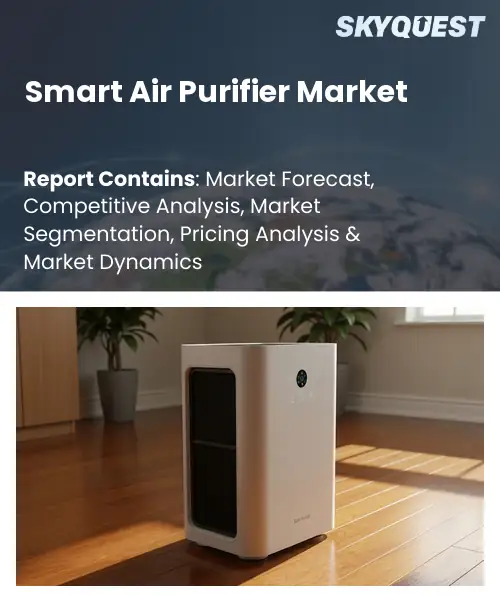
Smart Air Purifier Market
Report ID: SQMIG25H2103
Report ID: SQMIG25H2103
[email protected]
USA +1 351-333-4748
Report ID:
SQMIG25H2103 |
Region:
Global |
Published Date: June, 2026
Pages:
157
|Tables:
145
|Figures:
78


Global Smart Air Purifier Market size was valued at USD 7.0 Billion in 2024 and is poised to grow from USD 7.8 Billion in 2025 to USD 18.65 Billion by 2033, growing at a CAGR of 11.5% during the forecast period (2026-2033).
The primary driver of the smart air purifier market is heightened awareness of indoor air quality and health risks linked to pollutants, allergens, and airborne pathogens, a trend accelerated by urbanization and crises such as wildfires and COVID 19. As a market, smart purifiers combine traditional filtration technologies like HEPA and activated carbon with sensors, connectivity, and algorithms to monitor and respond to indoor conditions, making them integral to building ecosystems. Over the last decade the segment evolved from standalone filter units into networked devices offered by brands like Dyson, Xiaomi and Philips, finding adoption in homes, offices, healthcare settings.A critical factor shaping growth is rapid advancement in sensing and connectivity, enabling real time air quality analytics to trigger purification responses and improve health outcomes. Consequently building managers adopt networked purifiers to reduce absenteeism in offices, improve patient outcomes in hospitals, while hotels and schools deploy units to reassure guests. Device telemetry enables predictive maintenance and filter as a service models, allowing manufacturers to capture recurring revenue and support higher margins. Furthermore harmonization of indoor air quality standards and urbanization in Asia Pacific are expanding addressable markets, presenting partnerships with HVAC integrators and smart home platforms as revenue opportunities.
How are AI and IoT enhancing product differentiation in the smart air purifier market?
AI and IoT are shifting product differentiation in the smart air purifier market by turning devices into intelligent, connected experiences. Key aspects include machine learning driven sensing for adaptive filtration, cloud and edge connectivity for remote monitoring and updates, and interoperability with smart home systems. The market context is that core filtration technology has become commoditized so software intelligence and user experience drive choice. Vendors differentiate with personalized airflow, context aware operation and predictive maintenance that extend product life and reduce perceived friction. These capabilities support new services and richer brand experiences that make purifiers more than just hardware.Dyson May 2026, announced the Find+Follow Purifier Cool with on device AI vision that tracks occupants to direct airflow, illustrating how AI and IoT enable targeted performance, energy efficient operation and stronger consumer engagement.
Market snapshot - (2026-2033)
Global Market Size
USD 7.0 Billion
Largest Segment
HEPA Filtration
Fastest Growth
UV-C Light Purification
Growth Rate
11.5% CAGR
To get more insights on this market click here to Request a Free Sample Report
Global smart air purifier market is segmented by technology, application, coverage area, distribution channel, end user and region. Based on technology, the market is segmented into HEPA Filtration, Activated Carbon Filtration, Ionic / Electrostatic Purification and UV-C Light Purification. Based on application, the market is segmented into Residential, Commercial and Industrial. Based on coverage area, the market is segmented into Small Area, Medium Area and Large Area. Based on distribution channel, the market is segmented into Online and Offline. Based on end user, the market is segmented into Households, Offices, Healthcare Facilities and Hospitality. Based on region, the market is segmented into North America, Europe, Asia Pacific, Latin America and Middle East & Africa.
HEPA Filtration segment dominates because its proven capacity to capture fine particulate matter directly addresses primary air quality concerns that drive purchase decisions. This reliability fosters consumer and institutional trust, channel partner focus and manufacturer investment. Its predictable filter life and compatibility with sensor driven automation simplify integration into smart ecosystems, enabling clear maintenance models and recurring service revenue that anchor product portfolios and marketing strategies.
However, UV-C Light Purification is emerging as the most rapidly expanding technology area because advances in safe dosing, compact lamp designs and smart control integration respond to heightened demand for active pathogen mitigation. Certification progress and improved safety interlocks increase buyer confidence, while novel product forms and combined disinfection features create new use cases and revenue opportunities that accelerate adoption.
Offline segment dominates because face to face retail and channel relationships allow buyers to assess noise, build quality and perceived effectiveness before purchase, reducing purchase friction. Retailers and installers deliver visible after sales support, warranty services and filter replacement channels that suit larger capacity products, reinforcing brand credibility. These physical touchpoints concentrate buyer trust and preserve premium positioning while enabling professional sales cycles for commercial and institutional customers.
However, online is emerging as the most rapidly expanding channel because digital platforms expand assortment, enable direct to consumer pricing and simplify subscription based filter replenishment. Rich product content, reviews and targeted digital marketing speed trial, while improved logistics and platform partnerships allow fast scaling for innovators offering connected features and service oriented business models.
To get detailed segments analysis, Request a Free Sample Report
Asia Pacific dominates the global smart air purifier market due to a convergence of demand driven and supply side factors. High urban concentration and widespread public concern about indoor and outdoor air quality create sustained consumer interest in connected filtration solutions. Strong presence of consumer electronics manufacturers and component suppliers in the region enables rapid product development, iteration, and competitive pricing. Local brands often pair hardware innovation with software ecosystems, voice and mobile integration, and localized sensor calibration, improving perceived value. Public policy emphasis on air quality and active engagement from building and health stakeholders further encourage adoption across residential and commercial segments. Robust retail networks and a culture receptive to smart home technologies support scale deployment and reinforce regional leadership in design, manufacturing, and aftermarket service capabilities.
Smart Air Purifier Market in Japan reflects strong consumer preference for integrated home devices and high expectations for design and reliability. Manufacturers collaborate with technology partners and retailers to deliver compact, quiet systems optimized for urban living. Cultural emphasis on cleanliness and attention to indoor air quality supports premium positioning, while established aftersales and service networks reinforce consumer trust and encourage sustained product replacement cycles and localized innovation initiatives continue.
Smart Air Purifier Market in South Korea is driven by rapid adoption of smart home ecosystems, strong consumer interest in health oriented appliances, and active participation from electronics manufacturers in cross category integration. Urban density and episodic air quality concerns elevate demand for compact connected units. Retail channels and online marketplaces facilitate feature education and aftermarket services, encouraging manufacturers to emphasize connectivity, sensor accuracy and user centric design broadly adopted.
North America has experienced rapid expansion in the smart air purifier market driven by strong consumer awareness of indoor health, integrated smart home adoption, and a competitive technology ecosystem. Established appliance brands and startups alike focus on product differentiation through advanced sensing, filtration media innovation, and seamless connectivity with home platforms. Channel sophistication, including big box retail and dedicated online sales, supports broad consumer education and access to enhanced service offerings. Corporate and institutional procurement demand for improved indoor environments also amplifies adoption in commercial and office settings. Regulatory attention to air quality and partnerships between technology companies and healthcare stakeholders further elevate market relevance, encouraging continuous improvements in user experience, data privacy practices, and interoperable device ecosystems. This environment supports iterative product upgrades and deeper service engagement across diverse consumer segments.
Smart Air Purifier Market in United States is shaped by widespread smart home adoption, high consumer expectations for performance and data transparency, and active engagement from large appliance brands and innovative startups. Demand is influenced by concern for indoor health across varied climates and building types. Retail and professional channels support product education and service, while partnerships with healthcare and building management stakeholders drive uptake in office and institutional environments.
Smart Air Purifier Market in Canada reflects strong consumer interest in indoor air quality and a preference for solutions that balance performance with low noise and energy efficiency. Regional variation in housing stock and cross border technology flows shape product portfolios. Retailers emphasize certification and filter transparency to build trust, while local service offerings and manufacturer partnerships promote extended maintenance programs and tailored solutions for residential and small commercial settings.
Europe is strengthening its position in the smart air purifier market through coordinated emphasis on product quality, regulatory frameworks, and sustainability considerations. Consumers and corporate buyers increasingly prioritize verified performance, low environmental impact, and interoperability with building management systems, prompting manufacturers to refine filtration technologies and energy efficient operation. A strong culture of standards and certification supports trust while cross border trade and diverse climatic needs encourage modular product strategies. Investment in smart building integration and partnerships between appliance makers, energy providers, and health institutions further embed air quality solutions into broader environmental and wellness agendas, enhancing the region role in driving responsible innovation and best practice adoption. This environment favors vendors who can demonstrate lifecycle sustainability, transparent supply chains, and strong aftersales support across multiple markets.
Smart Air Purifier Market in Germany emphasizes engineering quality, energy efficiency, and compliance with rigorous standards, driving demand for systems that combine robust filtration with low operational costs. Industrial and commercial customers seek integrated solutions compatible with building management protocols, while consumers prioritize certified performance and reliability. Local manufacturers and vendors leverage technical expertise and collaboration with service providers to offer tailored solutions for diverse residential and institutional nationwide needs.
Smart Air Purifier Market in United Kingdom features strong consumer awareness around indoor air quality and a focus on design led products that integrate with home ecosystems. Urban living trends and emphasis on healthy workplaces support adoption in both residential and commercial segments. Retail and services prioritize transparent performance claims and filter certification, while local vendors and multinational brands compete through differentiated features, user experience, and maintenance and warranty programs.
Smart Air Purifier Market in France combines consumer interest in wellness with strong regulatory focus on air quality in shared spaces, encouraging solutions that are both discreet and efficient. Urban centers and hospitality sectors drive demand for quiet, design oriented units with proven filtration. Local distributors and installers emphasize certification and tailored service offerings, while manufacturers adapt product lines to suit varied residential footprints and commercial hospitality requirements market expectations.
To know more about the market opportunities by region and country, click here to
Buy The Complete Report
Rising Health Awareness Among Consumers
Advancements In Filtration Technology
High Initial Purchase Costs
Limited Consumer Awareness And Misconceptions
Request Free Customization of this report to help us to meet your business objectives.
Competition in the global smart air purifier market is driven by technology differentiation, strategic investments and channel partnerships that give incumbents and challengers advantage in sensor and platform capabilities. Electrolux’s strategic stake in Mila and major HVAC firms partnering with IAQ startups for allergen detection show M&A, investment and co‑development as active competitive strategies, with firms also differentiating via subscription filter models and advanced sensor suites.
Top Player’s Company Profile
Recent Developments
SkyQuest’s ABIRAW (Advanced Business Intelligence, Research & Analysis Wing) is our Business Information Services team that Collects, Collates, Correlates, and Analyses the Data collected by means of Primary Exploratory Research backed by robust Secondary Desk research. As per SkyQuest analysis, the global smart air purifier market is propelled primarily by heightened awareness of indoor air quality and health risks, while rapid advances in sensing, connectivity and AI-driven features further accelerate product adoption and differentiation. Adoption is nonetheless tempered by high upfront purchase costs that can deter budget-conscious consumers and institutions. Asia Pacific remains the dominant region thanks to dense urban populations, strong local manufacturing and receptive smart home markets, and HEPA filtration leads the technology segment due to proven particulate removal, reliability and easy integration into smart systems. Manufacturers that combine trusted filtration with intelligent services are best positioned to capture recurring revenue and long-term growth.
| Report Metric | Details |
|---|---|
| Market size value in 2024 | USD 7.0 Billion |
| Market size value in 2033 | USD 18.65 Billion |
| Growth Rate | 11.5% |
| Base year | 2024 |
| Forecast period | (2026-2033) |
| Forecast Unit (Value) | USD Billion |
| Segments covered |
|
| Regions covered | North America (US, Canada), Europe (Germany, France, United Kingdom, Italy, Spain, Rest of Europe), Asia Pacific (China, India, Japan, Rest of Asia-Pacific), Latin America (Brazil, Rest of Latin America), Middle East & Africa (South Africa, GCC Countries, Rest of MEA) |
| Companies covered |
|
| Customization scope | Free report customization with purchase. Customization includes:-
|
To get a free trial access to our platform which is a one stop solution for all your data requirements for quicker decision making. This platform allows you to compare markets, competitors who are prominent in the market, and mega trends that are influencing the dynamics in the market. Also, get access to detailed SkyQuest exclusive matrix.
Table Of Content
Executive Summary
Market overview
Parent Market Analysis
Market overview
Market size
KEY MARKET INSIGHTS
COVID IMPACT
MARKET DYNAMICS & OUTLOOK
Market Size by Region
KEY COMPANY PROFILES
Methodology
For the Smart Air Purifier Market, our research methodology involved a mixture of primary and secondary data sources. Key steps involved in the research process are listed below:
1. Information Procurement: This stage involved the procurement of Market data or related information via primary and secondary sources. The various secondary sources used included various company websites, annual reports, trade databases, and paid databases such as Hoover's, Bloomberg Business, Factiva, and Avention. Our team did 45 primary interactions Globally which included several stakeholders such as manufacturers, customers, key opinion leaders, etc. Overall, information procurement was one of the most extensive stages in our research process.
2. Information Analysis: This step involved triangulation of data through bottom-up and top-down approaches to estimate and validate the total size and future estimate of the Smart Air Purifier Market.
3. Report Formulation: The final step entailed the placement of data points in appropriate Market spaces in an attempt to deduce viable conclusions.
4. Validation & Publishing: Validation is the most important step in the process. Validation & re-validation via an intricately designed process helped us finalize data points to be used for final calculations. The final Market estimates and forecasts were then aligned and sent to our panel of industry experts for validation of data. Once the validation was done the report was sent to our Quality Assurance team to ensure adherence to style guides, consistency & design.
Analyst Support
Customization Options
With the given market data, our dedicated team of analysts can offer you the following customization options are available for the Smart Air Purifier Market:
Product Analysis: Product matrix, which offers a detailed comparison of the product portfolio of companies.
Regional Analysis: Further analysis of the Smart Air Purifier Market for additional countries.
Competitive Analysis: Detailed analysis and profiling of additional Market players & comparative analysis of competitive products.
Go to Market Strategy: Find the high-growth channels to invest your marketing efforts and increase your customer base.
Innovation Mapping: Identify racial solutions and innovation, connected to deep ecosystems of innovators, start-ups, academics, and strategic partners.
Category Intelligence: Customized intelligence that is relevant to their supply Markets will enable them to make smarter sourcing decisions and improve their category management.
Public Company Transcript Analysis: To improve the investment performance by generating new alpha and making better-informed decisions.
Social Media Listening: To analyze the conversations and trends happening not just around your brand, but around your industry as a whole, and use those insights to make better Marketing decisions.
REQUEST FOR SAMPLE
 REQUEST FREE CUSTOMIZATION


Want to customize this report? This report can be personalized according to your needs. Our analysts and industry experts will work directly with you to understand your requirements and provide you with customized data in a short amount of time. We offer $1000 worth of FREE customization at the time of purchase.
Feedback From Our Clients


 USA (+1) 351-333-4748

