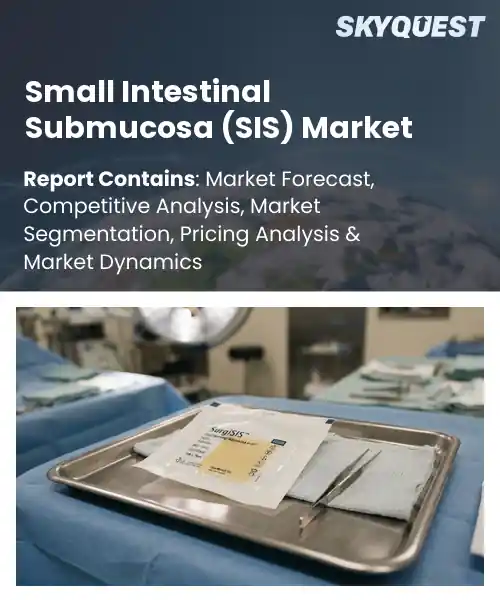
Small Intestinal Submucosa (SIS) Market
Report ID: SQMIG35B2498
Report ID: SQMIG35B2498
[email protected]
USA +1 351-333-4748
Report ID:
SQMIG35B2498 |
Region:
Global |
Published Date: August, 2026
Pages:
157
|Tables:
122
|Figures:
77


Global Small Intestinal Submucosa (Sis) Market size was valued at USD 748.0 Million in 2024 and is poised to grow from USD 813.08 Million in 2025 to USD 1584.78 Million by 2033, growing at a CAGR of 8.7% during the forecast period (2026-2033).
The global Small Intestinal Submucosa (SIS) market revolves around a biologically derived scaffold used in regenerative medicine, wound care, and veterinary applications. Its importance stems from SIS’s ability to promote cellular infiltration and vascularization while avoiding immunogenic reactions, making it a preferred alternative to synthetic polymers. Historically, the market emerged in the early 2000s when companies such as Cook Biotech introduced SIS‑ECM products for hernia repair, sparking clinical adoption across North America. Over the past decade, regulatory approvals and successful case studies in diabetic foot ulcer treatment have accelerated demand, positioning SIS as a cornerstone technology for tissue engineering solutions. Building on that clinical validation, the principal growth catalyst for the SIS market is the expanding demand for minimally invasive regenerative therapies across aging populations. As surgeons seek procedures that reduce hospital stays, SIS‑based patches for pelvic organ prolapse and rotator‑cuff repair deliver faster healing, which in turn drives hospital procurement budgets toward biologics. Concurrently, emerging veterinary segments in Europe and Asia adopt SIS for tendon reconstruction in racehorses, creating a parallel revenue stream that diversifies risk. These dynamics encourage investment in scalable manufacturing, prompting firms to launch GMP‑compliant facilities that lower unit costs and unlock price‑sensitive emerging markets globally.
How is AI-driven tissue engineering influencing the Small Intestinal Submucosa (SIS) market?
AI-driven tissue engineering is reshaping the Small Intestinal Submucosa market by automating scaffold design, accelerating biocompatibility testing, and enabling personalized grafts. Machine‑learning models predict optimal decellularization parameters, reducing trial‑and‑error cycles and shortening development timelines. Integrated imaging analytics guide precise placement of growth factors within SIS matrices, improving wound‑healing outcomes. These advances are attracting investment and expanding the clinical pipeline, positioning SIS as a versatile platform for regenerative therapies across surgery and chronic wound care. The technology also supports scalable manufacturing, helping firms meet rising demand while maintaining product consistency and regulatory compliance.In June 2026, a leading biotech announced an AI‑enhanced SIS hydrogel platform, demonstrating faster tissue integration and lower complication rates, which is driving broader adoption of SIS products and reinforcing market momentum.
Market snapshot - (2026-2033)
Global Market Size
USD 748.0 Million
Largest Segment
Meshes
Fastest Growth
Injectable Forms
Growth Rate
8.7% CAGR
To get more insights on this market click here to Request a Free Sample Report
Global small intestinal submucosa (sis) market is segmented by product type, source, application, end user and region. Based on product type, the market is segmented into Sheets, Meshes, Particulate & Powder and Injectable Forms. Based on source, the market is segmented into Porcine SIS, Bovine SIS and Other Animal Sources. Based on application, the market is segmented into Wound Care, Hernia Repair, Cardiovascular Repair, Orthopedic & Sports Medicine, Urology & Gynecology and Other Soft Tissue Repair. Based on end user, the market is segmented into Hospitals, Ambulatory Surgical Centers, Specialty Clinics and Research Institutes. Based on region, the market is segmented into North America, Europe, Asia Pacific, Latin America and Middle East & Africa.
Sheets segment dominates because clinicians favor planar formats that simplify handling, allow precise trimming, and provide consistent thickness for predictable integration with host tissue. This familiarity drives widespread adoption across a variety of procedures, reinforcing supplier confidence and encouraging focused research and development investments. The ease of storage and sterility maintenance further strengthens its market position, making it the preferred choice for routine surgical applications in modern operating rooms and outpatient settings as well.
However, Meshes segment experiences the fastest growth because its three dimensional architecture supports tissue ingrowth in complex defect repairs, attracting surgeons seeking minimally invasive solutions. Emerging bio engineered designs and expanding indications in hernia and orthopedic procedures stimulate demand, positioning meshes as a catalyst for future market expansion across the industry.
Porcine SIS segment dominates because its extracellular matrix closely mimics human tissue architecture, offering favorable biocompatibility and reduced immunogenic response. This biological similarity accelerates healing and makes it a trusted option for surgeons across multiple specialties. Established supply chains and extensive clinical evidence further reinforce confidence, encouraging continued procurement and fostering a robust ecosystem of manufacturers dedicated to porcine derived products in both acute and chronic repair scenarios worldwide and beyond.
Meanwhile, Bovine SIS segment is witnessing the strongest growth because recent advances in decellularization techniques have improved its structural integrity and safety profile. Rising interest from veterinary applications and expanding use in cardiovascular repairs create new demand channels, positioning bovine derived material as a high growth driver for the overall market.
To get detailed segments analysis, Request a Free Sample Report
North America benefits from a mature regulatory framework that supports rapid product approval and broad clinical adoption. Advanced research institutions and a robust network of biotech innovators accelerate development of SIS applications across wound care and reconstructive surgery. Strong reimbursement mechanisms encourage healthcare providers to integrate SIS technologies into standard practice. Collaborative partnerships between academic centers, device manufacturers, and specialty hospitals reinforce a cycle of innovation and market penetration. The region also enjoys a well‑established supply chain and extensive experience in biologic material handling, which together create a competitive advantage that sustains its leading market position.
United States Small Intestinal Submucosa (SIS) Market
Small Intestinal Submucosa (SIS) Market growth in the United States is propelled by extensive clinical research programs that continuously explore novel therapeutic uses. Established hospital systems integrate SIS solutions into multidisciplinary treatment pathways, reinforcing routine utilization. A dynamic venture capital environment fuels start‑up activity, encouraging rapid translation of laboratory breakthroughs to commercial products. Regulatory agencies provide clear guidance that expedites market entry while maintaining safety standards, fostering confidence among practitioners and patients alike.
Canada Small Intestinal Submucosa (SIS) Market
Small Intestinal Submucosa (SIS) Market development in Canada is supported by a collaborative healthcare model that emphasizes evidence‑based practice and cost‑effective solutions. Provincial health authorities prioritize technologies that demonstrate clinical benefit, encouraging adoption of SIS across surgical specialties. Research collaborations between universities and industry create a pipeline of innovative applications tailored to local clinical needs. The presence of skilled biomedical engineers and a strong focus on patient outcomes further strengthen the market’s credibility and expansion prospects.
European expansion is driven by a harmonized regulatory landscape that facilitates cross‑border product distribution and encourages multinational clinical trials. Deeply rooted academic research traditions generate a continuous flow of scientific insights, translating into diverse SIS‑based therapies. Health systems that emphasize value‑based procurement create demand for biologics that improve healing times and reduce overall care costs. Growing awareness of regenerative medicine among clinicians, coupled with supportive reimbursement policies, accelerates market acceptance. Strategic alliances between European biotech clusters and global manufacturers enhance technology transfer, reinforcing the region’s position as a hub for innovative SIS solutions.
Germany Small Intestinal Submucosa (SIS) Market
Small Intestinal Submucosa (SIS) Market in Germany benefits from a strong engineering heritage and a dense network of research hospitals that prioritize advanced wound management. Collaborative projects between medical universities and device firms drive continuous refinement of SIS products. Reimbursement frameworks that reward effective clinical outcomes support widespread adoption across surgical disciplines. The country’s commitment to high‑quality manufacturing standards further bolsters confidence among clinicians and patients alike.
United Kingdom Small Intestinal Submucosa (SIS) Market
Small Intestinal Submucosa (SIS) Market momentum in the United Kingdom is fueled by a proactive health policy environment that encourages innovative therapies. Leading academic medical centres spearhead clinical trials that broaden SIS indications, while national health services emphasize cost‑efficient solutions that improve patient recovery. Partnerships between research institutes and commercial entities accelerate technology transfer, positioning the United Kingdom as a front‑runner in SIS adoption across Europe.
France Small Intestinal Submucosa (SIS) Market
Small Intestinal Submucosa (SIS) Market emergence in France is characterized by increasing interest from specialty clinics seeking regenerative options for complex wounds. Government‑supported research initiatives promote collaboration between biotech startups and established pharmaceutical groups. Clinical guidelines that incorporate SIS evidence foster gradual integration into routine practice. The French medical community’s focus on personalized care aligns with the versatile nature of SIS, encouraging steady market growth.
Asia Pacific advances its SIS footprint through strategic investment in biologics research and a growing emphasis on minimally invasive procedures. Regional healthcare systems are adopting regenerative solutions to address rising demand for efficient postoperative recovery. Partnerships between multinational manufacturers and local research institutions accelerate technology adaptation to diverse clinical settings. Governmental incentives that support biomedical innovation stimulate domestic development of SIS platforms. The convergence of expanding surgical expertise and increasing patient awareness cultivates a fertile environment for SIS expansion across the region.
Japan Small Intestinal Submucosa (SIS) Market
Small Intestinal Submucosa (SIS) Market growth in Japan is propelled by a culture of precision medicine and a strong emphasis on surgical excellence. Leading university hospitals integrate SIS therapies into advanced reconstructive protocols, while collaborative networks with device firms streamline product customization for local needs. Regulatory pathways that balance safety with innovation encourage timely market entry, supporting broader clinical acceptance.
South Korea Small Intestinal Submucosa (SIS) Market
Small Intestinal Submucosa (SIS) Market development in South Korea is driven by a vibrant biotech ecosystem and rapid adoption of cutting‑edge surgical techniques. Government programs that prioritize regenerative healthcare foster research collaborations between hospitals and manufacturers. The focus on accelerating patient recovery aligns with SIS advantages, prompting increased utilization across dermatology and orthopaedic specialties.
To know more about the market opportunities by region and country, click here to
Buy The Complete Report
Growing Demand for Regenerative Therapies
Advances in Biomaterial Processing Techniques
High Production Cost Constraints
Regulatory Approval Challenges Persist
Request Free Customization of this report to help us to meet your business objectives.
The competitive landscape of the global Small Intestinal Submucosa (SIS) market is shaped by firms pursuing strategic M&A to broaden product portfolios, forming partnerships with surgical device manufacturers to integrate SIS scaffolds into advanced wound‑healing solutions, and investing in proprietary decellularization technologies that enhance biomechanical performance and reduce immunogenicity, thereby differentiating offerings in a rapidly consolidating sector.
Top Player’s Company Profile
Recent Developments
SkyQuest’s ABIRAW (Advanced Business Intelligence, Research & Analysis Wing) is our Business Information Services team that Collects, Collates, Correlates, and Analyses the Data collected by means of Primary Exploratory Research backed by robust Secondary Desk research. As per SkyQuest analysis, the global SIS market is propelled primarily by the growing demand for regenerative therapies that seek biologically compatible scaffolds to improve wound and organ repair, while advances in biomaterial processing techniques that enhance consistency and safety serve as a second catalyst accelerating clinical adoption. High production cost constraints remain the chief restraint, limiting uptake in price‑sensitive settings. North America continues to dominate due to its mature regulatory framework, strong reimbursement, and extensive research infrastructure. Within product types, the sheet format leads the market because its planar design simplifies handling and trimming, making it the preferred choice for surgeons across multiple applications.
| Report Metric | Details |
|---|---|
| Market size value in 2024 | USD 748.0 Million |
| Market size value in 2033 | USD 1584.78 Million |
| Growth Rate | 8.7% |
| Base year | 2024 |
| Forecast period | (2026-2033) |
| Forecast Unit (Value) | USD Million |
| Segments covered |
|
| Regions covered | North America (US, Canada), Europe (Germany, France, United Kingdom, Italy, Spain, Rest of Europe), Asia Pacific (China, India, Japan, Rest of Asia-Pacific), Latin America (Brazil, Rest of Latin America), Middle East & Africa (South Africa, GCC Countries, Rest of MEA) |
| Companies covered |
|
| Customization scope | Free report customization with purchase. Customization includes:-
|
To get a free trial access to our platform which is a one stop solution for all your data requirements for quicker decision making. This platform allows you to compare markets, competitors who are prominent in the market, and mega trends that are influencing the dynamics in the market. Also, get access to detailed SkyQuest exclusive matrix.
Table Of Content
Executive Summary
Market overview
Parent Market Analysis
Market overview
Market size
KEY MARKET INSIGHTS
COVID IMPACT
MARKET DYNAMICS & OUTLOOK
Market Size by Region
KEY COMPANY PROFILES
Methodology
For the Small Intestinal Submucosa (SIS) Market, our research methodology involved a mixture of primary and secondary data sources. Key steps involved in the research process are listed below:
1. Information Procurement: This stage involved the procurement of Market data or related information via primary and secondary sources. The various secondary sources used included various company websites, annual reports, trade databases, and paid databases such as Hoover's, Bloomberg Business, Factiva, and Avention. Our team did 45 primary interactions Globally which included several stakeholders such as manufacturers, customers, key opinion leaders, etc. Overall, information procurement was one of the most extensive stages in our research process.
2. Information Analysis: This step involved triangulation of data through bottom-up and top-down approaches to estimate and validate the total size and future estimate of the Small Intestinal Submucosa (SIS) Market.
3. Report Formulation: The final step entailed the placement of data points in appropriate Market spaces in an attempt to deduce viable conclusions.
4. Validation & Publishing: Validation is the most important step in the process. Validation & re-validation via an intricately designed process helped us finalize data points to be used for final calculations. The final Market estimates and forecasts were then aligned and sent to our panel of industry experts for validation of data. Once the validation was done the report was sent to our Quality Assurance team to ensure adherence to style guides, consistency & design.
Analyst Support
Customization Options
With the given market data, our dedicated team of analysts can offer you the following customization options are available for the Small Intestinal Submucosa (SIS) Market:
Product Analysis: Product matrix, which offers a detailed comparison of the product portfolio of companies.
Regional Analysis: Further analysis of the Small Intestinal Submucosa (SIS) Market for additional countries.
Competitive Analysis: Detailed analysis and profiling of additional Market players & comparative analysis of competitive products.
Go to Market Strategy: Find the high-growth channels to invest your marketing efforts and increase your customer base.
Innovation Mapping: Identify racial solutions and innovation, connected to deep ecosystems of innovators, start-ups, academics, and strategic partners.
Category Intelligence: Customized intelligence that is relevant to their supply Markets will enable them to make smarter sourcing decisions and improve their category management.
Public Company Transcript Analysis: To improve the investment performance by generating new alpha and making better-informed decisions.
Social Media Listening: To analyze the conversations and trends happening not just around your brand, but around your industry as a whole, and use those insights to make better Marketing decisions.
REQUEST FOR SAMPLE
 REQUEST FREE CUSTOMIZATION


Want to customize this report? This report can be personalized according to your needs. Our analysts and industry experts will work directly with you to understand your requirements and provide you with customized data in a short amount of time. We offer $1000 worth of FREE customization at the time of purchase.
Feedback From Our Clients


 USA (+1) 351-333-4748

