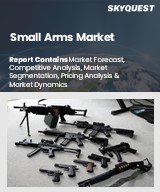
Small Arms Market
Report ID: SQMIG20A2457
Report ID: SQMIG20A2457
[email protected]
USA +1 351-333-4748
Report ID:
SQMIG20A2457 |
Region:
Global |
Published Date: January, 2026
Pages:
173
|Tables:
119
|Figures:
70


Global Small Arms Market size was valued at USD 9.37 Billion in 2024 and is poised to grow from USD 9.69 Billion in 2025 to USD 12.61 Billion by 2033, growing at a CAGR of 3.35% during the forecast period (2026–2033).
Closer to defense expenditures, the cyclical replacements of old assault rifles, and strong civilian demand for handguns for personal protection are the three biggest drivers of the global small arms market growth. Military organizations, nowadays, opt for 6.8 mm next-generation weapons designed to penetrate modern body armor. This is evident from the US Army setting aside USD 367.292 million for the NGSW program. Many more civilians visiting target shooting ranges, 34.4 million in the US alone, in 2024, boosted the sales of the modern sporting rifle.
Apart from more than 15% membership increases in national shooting federations in the US, Germany, and France, thanks to media coverage of precision-rifle competitions and action-pistol leagues. Many European armed forces' pistol tenders now require competition-grade accuracy, which combines sporting and tactical needs to raise the bar for service weapons. In response, manufacturers build adjustable gas blocks, flat-faced triggers, and modular chassis that can work on both competition and duty platforms. The International Precision Rifle Federation championships create a demand for barrels, optics, and ballistic computers, which generate extra revenue. Hunting license data from Scandinavia and Canada indicate that more young people are getting involved, which implies that they need equipment that must be replaced every few years. All these trends interact to create a virtuous cycle of innovation and sales in the small arms industry.
How does the NGSW Enhance Soldier Lethality and Accuracy?
One of the most significant recent advancements in small arms is the U.S. Army's introduction of the 6.8mm Next Generation Squad Weapon (NGSW) system. In March 2024, the 101st Airborne Division was the first unit to receive the XM7 rifle, XM250 automatic rifle, and XM157 fire-control system, which also replaced the Army's legacy M4/M4A1 and M249 systems. The new 6.8×51mm "Common" cartridge increases lethality, extends effective range, and increases barrier penetration capability for these weapons. Also, this system has been approved through extensive testing, even in Arctic extremes, to ensure its reliability in extreme environments.
Market snapshot - 2026-2033
Global Market Size
USD 9.07 Billion
Largest Segment
Semi-Automatic
Fastest Growth
Fully Automatic
Growth Rate
3.35% CAGR
To get more insights on this market click here to Request a Free Sample Report
The global small arms market is segmented into type, caliber, operation, end user, and region. By type, the market is classified into pistol, revolver, rifle, machine gun, and shotgun. Depending on caliber, it is divided into 5.56 mm, 6.8 mm, 7.62 mm, 4.9 mm, and 12.7 mm. According to operation, the market is trifurcated into manual, semi-automatic, and fully automatic. As per end user, it is bifurcated into civil & law enforcement and military. Regionally, it is analyzed across North America, Europe, Asia-Pacific, Latin America, and the Middle East and Africa.
As per the 2024 small arms market analysis, the percentage of rifles for sale is 32.56%, and the segment is anticipated to increase. This is linked to M4-family weapons ceded for platforms of 6.8 mm. The XM7 adoption is currently budgeted for the smallest arms by the Pentagon for the rifle's allocation in this spending cycle. The United Kingdom selected the Knight's Armament KS-1 weapons system, which utilizes a short-stroke piston operation to better support maritime environments. Sweden's emergency order of M4s demonstrates that operational urgency outweighs discussions about point of manufacture for the parts. Barrett has developed the MRAD modular sniper systems that support the demand for precision in multiple calibers that allows for increased opportunity for export.
Whereas the machine gun category is anticipated to have the highest small arms market share. The approach to .338 Norma Lightweight Medium Machine Gun (LMMG) prototype indicates the small arms market is pivoting to longer range without added weight of older 7.62 mm platforms. Police officers still have the best sidearms with pistols and revolvers. Smith & Wesson feature polymer-framed designs to reduce ounces while adding accessory rails. Shotguns still benefit as breaching and riot control weapons. Modular weapon architectures allow for common lowers to accept rifle uppers, carbine uppers, and personal-defense uppers which represent overall savings over time.
As per the 2024 small arms market forecast, the semi-automatic segment accounted for 37.80% of the revenue, which shows that demand has been high from civilian markets, law enforcement, and police agencies. Such systems are most popular because they feature accuracy, ease in handling, and compliance. They are perfectly suited for personal defense, sports, and tactical operation. The segment gets buoyed by the growing number of people interested in taking training classes for shooting for fun, also due to police forces around the world consuming the products, retaining the market share in the small arms sector.
Currently, most of the revenue has been generated by semi-automatic weapons, and the fully automatic systems are predicted to grow the segment at a CAGR of 5.81% in the next few coming years. This shift is due to the gain in firepower and operational flexibility ensured by military modernization programs, defense procurements, as well as paramilitary upgrades. Speed to deployment and high-intensity operational capabilities for high-value assets are made even faster within improvements in modularity, control mechanisms, and integration with smart targeting systems.
To get detailed segments analysis, Request a Free Sample Report
As per the small arms market regional analysis, North America is the greatest market, due to more government spending on defense, modernizing police systems, as well as the increasing number of people owning firearms privately. Defense modernization initiatives such as the 6.8mm NGSW system are the ones pressing United States into growth, whereas many private owners remain. Canada is much smaller than this market, but it does have increasing sales due to police usage and ownership of firearms. These factors will also affect the regional market; for example, increased tactical training, compliance, and advanced gun technologies.
Continuing to provide the most significant domestic small arms sector in any single country, the United States has achieved this through civilian participation in recreational shooting, law enforcement, and defense upgrades. Programs like the XM7 and XM250 rifles increased military spending in 2024. Advanced modular systems, semi-automatic firearms, and smart guns are also gaining popularity. The balance of the public still has considerable market scope in hunting, sports, and personal protection, thus making the United States a great hub for both technology innovation and manufacture.
The primary drivers for the small arms market in Canada are border security, law enforcement, and recreational firearms. Police tactical units were introduced to the use of semi-automatic rifles, while modular, lightweight weaponry gained some popularity. Defense suppliers work with domestic companies to meet regulatory requirements. Operational readiness is further assisted by training and simulation programs. However, the Canadian market is slow but surely growing; it focuses on high-precision, legal, and safe weapons.
The small arms industry in Asia-Pacific is on the increased march due to rising military budgets, advancements in the armed forces, and increasing regional security concerns. For instance, both China and India invest massively in light machine guns, rifles, and handguns for domestic production and usage. Although relatively small, civilian marketplaces are, however, growing in areas under regulation. New technologies such as modular systems and smart firearms will boost usage.
Case in point, small arms market sales in India have been rising rapidly on modernization and other defense initiative schemes like "Make in India." Increased local production of rifles and submachine guns was reported, which also included the armed forces, paramilitary, and police forces. Local businesses are producing more goods due to strategic alliances with international OEMs. Advanced semi-automatic and fully automatic equipment, including domestically produced assault rifles, are now making operations more efficient and compliant with national military policies.
China keeps a strong small arms market by producing and acquiring massive amounts of them for its military. This includes coherent trends like improving infantry weaponry, developing new assault rifle versions, and employing both semi-automatic and fully automatic systems. Guns might have several regulations in ownership, and licensed hunting, as well as shooting activities, provide some relief. This strategic thrust on defense self-sufficiency action in China is also fuel for innovations in small armaments that promise to be super strong, lightweight, and modular.
The modernization of military facilities and police enforcement systems, along with the delight of civilians spending time participating in sports, are the main drivers of the small arms market in Europe. NATO member states are rearing their troops with fully automatic, semi-automatic, and modular systems. The market is marked by stringent regulations, safety issues, and advanced engineering. Emerging technologies are gradually becoming established in terms of smart weapons and lighter-weight designs. Moderate growth is maintained through procurements and regional tensions.
Products chiefly traded in the UK small arms market comprising guns for sporting purposes, defense, and law enforcement. While military forces are still upgrading standard-issue rifles and light machine guns, with tactical police units favouring semi-automatic weapons. Access for civilians is severely curtailed to encourage target shooting and hunting. The period from 2024 to 2025 will witness procurement focus on modular, highly accurate, and compliant technologies to boost operational effectiveness while remaining within regulations.
In France, the small arms market is affected by police purchases and military upgrading. Modular and semi-automatic rifles and other specialized firearms have been used by counterterrorism units in recent years. Strictly regulated, are civilian markets with the main emphasis on hunting and sport shooting. With the advancement of optics, fire control systems, and lightweight designs, military and law enforcement applications will become more effective and convenient.
The well-regulated small arms market in Germany is centered on law enforcement, defense, and recreational shooting. While police departments purchase tactical and accurate firearms, the military purchases new rifles, modular systems, and semi-automatic platforms. Civilian shooting sports, which continue to have significance under stringent licensing, will also be considered. Trends for are towards modular weaponry, lightweight materials, and integration of smart firearms. These trends reinforce Germany's status as a technologically mature and compliant European market.
To know more about the market opportunities by region and country, click here to
Buy The Complete Report
Care for the Military for an Upgrade
Police and Civilian Needs
Laws and Regulations that Restrict
Manufacturing and R&D Costs are Exorbitant
Request Free Customization of this report to help us to meet your business objectives.
Major companies including Colt, FN Herstal, Heckler & Koch, Smith & Wesson, Glock, and Beretta dominate the highly competitive global small arms market. Collaboration with foreign countries, lighter concepts, applications of smart gun technologies, and modular weapon design are some of the key small arms market strategies being employed. While startups like TrackingPoint, Smart Shooter, and Desert Tech are disrupting the market with technologies differentiating engagement precision, artificial intelligence-based fire-control systems, and modular sniper rifles, larger companies continue focusing on providing military, law enforcement, and civilian options.
SkyQuest’s ABIRAW (Advanced Business Intelligence, Research & Analysis Wing) is our Business Information Services team that Collects, Collates, Correlates, and Analyses the Data collected by means of Primary Exploratory Research backed by robust Secondary Desk research.
As per SkyQuest analysis, ace the military modernizes, law enforcement advances, and interest in semi-automatic and modular rifles increases; the global small arms market is gradually growing. New technologies involving smart fire-control systems, advancements in ammunition, and lighter materials are affecting the landscape. The industry finds itself battling High-production costs and regulations restricting what can and can't be done. Smart ideas and smart partnerships have created opportunities. In short, the market is moving to sustainability, modularity, and precision. This contributes to the resilience of law enforcement, military, and civilian organizations across the globe.
| Report Metric | Details |
|---|---|
| Market size value in 2024 | USD 9.37 Billion |
| Market size value in 2033 | USD 12.61 Billion |
| Growth Rate | 3.35% |
| Base year | 2024 |
| Forecast period | 2026-2033 |
| Forecast Unit (Value) | USD Billion |
| Segments covered |
|
| Regions covered | North America (US, Canada), Europe (Germany, France, United Kingdom, Italy, Spain, Rest of Europe), Asia Pacific (China, India, Japan, Rest of Asia-Pacific), Latin America (Brazil, Rest of Latin America), Middle East & Africa (South Africa, GCC Countries, Rest of MEA) |
| Companies covered |
|
| Customization scope | Free report customization with purchase. Customization includes:-
|
To get a free trial access to our platform which is a one stop solution for all your data requirements for quicker decision making. This platform allows you to compare markets, competitors who are prominent in the market, and mega trends that are influencing the dynamics in the market. Also, get access to detailed SkyQuest exclusive matrix.
Table Of Content
Executive Summary
Market overview
Parent Market Analysis
Market overview
Market size
KEY MARKET INSIGHTS
COVID IMPACT
MARKET DYNAMICS & OUTLOOK
Market Size by Region
KEY COMPANY PROFILES
Methodology
For the Small Arms Market, our research methodology involved a mixture of primary and secondary data sources. Key steps involved in the research process are listed below:
1. Information Procurement: This stage involved the procurement of Market data or related information via primary and secondary sources. The various secondary sources used included various company websites, annual reports, trade databases, and paid databases such as Hoover's, Bloomberg Business, Factiva, and Avention. Our team did 45 primary interactions Globally which included several stakeholders such as manufacturers, customers, key opinion leaders, etc. Overall, information procurement was one of the most extensive stages in our research process.
2. Information Analysis: This step involved triangulation of data through bottom-up and top-down approaches to estimate and validate the total size and future estimate of the Small Arms Market.
3. Report Formulation: The final step entailed the placement of data points in appropriate Market spaces in an attempt to deduce viable conclusions.
4. Validation & Publishing: Validation is the most important step in the process. Validation & re-validation via an intricately designed process helped us finalize data points to be used for final calculations. The final Market estimates and forecasts were then aligned and sent to our panel of industry experts for validation of data. Once the validation was done the report was sent to our Quality Assurance team to ensure adherence to style guides, consistency & design.
Analyst Support
Customization Options
With the given market data, our dedicated team of analysts can offer you the following customization options are available for the Small Arms Market:
Product Analysis: Product matrix, which offers a detailed comparison of the product portfolio of companies.
Regional Analysis: Further analysis of the Small Arms Market for additional countries.
Competitive Analysis: Detailed analysis and profiling of additional Market players & comparative analysis of competitive products.
Go to Market Strategy: Find the high-growth channels to invest your marketing efforts and increase your customer base.
Innovation Mapping: Identify racial solutions and innovation, connected to deep ecosystems of innovators, start-ups, academics, and strategic partners.
Category Intelligence: Customized intelligence that is relevant to their supply Markets will enable them to make smarter sourcing decisions and improve their category management.
Public Company Transcript Analysis: To improve the investment performance by generating new alpha and making better-informed decisions.
Social Media Listening: To analyze the conversations and trends happening not just around your brand, but around your industry as a whole, and use those insights to make better Marketing decisions.
REQUEST FOR SAMPLE
 REQUEST FREE CUSTOMIZATION


Want to customize this report? This report can be personalized according to your needs. Our analysts and industry experts will work directly with you to understand your requirements and provide you with customized data in a short amount of time. We offer $1000 worth of FREE customization at the time of purchase.
Feedback From Our Clients


 USA (+1) 351-333-4748

