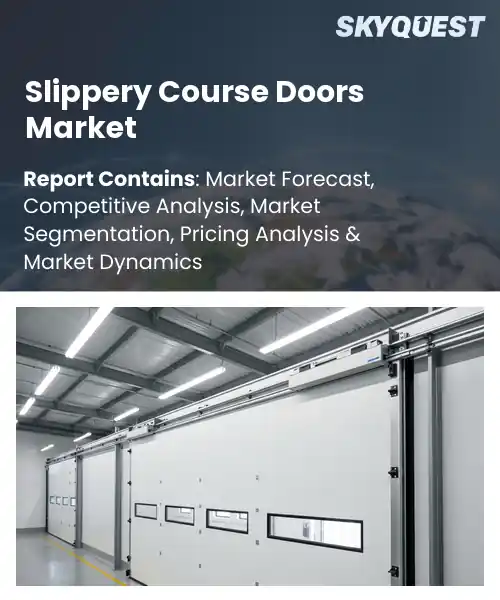
Slippery Course Doors Market
Report ID: SQMIG20B2124
Report ID: SQMIG20B2124
[email protected]
USA +1 351-333-4748
Report ID:
SQMIG20B2124 |
Region:
Global |
Published Date: February, 2026
Pages:
157
|Tables:
144
|Figures:
78


Global Slippery Course Doors Market size was valued at USD 2.54 Billion in 2024 and is poised to grow from USD 2.72 Billion in 2025 to USD 4.71 Billion by 2033, growing at a CAGR of 7.1% during the forecast period (2026-2033).
The primary driver of the slippery course doors market is rising demand for safety and traffic management in recreational obstacle courses and training facilities, which has reshaped product design. Slippery course doors are gates and panels used on wet or low-friction obstacles to control participant speed and access, and the market matters because parks and event operators need reliable devices that reduce injuries while preserving throughput. Over recent years the market moved from improvised wooden panels toward modular, corrosion-resistant systems with integrated sensors and actuation; for instance mud runs upgraded hinged boards to stainless steel pneumatic doors in adventure arenas.Building on those product advances, regulatory emphasis on participant safety has driven widespread adoption because stricter standards make inexpensive improvised barriers untenable and incentivize certified tested doors. Technological integration further accelerated growth since sensor-enabled closures and remote actuation allow operators to monitor flow, collect usage data, and respond to incidents, lowering insurance costs and enabling higher throughput. As a result suppliers find opportunities in retrofit programs for aging parks, installations for corporate team-building venues, and modular kits for pop-up races; real-world cases include adventure parks deploying analytics-driven door arrays to optimize course pacing and military trainers simulating controlled-entry scenarios.
How is IoT improving safety and monitoring in the slippery course doors market?
IoT is enhancing safety and monitoring in the slippery course doors market by combining embedded sensors with persistent connectivity. Key aspects include moisture and slip sensors, obstruction detection, and adaptive motor control that slow or halt doors when conditions become risky. Remote telemetry and cloud dashboards let operators see door health and environmental trends and trigger alerts for fast intervention. The market is shifting toward suppliers that offer integrated hardware software and service packages so facility teams can manage safety across multiple sites. Examples include intelligent sliding door controllers that adjust to foot traffic and cloud platforms that centralize alarms and maintenance workflows for quicker, coordinated responses.dormakaba February 2026, the acquisition of Avant-Garde Systems Inc broadened dormakaba’s North American service and integration footprint and speeds deployment of IoT enabled entrance controls that improve monitoring response and operational efficiency.
Market snapshot - (2026-2033)
Global Market Size
USD 2.54 Billion
Largest Segment
Manual Doors
Fastest Growth
Automatic Doors
Growth Rate
7.1% CAGR
To get more insights on this market click here to Request a Free Sample Report
Global slippery course doors market is segmented by product type, materials used, application area, end user, distribution channel and region. Based on product type, the market is segmented into Automatic Doors, Manual Doors, Sliding Doors and Others. Based on materials used, the market is segmented into Wooden Doors, Metal Doors, Glass Doors and Composite Doors. Based on application area, the market is segmented into Indoor Use and Outdoor Use. Based on end user, the market is segmented into Residential, Commercial and Industrial. Based on distribution channel, the market is segmented into Online and Offline. Based on region, the market is segmented into North America, Europe, Asia Pacific, Latin America and Middle East & Africa.
Sliding Doors segment dominates because their low profile operation and wide clearances reduce contact points and falling hazards on slippery courses, enabling safer, continuous movement. Their compatibility with reinforced tracks and anti slip materials lowers maintenance interruptions and supports modular designs for varied course layouts. Demand is driven by instructors and facility operators favoring predictable door dynamics that minimize unexpected resistance and facilitate rapid emergency access. Manufacturers prioritize robustness and easy servicing.
However, Automatic Doors are the most rapidly expanding area due to sensor integration, touchless operation, and retrofit flexibility, meeting hygiene and accessibility priorities. Innovations in control logic and power efficiency are broadening deployments and creating opportunities for service contracts and technology partnerships and enabling new customization options for course designers.
Metal Doors segment leads because its structural rigidity and resistance to impact make it ideal for high use slippery course environments where repeated contact and moisture exposure accelerate wear. Fabricators can apply corrosion resistant treatments and low friction coatings to improve longevity and predictable operation, supporting heavy duty hinges and sealing systems. Adoption is propelled by facility managers prioritizing lifecycle cost, safety compliance, and straightforward integration with mechanical door hardware. Supply chains favor standardized metal components.
Meanwhile, Composite Doors are emerging as the key high growth area because engineered laminates offer light weight and tunable surface textures that enhance grip and resist moisture. Material innovations enable rapid customization and straightforward retrofits, attracting operators seeking performance upgrades without structural overhaul and creating opportunities for premium products and service offerings.
To get detailed segments analysis, Request a Free Sample Report
Asia Pacific leads due to a concentration of advanced manufacturing capabilities, extensive supplier networks and deep technical expertise concentrated in key markets such as Japan and South Korea. Regional strengths include strong integration between component makers and original equipment manufacturers, favourable industrial infrastructure and a focus on materials innovation and precision engineering that elevate product quality and reliability. Close collaboration between research institutions and industry fosters rapid iteration of new designs and smart functionalities. A dense aftermarket and service ecosystem supports deployment and maintenance, while robust export orientation and trade linkages enable companies to scale across neighboring markets. This combination encourages ongoing investment and product differentiation across segments.
Slippery Course Doors Market Japan market benefits from a sophisticated manufacturing ecosystem focused on high quality production, advanced materials research and close collaboration with original equipment manufacturers. Strong supply chain integration and emphasis on precision engineering support development of premium door systems for industrial and commercial applications. Local service networks and export orientation reinforce leadership in design innovation, reliability and long term partnerships with domestic and regional integrators and customers.
Slippery Course Doors Market South Korea market is characterized by strong integration of automation technologies and a dynamic supplier base that accelerates product development and customization. Emphasis on compact, high performance designs and collaboration between component makers and systems integrators drives tailored solutions for demanding environments. Robust production capabilities, agile logistics and focus on innovation underpin competitive positioning, while export channels and service ecosystems support market engagement across clients globally.
Expansion in North America is propelled by a combination of infrastructural renewal, heightened emphasis on operational safety and facility efficiency, and active adoption of integrated access solutions across industrial and commercial sites. Robust distribution channels and experienced installation partners enable quicker deployment and aftermarket support, while demand for customization and retrofit options stimulates supplier innovation. Close ties with large industrial end users and facility managers favour solutions that integrate with building management and automation platforms. Market participants benefit from a mature procurement environment and strong service ecosystems that prioritize reliability and lifecycle support. Collaboration between manufacturers and local integrators, coupled with focus on compliance and performance verification, positions the region as an attractive arena for technology driven product enhancements and expanded commercial engagement.
Slippery Course Doors Market United States market benefits from a diverse end user base, strong industrial refurbishment activity and a mature network of distributors and installers. Emphasis on compliance, safety and integration with facility automation drives demand for sophisticated door systems. Close collaboration with commercial integrators supports customization and deployment. Established aftermarket service providers and access to technology partners help manufacturers deliver scalable, high performance solutions aligned with operator expectations.
Slippery Course Doors Market Canada market is shaped by diverse climatic conditions and sectoral demand from industrial operators seeking durable, high reliability door solutions. Preference for robust materials and serviceable designs favors suppliers offering tailored configurations and strong aftersales support. Regional logistics and proximity to manufacturing hubs enable efficient distribution and maintenance. Close engagement with facility owners and integrators promotes specification driven purchases and aftermarket activity across key infrastructure segments.
Europe is strengthening its position through a combination of rigorous technical standards, emphasis on energy efficiency and durability, and a well developed network of manufacturers and integration partners. Key markets focus on engineering excellence, modular design and compatibility with building management and safety systems, enabling suppliers to deliver highly specified solutions for varied infrastructure types. Retrofit demand in legacy buildings encourages tailored offerings and long term service contracts, while collaboration among research centres and industry accelerates material and product innovation. Strong aftermarket and maintenance ecosystems support lifecycle value propositions, and pan regional trade links allow companies to scale expertise across borders, reinforcing the region as a center for high quality, specification driven slippery course door solutions. This combination enhances competitiveness and supports premium market positioning.
Slippery Course Doors Market Germany market combines engineering heritage, strict quality standards and a dense network of precision suppliers. Demand for engineered, durable and specification driven door systems is supported by cooperation between manufacturers and industrial integrators. Focus on modularity and compatibility with automation promotes advanced, long lasting solutions. Strong service networks and export orientation position Germany market as a hub for premium door technologies and international client engagement broadly.
Slippery Course Doors Market United Kingdom market is shaped by strong regulatory focus on safety and building compliance, alongside demand for design sensitive solutions in urban developments. Suppliers are adapting through modular, retrofit friendly products and close collaboration with architects and integrators. Emphasis on lifecycle service and reliable maintenance underpins buyer preferences. Active networks of installers and specifiers help translate technical requirements into practical door system deployments across infrastructure projects.
Slippery Course Doors Market France market combines strong industrial demand with attention to design integration for public and commercial spaces. Local manufacturers emphasize tailored solutions that balance durability and aesthetics, meeting stringent safety and performance expectations. Coordination with transit and infrastructure operators fosters specification driven projects, while retrofit activity supports a steady service market. Established distribution channels and technical partners enable consistent installation practices and ongoing maintenance across urban applications.
To know more about the market opportunities by region and country, click here to
Buy The Complete Report
Rising Urban Entertainment Investments
Advancements In Safety Materials
High Installation And Maintenance Costs
Regulatory And Safety Compliance Challenges
Request Free Customization of this report to help us to meet your business objectives.
Competitive landscape in the global slippery course doors market is shaped by incumbents integrating embedded smart hardware and material innovators competing on low-friction finishes; market drivers include product differentiation through technology and OEM partnerships. Recent strategies are concrete: Doma’s partnership with Kolbe to embed motorized openers and identity sensors, and market reports note consolidation via supply-chain alliances and tech-led collaborations.
Top Player’s Company Profile
Recent Developments
SkyQuest’s ABIRAW (Advanced Business Intelligence, Research & Analysis Wing) is our Business Information Services team that Collects, Collates, Correlates, and Analyses the Data collected by means of Primary Exploratory Research backed by robust Secondary Desk research. As per SkyQuest analysis, a key driver for the global slippery course doors market is rising demand for safety and traffic management in recreational and training facilities, and a second driver is technological integration such as IoT enabled sensors and remote monitoring that improve safety and operational efficiency. Sliding doors are the dominating segment due to low profile operation and predictable dynamics, while Asia Pacific is the dominating region supported by advanced manufacturing and dense supplier networks. A significant restraint is high installation and maintenance costs which can slow upgrades and deter smaller operators from large scale deployment despite growing retrofit and smart access opportunities.
| Report Metric | Details |
|---|---|
| Market size value in 2024 | USD 2.54 Billion |
| Market size value in 2033 | USD 4.71 Billion |
| Growth Rate | 7.1% |
| Base year | 2024 |
| Forecast period | (2026-2033) |
| Forecast Unit (Value) | USD Billion |
| Segments covered |
|
| Regions covered | North America (US, Canada), Europe (Germany, France, United Kingdom, Italy, Spain, Rest of Europe), Asia Pacific (China, India, Japan, Rest of Asia-Pacific), Latin America (Brazil, Rest of Latin America), Middle East & Africa (South Africa, GCC Countries, Rest of MEA) |
| Companies covered |
|
| Customization scope | Free report customization with purchase. Customization includes:-
|
To get a free trial access to our platform which is a one stop solution for all your data requirements for quicker decision making. This platform allows you to compare markets, competitors who are prominent in the market, and mega trends that are influencing the dynamics in the market. Also, get access to detailed SkyQuest exclusive matrix.
Table Of Content
Executive Summary
Market overview
Parent Market Analysis
Market overview
Market size
KEY MARKET INSIGHTS
COVID IMPACT
MARKET DYNAMICS & OUTLOOK
Market Size by Region
KEY COMPANY PROFILES
Methodology
For the Slippery Course Doors Market, our research methodology involved a mixture of primary and secondary data sources. Key steps involved in the research process are listed below:
1. Information Procurement: This stage involved the procurement of Market data or related information via primary and secondary sources. The various secondary sources used included various company websites, annual reports, trade databases, and paid databases such as Hoover's, Bloomberg Business, Factiva, and Avention. Our team did 45 primary interactions Globally which included several stakeholders such as manufacturers, customers, key opinion leaders, etc. Overall, information procurement was one of the most extensive stages in our research process.
2. Information Analysis: This step involved triangulation of data through bottom-up and top-down approaches to estimate and validate the total size and future estimate of the Slippery Course Doors Market.
3. Report Formulation: The final step entailed the placement of data points in appropriate Market spaces in an attempt to deduce viable conclusions.
4. Validation & Publishing: Validation is the most important step in the process. Validation & re-validation via an intricately designed process helped us finalize data points to be used for final calculations. The final Market estimates and forecasts were then aligned and sent to our panel of industry experts for validation of data. Once the validation was done the report was sent to our Quality Assurance team to ensure adherence to style guides, consistency & design.
Analyst Support
Customization Options
With the given market data, our dedicated team of analysts can offer you the following customization options are available for the Slippery Course Doors Market:
Product Analysis: Product matrix, which offers a detailed comparison of the product portfolio of companies.
Regional Analysis: Further analysis of the Slippery Course Doors Market for additional countries.
Competitive Analysis: Detailed analysis and profiling of additional Market players & comparative analysis of competitive products.
Go to Market Strategy: Find the high-growth channels to invest your marketing efforts and increase your customer base.
Innovation Mapping: Identify racial solutions and innovation, connected to deep ecosystems of innovators, start-ups, academics, and strategic partners.
Category Intelligence: Customized intelligence that is relevant to their supply Markets will enable them to make smarter sourcing decisions and improve their category management.
Public Company Transcript Analysis: To improve the investment performance by generating new alpha and making better-informed decisions.
Social Media Listening: To analyze the conversations and trends happening not just around your brand, but around your industry as a whole, and use those insights to make better Marketing decisions.
REQUEST FOR SAMPLE
 REQUEST FREE CUSTOMIZATION


Want to customize this report? This report can be personalized according to your needs. Our analysts and industry experts will work directly with you to understand your requirements and provide you with customized data in a short amount of time. We offer $1000 worth of FREE customization at the time of purchase.
Feedback From Our Clients


 USA (+1) 351-333-4748

