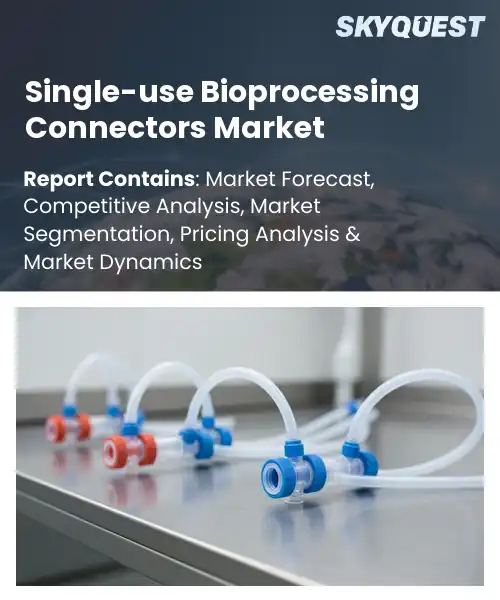
Single-use Bioprocessing Connectors Market
Report ID: SQMIG35J2219
Report ID: SQMIG35J2219
[email protected]
USA +1 351-333-4748
Report ID:
SQMIG35J2219 |
Region:
Global |
Published Date: February, 2026
Pages:
157
|Tables:
89
|Figures:
76


Global Single-Use Bioprocessing Connectors Market size was valued at USD 1.23 Billion in 2024 and is poised to grow from USD 1.42 Billion in 2025 to USD 4.53 Billion by 2033, growing at a CAGR of 15.6% during the forecast period (2026-2033).
The primary driver of the single use bioprocessing connectors market is the adoption of disposable fluid pathway systems that reduce contamination risk and accelerate changeover. This market supplies sterile connectors, tubing fittings and aseptic couplers used across upstream and downstream workflows and matters because biologics demand flexibility, lower capex and robust sterility control. The sector evolved from stainless steel infrastructure toward modular disposables, with companies shifting to closed systems to manage complex molecules.
For example, rapid scale up of monoclonal antibody processes and the rise of contract manufacturing have compelled manufacturers to integrate single use connectors in plant design. A key factor driving global growth is the surge in complex biologics and outsourced manufacturing that creates demand for connectors ensuring sterility and enabling rapid line changes. When cell and gene therapy developers move small batches between closed units they adopt aseptic quick connect solutions, and consequentlycontract manufacturers invest in modular disposable assemblies to accommodate clients. This cause produces opportunities for connector makers to offer validated components and integrated sensor enabled couplings that reduce cleaning validation burdens and accelerate regulatory submission, for example enabling faster lot release in monoclonal antibody campaigns and agile pandemic response.
How is Automation Enhancing Efficiency in the Single-use Bioprocessing Connectors Market?Automation is improving efficiency in the single use bioprocessing connectors market by replacing repetitive manual connections with consistent automated operations. Automated sterile welders and closed coupling systems standardize aseptic transfers and reduce reliance on specialized operators. Integration with factory control software and digital record keeping speeds validation and simplifies troubleshooting. These advances not only reduce downtime while allowing quicker campaign changeovers but also reduce the overall risk of contamination in multiproduct facilities. A suitable example would be automated welding devices and revalidated aseptic connectors that fit directly into single use assemblies, thereby, making processes more repeatable and easier to scale.
Market snapshot - (2026-2033)
Global Market Size
USD 1.23 Billion
Largest Segment
Aseptic Connectors
Fastest Growth
Aseptic Connectors
Growth Rate
15.6% CAGR
To get more insights on this market click here to Request a Free Sample Report
Global single-use bioprocessing connectors market is segmented into product type, application, end user and region. Based on product type, the market is segmented into aseptic connectors and conventional connectors. Based on application, the market is segmented into upstream bioprocessing, downstream bioprocessing, and fill-finish operations. Based on end user, the market is segmented into biopharmaceutical & pharmaceutical companies, CROs & CMOs and academic & research institutes. Based on region, the market is segmented into North America, Europe, Asia Pacific, Latin America and Middle East & Africa.
Aseptic connectors segment dominates with large single-use bioprocessing connectors market share because they deliver validated sterile interfaces that directly reduce contamination risks inherent in disposable workflows, enabling closed transfers and simplifying regulatory acceptance. Aseptic connectors are also designed to work with disposable assemblies and have a low particle generation rate; therefore, manufacturers will spend more on materials, ergonomics, and other aspects that increase the reliability of processes associated with aseptic connectors resulting in ease of changeovers, greater simplification, and increased use of single-use manufacturing architectures.
As per single-use bioprocessing connectors market analysis, conventional connectors have the fastest growth rate in the market due to their low costs, ruggedness and ability to be used routinely or in lower-risk operations; simple designs make them easy to retrofit to existing systems. As each incremental enhancement to the cleanliness or compatibility of these connectors is developed, an increasing number of companies have already or will begin using them in their development and manufacturing processes.
As per single-use bioprocessing connectors market forecast, the upstream bioprocessing segment is seeing high demand for connectors related to large volume bioreactor interfacing, sterile media feeding, and frequent bag changes, which makes connector performance critical to the uptime of the overall process. The trend towards disposable upstream systems has raised many priorities such as low particle shedding, reliable sealing during agitation, and quick sterile assembly, leading to designs that enhance operational flexibility and minimize contamination-induced disruptions in both development and production.
As per single-use bioprocessing connectors market outlook, fill-finish operations are becoming the fastest growing segment in the market due to the increasing number of single-dose therapies. As a result, there is a demand for aseptic disposable filling solutions. Thus, the demand for validated, low-shedding, and quick-connecting connectors compatible with automated filling lines and closed transfer processes is causing increased innovation through the ability of contract manufacturers and drug sponsors to deploy rapidly compliant launch-ready fill platforms and expand their market opportunities.
To get detailed segments analysis, Request a Free Sample Report
As per single-use bioprocessing connectors market regional forecast, biopharmaceutical manufacturing activity is concentrated in North America, making it the dominant region in the market. This dominance can be attributed to the high adoption of single-use technologies, the presence of numerous contract development and manufacturing organizations (CDMOs), and a regulatory and standards landscape supportive of flexible disposable solutions. Additionally, product innovation and speed-to-market are driven by well-established supply chains, substantial capital investment in process intensification and analytical capabilities, and extensive collaboration between connector manufacturers and end users.
The United States is home to an established single-use bioprocessing connectors market that is bolstered by the deep integration of single-use systems into clinical and commercial manufacturing, a large supplier and service ecosystem, and stringent quality and documentation requirements. End users are primarily concerned with ensuring aseptic integrity, compatibility of connectors between systems, and supplier support for qualification activities.
The Canada single-use bioprocessing connectors market benefits from a growing network of research institutions and manufacturing facilities, a strong emphasis on contamination control, and collaborative relationships between local suppliers and multinational firms. Buyers are seeking reliable connector designs and simplified support for qualification activities, as well as responsiveness from suppliers. Regional procurement preferences and technical service capabilities highlight the development of customized connector solutions that offer operational flexibility and regulatory clarity.
As per single-use bioprocessing connectors market regional outlook, the growth of market is fueled by several factors: A large manufacturing base, advanced engineering expertise, and a regulatory framework that encourages flexible and contamination mitigate technologies. The ongoing collaboration among connector manufacturers, biomanufacturers, and academic institutions accelerates the validation and adoption of standardized interfaces that simplify the integration of these products into existing systems.
Germany single-use bioprocessing connectors market is supported by localized engineering talent, proximity to precision component suppliers, and pervasive process optimization throughout the pharmaceutical manufacturing industry. Customers place high value on the robustness of connectors, compatibility with industrial automation, and technical documentation available for each product. The close relationship between manufacturers and testing laboratories ensures connectors meet or exceed qualification requirements before sale. Buyers prefer suppliers that provide modular design along with certified material performance, as well as dependable regional service networks and rapid response.
The single-use bioprocessing connectors market in the United Kingdom is thriving, because of a healthy biotech sector, a growing number of contract manufacturing organizations (CMOs) and contract development organizations (CDOs), and substantial investment into flexible manufacturing solutions. End users appreciate connector qualifications, flexible options for connecting to different types of equipment, and strong collaboration between supply partners to facilitate process transfer. The desire to get to the clinic and commercialize quickly is generating increasing demand for modular and interoperable connectors, supported by engineering support and comprehensive technical services.
The single-use bioprocessing connector market in France is developing as a result of greater collaboration between research facilities, medium-sized device manufacturers and specific connector suppliers that focus on compatibility of materials and the ability to deliver biocompatible products in a sterile manner. The growing interest in connectors that simplify validation, minimize the risk of contamination, and allow for integration with modular production systems is causing a shift in how procurement decisions are made. The suppliers that are receiving favourable procurement decisions are the ones that provide complete technical documentation, offer local support for qualification and provide designs that meet compact facility requirements and strategies for process intensification.
Through a targeted investment in biomanufacturing infrastructure, increased local production capabilities, and enhanced collaboration with global connector suppliers to reformulate product offerings for Asia Pacific Regional process requirements, the Asia Pacific region is strengthening its position as a leader in biomanufacturing. Manufacturers in Asia Pacific are focused on developing compact, highly reliable connectors that enable continuous bioprocessing and maintain cleanliness throughout upstream and downstream processes while also allowing for easy integration into automated systems. With continued growth in technical expertise, establishment of local standards alignment with applicable regulatory requirements, and improved responsiveness from supply chain beneficiaries, the impediments to adopting these types of products are diminishing.
In Japan single-use bioprocessing connectors market, key considerations include precision manufacturing, strict adherence to material requirements, and the ability to integrate easily into existing manufacturing processes using advanced automation systems. Traceability and high levels of reliability are critical factors for end-users when selecting single-use bioprocessing connectors, as is compatibility with various compact facility design layouts. Local manufacturers are focusing on producing connectors made from robust materials with improved sealing technology to meet the requirements for producing aseptic bags.
The South Korea single-use bioprocessing connectors market is expanding due to an expanding client base and evolving biotech ecosystem within South Korea, the modernization of bioprocessing facilities, and the cooperation of South Korean manufacturers / distributors and foreign technology providers. Buyers in South Korea prefer connectors that will allow for efficient qualifications, compact integration into systems, and reliable aseptic performance.
To know more about the market opportunities by region and country, click here to
Buy The Complete Report
Growing Biopharmaceutical Production Demand
The growth of demand for biopharmaceuticals is driving the increased adoption of single-use connectors due to their ability to enable rapid scaling of processes, decreased risk of cross-contamination, and ease of changeover within a facility. Manufacturers appreciate the added flexibility provided by single-use connectors in switching between products and/or batches, allowing for modular production and quicker campaign turnaround times. This preference creates an environment in which manufacturers are willing to invest in connectors that will integrate with disposable bags and tubing to provide compatibility and supply reliability, which will subsequently support overall growth of the market as organizations look for operational agility and contamination control/mitigation opportunities.
Preference for Single Use Systems
The preference for single-use systems is increasing as a result of their ability to reduce turnaround times, decrease cross-contamination risk, and minimize the need for substantial cleaning validation, allowing for more responsive manufacturing strategies. Single-use systems are typically adopted because of the operational simplicity and reduced footprint of disposable assemblies, which gives facilities flexibility to repurpose existing space and adjust workflow more easily. This operational advantage leads manufacturers and contract developers to standardize connector technology in order to support flexible production layouts and accelerate product introductions, ultimately aiding in the expansion of the overall market.
High Consumable Operating Costs
Concerns about the continuous expense associated with disposable connector costs create a barrier for buyers who consider the ongoing costs of purchasing and disposing of the products against their perceived benefit, particularly in the presence of budget pressures. Companies that are budget constrained in terms of operations or prioritize capital expenditures will often delay or limit their switch to single-use connectors that would otherwise provide value in favor of more durable reusable options. Additionally, both lifecycle cost sensitivity and uncertainty related to variability along the supply chain have prevented many segments from readily adopting connections through disposable technology thereby restricting the growth of the market despite the technological benefits that disposable connectivity solutions can provide.
Regulatory and Compatibility Challenges
Regulatory issues and a lack of compatibility with various processes have limited market growth as manufacturers must show evidence of the safety, sterility and compatibility of their connectors across a multitude of different process platforms which places an enormous burden on manufacturers due to validation and documentation requirements. Variability in industry standards and proprietary interfaces results in an increase in the effort necessary to qualify a connector for use with a given system making many companies hesitant to adopt them until compliance is verified; thereby creating a degree of caution in the purchase process and lengthening the timelines necessary to qualify connectors leading to slower market penetration and increased incentive for suppliers to complete additional testing and certification before the customer commits to a larger order.
Request Free Customization of this report to help us to meet your business objectives.
The single-use bioprocessing connectors industry has many competitors among the world’s life-science and bioprocessing technology providers. Many are introducing new products or developing sterile fluid transfer systems and forming partnerships with biopharmaceutical manufacturers. Companies such as Sartorius AG, Merck KGaA, ThermoFisher Scientific, Saint-Gobain and Colder Products Company account for a substantial percentage of the overall demand for aseptic connectors and integrated single-use systems, which are required in both upstream and downstream bioprocessing. Most of these companies are committed to investing heavily in technologies, increasing their manufacturing capabilities and collaborating with biotechnology companies to accommodate the increased need for biologics, including cell and gene therapies.
Modular Facility Adoption: Bio-process manufacturing has developed into more modular, revalidated single-use connectors to increase the speed at which facilities can be built and allow faster modification of processes. These modular connector systems can provide flexibility in production scale. Furthermore, they aid in the rapid transfer of technology from one site to another while reducing the need for multi-purpose, fixed installations of stainless steel or other capital-intensive infrastructures. Installation is straightforward with modular connectors due to the simplified equipment requirements, thus helping to decrease cross-contamination risk and better align with the outsourced or multi-product manufacturing model. Additionally, many connector suppliers have emphasized using standardized interface connections with pre-assembled components leading to widespread use of modular connectors by contract manufacturers and emerging biotech companies that want to operate efficiently and at a lower cost.
Sustainability and Waste Reduction: Manufacturers and end-users are looking for connectors that create a minimal material footprint and have improved methods of handling end-of-life as part of their overall sustainability objectives. The consensus is that recyclable materials should be used in the production of connectors, packaging should be minimized, and designs should allow for easy separation of disposable components to facilitate waste treatment. When procurement processes consider environmental factors/impact over performance or life cycle properties, it drives suppliers to invent new materials and programs that allow circularity to take place.
SkyQuest’s ABIRAW (Advanced Business Intelligence, Research & Analysis Wing) is our Business Information Services team that Collects, Collates, Correlates, and Analyses the Data collected by means of Primary Exploratory Research backed by robust Secondary Desk research.
As per SkyQuest analysis, the global single-use bioprocessing connectors market growth has been driven by the increasing acceptance of disposable fluid path systems that lessen the likelihood of contamination and speed up the process of changeover. The increasing complexity of biologics and off-site production has also contributed to the demand for validated aseptic interconnects, which helps to support these two global single-use bioprocessing connectors' market trends. However, despite favorable conditions for market growth, the pricing of consumables limits the ability to implement them in cost-sensitive operations due to high operating costs. North America continues to be the largest market for these products with many biopharmaceutical manufacturers located within its borders and having implemented single-use products; aseptic connectors are also the largest product segment because they provide validated sterile interfaces and simplify regulatory procedures. Suppliers who can provide a balance of price, compatibility and sustainability will have the best chance of capturing these opportunities.
| Report Metric | Details |
|---|---|
| Market size value in 2024 | USD 1.23 Billion |
| Market size value in 2033 | USD 4.53 Billion |
| Growth Rate | 15.6% |
| Base year | 2024 |
| Forecast period | (2026-2033) |
| Forecast Unit (Value) | USD Billion |
| Segments covered |
|
| Regions covered | North America (US, Canada), Europe (Germany, France, United Kingdom, Italy, Spain, Rest of Europe), Asia Pacific (China, India, Japan, Rest of Asia-Pacific), Latin America (Brazil, Rest of Latin America), Middle East & Africa (South Africa, GCC Countries, Rest of MEA) |
| Companies covered |
|
| Customization scope | Free report customization with purchase. Customization includes:-
|
To get a free trial access to our platform which is a one stop solution for all your data requirements for quicker decision making. This platform allows you to compare markets, competitors who are prominent in the market, and mega trends that are influencing the dynamics in the market. Also, get access to detailed SkyQuest exclusive matrix.
Table Of Content
Executive Summary
Market overview
Parent Market Analysis
Market overview
Market size
KEY MARKET INSIGHTS
COVID IMPACT
MARKET DYNAMICS & OUTLOOK
Market Size by Region
KEY COMPANY PROFILES
Methodology
For the Single-use Bioprocessing Connectors Market, our research methodology involved a mixture of primary and secondary data sources. Key steps involved in the research process are listed below:
1. Information Procurement: This stage involved the procurement of Market data or related information via primary and secondary sources. The various secondary sources used included various company websites, annual reports, trade databases, and paid databases such as Hoover's, Bloomberg Business, Factiva, and Avention. Our team did 45 primary interactions Globally which included several stakeholders such as manufacturers, customers, key opinion leaders, etc. Overall, information procurement was one of the most extensive stages in our research process.
2. Information Analysis: This step involved triangulation of data through bottom-up and top-down approaches to estimate and validate the total size and future estimate of the Single-use Bioprocessing Connectors Market.
3. Report Formulation: The final step entailed the placement of data points in appropriate Market spaces in an attempt to deduce viable conclusions.
4. Validation & Publishing: Validation is the most important step in the process. Validation & re-validation via an intricately designed process helped us finalize data points to be used for final calculations. The final Market estimates and forecasts were then aligned and sent to our panel of industry experts for validation of data. Once the validation was done the report was sent to our Quality Assurance team to ensure adherence to style guides, consistency & design.
Analyst Support
Customization Options
With the given market data, our dedicated team of analysts can offer you the following customization options are available for the Single-use Bioprocessing Connectors Market:
Product Analysis: Product matrix, which offers a detailed comparison of the product portfolio of companies.
Regional Analysis: Further analysis of the Single-use Bioprocessing Connectors Market for additional countries.
Competitive Analysis: Detailed analysis and profiling of additional Market players & comparative analysis of competitive products.
Go to Market Strategy: Find the high-growth channels to invest your marketing efforts and increase your customer base.
Innovation Mapping: Identify racial solutions and innovation, connected to deep ecosystems of innovators, start-ups, academics, and strategic partners.
Category Intelligence: Customized intelligence that is relevant to their supply Markets will enable them to make smarter sourcing decisions and improve their category management.
Public Company Transcript Analysis: To improve the investment performance by generating new alpha and making better-informed decisions.
Social Media Listening: To analyze the conversations and trends happening not just around your brand, but around your industry as a whole, and use those insights to make better Marketing decisions.
REQUEST FOR SAMPLE
 REQUEST FREE CUSTOMIZATION
Global Single-Use Bioprocessing Connectors Market size was valued at USD 1.23 Billion in 2024 and is poised to grow from USD 1.42 Billion in 2025 to USD 4.53 Billion by 2033, growing at a CAGR of 15.6% during the forecast period (2026-2033).
I cannot locate two verified startups founded in or after 2019 that specifically focus on single use bioprocessing connectors. Do you want me to (a) include verified emerging companies founded before 2019 that have recent connector product launches, or (b) include recent spinouts and early stage firms working on adjacent single use fluid management components, or (c) proceed only with larger established suppliers and recent competitive strategies? 'Merck KGaA', 'Sartorius AG', 'Pall Corporation', 'Thermo Fisher Scientific', 'EMD Millipore', '3M', 'NXTGEN', 'John Burke & Associates', 'Aseptic Technologies', 'Saint-Gobain', 'Colder Products Company', 'Bioprocessing Technology Institute', 'KCTech Co., Ltd.', 'Amgen Inc.', 'Watlow Electric Manufacturing Company', 'GVS Group', 'Entegris, Inc.', 'Cee Kay Supply', 'AB Sciex', 'Avid Bioservices'
The expanding demand for biopharmaceuticals drives adoption of single-use connectors because they enable rapid process scaling, reduce cross-contamination risk, and simplify facility changeovers. Manufacturers value the flexibility single-use connectors provide when switching between products or batches, facilitating modular production and faster campaign turnaround. This preference encourages investment in connectors that integrate with disposable bags and tubing, reinforcing supplier focus on compatibility and supply reliability, which in turn supports broader market growth as firms seek operational agility and contamination control and mitigation efforts.
Modular Facility Adoption: Bioprocessing stakeholders increasingly favor modular, prevalidated single-use connector systems to accelerate facility build-out and enable rapid process reconfiguration. These solutions support flexible production scales and permit faster technology transfer between sites while lowering reliance on fixed stainless steel infrastructure. The modular approach simplifies installation, reduces cross-contamination risk, and aligns with outsourced and multi-product manufacturing models. Supplier emphasis on standardized interfaces and preassembled assemblies is fostering broader adoption across contract manufacturers and emerging biotech firms seeking operational agility and cost efficiency.
Why does North America Dominate the Global Single-use Bioprocessing Connectors Market? |@12


Want to customize this report? This report can be personalized according to your needs. Our analysts and industry experts will work directly with you to understand your requirements and provide you with customized data in a short amount of time. We offer $1000 worth of FREE customization at the time of purchase.
Feedback From Our Clients


 USA (+1) 351-333-4748

