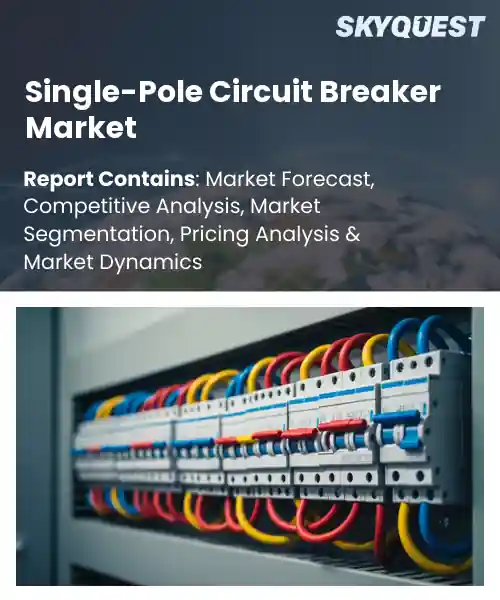
Single-Pole Circuit Breaker Market
Report ID: SQMIG20I2940
Report ID: SQMIG20I2940
[email protected]
USA +1 351-333-4748
Report ID:
SQMIG20I2940 |
Region:
Global |
Published Date: April, 2026
Pages:
157
|Tables:
92
|Figures:
76


Global Single-Pole Circuit Breaker Market size was valued at USD 5.84 Billion in 2024 and is poised to grow from USD 6.18 Billion in 2025 to USD 5.8 Billion by 2033, growing at a CAGR of 5.9% during the forecast period (2026-2033).
Single pole circuit breakers serve as the primary protective devices for individual circuits in residential and commercial electrical systems, and the market thus underpins electrical safety and reliability. Growth has been propelled by rising residential construction, retrofits driven by stricter electrical codes and broader electrification trends; for example, after 2010 building code updates in North America increased breaker replacement rates while smart home adoption encouraged upgrades. Historically the market evolved from basic thermal magnetic designs to more compact, modular and digitally enabled breakers produced by established suppliers such as Schneider Electric and Eaton, reflecting demand for greater safety and interoperability.Building on that evolution, a central factor shaping global single pole circuit breaker demand is rapid electrification of uses, which increases both circuit counts and technical performance requirements. As more households install electric vehicle chargers, for example, additional dedicated circuits create sustained volume growth and push manufacturers toward higher ampacity and enhanced trip accuracy; similar pressure arises from solar plus battery installations that need coordinated protection and monitoring. Consequently suppliers that offer modular, retrofit friendly and networked breakers gain market share while utilities and installers adopt smarter components, creating opportunities in emerging urban markets across Asia Pacific and Latin America.
How is IoT-enabled monitoring enhancing reliability in the single-pole circuit breaker market?
IoT enabled monitoring enhances reliability in the single pole circuit breaker market by giving continuous, device level visibility into load, temperature and trip status. Key aspects include remote sensing, real time alerts and predictive diagnostics that reveal thermal stress and developing faults before they lead to outages. The market now favors digital ready panels and retrofit smart breakers as building owners and utilities seek resilience with distributed energy resources. Manufacturers are embedding sensors and cloud analytics to speed diagnosis and simplify maintenance. In practice electrical teams use breaker level telemetry to isolate faults faster, reduce unplanned downtime and extend equipment life.Eaton March 2026, announced a collaboration with SPAN to integrate energy intelligence into smart panels, demonstrating how breaker level IoT telemetry enables predictive alerts faster fault isolation and automated load management to boost efficiency and support market adoption.
Market snapshot - (2026-2033)
Global Market Size
USD 5.84 Billion
Largest Segment
Input/Output (I/O) Connectors (RJ45/USB/SFP)
Fastest Growth
PCIe & Mezzanine Connectors
Growth Rate
5.9% CAGR
To get more insights on this market click here to Request a Free Sample Report
Global single-pole circuit breaker market is segmented by connector interface type, server architecture, end-use vertical and region. Based on connector interface type, the market is segmented into High-Speed Backplane Connectors, PCIe & Mezzanine Connectors and Input/Output (I/O) Connectors (RJ45/USB/SFP). Based on server architecture, the market is segmented into Blade Servers, Rack-mount Servers (1U, 2U, 4U) and Tower & Micro-Servers. Based on end-use vertical, the market is segmented into Hyperscale Data Centers & Cloud Providers, Enterprise IT Infrastructure and Others (Edge Computing & Telecommunications). Based on region, the market is segmented into North America, Europe, Asia Pacific, Latin America and Middle East & Africa.
PCIe & Mezzanine Connectors segment dominates because their integration demands precise, board-level overcurrent protection that aligns with single-pole breaker characteristics. High-density mezzanine power rails and modular add-in cards create concentrated fault risks that require isolated protection per lane, driving designers to favor single-pole breakers for reliable fault isolation, thermal management, and predictable tripping behavior. This compatibility with compact, serviceable power delivery architectures sustains market preference.
However, High-Speed Backplane Connectors are the fastest-growing area as backplane power consolidation and higher per-channel currents demand channel-level protection. Their adoption is driven by evolving chassis topologies and bandwidth needs that favor compact single-pole breakers for fault localization. This creates opportunities for smaller breakers and closer thermal and electromagnetic integration.
Blade Servers segment leads because their dense, modular chassis concentrate multiple power domains that necessitate individualized protection, aligning with single-pole breaker functionality. Hot-swappable blades and shared power infrastructure create fault propagation risks that single-pole breakers mitigate by isolating failures without disrupting neighboring modules. Emphasis on high availability and maintainability prompts system designers to integrate per-rail protection, making single-pole breakers a preferred solution for reliability and serviceability in these architectures.
Meanwhile, Rack-mount Servers (1U, 2U, 4U) are the fastest-growing area as scalable deployments and rising power density drive need for adaptable protection. Frequent hardware refresh cycles and virtualization increase demand for rack-level, space-efficient single-pole breakers that enable per-rail protection. This accelerates demand for modular breaker designs and flexible rack integration.
To get detailed segments analysis, Request a Free Sample Report
Asia Pacific dominance is rooted in a convergence of manufacturing strength, concentrated demand centers and deep supply chain integration. Large electronics and electrical equipment clusters in the region enable rapid product development, cost-effective production and close supplier relationships that support both original equipment manufacturers and aftermarket channels. Governments and industry prioritize grid reliability, safety and energy efficiency, driving adoption of standardized and customized single-pole breakers across residential, commercial and industrial segments. Strong export orientation, investment in component sourcing and testing infrastructure, as well as partnerships with global technology firms, bolster competitiveness. The region also benefits from a skilled engineering workforce and aggressive product innovation that accelerate time to market for compact, high-reliability breaker designs suited to dense urban and industrial applications.
Single-Pole Circuit Breaker Market in Japan is shaped by advanced electronics expertise and stringent safety and technical standards that emphasize compact, high-reliability designs. Domestic manufacturers focus on precision engineering and rigorous testing, supplying both local construction and high-end industrial applications. Collaboration between equipment makers and utilities fosters tailored solutions, while established export channels and reputation for quality drive demand for innovative breakers that meet specifications across complex electrical systems reliably.
Single-Pole Circuit Breaker Market in South Korea benefits from concentrated manufacturing clusters and large electrical conglomerates that drive component integration and efficient production cycles. Emphasis on industrial automation, electronics manufacturing and smart infrastructure creates demand for breakers compatible with advanced control systems. Local suppliers work closely with global partners to refine product functionality and reliability, while domestic standards support deployment across commercial projects and export markets seeking compact breaker solutions.
The rapid expansion in North America is driven by a combination of infrastructure modernization efforts, heightened safety and regulatory expectations, and strong demand from residential and commercial retrofit activity. Growing interest in smart home and building management systems encourages manufacturers to develop breakers with enhanced connectivity and diagnostic capabilities. A well-established distribution network and service ecosystem support aftermarket replacement and professional installation channels. Close collaboration between utilities, standards bodies and manufacturers promotes interoperability and reliability. Domestic innovation in materials and circuit protection technology, alongside strategic partnerships with global suppliers, enables tailored products that address diverse climatic and grid conditions across the region, reinforcing North America as a dynamic market for single-pole breaker development and adoption. Manufacturers also emphasize certified performance, installer training and comprehensive warranty support to build trust with commercial contractors and homeowners, further accelerating uptake across varied market segments.
Single-Pole Circuit Breaker Market in United States is characterized by diverse application needs across residential renovation, commercial construction and industrial retrofit projects. Strong emphasis on safety codes and third-party certifications drives demand for breakers with proven performance and compatibility. Manufacturers and distributors maintain extensive aftermarket channels and technical support, while innovation in smart connectivity and diagnostics meets installer and utility expectations, fostering collaboration on standards and product development for installations.
Single-Pole Circuit Breaker Market in Canada is shaped by urban modernization and a need for grid resilience, driving demand for durable, climate-resistant breaker designs. Regulatory oversight and standards encourage adoption of reliable protection devices across new builds and renovation projects. Local suppliers prioritize performance in varied temperatures while coordinating with distributors to address remote installation challenges. Collaboration with utilities on stability and energy efficiency supports tailored product selection and services.
Europe is strengthening its position through a combination of harmonized regulatory frameworks, a strong focus on safety and energy efficiency, and sustained investment in grid modernization and building retrofits. Manufacturers emphasize product interoperability, certification and quality assurance to meet varied national requirements while streamlining cross-border trade. The emphasis on integrating distributed generation and smart grid technologies fosters demand for breakers with advanced control and monitoring features. Collaboration among industry associations, research institutions and utilities accelerates innovation in materials and protective functionality, and local production capabilities complement imports to create a balanced market that values reliability, sustainability and technical sophistication. Manufacturers also focus on modular, space-efficient designs and on aftermarket service networks that simplify retrofit work and support integration with renewable energy and smart grid applications.
Single-Pole Circuit Breaker Market in Germany is anchored by a strong industrial base and engineering expertise that emphasize reliability and precision. Demand is driven by industrial automation, manufacturing facilities and stringent safety and performance standards. Domestic producers excel at robust designs and customization for heavy-duty applications, while close ties between research institutes and manufacturers foster innovation in materials and protection technologies. Well-developed distribution and service networks support installations and retrofit.
Single-Pole Circuit Breaker Market in United Kingdom reflects efforts to modernize aging building stock and upgrade commercial installations, creating opportunities for retrofit-friendly breaker solutions. Regulatory focus on safety and efficient electrical installations encourages certified products and installer training. Suppliers emphasize compact designs and compatibility with smart home systems to meet contractor expectations. Strong service and distribution channels support replacement cycles, while collaboration with standard bodies ensures widespread conformity in installations.
Single-Pole Circuit Breaker Market in France is influenced by a diverse energy mix and emphasis on grid stability and safety, creating demand for reliable protection devices. Manufacturers offer solutions for urban infrastructure and industrial facilities with attention to integration with distributed generation and building management systems. Certification and collaboration with utilities encourage deployment of breakers that meet needs, while local service providers support maintenance and retrofit across broader regional networks.
To know more about the market opportunities by region and country, click here to
Buy The Complete Report
Increasing Adoption In Residential Sector
Regulatory Support For Safety Standards
Supply Chain Complexity And Constraints
Competition From Alternative Protection Technologies
Request Free Customization of this report to help us to meet your business objectives.
Competitive dynamics center on incumbents leveraging M&A, strategic investments and technology partnerships while startups push solid state and retrofit innovation; for example ABB Technology Ventures invested in Atom Power’s digital breaker technology and Infineon has partnered with Amber Solutions on solid state control work. These moves drive product differentiation, faster time to market and channel partnerships as key competition drivers.
Top Player’s Company Profile
Recent Developments
SkyQuest’s ABIRAW (Advanced Business Intelligence, Research & Analysis Wing) is our Business Information Services team that Collects, Collates, Correlates, and Analyses the Data collected by means of Primary Exploratory Research backed by robust Secondary Desk research. As per SkyQuest analysis, one key driver is increasing adoption in the residential sector, which raises replacement and new-build demand for compact single-pole breakers, and a second driver is strengthening regulatory support and safety codes that favor certified, digitally enabled devices. A restraint remains supply chain complexity and constrained component sourcing that can hinder production and delay deliveries. The market is dominated regionally by Asia Pacific due to manufacturing scale and strong demand, while the PCIe and Mezzanine Connectors segment leads on the product side because board-level, lane-specific protection aligns with single-pole functionality. Overall, suppliers offering modular, retrofit-friendly and networked breakers are best positioned to capture growth.
| Report Metric | Details |
|---|---|
| Market size value in 2024 | USD 5.84 Billion |
| Market size value in 2033 | USD 5.8 Billion |
| Growth Rate | 5.9% |
| Base year | 2024 |
| Forecast period | (2026-2033) |
| Forecast Unit (Value) | USD Billion |
| Segments covered |
|
| Regions covered | North America (US, Canada), Europe (Germany, France, United Kingdom, Italy, Spain, Rest of Europe), Asia Pacific (China, India, Japan, Rest of Asia-Pacific), Latin America (Brazil, Rest of Latin America), Middle East & Africa (South Africa, GCC Countries, Rest of MEA) |
| Companies covered |
|
| Customization scope | Free report customization with purchase. Customization includes:-
|
To get a free trial access to our platform which is a one stop solution for all your data requirements for quicker decision making. This platform allows you to compare markets, competitors who are prominent in the market, and mega trends that are influencing the dynamics in the market. Also, get access to detailed SkyQuest exclusive matrix.
Table Of Content
Executive Summary
Market overview
Parent Market Analysis
Market overview
Market size
KEY MARKET INSIGHTS
COVID IMPACT
MARKET DYNAMICS & OUTLOOK
Market Size by Region
KEY COMPANY PROFILES
Methodology
For the Single-Pole Circuit Breaker Market, our research methodology involved a mixture of primary and secondary data sources. Key steps involved in the research process are listed below:
1. Information Procurement: This stage involved the procurement of Market data or related information via primary and secondary sources. The various secondary sources used included various company websites, annual reports, trade databases, and paid databases such as Hoover's, Bloomberg Business, Factiva, and Avention. Our team did 45 primary interactions Globally which included several stakeholders such as manufacturers, customers, key opinion leaders, etc. Overall, information procurement was one of the most extensive stages in our research process.
2. Information Analysis: This step involved triangulation of data through bottom-up and top-down approaches to estimate and validate the total size and future estimate of the Single-Pole Circuit Breaker Market.
3. Report Formulation: The final step entailed the placement of data points in appropriate Market spaces in an attempt to deduce viable conclusions.
4. Validation & Publishing: Validation is the most important step in the process. Validation & re-validation via an intricately designed process helped us finalize data points to be used for final calculations. The final Market estimates and forecasts were then aligned and sent to our panel of industry experts for validation of data. Once the validation was done the report was sent to our Quality Assurance team to ensure adherence to style guides, consistency & design.
Analyst Support
Customization Options
With the given market data, our dedicated team of analysts can offer you the following customization options are available for the Single-Pole Circuit Breaker Market:
Product Analysis: Product matrix, which offers a detailed comparison of the product portfolio of companies.
Regional Analysis: Further analysis of the Single-Pole Circuit Breaker Market for additional countries.
Competitive Analysis: Detailed analysis and profiling of additional Market players & comparative analysis of competitive products.
Go to Market Strategy: Find the high-growth channels to invest your marketing efforts and increase your customer base.
Innovation Mapping: Identify racial solutions and innovation, connected to deep ecosystems of innovators, start-ups, academics, and strategic partners.
Category Intelligence: Customized intelligence that is relevant to their supply Markets will enable them to make smarter sourcing decisions and improve their category management.
Public Company Transcript Analysis: To improve the investment performance by generating new alpha and making better-informed decisions.
Social Media Listening: To analyze the conversations and trends happening not just around your brand, but around your industry as a whole, and use those insights to make better Marketing decisions.
REQUEST FOR SAMPLE
 REQUEST FREE CUSTOMIZATION


Want to customize this report? This report can be personalized according to your needs. Our analysts and industry experts will work directly with you to understand your requirements and provide you with customized data in a short amount of time. We offer $1000 worth of FREE customization at the time of purchase.
Feedback From Our Clients


 USA (+1) 351-333-4748

