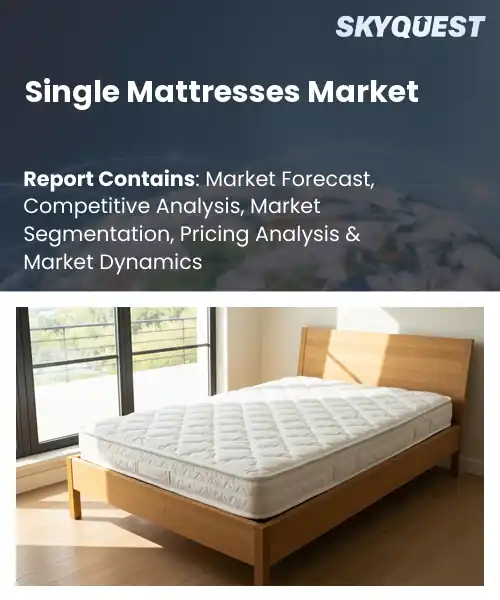
Single Mattresses Market
Report ID: SQMIG25F2108
Report ID: SQMIG25F2108
[email protected]
USA +1 351-333-4748
Report ID:
SQMIG25F2108 |
Region:
Global |
Published Date: April, 2026
Pages:
157
|Tables:
116
|Figures:
77


Global Single Mattresses Market size was valued at USD 38.2 Billion in 2024 and is poised to grow from USD 40.64 Billion in 2025 to USD 38.4 Billion by 2033, growing at a CAGR of 6.4% during the forecast period (2026-2033).
Rising single-occupancy households are the primary driver of the single mattresses market, reshaping demand and retail formats across regions. This market covers manufacturing, distribution, and services for mattresses sized for individual use, and it matters because sleep products intersect with demographic shifts, housing trends, and consumer preferences that affect purchase cycles. Over time the sector shifted from uniform innerspring models sold in furniture outlets to a fragmented landscape dominated by memory foam, hybrid constructions, and direct-to-consumer brands. Urban densification and growth in student accommodations in cities such as Tokyo and New York have increased demand and stimulated compact, modular innovations.The rise of e-commerce and DTC models is a key factor catalyzing growth in the global single mattresses market because online distribution lowers entry barriers and shortens supply chains, which reduces costs and increases margin flexibility. As a result manufacturers can invest in R&D for memory foam formulations, cooling gels, and modular bases that meet niche needs such as student housing, short-stay rentals, and aging-in-place healthcare beds. Lower prices and broader selection drive higher conversion rates, thereby attracting investors and retailers to expand SKU depth and geographic reach. Consequently opportunities emerge for smart mattress integration, circular-sourcing programs, and localized manufacturing to capture underserved urban and emerging-market segments.
How is AI improving manufacturing efficiency in the single mattresses market?
AI is improving manufacturing efficiency in the single mattresses market by enhancing planning, process control and quality assurance. Key aspects include demand forecasting, material optimization and vision based inspection that catch defects early. Today manufacturers pair machine learning with automation to streamline foam cutting, standardize stitching and predict equipment maintenance. In a market that prizes fast delivery and tailored comfort, AI helps reduce waste and simplify production while preserving craftsmanship. Real world examples show firms using data driven insights to align inventory with shopper preferences and to shorten the cycle from design to market, keeping operations responsive and consumer focused.Sleep Number March 2026, the company redesigned its mattress portfolio to simplify models and highlight adaptive technology, a change that AI driven forecasting and automated inspection can support by reducing production complexity, improving throughput and accelerating delivery to retailers and consumers.
Market snapshot - (2026-2033)
Global Market Size
USD 38.2 Billion
Largest Segment
Sustainable Food & Beverage
Fastest Growth
Eco-friendly Personal Care & Cosmetics
Growth Rate
6.4% CAGR
To get more insights on this market click here to Request a Free Sample Report
Global single mattresses market is segmented by product category, material source, certification standard, distribution channel and region. Based on product category, the market is segmented into Eco-friendly Personal Care & Cosmetics, Sustainable Food & Beverage, Ethical Fashion & Apparel and Others. Based on material source, the market is segmented into Recycled/Upcycled Materials, Bio-based & Biodegradable and Responsibly Sourced Natural Materials. Based on certification standard, the market is segmented into Certified Organic (USDA/EU) and Fair Trade & Carbon Neutral. Based on distribution channel, the market is segmented into Online D2C & Marketplace Platforms and Retail Stores & Supermarkets. Based on region, the market is segmented into North America, Europe, Asia Pacific, Latin America and Middle East & Africa.
Recycled/Upcycled Materials segment dominates because manufacturers leverage waste streams to lower input costs and meet growing sustainability preferences in the Single Mattresses Market market. Repurposing foams, fabrics and fibers creates reliable supply loops and reduces reliance on virgin commodities, enabling competitive pricing and fast scaling. Brand partnerships with recyclers and streamlined manufacturing processes also drive procurement stability, while consumer perception of circular products strengthens brand loyalty and repeat purchase dynamics.
However, Bio-based & Biodegradable is the most rapidly expanding area, driven by innovation in plant-derived foams and compostable covers that address end-of-life concerns and appeal to eco-conscious buyers. Manufacturers invest in R&D to improve durability while maintaining biodegradability, and regulatory momentum toward sustainable disposal accelerates adoption, creating new product differentiation and circular business models.
Online D2C & Marketplace Platforms segment dominates because direct sales and digital marketplaces align with how consumers research and purchase single mattresses, lowering distribution friction and enabling personalized configurations. These channels provide rich customer data that informs product development, targeted marketing and flexible pricing, while logistics innovations support efficient delivery and returns. Brand control over messaging and margin preservation further incentivizes manufacturers to prioritize online-first strategies that scale rapidly across consumer cohorts.
Meanwhile, Retail Stores & Supermarkets is witnessing the strongest growth momentum as experiential showrooms and omnichannel partnerships restore in-person testing and immediacy for single mattress shoppers. Retailers enhance displays, trial areas and bundled offers to drive conversion, while brand collaborations create curated assortments. This physical presence complements digital channels, expanding reach, reducing returns and unlocking incremental sales opportunities.
To get detailed segments analysis, Request a Free Sample Report
Asia Pacific dominance is driven by converging structural and demand side strengths that create a broad and adaptable market environment. Urbanization and the proliferation of single person households have generated persistent demand for compact and flexible sleep solutions, while rising disposable incomes and increasing focus on sleep health and wellbeing encourage consumers to upgrade to specialized and ergonomic products. Robust regional manufacturing capability supports cost competitive production and extensive product variety, enabling fast response to local preferences and seasonal shifts. Well developed e commerce platforms and dense retail networks facilitate rapid distribution across diverse markets, and domestic brands combine technological innovation, design localization and targeted marketing. Strong supply chain ecosystems and cross border trade further amplify regional reach, supporting both mass market penetration and differentiated premium offerings tailored to younger, tech oriented consumers.
Single Mattresses Market in Japan is characterized by consumer preference for high quality, compact and technologically enhanced designs that address space constraints and sleep health. Established domestic brands emphasize meticulous craftsmanship, materials innovation and durability, while retailers curate premium sleep experiences through specialized stores and integrated services. A discerning customer base values ergonomic support, hygiene features and sleep integrations, encouraging product differentiation and focused marketing across urban centers.
Single Mattresses Market in South Korea reflects a design driven and tech savvy consumer base favoring compact, multifunctional sleep solutions for constrained urban environments. Domestic manufacturers and digitally native brands lead material and comfort innovation, while e commerce and omnichannel retail models support quick market reach and consumer trial. Marketing focuses on ergonomics, space efficiency and lifestyle fit, encouraging customization options and frequent product iteration to match evolving consumer preferences.
North America rapid expansion stems from a combination of consumer preference shifts, channel innovation and supply side agility that together accelerate adoption across segments. Growing emphasis on sleep quality and personalized comfort encourages shoppers to explore specialized single mattress offerings, while direct to consumer models and streamlined e commerce fulfillment reduce friction and broaden reach beyond traditional retail. Flexible trial and return policies, coupled with clear marketing of ergonomic and health benefits, lower purchase barriers. Manufacturers focus on product differentiation through modular sizing, sustainable materials and sleep technology integrations, while established retailers and nimble startups collaborate to improve distribution and service. The result is a dynamic market that favors rapid product iteration, strong competition and clear segmentation by lifestyle needs.
Single Mattresses Market in United States features a blend of established retail channels and direct to consumer brands emphasizing convenience, trial options and fast delivery. Product innovation centers on comfort customization, ease of setup and integrated sleep technology, while marketing highlights health and lifestyle alignment. Institutional demand from student housing and rental furnishing supports recurring purchases, and partnerships across retail and logistics networks enhance market accessibility and varied consumer demographics.
Single Mattresses Market in Canada is shaped by consumer focus on comfort, durability and environmental responsibility, prompting a shift toward sustainable materials. Retail ecosystems blend national chains and online specialists, with logistics considerations influencing product design and packaging. Regional preferences favor practical, space efficient models suited to diverse living arrangements. Brands leverage local craftsmanship and certifications to build trust, while omnichannel strategies balance in store experience with efficient home delivery.
Europe strengthens its position through a blend of regulatory rigor, sustainability leadership and consumer driven innovation that elevates product standards and market credibility. Emphasis on eco friendly materials, circular economy initiatives and clear labeling fosters trust and encourages premiumization while pushing manufacturers toward transparent supply chains. Strong retail and wholesale networks support consistent distribution, and a vibrant ecosystem of specialized brands, designers and sleep research institutions drives product differentiation through ergonomics and craftsmanship. Cross border trade and harmonized standards facilitate market access across diverse national markets, while digital channels and experiential retail formats enable tailored consumer journeys. Together these forces create a market characterized by quality conscious demand, responsible manufacturing practices and steady expansion of specialized single mattress offerings globally.
Single Mattresses Market in Germany centers on engineering led design, strict quality standards and emphasis on durability. Manufacturers apply material science and precision manufacturing to produce reliable comfort and support, while certifications and testing build consumer trust. Retailers mix specialist sleep shops and efficient online channels, with sustainability credentials shaping buyer choices. The market rewards long lasting, technically described solutions and professional sales guidance that emphasizes performance and lifecycle value.
Single Mattresses Market in United Kingdom is shaped by dense urban living, a significant student and rental population and strong online retail uptake. Brands focus on compact, easy to install models and trial policies that reduce purchase hesitation, while omnichannel strategies combine experiential showrooms with fast home delivery. Design trends emphasize comfort and practical aesthetics, and rising sleep health awareness supports partnerships with wellness providers and targeted urban lifestyle campaigns.
Single Mattresses Market in France emphasizes blend of design, comfort and sustainability that appeals to style conscious consumers. Brands highlight aesthetic finishes, natural materials and ergonomic support to align with domestic tastes, while specialist retailers offer experiential shopping and tailored advice. E commerce growth complements boutique retail, enabling curated product storytelling. Certification and environmental claims resonate, prompting investment in transparent sourcing and local manufacturing to distinguish offerings in urban markets.
To know more about the market opportunities by region and country, click here to
Buy The Complete Report
Rising Health Consciousness Among Consumers
Growth In Online Retail Channels
High Production and Material Costs
Fragmented Distribution and Channel Confusion
Request Free Customization of this report to help us to meet your business objectives.
Competitive landscape in the Global Single Mattresses Market is shaped by consolidation, direct to consumer pricing disruption, smart sleep technology, and sustainability driven service models. Recent M&A and strategic partnerships such as Somnigroup's acquisition of Mattress Firm and Mattress Firm's alliance with SleepScore Labs, alongside tech plays like Eight Sleep's product and acquisition led innovation, are accelerating differentiation and channel control.
Top Player’s Company Profile
Recent Developments
SkyQuest’s ABIRAW (Advanced Business Intelligence, Research & Analysis Wing) is our Business Information Services team that Collects, Collates, Correlates, and Analyses the Data collected by means of Primary Exploratory Research backed by robust Secondary Desk research. As per SkyQuest analysis, the global single mattresses market is being driven primarily by rising single-occupancy households that boost demand for compact, affordable sleep solutions, supported further by the rapid expansion of online D2C and marketplace platforms which lower purchase friction and enable greater selection. However high production and material costs constrain pricing flexibility and slow adoption among cost-sensitive buyers. Asia Pacific emerges as the dominating region due to urbanization, robust manufacturing and strong e-commerce ecosystems, while recycled and upcycled materials represent the dominating segment as brands pursue circular sourcing to cut costs and meet sustainability expectations. Together these forces favor innovation in materials, distribution and product design.
| Report Metric | Details |
|---|---|
| Market size value in 2024 | USD 38.2 Billion |
| Market size value in 2033 | USD 38.4 Billion |
| Growth Rate | 6.4% |
| Base year | 2024 |
| Forecast period | (2026-2033) |
| Forecast Unit (Value) | USD Billion |
| Segments covered |
|
| Regions covered | North America (US, Canada), Europe (Germany, France, United Kingdom, Italy, Spain, Rest of Europe), Asia Pacific (China, India, Japan, Rest of Asia-Pacific), Latin America (Brazil, Rest of Latin America), Middle East & Africa (South Africa, GCC Countries, Rest of MEA) |
| Companies covered |
|
| Customization scope | Free report customization with purchase. Customization includes:-
|
To get a free trial access to our platform which is a one stop solution for all your data requirements for quicker decision making. This platform allows you to compare markets, competitors who are prominent in the market, and mega trends that are influencing the dynamics in the market. Also, get access to detailed SkyQuest exclusive matrix.
Table Of Content
Executive Summary
Market overview
Parent Market Analysis
Market overview
Market size
KEY MARKET INSIGHTS
COVID IMPACT
MARKET DYNAMICS & OUTLOOK
Market Size by Region
KEY COMPANY PROFILES
Methodology
For the Single Mattresses Market, our research methodology involved a mixture of primary and secondary data sources. Key steps involved in the research process are listed below:
1. Information Procurement: This stage involved the procurement of Market data or related information via primary and secondary sources. The various secondary sources used included various company websites, annual reports, trade databases, and paid databases such as Hoover's, Bloomberg Business, Factiva, and Avention. Our team did 45 primary interactions Globally which included several stakeholders such as manufacturers, customers, key opinion leaders, etc. Overall, information procurement was one of the most extensive stages in our research process.
2. Information Analysis: This step involved triangulation of data through bottom-up and top-down approaches to estimate and validate the total size and future estimate of the Single Mattresses Market.
3. Report Formulation: The final step entailed the placement of data points in appropriate Market spaces in an attempt to deduce viable conclusions.
4. Validation & Publishing: Validation is the most important step in the process. Validation & re-validation via an intricately designed process helped us finalize data points to be used for final calculations. The final Market estimates and forecasts were then aligned and sent to our panel of industry experts for validation of data. Once the validation was done the report was sent to our Quality Assurance team to ensure adherence to style guides, consistency & design.
Analyst Support
Customization Options
With the given market data, our dedicated team of analysts can offer you the following customization options are available for the Single Mattresses Market:
Product Analysis: Product matrix, which offers a detailed comparison of the product portfolio of companies.
Regional Analysis: Further analysis of the Single Mattresses Market for additional countries.
Competitive Analysis: Detailed analysis and profiling of additional Market players & comparative analysis of competitive products.
Go to Market Strategy: Find the high-growth channels to invest your marketing efforts and increase your customer base.
Innovation Mapping: Identify racial solutions and innovation, connected to deep ecosystems of innovators, start-ups, academics, and strategic partners.
Category Intelligence: Customized intelligence that is relevant to their supply Markets will enable them to make smarter sourcing decisions and improve their category management.
Public Company Transcript Analysis: To improve the investment performance by generating new alpha and making better-informed decisions.
Social Media Listening: To analyze the conversations and trends happening not just around your brand, but around your industry as a whole, and use those insights to make better Marketing decisions.
REQUEST FOR SAMPLE
 REQUEST FREE CUSTOMIZATION


Want to customize this report? This report can be personalized according to your needs. Our analysts and industry experts will work directly with you to understand your requirements and provide you with customized data in a short amount of time. We offer $1000 worth of FREE customization at the time of purchase.
Feedback From Our Clients


 USA (+1) 351-333-4748

