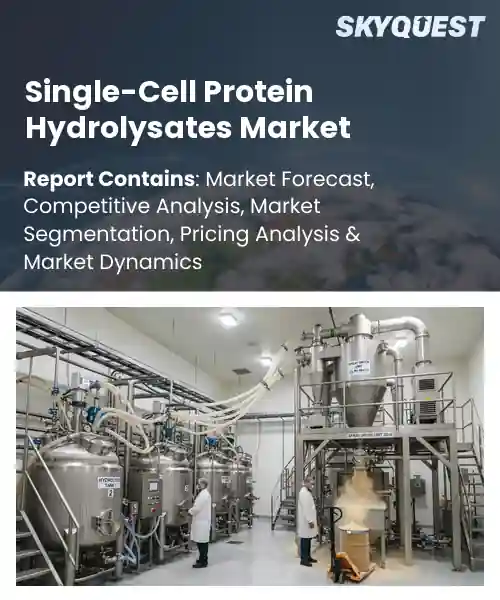
Single-Cell Protein Hydrolysates Market
Report ID: SQMIG15E4384
Report ID: SQMIG15E4384
[email protected]
USA +1 351-333-4748
Report ID:
SQMIG15E4384 |
Region:
Global |
Published Date: August, 2026
Pages:
157
|Tables:
119
|Figures:
77


Global Single-Cell Protein Hydrolysates Market size was valued at USD 786.0 Million in 2024 and is poised to grow from USD 876.39 Million in 2025 to USD 2093.62 Million by 2033, growing at a CAGR of 11.5% during the forecast period (2026-2033).
Regulatory encouragement for ingredients drives the growth engine of the SCP hydrolysates market, because authorities in the EU and US have streamlined approvals for microbial proteins that meet safety and labeling criteria. This easing of compliance reduces time‑to‑market, prompting food firms to sign joint‑development agreements with biotech startups that specialize in fermentation. As a result, plant‑based meat manufacturers incorporate yeast‑derived hydrolysates to improve amino‑acid balance and solubility, while aquaculture feed producers replace fishmeal with bacterial peptide blends, lowering cost and ecological footprint. These partnerships expand capacity, attract venture capital, and create a feedback loop that accelerates innovation and market penetration.
How is AI-driven process automation influencing cost efficiency in the single-cell protein hydrolysates market?
AI‑driven process automation is reshaping the single‑cell protein hydrolysates sector by linking real‑time data with predictive models that fine‑tune fermentation conditions. Machine learning algorithms monitor temperature, pH and nutrient feed, instantly adjusting parameters to keep microbes in their optimal growth window. This reduces batch failures, lowers energy consumption and trims raw material waste, all of which translate into tighter cost structures. As producers scale up to meet rising demand for sustainable protein, the ability to run continuous, high‑efficiency processes becomes a decisive competitive edge, making the market more attractive for new entrants and investors alike.
Market snapshot - (2026-2033)
Global Market Size
USD 786.0 Million
Largest Segment
Yeast-Based
Fastest Growth
Algae-Based
Growth Rate
11.5% CAGR
To get more insights on this market click here to Request a Free Sample Report
Global single-cell protein hydrolysates market is segmented by source, form, application, end user and region. Based on source, the market is segmented into Yeast-Based, Algae-Based, Bacteria-Based and Fungi-Based. Based on form, the market is segmented into Powder and Liquid. Based on application, the market is segmented into Animal Feed, Food & Beverages, Nutraceuticals and Biotechnology & Fermentation. Based on end user, the market is segmented into Feed Manufacturers, Food Manufacturers, Nutraceutical Companies and Research Institutions. Based on region, the market is segmented into North America, Europe, Asia Pacific, Latin America and Middle East & Africa.
Yeast-Based segment dominates because its rapid growth kinetics and well established fermentation infrastructure enable cost effective large scale production. The organism’s ability to convert inexpensive carbon sources into high quality protein hydrolysates aligns with industry demand for consistent supply and functional amino acid profiles. Moreover, regulatory familiarity and proven safety records foster confidence among manufacturers, reinforcing its leadership in the Single Cell Protein Hydrolysates Market across diverse feedstock streams globally.
However, Algae-Based segment is emerging as the key high growth area in the Single Cell Protein Hydrolysates Market. Its unique photosynthetic capability reduces reliance on agricultural feedstocks, attracting sustainability focused producers. Continuous advances in strain engineering and downstream processing are unlocking new functional applications, accelerating market expansion and creating fresh revenue opportunities.
Powder segment dominates because its solid state simplifies storage, transportation, and integration into existing manufacturing lines. The low moisture content enhances shelf life and preserves functional amino acid integrity, meeting the stringent quality expectations of feed and food producers. Additionally, the ease of precise dosing supports consistent product performance, making powder the preferred choice for large scale applications in the Single Cell Protein Hydrolysates Market across diverse formulation requirements globally and today.
Meanwhile, Liquid segment is witnessing the strongest growth momentum in the Single Cell Protein Hydrolysates Market. Its solubility enables incorporation into beverage and nutraceutical formulations, meeting rising consumer demand for ready to use functional ingredients. Innovations in stabilization technologies are expanding its application scope, driving rapid market uptake and opening new channels.
To get detailed segments analysis, Request a Free Sample Report
Asia Pacific combines a robust research ecosystem with strong governmental incentives that emphasize sustainable nutrition and industrial biotechnology. The region benefits from advanced fermentation capabilities and a deep expertise in microbial strain development, which accelerates product innovation. Major food and feed manufacturers are integrating protein hydrolysates into novel applications, driven by consumer demand for clean‑label and functional ingredients. Strategic collaborations between academic institutions and biotech firms foster rapid translation of laboratory breakthroughs to commercial scale. Moreover, supportive regulatory pathways encourage investment and facilitate market entry for emerging producers, reinforcing the region’s leadership in both technology and supply chain development.
Single-Cell Protein Hydrolysates Market in Japan is propelled by a long‑standing focus on food safety and functional nutrition, encouraging manufacturers to explore microbial protein solutions for health‑focused products. Collaborative networks linking research universities with industrial partners enable rapid scaling of novel hydrolysate processes, while consumer trends toward plant‑derived and alternative proteins further stimulate demand across food and feed sectors.
Single-Cell Protein Hydrolysates Market in South Korea benefits from aggressive government support for biotech entrepreneurship and a thriving startup ecosystem that emphasizes sustainable protein sources. Integration of hydrolysates into high‑value food ingredients and animal nutrition aligns with national goals for resource efficiency, while strong export orientation pushes domestic firms to meet international quality standards and expand market reach.
North America experiences rapid expansion due to a confluence of consumer interest in healthful, plant‑forward ingredients and substantial private capital directed toward biotech innovation. Leading food corporations are partnering with specialized fermentation companies to embed protein hydrolysates into functional foods, beverages, and specialty feed formulations. Robust intellectual property frameworks and a mature venture ecosystem encourage continuous R&D, while regulatory clarity around novel protein sources accelerates product approvals. The region’s emphasis on sustainability and circular economy principles also motivates manufacturers to adopt microbial protein solutions as greener alternatives to conventional animal‑derived proteins, reinforcing market momentum across multiple application domains.
Single-Cell Protein Hydrolysates Market in the United States is energized by a dynamic venture landscape that funds cutting‑edge fermentation technologies and scale‑up facilities. Major food processors are incorporating hydrolysates into protein‑enhanced snacks and functional beverages, while feed producers seek sustainable alternatives to traditional protein meals. Strong consumer awareness of environmental impact further drives adoption of microbial protein solutions across diverse product categories.
Single-Cell Protein Hydrolysates Market in Canada leverages a supportive policy environment that prioritizes clean technology and sustainable agriculture. Collaborative research programs between universities and biotech firms focus on optimizing enzyme processes for higher yield and functional performance. Growing interest in locally sourced protein ingredients aligns with national objectives for food security and reduced reliance on imported feedstock.
Europe strengthens its position through coordinated research initiatives and a regulatory climate that encourages innovation in sustainable food ingredients. The region’s emphasis on circular bioeconomy concepts drives investment in microbial protein platforms that convert waste streams into high‑quality hydrolysates. Strategic partnerships among food manufacturers, feed producers, and biotech innovators facilitate knowledge exchange and accelerate commercialization pathways. Comprehensive environmental standards and consumer demand for responsibly sourced nutrition further motivate companies to integrate hydrolysates into a broad spectrum of products, reinforcing Europe’s role as a forward‑looking hub for sustainable protein technologies.
Single-Cell Protein Hydrolysates Market in Germany benefits from a strong engineering tradition and extensive public‑private research consortia focused on microbial fermentation efficiency. Food producers are adopting hydrolysates for functional ingredients in dairy alternatives and fortified snacks, while feed manufacturers value the consistent amino acid profile for livestock nutrition.
Single-Cell Protein Hydrolysates Market in the United Kingdom is driven by a vibrant startup ecosystem and government programmes that support low‑carbon protein solutions. Integration of hydrolysates into health‑focused beverages and specialty animal feeds aligns with consumer preferences for sustainability and transparency.
Single-Cell Protein Hydrolysates Market in France capitalizes on a heritage of culinary innovation and a regulatory framework that facilitates novel food ingredient adoption. Food artisans and large‑scale manufacturers alike are exploring hydrolysates to enhance texture and nutritional value in both traditional and emerging product lines.
To know more about the market opportunities by region and country, click here to
Buy The Complete Report
Rising Demand for Sustainable Protein
Advancements In Enzyme Technology
Regulatory Uncertainty Around Novel Ingredients
High Capital Expenditure For Production Facilities
Request Free Customization of this report to help us to meet your business objectives.
The competitive landscape is shaped by intense rivalry among biotech firms leveraging microbial fermentation to produce protein hydrolysates, driving rapid innovation in strain engineering and cost‑effective downstream processing; recent M&A activity such as a large agrifood conglomerate acquiring a niche SCP developer, and strategic partnerships linking enzyme specialists with food manufacturers, are accelerating market penetration and differentiating product portfolios.
Top Player’s Company Profile
SkyQuest’s ABIRAW (Advanced Business Intelligence, Research & Analysis Wing) is our Business Information Services team that Collects, Collates, Correlates, and Analyses the Data collected by means of Primary Exploratory Research backed by robust Secondary Desk research.
As per SkyQuest analysis, the global single‑cell protein hydrolysates market is propelled chiefly by rising demand for sustainable protein, as consumers and manufacturers seek low‑footprint alternatives. A second strong catalyst is rapid progress in enzyme technology that boosts hydrolysis efficiency and product functionality. However, lingering regulatory uncertainty around novel food ingredients can delay approvals and temper investment. Asia Pacific leads the market, due to robust research ecosystems, supportive policies and extensive fermentation capabilities. Within the segment landscape, yeast‑based hydrolysates dominate because of fast growth rates, established production infrastructure and trusted safety profiles, reinforcing the region’s growth trajectory.
| Report Metric | Details |
|---|---|
| Market size value in 2024 | USD 786.0 Million |
| Market size value in 2033 | USD 2093.62 Million |
| Growth Rate | 11.5% |
| Base year | 2024 |
| Forecast period | (2026-2033) |
| Forecast Unit (Value) | USD Million |
| Segments covered |
|
| Regions covered | North America (US, Canada), Europe (Germany, France, United Kingdom, Italy, Spain, Rest of Europe), Asia Pacific (China, India, Japan, Rest of Asia-Pacific), Latin America (Brazil, Rest of Latin America), Middle East & Africa (South Africa, GCC Countries, Rest of MEA) |
| Companies covered |
|
| Customization scope | Free report customization with purchase. Customization includes:-
|
To get a free trial access to our platform which is a one stop solution for all your data requirements for quicker decision making. This platform allows you to compare markets, competitors who are prominent in the market, and mega trends that are influencing the dynamics in the market. Also, get access to detailed SkyQuest exclusive matrix.
Table Of Content
Executive Summary
Market overview
Parent Market Analysis
Market overview
Market size
KEY MARKET INSIGHTS
COVID IMPACT
MARKET DYNAMICS & OUTLOOK
Market Size by Region
KEY COMPANY PROFILES
Methodology
For the Single-Cell Protein Hydrolysates Market, our research methodology involved a mixture of primary and secondary data sources. Key steps involved in the research process are listed below:
1. Information Procurement: This stage involved the procurement of Market data or related information via primary and secondary sources. The various secondary sources used included various company websites, annual reports, trade databases, and paid databases such as Hoover's, Bloomberg Business, Factiva, and Avention. Our team did 45 primary interactions Globally which included several stakeholders such as manufacturers, customers, key opinion leaders, etc. Overall, information procurement was one of the most extensive stages in our research process.
2. Information Analysis: This step involved triangulation of data through bottom-up and top-down approaches to estimate and validate the total size and future estimate of the Single-Cell Protein Hydrolysates Market.
3. Report Formulation: The final step entailed the placement of data points in appropriate Market spaces in an attempt to deduce viable conclusions.
4. Validation & Publishing: Validation is the most important step in the process. Validation & re-validation via an intricately designed process helped us finalize data points to be used for final calculations. The final Market estimates and forecasts were then aligned and sent to our panel of industry experts for validation of data. Once the validation was done the report was sent to our Quality Assurance team to ensure adherence to style guides, consistency & design.
Analyst Support
Customization Options
With the given market data, our dedicated team of analysts can offer you the following customization options are available for the Single-Cell Protein Hydrolysates Market:
Product Analysis: Product matrix, which offers a detailed comparison of the product portfolio of companies.
Regional Analysis: Further analysis of the Single-Cell Protein Hydrolysates Market for additional countries.
Competitive Analysis: Detailed analysis and profiling of additional Market players & comparative analysis of competitive products.
Go to Market Strategy: Find the high-growth channels to invest your marketing efforts and increase your customer base.
Innovation Mapping: Identify racial solutions and innovation, connected to deep ecosystems of innovators, start-ups, academics, and strategic partners.
Category Intelligence: Customized intelligence that is relevant to their supply Markets will enable them to make smarter sourcing decisions and improve their category management.
Public Company Transcript Analysis: To improve the investment performance by generating new alpha and making better-informed decisions.
Social Media Listening: To analyze the conversations and trends happening not just around your brand, but around your industry as a whole, and use those insights to make better Marketing decisions.
REQUEST FOR SAMPLE
 REQUEST FREE CUSTOMIZATION
Global Single-Cell Protein Hydrolysates Market size was valued at USD 786.0 Million in 2024 and is poised to grow from USD 876.39 Million in 2025 to USD 2093.62 Million by 2033, growing at a CAGR of 11.5% during the forecast period (2026-2033).
The competitive landscape is shaped by intense rivalry among biotech firms leveraging microbial fermentation to produce protein hydrolysates, driving rapid innovation in strain engineering and cost‑effective downstream processing; recent M&A activity such as a large agrifood conglomerate acquiring a niche SCP developer, and strategic partnerships linking enzyme specialists with food manufacturers, are accelerating market penetration and differentiating product portfolios. 'AngelYeast Co., Ltd.', 'Lesaffre International', 'Lallemand Inc.', 'Kerry Group plc', 'DSM-Firmenich AG', 'Ajinomoto Co., Inc.', 'Archer Daniels Midland Company', 'Cargill, Incorporated', 'Novonesis Group', 'Alltech, Inc.', 'Leiber GmbH', 'AB Mauri', 'Ohly GmbH', 'Titan Biotech Limited', 'Biorigin', 'Synergy Flavors, Inc.', 'Associated British Foods plc', 'Evonik Industries AG', 'Nutreco N.V.', 'Calysta, Inc.'
The increasing consumer preference for environmentally friendly protein options is prompting food manufacturers to incorporate single‑cell protein hydrolysates into their formulations, thereby expanding market demand. This shift is driven by heightened awareness of climate impact, resource efficiency, and animal welfare concerns, which collectively encourage the adoption of alternative protein sources. As companies seek to meet regulatory sustainability targets and respond to market expectations, the demand for scalable, low‑footprint ingredients such as hydrolyzed microbial proteins continues to rise, supporting robust market growth.
Sustainable Feedstock Integration: Manufacturers are increasingly substituting traditional protein sources with single‑cell protein hydrolysates derived from waste streams such as agricultural residues, food by‑products, and methane‑rich effluents. This shift reduces reliance on land‑intensive crops, lowers greenhouse‑gas emissions, and aligns with circular‑economy mandates across food, animal feed, and bio‑chemical sectors. Companies are forging partnerships with waste‑management firms to secure steady, low‑cost feedstock, while investors reward the reduced environmental footprint, accelerating market adoption and encouraging further R&D investment in the next decade global supply chains.
Why does Asia Pacific Dominate the Global Single-Cell Protein Hydrolysates Market? |@12


Want to customize this report? This report can be personalized according to your needs. Our analysts and industry experts will work directly with you to understand your requirements and provide you with customized data in a short amount of time. We offer $1000 worth of FREE customization at the time of purchase.
Feedback From Our Clients


 USA (+1) 351-333-4748

