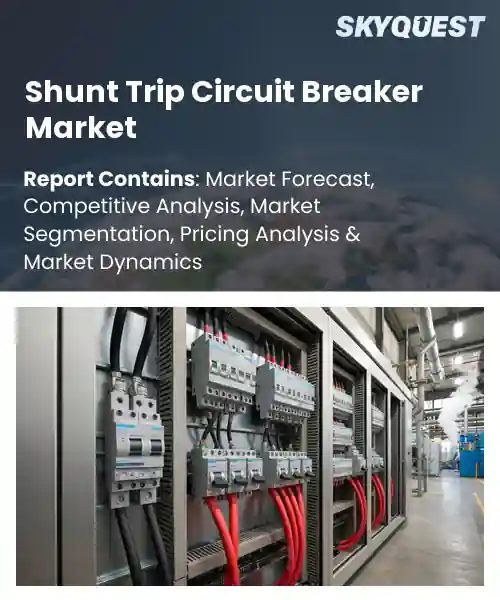
Shunt Trip Circuit Breaker Market
Report ID: SQMIG20D2776
Report ID: SQMIG20D2776
[email protected]
USA +1 351-333-4748
Report ID:
SQMIG20D2776 |
Region:
Global |
Published Date: July, 2026
Pages:
157
|Tables:
148
|Figures:
78


Global Shunt Trip Circuit Breaker Market size was valued at USD 7.32 Billion in 2024 and is poised to grow from USD 7.74 Billion in 2025 to USD 12.16 Billion by 2033, growing at a CAGR of 5.8% during the forecast period (2026-2033).
The expansion of renewable energy is driving the shunt trip circuit breaker market trends as the need for rapid fault isolation grows. Wind and solar farms produce variable power, which can cause quick overloads. Grid operators are starting to upgrade panels with shunt-trip units. This demand has driven manufacturers to develop compact, communication-enabled breakers that can be integrated into SCADA networks, creating a lucrative niche for companies offering seamless integration. In Texas, a 500-MW solar installation with networked shunt-trip breakers cut outage response times from minutes to seconds, improving reliability and drawing in more capital. This cause-effect link between the clean-energy growth and the smarter protection drives global opportunities for innovation and market entry.
How is IoT Integration Influencing the Shunt Trip Circuit Breaker Market?
The integration of IoT in the shunt trip circuit breaker market growth is also expected to gain traction as the use of sensors and communication modules will enable real-time monitoring, remote actuation and predictive maintenance. These capabilities can be used by utilities and industrial facilities to instantly detect fault conditions, reduce downtime and optimise energy usage. Connected breakers send data to the cloud, where analytics can identify wear patterns and send alerts before failure occurs. The added intelligence also allows for automated compliance reporting and integration with larger smart-grid initiatives, helping to make the technology more attractive to end users looking for reliability and operational efficiency.
In June 2024, a leading manufacturer introduced an IoT-enabled shunt-trip breaker that streams status data to a centralized dashboard, enhancing fault response times and facilitating proactive asset management.
Market snapshot - (2026-2033)
Global Market Size
USD 7.32 Billion
Largest Segment
Molded Case
Fastest Growth
Vacuum Circuit
Growth Rate
5.8% CAGR
To get more insights on this market click here to Request a Free Sample Report
Global shunt trip circuit breaker market is segmented by breaker category, voltage rating, control supply, application environment, sales channel and region. Based on breaker category, the market is segmented into miniature circuit, molded case, air circuit and vacuum circuit. Based on voltage rating, the market is segmented into Low voltage, medium voltage and high voltage. Based on control supply, the market is segmented into 24V DC, 120V AC, 240V AC and others. Based on application environment, the market is segmented into emergency stops, fire alarms, elevator shafts, industrial machinery and data centers. Based on sales channel, the market is segmented into direct electrical, panel builders and wholesale distributors. Based on region, the market is segmented into North America, Europe, Asia Pacific, Latin America and Middle East & Africa.
Miniature circuit segment dominates because it integrates seamlessly with compact panels where space constraints are critical, allowing designers to embed shunt trip functionality without sacrificing layout efficiency. Its lightweight construction and standardized mounting facilitate rapid installation, which appeals to OEMs seeking cost‑effective solutions. Additionally, the prevalence of low‑voltage distribution in residential and small‑commercial settings fuels consistent demand, reinforcing its leadership position in the market and supporting safety compliance across diverse installations.
However, molded case segment is the most rapidly expanding because rising adoption of medium‑size equipment in industrial automation drives demand for shunt‑trip breakers that can handle fault currents while retaining a compact footprint. Innovations in arc‑quenching technology improve reliability, and regulatory incentives encourage manufacturers to specify molded case units, creating a growth engine for this sub‑segment.
Medium voltage segment leads because it matches the electrical architecture of large‑scale facilities where shunt trip circuit breakers must interrupt substantial fault energies, ensuring system stability and safety. The ability to integrate with advanced protection relays makes medium‑voltage units essential for critical infrastructure such as factories and data centers. Moreover, evolving standards demanding coordinated shutdowns amplify the relevance of medium‑voltage solutions, solidifying their pivotal market position.
Meanwhile, low voltage segment is witnessing the strongest growth momentum because expanding residential and commercial electrification projects increasingly require integrated safety devices. Shunt trip breakers designed for low‑voltage applications benefit from simplified wiring, lower installation costs, and compatibility with emerging smart‑home ecosystems. This rise fuels demand for compact, cost‑effective units, positioning low‑voltage solutions as a fast‑moving catalyst for market expansion.
To get detailed segments analysis, Request a Free Sample Report
Asia Pacific is the largest contributor to the global shunt trip circuit breaker market share due to the combination of advanced manufacturing capabilities, large-scale upgrade of electrical infrastructure, and focus on safety standards. The region has a well-developed industrial base of advanced automation and power management solutions. The rising adoption of smart grid initiatives and increasing awareness towards electrical hazard mitigation further drive the demand. Leading OEMs are making strategic investments to increase product innovation and cost competitiveness. Furthermore, supportive regulatory frameworks encourage the deployment of reliable protection devices across utilities, commercial facilities, and residential projects. This combination of technology leadership, market size and proactive policy makes for a strong ecosystem that supports the region’s leading position. In addition, the concentration of research institutions and industry clusters in cooperation speeds up the evolution of next-generation protective technologies, further enhancing the region’s competitive advantage.
Shunt trip circuit breaker market outlook in Japan is propelled by rigorous safety compliance and a deep‑rooted culture of precision engineering. Domestic manufacturers leverage long‑standing expertise to deliver high‑reliability devices for complex industrial plants and dense urban power grids. Continuous modernization of aging infrastructure coupled with strong demand for energy efficiency drives adoption across utilities, manufacturing sectors, and building automation projects, reinforcing Japan’s role as a key hub for advanced protective solutions.
Shunt trip circuit breaker market forecast in South Korea benefits from a strong export focus and rapid digital integration within power distribution networks. Local producers incorporate advanced communication protocols, allowing seamless coordination with smart grid platforms and renewable energy sites. Government incentives for infrastructure resilience encourage deployment in manufacturing complexes, data centers, and residential projects. This setting fosters an ecosystem where innovation and cost efficiency combine to reinforce South Korea’s competitive position globally.
The shunt trip circuit breaker market in North America is witnessing rapid growth due to heightened attention on electrical safety, extensive power grid modernization initiatives, and a significant demand for dependable protection in industrial and commercial settings. Strong engineering talent and a culture of innovation accelerate product development and integration with advanced control systems. Regulatory frameworks focus on risk mitigation and are pushing utilities and building owners to upgrade legacy protection devices. The investment in renewable energy and data center infrastructure increases the need for robust trip solutions that guarantees continuity and protects critical loads. The rapid adoption of next-generation protective technologies is also driven by the collaborative ecosystem of manufacturers, system integrators and standards organizations.
Shunt trip circuit breaker market regional outlook in the United States is shaped by extensive industrial activity and a nationwide emphasis on grid reliability. Leading manufacturers prioritize integration with intelligent building systems and advanced monitoring solutions. Ongoing upgrades of aging transmission infrastructure and the expansion of renewable generation create demand for high‑performance protective devices. Safety regulations and incentive programs further drive adoption across commercial facilities, data centers, and critical infrastructure projects, reinforcing the United States as a major driver of market momentum.
Shunt trip circuit breaker market regional forecast in Canada benefits from a strong emphasis on electrical safety standards and continuous investment in power distribution upgrades. Canadian manufacturers and distributors focus on delivering solutions compatible with harsh climate conditions and remote site requirements. Growth in mining operations, renewable energy projects, and smart building initiatives creates steady demand for reliable trip devices. Collaborative efforts between industry associations and regulatory bodies support the adoption of advanced protection technologies, enhancing overall system resilience across the country.
Europe is cementing its position in shunt trip circuit breaker market with collaborative regulatory initiatives, focus on sustainable energy integration, and a history of engineering excellence. The region’s emphasis on harmonizing safety standards is helping create cross-border market access, and encouraging manufacturers to adopt harmonized design protocols. Investment in smart grid rollouts and historic infrastructure retrofits is driving demand for sophisticated protective devices that can operate reliably in diverse environments. Collaborative research projects between universities, industry clusters and standards bodies are accelerating innovation in fault detection and remote control capabilities. This joint effort on high reliability, energy efficiency and interoperability makes Europe more competitive and reinforces its position as a major player in the global development of shunt trip technology.
Shunt trip circuit breaker market analysis in Germany is driven by a robust industrial base and a strong emphasis on operational safety across manufacturing and energy sectors. German producers leverage precision engineering to create high‑performance devices that integrate seamlessly with automation and digital monitoring systems. Ongoing modernization of the national grid, combined with incentives for renewable integration, sustains demand for reliable trip solutions. The collaborative network of research institutes and industry associations further accelerates technology advancement within the German market.
Shunt trip circuit breaker market penetration in the United Kingdom benefits from stringent safety legislation and a growing focus on smart building infrastructure. British manufacturers prioritize interoperability with renewable energy systems and advanced control platforms, ensuring compliance with evolving regulatory expectations. Investment in grid resilience and the upgrade of aging electrical installations across commercial and residential sectors drive demand for reliable protective devices. Ongoing collaboration between universities, standards bodies, and industry players fosters continuous innovation, reinforcing the United Kingdom’s role in the European market.
Shunt trip circuit breaker industry in France is shaped by a strong commitment to energy transition and rigorous protection standards for both industrial and residential applications. French firms emphasize integration with emerging renewable power sources and advanced grid management solutions, aligning with national sustainability goals. Modernization projects for aging infrastructure and the expansion of data center capacity increase the need for dependable trip devices. Collaborative efforts among research laboratories, professional societies, and manufacturers drive continuous improvement and competitive positioning within the French market.
To know more about the market opportunities by region and country, click here to
Buy The Complete Report
Increasing Safety Regulations
Adoption of Smart Grid Technologies
High Initial Capital Costs
Complex Installation and Maintenance
Request Free Customization of this report to help us to meet your business objectives.
The competitive landscape of the global shunt‑trip circuit breaker market is shaped by aggressive consolidation and rapid innovation, with players leveraging strategic acquisitions and sizable funding rounds to accelerate product development and expand geographic reach. The acquisition of Altus Power by The Rise Fund underscores a trend toward integrating advanced energy‑management solutions, while Material’s recent $7.1 million seed round highlights the influx of capital aimed at next‑generation protection technologies. These moves intensify rivalry, driving manufacturers to differentiate through smart‑grid compatibility and enhanced safety features.
Top Player’s Company Profile
Recent Developments in the Shunt Trip Circuit Breaker Market
SkyQuest’s ABIRAW (Advanced Business Intelligence, Research & Analysis Wing) is our Business Information Services team that Collects, Collates, Correlates, and Analyses the Data collected by means of Primary Exploratory Research backed by robust Secondary Desk research. As per SkyQuest analysis, the global shunt‑trip circuit breaker market is propelled primarily by tightening safety regulations that mandate rapid power isolation, while a secondary boost comes from the rapid expansion of renewable‑energy projects demanding smarter fault protection; the Miniature Circuit segment leads the market thanks to its space‑saving design and broad low‑voltage use, and Asia Pacific holds the dominant share driven by extensive industrial upgrades and supportive policies. However, high initial capital costs act as a notable restraint, tempering adoption especially in cost‑sensitive regions. Manufacturers are also investing in IoT‑enabled designs to enhance real‑time monitoring and predictive maintenance.
| Report Metric | Details |
|---|---|
| Market size value in 2024 | USD 7.32 Billion |
| Market size value in 2033 | USD 12.16 Billion |
| Growth Rate | 5.8% |
| Base year | 2024 |
| Forecast period | (2026-2033) |
| Forecast Unit (Value) | USD Billion |
| Segments covered |
|
| Regions covered | North America (US, Canada), Europe (Germany, France, United Kingdom, Italy, Spain, Rest of Europe), Asia Pacific (China, India, Japan, Rest of Asia-Pacific), Latin America (Brazil, Rest of Latin America), Middle East & Africa (South Africa, GCC Countries, Rest of MEA) |
| Companies covered |
|
| Customization scope | Free report customization with purchase. Customization includes:-
|
To get a free trial access to our platform which is a one stop solution for all your data requirements for quicker decision making. This platform allows you to compare markets, competitors who are prominent in the market, and mega trends that are influencing the dynamics in the market. Also, get access to detailed SkyQuest exclusive matrix.
Table Of Content
Executive Summary
Market overview
Parent Market Analysis
Market overview
Market size
KEY MARKET INSIGHTS
COVID IMPACT
MARKET DYNAMICS & OUTLOOK
Market Size by Region
KEY COMPANY PROFILES
Methodology
For the Shunt Trip Circuit Breaker Market, our research methodology involved a mixture of primary and secondary data sources. Key steps involved in the research process are listed below:
1. Information Procurement: This stage involved the procurement of Market data or related information via primary and secondary sources. The various secondary sources used included various company websites, annual reports, trade databases, and paid databases such as Hoover's, Bloomberg Business, Factiva, and Avention. Our team did 45 primary interactions Globally which included several stakeholders such as manufacturers, customers, key opinion leaders, etc. Overall, information procurement was one of the most extensive stages in our research process.
2. Information Analysis: This step involved triangulation of data through bottom-up and top-down approaches to estimate and validate the total size and future estimate of the Shunt Trip Circuit Breaker Market.
3. Report Formulation: The final step entailed the placement of data points in appropriate Market spaces in an attempt to deduce viable conclusions.
4. Validation & Publishing: Validation is the most important step in the process. Validation & re-validation via an intricately designed process helped us finalize data points to be used for final calculations. The final Market estimates and forecasts were then aligned and sent to our panel of industry experts for validation of data. Once the validation was done the report was sent to our Quality Assurance team to ensure adherence to style guides, consistency & design.
Analyst Support
Customization Options
With the given market data, our dedicated team of analysts can offer you the following customization options are available for the Shunt Trip Circuit Breaker Market:
Product Analysis: Product matrix, which offers a detailed comparison of the product portfolio of companies.
Regional Analysis: Further analysis of the Shunt Trip Circuit Breaker Market for additional countries.
Competitive Analysis: Detailed analysis and profiling of additional Market players & comparative analysis of competitive products.
Go to Market Strategy: Find the high-growth channels to invest your marketing efforts and increase your customer base.
Innovation Mapping: Identify racial solutions and innovation, connected to deep ecosystems of innovators, start-ups, academics, and strategic partners.
Category Intelligence: Customized intelligence that is relevant to their supply Markets will enable them to make smarter sourcing decisions and improve their category management.
Public Company Transcript Analysis: To improve the investment performance by generating new alpha and making better-informed decisions.
Social Media Listening: To analyze the conversations and trends happening not just around your brand, but around your industry as a whole, and use those insights to make better Marketing decisions.
REQUEST FOR SAMPLE
 REQUEST FREE CUSTOMIZATION
Global Shunt Trip Circuit Breaker Market size was valued at USD 7.32 Billion in 2024 and is poised to grow from USD 7.74 Billion in 2025 to USD 12.16 Billion by 2033, growing at a CAGR of 5.8% during the forecast period (2026-2033).
The competitive landscape of the global shunt‑trip circuit breaker market is shaped by aggressive consolidation and rapid innovation, with players leveraging strategic acquisitions and sizable funding rounds to accelerate product development and expand geographic reach. The acquisition of Altus Power by The Rise Fund underscores a trend toward integrating advanced energy‑management solutions, while Material’s recent $7.1 million seed round highlights the influx of capital aimed at next‑generation protection technologies. These moves intensify rivalry, driving manufacturers to differentiate through smart‑grid compatibility and enhanced safety features. 'ABB Ltd', 'Schneider Electric SE', 'Siemens AG', 'Eaton Corporation', 'Legrand SA', 'Mitsubishi Electric Corporation', 'Fuji Electric Co Ltd', 'Rockwell Automation Inc', 'General Electric Company', 'Chint Group Co Ltd', 'Wasion Holdings Limited', 'Sensata Technologies Inc', 'Carling Technologies Inc', 'Littelfuse Inc', 'TE Connectivity Ltd', 'Phoenix Contact GmbH & Co KG', 'S&C Electric Company', 'G&W Electric Company', 'Hubbell Incorporated', 'Delta Electronics Inc'
The growing emphasis on occupational safety and equipment protection in industrial facilities drives demand for shunt trip circuit breakers, as they provide rapid isolation of power during fault conditions, reducing risk of fire, equipment damage, and personal injury. This regulatory pressure encourages manufacturers and end‑users to integrate advanced protective devices into new installations and retrofit projects, thereby expanding market adoption across sectors such as manufacturing, oil and gas, and renewable energy and supporting the overall resilience of critical infrastructure worldwide.
Smart Grid Integration: The rapid deployment of intelligent distribution networks is driving demand for shunt trip circuit breakers that can communicate remotely and react to grid anomalies. Utilities seek devices that support automated fault isolation, seamless coordination with supervisory control systems, and real‑time status reporting. This convergence of digital control and traditional protection equipment is reshaping product design, prompting manufacturers to embed communication protocols, enhance diagnostic capabilities, and ensure compatibility with emerging IoT platforms, thereby expanding market relevance for customers.
Why does Asia Pacific Dominate the Global Shunt Trip Circuit Breaker Market? |@12


Want to customize this report? This report can be personalized according to your needs. Our analysts and industry experts will work directly with you to understand your requirements and provide you with customized data in a short amount of time. We offer $1000 worth of FREE customization at the time of purchase.
Feedback From Our Clients


 USA (+1) 351-333-4748

