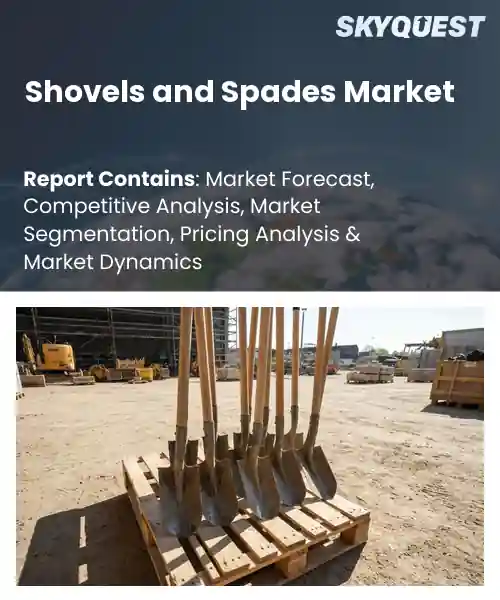
Shovels and Spades Market
Report ID: SQMIG20H2143
Report ID: SQMIG20H2143
[email protected]
USA +1 351-333-4748
Report ID:
SQMIG20H2143 |
Region:
Global |
Published Date: August, 2026
Pages:
157
|Tables:
144
|Figures:
78


Global Shovels And Spades Market size was valued at USD 2.10 Billion in 2024 and is poised to grow from USD 2.21 Billion in 2025 to USD 3.38 Billion by 2033, growing at a CAGR of 5.4% during the forecast period (2026-2033).
The global shovels and spades market trends includes manufacturers and distributors of tools used in construction, agriculture, and landscaping. Its importance derives from the function these tools serve in earth moving, safety compliance, and productivity improvement. Demand first surged after World II when massive infrastructure projects, such as the 1950s U.S. highway expansions, required extensive manual labor. Although mechanization later reduced reliance on manual equipment, a recent revival is evident as sustainability pressures favor low‑emission alternatives and developing economies increase housing construction. Thus, the main driver today is the renewed preference for affordable, low‑tech solutions in regions with limited machinery penetration.
Urbanization and infrastructure renewal constitute the second decisive factor shaping the global shovels and spades market share, because expanding cities generate demand for ground‑preparation activities that cannot be fully automated. In growing megacities such as Lagos and Jakarta, municipal utilities employ hand‑operated spades to retrofit drainage networks, a task that remains prohibitive for excavators on narrow alleys. This reliance creates opportunities for manufacturers to introduce ergonomically designed, corrosion‑resistant models that reduce worker fatigue and increase turnaround time. Consequently, suppliers that integrate handle sensors offering torque feedback can capture contracts, while governments that incentivize low‑carbon construction amplify market expansion across emerging regions.
How is AI Transforming the Shovels and Spades Market?
AI is reshaping the shovels and spades market growth by embedding intelligent sensors, predictive analytics, and machine‑learning algorithms into traditional tools. Manufacturers now offer handles that monitor usage patterns, alert users to fatigue, and suggest optimal grip angles, while inventory systems automatically reorder stock based on real‑time demand forecasts. Retailers benefit from AI‑driven recommendation engines that match customers with the most suitable product based on project type and skill level. Service teams leverage remote diagnostics to schedule maintenance before failures occur, reducing downtime for contractors.
Together, these advances turn a simple manual instrument into a connected, data‑rich asset that improves safety, productivity, and cost efficiency across construction sites.No publicly announced AI‑driven initiative has been reported in the shovels and spades market as of the latest available information.
Market snapshot - (2026-2033)
Global Market Size
USD 2.1 Billion
Largest Segment
Shovels
Fastest Growth
Spades
Growth Rate
5.4% CAGR
To get more insights on this market click here to Request a Free Sample Report
Global shovels and spades market is segmented by product type, material, handle material, application, distribution channel and region. Based on product type, the market is segmented into shovels and spades. Based on material, the market is segmented into steel, aluminum and others. Based on handle material, the market is segmented into wood, fiberglass, metal and others. Based on application, the market is segmented into gardening, construction, agriculture and others. Based on distribution channel, the market is segmented into offline and online. Based on region, the market is segmented into North America, Europe, Asia Pacific, Latin America and Middle East & Africa.
Steel segment dominates because its inherent strength and resistance to deformation make it the preferred choice for heavy duty tools. Manufacturers rely on steel to ensure long service life, especially in demanding construction and agricultural tasks. The material’s ability to withstand impact and wear builds confidence among professional users, driving consistent demand. Its proven performance also supports higher price tolerance, reinforcing its leadership in the market.
However, aluminum segment is witnessing the strongest growth momentum because its lightweight nature reduces user fatigue and enables rapid manoeuvrability. Advances in alloy technology are enhancing corrosion resistance, widening its appeal across gardening and light construction applications. This innovation attracts new user groups, accelerating market expansion and opening fresh opportunities for product diversification.
Fiberglass segment stands out because its vibration damping properties enhance user comfort during prolonged tasks. The material’s flexibility absorbs shocks, reducing strain on the hands and wrists, which is critical for both professional laborers and hobby gardeners. Its resistance to rot and moisture extends handle lifespan, making it a reliable choice for diverse environments. These ergonomic advantages differentiate fiberglass handled tools, fostering strong market preference.
On the other hand, wood segment is experiencing rapid expansion because its natural aesthetic appeals to eco conscious consumers seeking sustainable options. Advances in treatment processes improve durability and resistance to decay, widening acceptance beyond traditional gardening. This growing consumer preference fuels demand, positioning wood handles as a key growth driver that broadens market reach and stimulates product innovation.
To get detailed segments analysis, Request a Free Sample Report
North America leads the market through a blend of deep-rooted construction activity, extensive infrastructure renewal, and a robust distribution network that supports rapid product availability. The region benefits from strong engineering expertise and a culture of safety that drives demand for high‑performance tools. A mature retail landscape, coupled with proactive adoption of ergonomic designs, reinforces customer loyalty. Moreover, ongoing public investment in transportation and residential projects sustains a steady flow of orders, while a well‑established supply chain ensures consistent quality and innovation. These factors collectively cement North America’s position at the forefront of the global market.
Shovels and spades market outlook in United States thrives on large‑scale public works and private development projects that emphasize durability and efficiency. Consumers value advanced materials that reduce fatigue, prompting manufacturers to prioritize lightweight yet resilient designs. A competitive retail environment encourages frequent product upgrades, while a strong emphasis on occupational health standards fuels demand for ergonomically engineered tools. Collaborative relationships between suppliers and construction firms further enhance market responsiveness.
Shovels and spades market forecast in Canada is shaped by widespread infrastructure modernization and a seasonal construction rhythm that drives inventory turnover. Preference for tools that perform reliably in variable climates encourages innovation in corrosion‑resistant coatings. Retail channels are highly integrated, offering both specialized dealer networks and online access, which broadens consumer reach. A focus on sustainability and responsible sourcing also influences purchasing decisions, reinforcing the market’s alignment with broader environmental objectives.
European expansion is anchored by stringent regulatory frameworks that prioritize worker safety and environmental stewardship, prompting a shift toward high‑quality, ergonomically designed tools. The region’s diversified construction landscape, ranging from historic renovation to modern urban development, fuels varied product requirements. Strong engineering traditions foster continuous innovation, while collaborative industry clusters accelerate knowledge sharing. Growing consumer awareness of durability and lifecycle cost further propels demand for premium shovels and spades, positioning Europe as a dynamic growth engine within the global arena.
Shovels and spades market regional outlook in Germany benefits from a reputation for precision engineering and a concentration of original equipment manufacturers. Demand is driven by sophisticated construction methodologies that require tools with exacting standards for balance and strength. A well‑organized distribution system ensures swift market penetration, while sustainability initiatives encourage the use of recyclable materials. Close cooperation between academic research institutes and industry accelerates product development, reinforcing Germany’s dominant market role.
Shovels and spades market regional forecast in United Kingdom experiences rapid uptake due to aggressive urban regeneration and a vibrant residential building sector. Builders increasingly seek lightweight yet robust tools that enhance productivity on constrained sites. The market is energized by a proactive trade association network that promotes best practices and safety certifications. Retail diversity, encompassing both traditional hardware outlets and e‑commerce platforms, expands consumer access, while a growing emphasis on heritage project preservation drives demand for specialized tool specifications.
Shovels and spades market analysis in France is emerging as a niche segment supported by heightened interest in eco‑friendly construction practices. French firms prioritize tools that combine durability with reduced environmental impact, fostering innovation in bio‑based handle materials. The market benefits from a strong artisanal tradition that values craftsmanship, encouraging premium positioning. Integration of digital ordering platforms streamlines procurement for small and medium enterprises, further nurturing market maturation.
Asia Pacific advances its market stature through a convergence of rapid urbanization, extensive infrastructure programs, and a cultural emphasis on manual craftsmanship. Manufacturers in the region focus on cost‑effective production without sacrificing quality, leveraging advanced manufacturing techniques to meet diverse consumer expectations. Growing awareness of ergonomic health drives adoption of tools designed to lessen strain, while expanding retail formats, both brick‑and‑mortar and online, improve product accessibility. Collaborative initiatives between governments and industry bodies also promote standardization and skill development, reinforcing the region’s competitive edge.
Shovels and spades market penetration in Japan reflects a blend of high‑technology manufacturing and respect for traditional building methods. Demand is fueled by meticulous construction standards that favor tools offering precise control and exceptional balance. Manufacturers emphasize lightweight alloys and ergonomic grips to align with the country’s focus on worker well‑being. A sophisticated distribution network ensures rapid delivery to both large contractors and small‑scale artisans, while continuous product refinement sustains market relevance.
Shovels and spades industry in South Korea is propelled by robust public infrastructure initiatives and a dynamic private construction sector. The market favors innovative designs that incorporate vibration‑reduction technology, addressing heightened safety concerns. Domestic producers leverage advanced metalworking capabilities to supply durable, high‑performance tools at competitive pricing. An integrated online marketplace expands reach to emerging builders, while government‑backed training programs reinforce skilled usage, collectively strengthening the country’s market position.
To know more about the market opportunities by region and country, click here to
Buy The Complete Report
Infrastructure Development Boosts Demand
Technological Innovations Enhance Efficiency
Fluctuating Raw Material Prices
Stringent Environmental Regulations
Request Free Customization of this report to help us to meet your business objectives.
The global calcium assay market is highly competitive, comprising diversified life-science companies, biochemical reagent suppliers, and specialized assay developers that compete through detection sensitivity, assay speed, fluorescence or luminescence performance, automation compatibility, sample flexibility, and high-throughput screening capabilities. Major participants include Abcam, Thermo Fisher Scientific, Merck KGaA, BioVision, Cell Signaling Technology, Promega, Bio-Rad Laboratories, Cayman Chemical, Creative Diagnostics, GenScript, Elabscience, Abnova, Boster Biological Technology, AAT Bioquest, ScienCell Research Laboratories, MyBioSource, Takara Bio, Enzo Life Sciences, and Dojindo Laboratories. Leading suppliers offer multiple calcium-detection approaches, including colorimetric assays for quantitative calcium determination and fluorescent or luminescent indicators for monitoring intracellular calcium mobilization. Thermo Fisher competes through its Invitrogen Molecular Probes portfolio, including Fluo-4, Fluo-3, Fura-2, and Fluo-4 Direct calcium assays designed for microplate, imaging, and high-throughput applications, while Abcam offers colorimetric, fluorometric, luminometric, and cell-based calcium-flux assays. Competition is increasingly focused on homogeneous add-and-read workflows, no-wash formats, larger assay windows, lower background fluorescence, automation, and compatibility with high-content and high-throughput screening platforms.
Top Player’s Company Profile
Recent Developments in the Shovels and Spades Market
SkyQuest’s ABIRAW (Advanced Business Intelligence, Research & Analysis Wing) is our Business Information Services team that Collects, Collates, Correlates, and Analyses the Data collected by means of Primary Exploratory Research backed by robust Secondary Desk research. As per SkyQuest analysis, the global shovels and spades market is being propelled by infrastructure development which drives steady demand for manual earth‑moving tools, while advances in ergonomic design and smart sensors serve as a second driver boosting productivity. However, volatile raw material prices act as a restraint, pressuring margins and slowing upgrades. North America remains the dominant region thanks to mature construction activity and robust distribution networks, and the steel‑based product segment continues to lead due to its strength and durability.
| Report Metric | Details |
|---|---|
| Market size value in 2024 | USD 2.1 Billion |
| Market size value in 2033 | USD 3.38 Billion |
| Growth Rate | 5.4% |
| Base year | 2024 |
| Forecast period | (2026-2033) |
| Forecast Unit (Value) | USD Billion |
| Segments covered |
|
| Regions covered | North America (US, Canada), Europe (Germany, France, United Kingdom, Italy, Spain, Rest of Europe), Asia Pacific (China, India, Japan, Rest of Asia-Pacific), Latin America (Brazil, Rest of Latin America), Middle East & Africa (South Africa, GCC Countries, Rest of MEA) |
| Companies covered |
|
| Customization scope | Free report customization with purchase. Customization includes:-
|
To get a free trial access to our platform which is a one stop solution for all your data requirements for quicker decision making. This platform allows you to compare markets, competitors who are prominent in the market, and mega trends that are influencing the dynamics in the market. Also, get access to detailed SkyQuest exclusive matrix.
Table Of Content
Executive Summary
Market overview
Parent Market Analysis
Market overview
Market size
KEY MARKET INSIGHTS
COVID IMPACT
MARKET DYNAMICS & OUTLOOK
Market Size by Region
KEY COMPANY PROFILES
Methodology
For the Shovels and Spades Market, our research methodology involved a mixture of primary and secondary data sources. Key steps involved in the research process are listed below:
1. Information Procurement: This stage involved the procurement of Market data or related information via primary and secondary sources. The various secondary sources used included various company websites, annual reports, trade databases, and paid databases such as Hoover's, Bloomberg Business, Factiva, and Avention. Our team did 45 primary interactions Globally which included several stakeholders such as manufacturers, customers, key opinion leaders, etc. Overall, information procurement was one of the most extensive stages in our research process.
2. Information Analysis: This step involved triangulation of data through bottom-up and top-down approaches to estimate and validate the total size and future estimate of the Shovels and Spades Market.
3. Report Formulation: The final step entailed the placement of data points in appropriate Market spaces in an attempt to deduce viable conclusions.
4. Validation & Publishing: Validation is the most important step in the process. Validation & re-validation via an intricately designed process helped us finalize data points to be used for final calculations. The final Market estimates and forecasts were then aligned and sent to our panel of industry experts for validation of data. Once the validation was done the report was sent to our Quality Assurance team to ensure adherence to style guides, consistency & design.
Analyst Support
Customization Options
With the given market data, our dedicated team of analysts can offer you the following customization options are available for the Shovels and Spades Market:
Product Analysis: Product matrix, which offers a detailed comparison of the product portfolio of companies.
Regional Analysis: Further analysis of the Shovels and Spades Market for additional countries.
Competitive Analysis: Detailed analysis and profiling of additional Market players & comparative analysis of competitive products.
Go to Market Strategy: Find the high-growth channels to invest your marketing efforts and increase your customer base.
Innovation Mapping: Identify racial solutions and innovation, connected to deep ecosystems of innovators, start-ups, academics, and strategic partners.
Category Intelligence: Customized intelligence that is relevant to their supply Markets will enable them to make smarter sourcing decisions and improve their category management.
Public Company Transcript Analysis: To improve the investment performance by generating new alpha and making better-informed decisions.
Social Media Listening: To analyze the conversations and trends happening not just around your brand, but around your industry as a whole, and use those insights to make better Marketing decisions.
REQUEST FOR SAMPLE
 REQUEST FREE CUSTOMIZATION
Global Shovels And Spades Market size was valued at USD 2.1 Billion in 2024 and is poised to grow from USD 2.21 Billion in 2025 to USD 3.38 Billion by 2033, growing at a CAGR of 5.4% during the forecast period (2026-2033).
Top Player’s Company Profile 'Fiskars Group', 'Ames Companies, Inc.', 'Truper Herramientas', 'Spear & Jackson Group', 'Bully Tools', 'True Temper', 'Razor-Back', 'Garant Tools', 'Burgon & Ball', 'Corona Tools', 'Bosch Power Tools', 'DeWit Garden Tools', 'Wilcox All-Pro Tools', 'Nupla Corporation', 'Faithfull Tools', 'Roughneck Tools', 'Hultafors Group', 'Bellota Agrisolutions', 'Craftsman', 'Wolf-Garten'
The rapid expansion of public and private infrastructure projects creates a sustained need for shovels and spades, as these tools are essential for earthmoving, grading, and foundation work, thereby driving market expansion through increased procurement cycles and broader geographic outreach across emerging and developed economies. These initiatives often prioritize speed and reliability, prompting manufacturers to innovate designs and supply chains, which further reinforces demand momentum and encourages investment from distributors and end‑users seeking dependable equipment for large‑scale construction activities throughout the project lifecycle.
Sustainable Materials Adoption: Growing environmental awareness is prompting manufacturers and end‑users to prioritize eco‑friendly alloys and recycled steel in shovel and spade production. Companies are investing in greener supply chains, employing low‑carbon manufacturing processes, and offering products with reduced embodied energy. This shift not only aligns with corporate sustainability pledges but also meets client demand for greener infrastructure, driving broader acceptance of biodegradable coatings and circular‑economy initiatives across construction and mining sectors, and fostering long‑term resilience for stakeholders worldwide while enhancing brand reputation.
Why does North America Dominate the Global Shovels and Spades Market? |@12


Want to customize this report? This report can be personalized according to your needs. Our analysts and industry experts will work directly with you to understand your requirements and provide you with customized data in a short amount of time. We offer $1000 worth of FREE customization at the time of purchase.
Feedback From Our Clients


 USA (+1) 351-333-4748

