Shop insurance Market
Report ID: SQMIG40P2021
Report ID: SQMIG40P2021
[email protected]
USA +1 351-333-4748
Report ID:
SQMIG40P2021 |
Region:
Global |
Published Date: March, 2026
Pages:
157
|Tables:
143
|Figures:
78


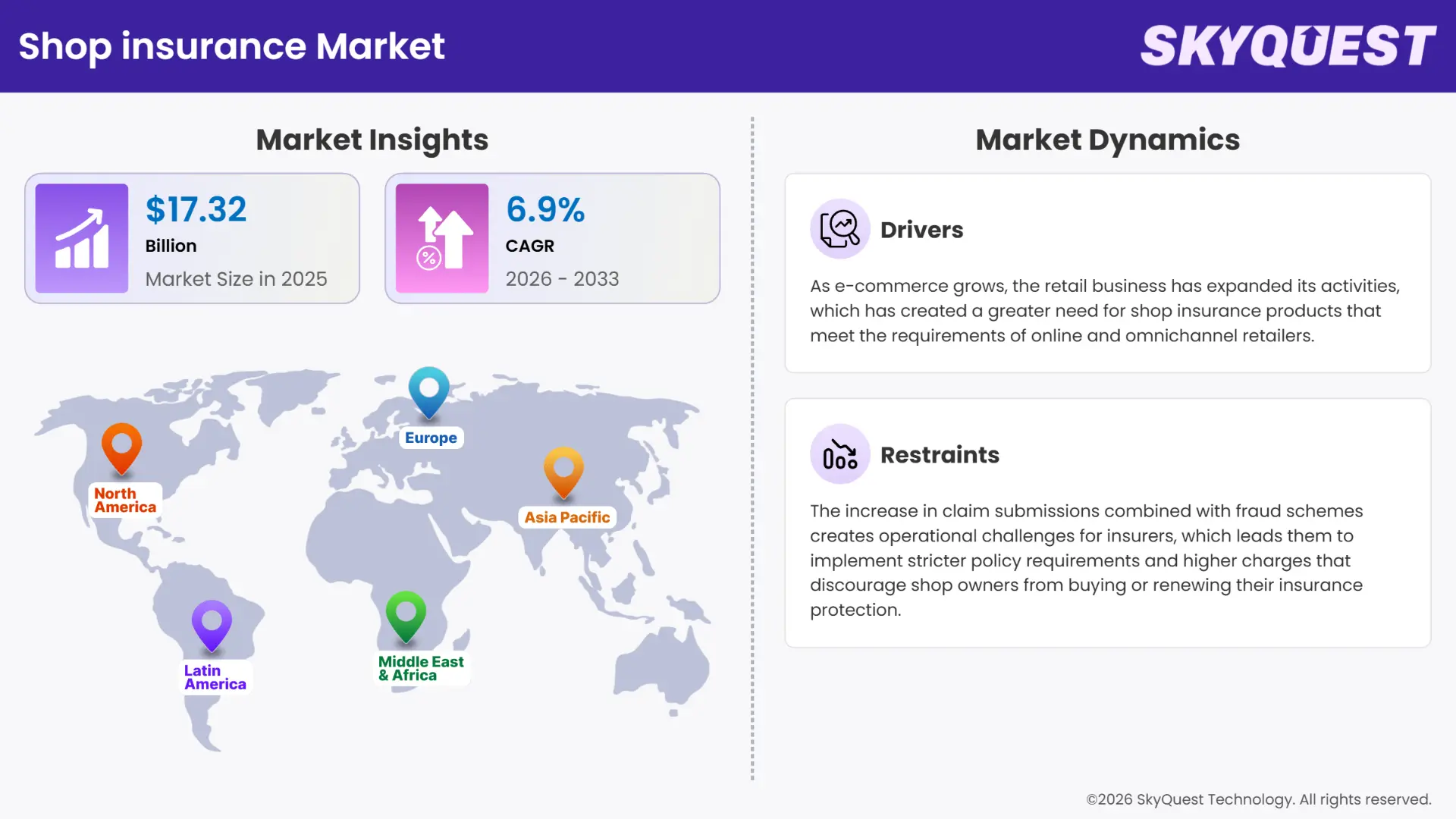
Global Shop Insurance Market size was valued at USD 16.20 Billion in 2024 and is poised to grow from USD 17.32 Billion in 2025 to USD 29.53 Billion by 2033, growing at a CAGR of 6.9% during the forecast period (2026-2033).
Key Takeaways: Market Trends & Insights
The global shop insurance market outlook changes which serve as the market's main expansion driver because shop owners now understand their risks better. The market serves a critical purpose because it enables companies to continue operations while maintaining their landlord and lender relationships and protecting their revenue streams during fire incidents and thefts and supply chain disruptions and customer accidents. The insurance industry developed from local indemnity contracts which existed as customized solutions to standard package policies that offered property and public liability and business interruption protection.
Moreover, the shop insurance industry developed new products through cyber add-ons and parametric weather triggers which had recently been developed to address new hazards that emerged from e-commerce platform partnerships. Insurtech data and distribution channels act as the central element which determines shop insurance market development because superior point-of-sale and sensor data streams enable accurate risk evaluation and rapid claims processing. The insurance companies enable policyholders to pay based on their actual usage while offering additional protection through cyber and stock-in-transit coverage which small chains and pop-ups are starting to adopt. The system enables insurers to use POS integration for theft detection and revenue drop validation, which allows them to expedite claim processing both for parametric flood products and emergency repair needs. The first process decreases underwriting risks while the second process creates opportunities to sell additional products through payment processors and other distribution channels.
How is AI Transforming the Shop Insurance Market?
The AI technology currently transforms shop insurance by enhancing the three core processes of underwriting and claims management and customer service. The main features provide automated risk assessment through sensor data and image analysis and photo-based damage estimation for first loss reporting and customized insurance solutions for small retailers and advanced fraud detection through pattern recognition. The independent shops receive better access to insurance through the insurance industry, which currently uses models from most carriers and insurtechs to fast-track quotation processes and triage claim assessments. The tools enable shops to create customized policies while achieving fast claim resolutions and receiving clear instructions on risk management, which boosts store operations and improves customer service.
NEXT Insurance established a collaboration with ZestyAI in February 2025 to introduce AI risk analytics for property assessment, which enhances underwriting accuracy for small shop insurance policies. The innovation enables fast policy binding through its inspection and pricing process, which works together with its policy binding system. The enhanced market efficiency enables independent retailers to access customized coverage options, which create unique insurance solutions through tailored market offerings.
To get more insights on this market click here to Request a Free Sample Report
The global shop insurance market is segmented by coverage, policy type, enterprise size, distribution channel, end user, and region. Based on coverage, the market is divided into dwelling coverage, content coverage, and optional coverages. In terms of policy type, it is categorized into standard shop insurance policies and customized package policies (bundled coverage). By enterprise size, the market includes small and medium-sized businesses and large enterprises. Based on distribution channels, the segmentation comprises online portals and offline channels. In terms of end users, the market covers food retail, arts and crafts, clothing, grocery, and other sectors. Geographically, the market is segmented into North America, Europe, Asia Pacific, Latin America, and the Middle East & Africa.
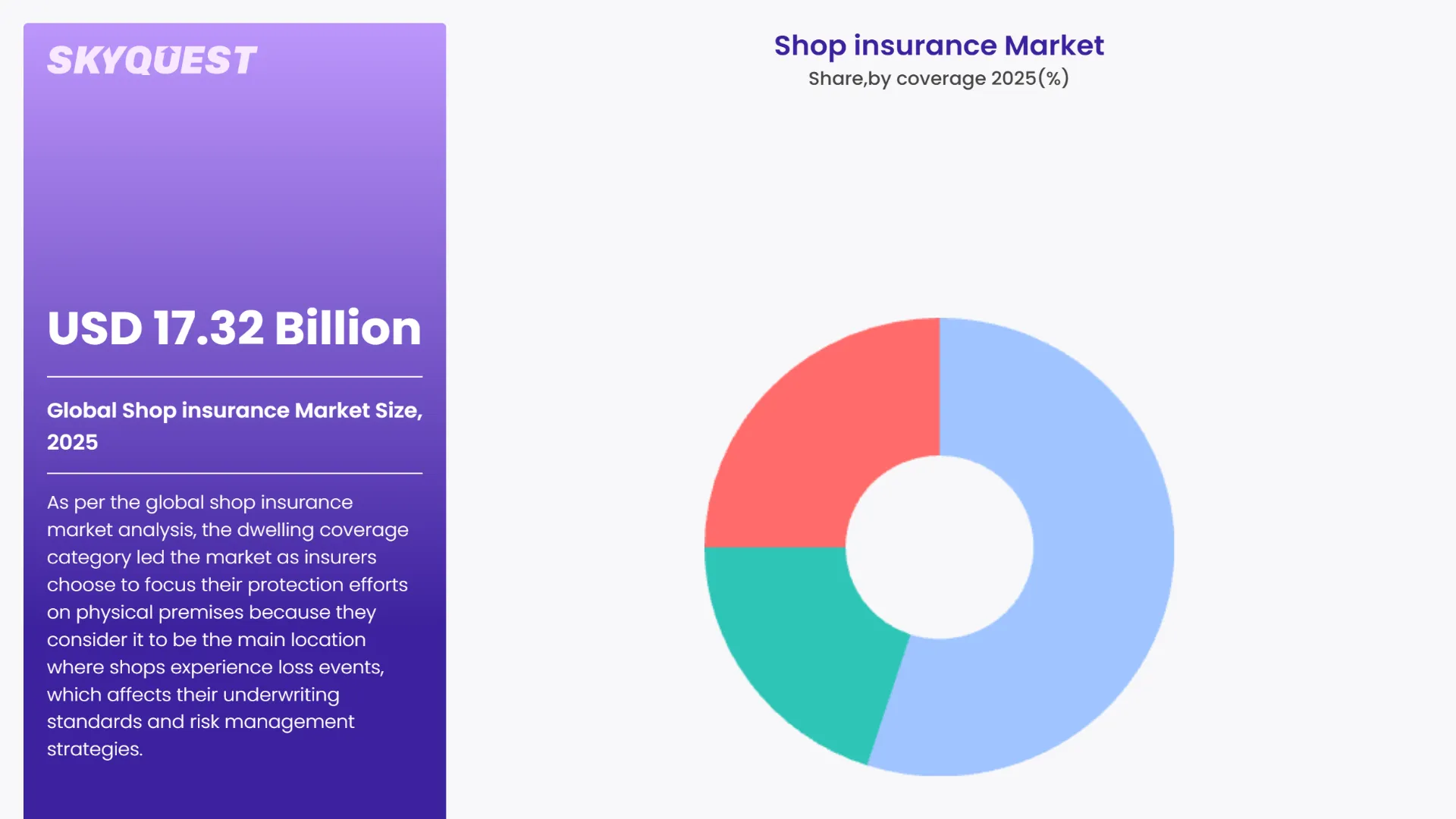
As per the global shop insurance market analysis, the dwelling coverage category led the market as insurers choose to focus their protection efforts on physical premises because they consider it to be the main location where shops experience loss events, which affects their underwriting standards and risk management strategies. The industry develops standardized inspection processes and premium structures because building security requirements and fire protection and storm protection capabilities have become essential for protecting building structures. Insurers use their claims management resources and their risk assessment resources to support building protection, which creates a balanced product distribution system throughout the insurance market.
However, the content coverage segment develops at the highest speed because shop operators need wider protection from theft and spoilage and accidental damage for their inventory and equipment and stock. Content products become more appealing because of better inventory valuation methods and microinsurance options and simplified digital claims processes, which enable insurers to upsell and create tailored policies for retail businesses and generate new business streams through their modular add-on solutions.
According to the global shop insurance market forecast, the offline channels holds the largest market share because most shop owners need to meet face-to-face with application experts to make complicated policy selection decisions and complete risk evaluations through physical surveys and obtain custom endorsements, which establishes trust between them and their agents and brokers. Physical channels allow insurers to handle thorough inspections while reaching agreements on specific coverage details and providing direct assistance during the claims process, thus enabling them to focus their training and loss control efforts on intermediaries who will create strong relationships for ongoing traditional customer acquisition and retention.
Whereas the online portal category is anticipated to have the highest shop insurance market share because its digital quoting system and instant endorsement feature and simplified claims process make it easier for shops to obtain services, which attracts customers who prefer digital solutions. The combination of point-of-sale system API integrations and data-driven underwriting and embedded offers enables insurers to achieve rapid growth while reaching underserved shops and developing modular products, which will expand their future market distribution capabilities.
To get detailed segments analysis, Request a Free Sample Report
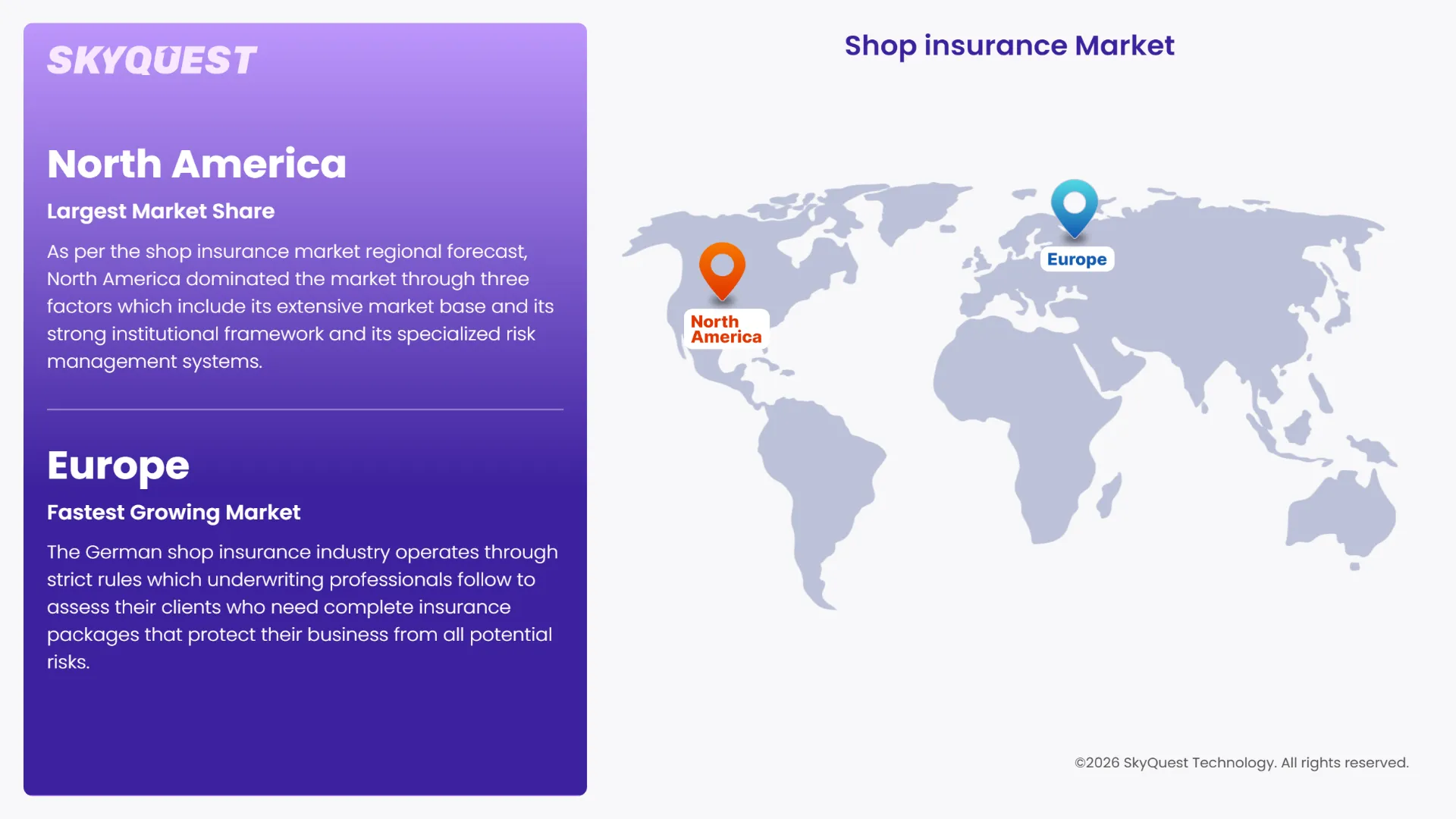
As per the shop insurance market regional forecast, North America dominated the market through three factors which include its extensive market base and its strong institutional framework and its specialized risk management systems. Insurers and reinsurers demonstrate their advanced underwriting ability, which enables them to deliver an extensive range of protections that suit multiple retail business models. Established broker networks together with affinity partnerships enable both small and large shop operators to effectively distribute their products while making them easier to access. Companies that use advanced digital systems can manage their policies and process claims effectively while their data analytics systems help them create specific risk categories. The combination of regulatory rules and capital market entry points functions as a catalyst which drives businesses to develop new products while developing their existing offerings. The close cooperation between carriers and technology vendors together with service providers results in rapid creation of modular solutions which meet new retail challenges and operational difficulties for businesses that operate across the region.
The United States shop insurance market operates through intense competition between insurers who provide specialized liability and property packages for different retail business models. The national broker networks together with independent agents and digital platforms enable distribution partners to handle both placement and renewal procedures without difficulty. The shop operators maintain their operations through their focus on two areas which include efficient claims processing and implementing services that prevent losses. The retail technology system and its risk consultant partnerships enable product development, which creates coverage solutions that match both operational requirements and specific site risks.
The Canadian shop insurance market growth relies on relationship-based distribution systems which use local underwriting specialists who understand regional regulatory requirements and weather patterns to create insurance solutions. The carriers work together with brokers and retail associations to develop coverage solutions which match community standards and actual operational needs. Providers create distinct service experiences through their loss of mitigation services and customer service. Digital policy servicing and analytics technology enable customers to reduce their underwriting costs. The insurance industry shows readiness to develop specialized coverage options which create bundled products that protect different types of shops within both urban and regional areas.
European markets are expanding quickly due to three drivers which include regulatory standardization and retail businesses becoming more advanced and technological advancements in distribution channels. Insurtech companies and traditional carriers establish partnerships to create modular solutions which handle the various risks that shops face in their physical and online operations. Cross-border trade activities together with unified supply chain operations create a need for insurance that provides coverage throughout all geographical boundaries which leads to the development of new products and easier placement methods. Small and medium retailers develop trust through their improvement of three service areas which include service quality assessment and claims processing speed and risk engineering work. Market consolidation between distributors and strategic alliances with retail associations enables distributors to expand their customer base. The European economies experience growth since businesses choose to protect their operations and brand image through insurance policies which create stability in their major markets.
The German shop insurance industry operates through strict rules which underwriting professionals follow to assess their clients who need complete insurance packages that protect their business from all potential risks. The relationship between carriers and craft and trade organizations enables both traditional and modern retail operators to obtain customized insurance solutions. Organizations prioritize two activities which involve technical measures for preventing losses and performing in-depth evaluations of all potential risks which lead to stable premium rates and efficient claims handling. The local regulatory framework and business practices create distribution methods which already established broker networks can use through their existing partnership systems.
The United Kingdom shop insurance sector demonstrates its ability to create new products through its rapid implementation of online distribution systems. The Insurtech industry and insurance companies develop flexible product systems which include different endorsement options to meet the specific insurance needs of retailers who operate both physical and online stores. The intense competition between distributors pushes them to enhance their service delivery through two specific improvements which include faster claims processing and risk management services that provide extra benefits. Companies achieve market growth through their close relationship with retail trade bodies and their focus on delivering services that meet customer needs.
The French shop insurance market shows new market potential because insurance providers develop better insurance products which match the needs of urban boutiques and regional retailers who need special liability and property coverage. Companies use both traditional broker connections and new direct and digital channels to increase distribution access. The underwriting process, which takes place in specific areas together with the customer assistance system, enables insurers to create effective strategies for entering new markets. The local associations together with their loss prevention advice system create safety for shop owners through their technical support which enables shops to start using structured protection systems.
Asia Pacific strengthens its functions through distribution of modernization and capacity development and product development for local markets. Insurers use digital platforms and mobile channels for retail distribution while their underwriting capacity increases through partnerships with international insurers and reinsurers. Local regulators create an environment that supports new service development by promoting both innovation and consumer protection. Retailers need modular insurance solutions because their operational and cyber risk needs have grown through their development of omnichannel systems. Organizations that use analytics and telematics can select better risks and maintain their pricing standards. The technology sector and brokers along with carriers work together on joint projects which help create solutions that can grow beyond their initial capabilities, thus helping the region develop into a stronger competitor in the global shop insurance market.
The Japanese shop insurance market requires exact underwriting specifications which need to work with the high service standards that retailers depend on for their business operations. Insurance companies provide custom solutions that match specific regional needs while helping businesses protect their operational activities through continuity programs. The distribution system uses traditional agency relationships together with modern digital platforms which offer advanced operational capabilities. Insurers build their reputation through loss prevention consulting and high-quality claims service delivery, which drives adoption of their services across both conventional and new retail business models.
The South Korean shop insurance market trends benefit from digital technologies which businesses quickly implement through cooperation between insurtech companies and traditional insurance providers to create new distribution and customer service systems that utilize advanced technologies. The market now provides products which support omnichannel retailers who need solutions for both cybersecurity threats and business continuity requirements. Organizations provide small business operators with access to brokers and digital platforms, while their partnerships with logistics and payment systems enable deeper integration of their services. The retail business expands into urban areas when companies use efficient customer service systems which help them process claims quickly.
To know more about the market opportunities by region and country, click here to
Buy The Complete Report
Expansion Of E-commerce Channels
Adoption Of Digital Risk Tools
Rising Claims and Fraud Exposure
Complex Regulatory Compliance Burden
Request Free Customization of this report to help us to meet your business objectives.
The competitive environment for global shop insurance reaches its peak because merchants and point of sale systems currently implement embedded insurance solutions at an increasing rate which creates direct competition between different distribution methods, user experience design, and merchant collaboration efforts. The business consolidation strategy of Real companies operates through M&A activities which include the Setoo Pattern merger and Coverdash plus LendingTree partnership distribution system and Weecover platform development of products which offer custom checkout insurance.
SkyQuest’s ABIRAW (Advanced Business Intelligence, Research & Analysis Wing) is our Business Information Services team that Collects, Collates, Correlates, and Analyses the Data collected by means of Primary Exploratory Research backed by robust Secondary Desk research.
As per SkyQuest analysis, the global shop insurance market growth is driven through e-commerce channel expansion, which boosts demand for omnichannel and parcel-related coverages, and digital risk tools that enable more precise underwriting and quicker claims processing. The market faces challenges from rising claims and fraud exposure, which restrict pricing and underwriting flexibility. North America continues to dominate due to advanced distribution, data-rich underwriting, and mature broker networks; while dwelling coverage is the dominating segment as insurers prioritize protection of physical premises. The market environment currently favors partnerships that use modular tech-enabled products to help small and medium retailers access more product options.
| Report Metric | Details |
|---|---|
| Market size value in 2024 | USD 16.20 Billion |
| Market size value in 2033 | USD 29.53 Billion |
| Growth Rate | 6.9% |
| Base year | 2024 |
| Forecast period | 2026-2033 |
| Forecast Unit (Value) | USD Billion |
| Segments covered |
|
| Regions covered | North America (US, Canada), Europe (Germany, France, United Kingdom, Italy, Spain, Rest of Europe), Asia Pacific (China, India, Japan, Rest of Asia-Pacific), Latin America (Brazil, Rest of Latin America), Middle East & Africa (South Africa, GCC Countries, Rest of MEA) |
| Companies covered |
|
| Customization scope | Free report customization with purchase. Customization includes:-
|
To get a free trial access to our platform which is a one stop solution for all your data requirements for quicker decision making. This platform allows you to compare markets, competitors who are prominent in the market, and mega trends that are influencing the dynamics in the market. Also, get access to detailed SkyQuest exclusive matrix.
Table Of Content
Executive Summary
Market overview
Parent Market Analysis
Market overview
Market size
KEY MARKET INSIGHTS
COVID IMPACT
MARKET DYNAMICS & OUTLOOK
Market Size by Region
KEY COMPANY PROFILES
Methodology
For the Shop insurance Market, our research methodology involved a mixture of primary and secondary data sources. Key steps involved in the research process are listed below:
1. Information Procurement: This stage involved the procurement of Market data or related information via primary and secondary sources. The various secondary sources used included various company websites, annual reports, trade databases, and paid databases such as Hoover's, Bloomberg Business, Factiva, and Avention. Our team did 45 primary interactions Globally which included several stakeholders such as manufacturers, customers, key opinion leaders, etc. Overall, information procurement was one of the most extensive stages in our research process.
2. Information Analysis: This step involved triangulation of data through bottom-up and top-down approaches to estimate and validate the total size and future estimate of the Shop insurance Market.
3. Report Formulation: The final step entailed the placement of data points in appropriate Market spaces in an attempt to deduce viable conclusions.
4. Validation & Publishing: Validation is the most important step in the process. Validation & re-validation via an intricately designed process helped us finalize data points to be used for final calculations. The final Market estimates and forecasts were then aligned and sent to our panel of industry experts for validation of data. Once the validation was done the report was sent to our Quality Assurance team to ensure adherence to style guides, consistency & design.
Analyst Support
Customization Options
With the given market data, our dedicated team of analysts can offer you the following customization options are available for the Shop insurance Market:
Product Analysis: Product matrix, which offers a detailed comparison of the product portfolio of companies.
Regional Analysis: Further analysis of the Shop insurance Market for additional countries.
Competitive Analysis: Detailed analysis and profiling of additional Market players & comparative analysis of competitive products.
Go to Market Strategy: Find the high-growth channels to invest your marketing efforts and increase your customer base.
Innovation Mapping: Identify racial solutions and innovation, connected to deep ecosystems of innovators, start-ups, academics, and strategic partners.
Category Intelligence: Customized intelligence that is relevant to their supply Markets will enable them to make smarter sourcing decisions and improve their category management.
Public Company Transcript Analysis: To improve the investment performance by generating new alpha and making better-informed decisions.
Social Media Listening: To analyze the conversations and trends happening not just around your brand, but around your industry as a whole, and use those insights to make better Marketing decisions.
REQUEST FOR SAMPLE
 REQUEST FREE CUSTOMIZATION
Global Shop Insurance Market size was valued at USD 16.2 Billion in 2024 and is poised to grow from USD 17.32 Billion in 2025 to USD 29.53 Billion by 2033, growing at a CAGR of 6.9% during the forecast period (2026-2033).
The Global shop insurance competitive landscape is driven by rapid adoption of embedded insurance at point of sale and merchant platforms, intensifying competition around distribution, UX and merchant partnerships. Real strategies are consolidation via M&A such as the Setoo Pattern merger, partnership-led channel expansion exemplified by Coverdash and LendingTree, and API-first product innovation from platforms like Weecover that embed tailored cover at checkout. 'Berkshire Hathaway', 'Allianz', 'AXA', 'Cigna', 'Liberty Mutual Insurance', 'Progressive Casualty Insurance Company', 'Ping An Insurance', 'Allstate Insurance Company', 'AIA Group', 'China Life Insurance Company', 'MetLife', 'Farmers Insurance', 'Chubb Limited', 'Tokio Marine Holdings', 'The Hartford', 'Zurich Insurance Group', 'Travelers Companies', 'Nationwide Mutual Insurance Company', 'American Family Insurance', 'Aviva plc'
E-commerce expansion has broadened the range and volume of retail activity, prompting greater demand for shop insurance products tailored to online and omnichannel sellers. Insurers respond by designing policies that address parcel loss, customer injury in click‑and‑collect scenarios, and stock handling across multiple fulfillment points, which increases product relevance and adoption. Broader distribution through online brokers and marketplaces also simplifies purchase and renewal processes, encouraging shop owners to secure coverage, thereby supporting market growth through improved accessibility and perceived value of tailored insurance solutions.
Digital Distribution And Personalization: Insurers are shifting toward seamless digital channels and tailored product experiences, enabling brokers and retailers to offer shop specific policies that match customer preferences and purchase patterns. This trend emphasizes simplified online quoting, contextual add ons at point of sale, and personalized coverage bundles driven by behavioral insights. Resulting improvements in conversion and retention encourage partnerships with omnichannel platforms and fintechs, while underwriting and customer service adapt to deliver faster, more relevant interactions that align with shopping journeys and expectations.
North America Dominate the Global Shop insurance Market.
Dwelling Coverage is the leading segment, as insurers prioritize protecting the physical premises of retail establishments from damages and operational disruptions.
AI is improving underwriting, claims management, fraud detection, and customer service through automated risk assessment, image-based damage estimation, and personalized insurance offerings for retailers.


Want to customize this report? This report can be personalized according to your needs. Our analysts and industry experts will work directly with you to understand your requirements and provide you with customized data in a short amount of time. We offer $1000 worth of FREE customization at the time of purchase.
Feedback From Our Clients


 USA (+1) 351-333-4748

