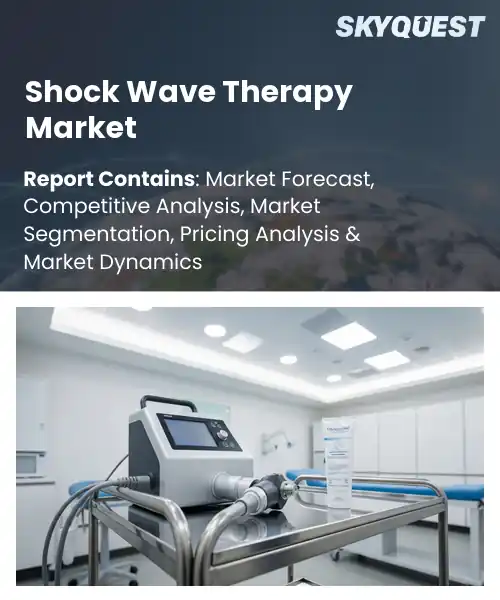
Shock Wave Therapy Market
Report ID: SQMIG35A4182
Report ID: SQMIG35A4182
[email protected]
USA +1 351-333-4748
Report ID:
SQMIG35A4182 |
Region:
Global |
Published Date: July, 2026
Pages:
157
|Tables:
178
|Figures:
79


Global Shock Wave Therapy Market size was valued at USD 2.6 Billion in 2024 and is poised to grow from USD 2.75 Billion in 2025 to USD 4.28 Billion by 2033, growing at a CAGR of 5.7% during the forecast period (2026-2033).
Shock wave therapy (SWT) counts as a non-invasive approach that sends acoustic pulses to help with musculoskeletal issues, chronic wounds, and also urological problems. The market has been growing quickly, mainly because clinicians are noticing it can speed up tissue recovery while at the same time decreasing the dependence on pharmaceuticals.
The biggest factor driving the global shock wave therapy market growth is the increasing burden of musculoskeletal ailments in older groups, together with the push to cut down opioid use. Payers and care teams tend to favor options that give pain relief without addictive drugs, so many hospitals end up putting SWT machines into rehab departments. That uptake fuels equipment sales, and it also nudges manufacturers to build portable, lower cost devices… which then opens up room in several developing economies. Sports medicine clinics are a clear example too, because athletes tend to bounce back sooner, which reduces downtime and can even help the whole squad perform better. That cycle then boosts demand for training programs, and recurring service agreements. So, in the end, revenue is not only about hardware, but also about consumables, maintenance, and tele-health analytics
AI is improving shock wave therapy market outlook by making them more accurate and more tailored to each patient. AI methods can look at ultrasound images and identify the specific tissue areas that should be treated, so clinicians can aim energy where it will probably matter most. On top of that, machine learning models can forecast how someone might respond, which helps set the pressure and the frequency before the first pulse. And during treatment, sensors can feed real time information back to the device, so output gets adjusted while the session is happening, this can reduce discomfort and maybe accelerate healing. Overall, these features are shifting the market away from a one size fits all setup toward data driven treatment routines that can improve outcomes and also lower repeat visits
Market snapshot - (2026-2033)
Global Market Size
USD 2.6 Billion
Largest Segment
Focused Shock Wave Therapy Devices
Fastest Growth
Piezoelectric Shock Wave Therapy Devices
Growth Rate
5.7% CAGR
To get more insights on this market click here to Request a Free Sample Report
The global shock wave therapy market is segmented by product type, application, end user, technology, mobility type, patient type and region. Based on product type, the market is segmented into Focused Shock Wave Therapy Devices, Radial Shock Wave Therapy Devices, Electromagnetic Shock Wave Therapy Devices, Electrohydraulic Shock Wave Therapy Devices, Piezoelectric Shock Wave Therapy Devices and Others. Based on application, the market is segmented into Orthopedic Disorders, Urology, Cardiology, Sports Medicine, Physiotherapy and Others. Based on end user, the market is segmented into Hospitals, Physiotherapy Clinics, Sports Medicine Centers, Ambulatory Surgical Centers and Others. Based on technology, the market is segmented into Portable Shock Wave Therapy Systems, Table-top Shock Wave Therapy Systems and AI-enabled Therapy Systems. Based on mobility type, the market is segmented into Fixed Systems and Portable Systems. Based on patient type, the market is segmented into Adult, Geriatric and Pediatric. Based on region, the market is segmented into North America, Europe, Asia Pacific, Latin America and Middle East & Africa.
As per the shock wave therapy market analysis, Focused Shock Wave Therapy Devices are leading the segment, mainly because clinicians want very precise energy delivery that hits deep tissue lesions, so they end up seeing better clinical outcomes. Also, the way these devices can be tuned for focal depth and energy flux density matches the rising preference for minimally invasive procedures across different specialties. On top of that, the strong evidence around bone recovery and tendinopathy management makes physicians feel more confident, so hospitals and clinics keep putting money into these systems for patients globally.
Meanwhile, Piezoelectric Shock Wave Therapy Devices seem to be the fastest growing piece, mostly because they are more compact and can generate pulses quickly, which makes them easier to plug into outpatient workflows in a cost effective manner. Their low upkeep requirements and the fact they can work alongside emerging AI platforms also pull in newer adopters, which then helps the market widen and allows new therapeutic approaches to pop up.
According to the shock wave therapy market forecast, Orthopedic disorders drive most of the application demand, because they affect the biggest patient pool that needs non surgical, musculoskeletal pain management and functional repair rather than an operation. Clinicians like shock wave therapy because it can speed up bone and soft tissue repair, which helps lower dependence on medications and surgical options. That broad relevance keeps procurement steady from hospitals and physiotherapy providers who are after durable solutions that feel evidence based. Plus, favorable reimbursement patterns and expanding clinical guidance further lock in adoption, not only for acute care but also for long term pathways.
On the other hand, Sports Medicine is moving the fastest, because athletes, trainers, and rehab teams are increasingly chasing quicker return to activity tools that boost performance without going invasive. More high impact sports participation, and a stronger emphasis on injury prevention basically raises demand for portable shock wave units. So manufacturers respond by iterating faster and expanding product lines that fit this niche very directly.
To get detailed segments analysis, Request a Free Sample Report
As per the shock wave therapy market regional forecast, North America is staying ahead due to a more sophisticated healthcare delivery web, solid reimbursement rules, and this overall mindset that tends to welcome new therapeutic approaches. A lot of the confidence comes from extensive clinical research done by top academic groups, while there’s also this heavy clustering of device producers, which helps with quick product availability and ongoing post‑market backing. Insurers, care providers, and technology companies keep forming close working ties, so adoption moves faster, and patients also seem more aware of non‑invasive options, so demand stays steady. On top of that, regulatory pathways mix safety requirements with faster access, letting new technologies enter the market sooner, and that’s basically why the region keeps acting as a benchmark for both clinical results and operational performance in shock wave therapy.
United States Shock Wave Therapy Market
The Shock Wave Therapy sector in the United States is driven by an integrated care setup, where multidisciplinary teams slot the technology into orthopedic, sports medicine, and urological practices without too much friction. Strong insurance backing plus an open attitude toward emerging medical devices helps clinicians use upgraded protocols, and research-heavy hospitals keep producing evidence that supports wider clinical guidelines. Also, having large manufacturers located inside the country speeds up technology transfer, training, and service reliability, which then reinforces this loop of confidence and ongoing use across multiple patient groups.
Canada Shock Wave Therapy Market
In Canada, the Shock Wave Therapy industry benefits from a publicly funded system that leans into cost‑effective, evidence‑based interventions. Provincial health authorities often bring shock wave therapy into care pathways for long‑term musculoskeletal issues, so adoption is more uniform across both city and countryside. Joint research efforts between universities and industry players generate more local clinical data, which strengthens clinician trust. And with access to training programs plus a supportive regulatory setup, health providers are better able to fold the therapy into everyday practice, pushing gradual growth in patient uptake.
The European shock wave therapy market penetration looks fueled by a regulatory environment that’s more harmonized, so device approvals can move more smoothly across borders and multinational clinical studies feel more encouraged. Across many European health systems, non‑surgical approaches are getting prioritized, and shock wave therapy is often positioned as a go‑to choice for chronic pain control and regenerative care. Reimbursement in important markets, paired with detailed clinical guidance, also lifts physician confidence. There’s also a fairly dense chain of research organizations in places like Germany, the United Kingdom, and France, and they keep producing credible evidence that improves market standing. When manufacturers, hospitals, and professional societies collaborate, knowledge exchange speeds up, and best practices spread quickly across the region.
Germany Shock Wave Therapy Market
The German Shock Wave Therapy market is supported by a long‑running culture of medical innovation, plus a thick network of specialized outpatient clinics. Reimbursement structures make room for a broad set of indications, so clinicians can adopt the technology early in their treatment flow. Major German universities run careful clinical studies that end up influencing European guidelines, which strengthens the evidence layer behind the therapy. Since many major device producers are nearby, access to newer equipment is faster, and continuous professional education keeps healthcare teams’ skills consistent.
United Kingdom Shock Wave Therapy Market
In the United Kingdom, the Shock Wave Therapy market sees fast expansion because health policy tends to focus on early intervention for musculoskeletal disorders. National health service pathways increasingly include the technology, and private practices tend to respond with quick adoption. A strong research ecosystem feeds high‑impact publications, which then speeds up guideline acceptance. Training academies and professional societies also run frequent workshops, so practitioner know‑how keeps building. Altogether, policy support, evidence generation, and education connect in a way that supports accelerated market growth.
France Shock Wave Therapy Market
France’s Shock Wave Therapy market is starting to gain momentum as clinicians look for non‑invasive ways to handle a growing burden of chronic pain. Health insurance programs are gradually recognizing the therapy’s value, which supports broader reimbursement. Joint research initiatives between French hospitals and device manufacturers help generate localized clinical evidence, and that raises practitioner confidence. Plus, educational efforts led by professional societies increase awareness, while more incremental take‑up in physiotherapy and sports medicine suggests the therapy is steadily gaining a firmer foothold in the national healthcare environment.
Asia Pacific is consolidating its role through more heightened awareness about the benefits of non-surgical treatment, plus an expanding middle-class population that wants advanced healthcare options. In several economies, government health programs are actively backing the integration of shock wave therapy into public hospitals, and they’re stressing preventive care, as well as rehabilitative care, sometimes in a clear pathway. Meanwhile, aging demographics increase the prevalence of chronic musculoskeletal conditions, so there is this natural demand for effective interventions that are generally low-risk, or at least perceived that way. Local manufacturers are also putting money into research and development, tailoring devices to regional clinical preferences and cost considerations which matters a lot in day-to-day purchasing decisions. Cross-border collaborations among research institutions, clinicians, and industry are accelerating knowledge transfer too, and this is positioning the region as a growing hub, for clinical adoption and also technological innovation.
Japan Shock Wave Therapy Market
The Shock Wave Therapy Market in Japan is reinforced by a strong emphasis on precision medicine and a well-established network of specialty clinics that operate with consistent routines. National health insurance schemes provide coverage for a range of approved indications, so clinical use becomes more widespread, rather than limited. Japanese universities and hospitals run rigorous outcome studies that feed into practice guidelines, and that builds a solid evidence foundation over time. Domestic manufacturers work closely with healthcare providers to refine device ergonomics and treatment protocols, making sure things match local clinical standards, and even patient expectations, with less friction.
South Korea Shock Wave Therapy Market
The Shock Wave Therapy Market in South Korea benefits from rapid technology adoption and a health system that actively encourages innovative therapies. Reimbursement policies support a broad spectrum of applications, spanning orthopedics to urology, and this helps integration into both hospital settings and private practice, depending on where the patient goes. Robust clinical research from leading medical centers provides strong scientific endorsement, while government incentives for medical device development inspire more domestic innovation. Educational workshops and certification programs enhance clinician proficiency, and that tends to drive consistent growth in patient access across the country, even as the demand keeps shifting.
To know more about the market opportunities by region and country, click here to
Buy The Complete Report
Increasing Clinical Acceptance
Expanding Reimbursement Coverage
High Initial Capital Expenditure
Regulatory Approval Uncertainty
Request Free Customization of this report to help us to meet your business objectives.
The global shock wave therapy market feels shaped by intense competition, between the well established device manufacturers and the new coming innovators, plus there’s been some recent M&A stuff like when a major medical equipment conglomerate bought a prominent acoustic energy firm, and that is helping the market consolidate faster . In the same time, tech providers keep forming strategic partnerships with orthopedic clinics , so clinical adoption is widening, while companies are also putting money into portable AI enhanced shock wave systems, in order to stand out and seize some smaller therapeutic niches.
Top Player’s Company Profile
Recent Developments in the Shock Wave Therapy Market
SkyQuest’s ABIRAW (Advanced Business Intelligence, Research & Analysis Wing) is our Business Information Services team that Collects, Collates, Correlates, and Analyses the Data collected by means of Primary Exploratory Research backed by robust Secondary Desk research.
As per SkyQuest analysis, the global shock wave therapy market is propelled primarily by rising clinical acceptance of the technology, and this is boosted even more by expanding reimbursement coverage, which lowers the financial barrier for patients. North America leads the market , largely because the healthcare infrastructure is more advanced and insurance frameworks tend to support faster adoption. Focused shock wave therapy devices dominate the product landscape which fits clinicians preference for accurate energy delivery. Still, the high upfront capital expenditure for advanced systems remains a restraint , and that slows uptake, especially for smaller clinics. Also AI enabled platforms are starting to appear, they help tailor sessions, and that lets clinicians push for better outcomes. Overall, these factors are shaping a market that looks set for steadier growth, not just a short spike.
| Report Metric | Details |
|---|---|
| Market size value in 2024 | USD 2.6 Billion |
| Market size value in 2033 | USD 4.28 Billion |
| Growth Rate | 5.7% |
| Base year | 2024 |
| Forecast period | (2026-2033) |
| Forecast Unit (Value) | USD Billion |
| Segments covered |
|
| Regions covered | North America (US, Canada), Europe (Germany, France, United Kingdom, Italy, Spain, Rest of Europe), Asia Pacific (China, India, Japan, Rest of Asia-Pacific), Latin America (Brazil, Rest of Latin America), Middle East & Africa (South Africa, GCC Countries, Rest of MEA) |
| Companies covered |
|
| Customization scope | Free report customization with purchase. Customization includes:-
|
To get a free trial access to our platform which is a one stop solution for all your data requirements for quicker decision making. This platform allows you to compare markets, competitors who are prominent in the market, and mega trends that are influencing the dynamics in the market. Also, get access to detailed SkyQuest exclusive matrix.
Table Of Content
Executive Summary
Market overview
Parent Market Analysis
Market overview
Market size
KEY MARKET INSIGHTS
COVID IMPACT
MARKET DYNAMICS & OUTLOOK
Market Size by Region
KEY COMPANY PROFILES
Methodology
For the Shock Wave Therapy Market, our research methodology involved a mixture of primary and secondary data sources. Key steps involved in the research process are listed below:
1. Information Procurement: This stage involved the procurement of Market data or related information via primary and secondary sources. The various secondary sources used included various company websites, annual reports, trade databases, and paid databases such as Hoover's, Bloomberg Business, Factiva, and Avention. Our team did 45 primary interactions Globally which included several stakeholders such as manufacturers, customers, key opinion leaders, etc. Overall, information procurement was one of the most extensive stages in our research process.
2. Information Analysis: This step involved triangulation of data through bottom-up and top-down approaches to estimate and validate the total size and future estimate of the Shock Wave Therapy Market.
3. Report Formulation: The final step entailed the placement of data points in appropriate Market spaces in an attempt to deduce viable conclusions.
4. Validation & Publishing: Validation is the most important step in the process. Validation & re-validation via an intricately designed process helped us finalize data points to be used for final calculations. The final Market estimates and forecasts were then aligned and sent to our panel of industry experts for validation of data. Once the validation was done the report was sent to our Quality Assurance team to ensure adherence to style guides, consistency & design.
Analyst Support
Customization Options
With the given market data, our dedicated team of analysts can offer you the following customization options are available for the Shock Wave Therapy Market:
Product Analysis: Product matrix, which offers a detailed comparison of the product portfolio of companies.
Regional Analysis: Further analysis of the Shock Wave Therapy Market for additional countries.
Competitive Analysis: Detailed analysis and profiling of additional Market players & comparative analysis of competitive products.
Go to Market Strategy: Find the high-growth channels to invest your marketing efforts and increase your customer base.
Innovation Mapping: Identify racial solutions and innovation, connected to deep ecosystems of innovators, start-ups, academics, and strategic partners.
Category Intelligence: Customized intelligence that is relevant to their supply Markets will enable them to make smarter sourcing decisions and improve their category management.
Public Company Transcript Analysis: To improve the investment performance by generating new alpha and making better-informed decisions.
Social Media Listening: To analyze the conversations and trends happening not just around your brand, but around your industry as a whole, and use those insights to make better Marketing decisions.
REQUEST FOR SAMPLE
 REQUEST FREE CUSTOMIZATION
Global Shock Wave Therapy Market size was valued at USD 2.6 Billion in 2024 and is poised to grow from USD 2.75 Billion in 2025 to USD 4.28 Billion by 2033, growing at a CAGR of 5.7% during the forecast period (2026-2033).
The global shock wave therapy market is shaped by intense competition among established device manufacturers and emerging innovators, with recent M&A activity such as the acquisition of a leading acoustic‑energy firm by a major medical‑equipment conglomerate accelerating market consolidation. Strategic partnerships between technology providers and orthopedic clinics are expanding clinical adoption, while firms are investing in portable, AI‑enhanced shock wave systems to differentiate product portfolios and capture niche therapeutic segments. 'Dornier MedTech', 'STORZ Medical', 'Zimmer MedizinSysteme', 'BTL Industries', 'EMS Electro Medical Systems', 'Richard Wolf', 'Olympus Corporation', 'Medispec', 'MTS Medical', 'Chattanooga', 'DirexGroup', 'Siemens Healthineers', 'Inceler Medikal', 'GymnaUniphy', 'Shenzhen Huikang Medical Apparatus', 'Urontech', 'Likamed', 'HANIL-TM', 'Wikkon', 'Pulse Biosciences'
The growing body of clinical evidence demonstrating accelerated tissue regeneration and reduced recovery times has increased physician confidence in shock wave therapy, leading to wider adoption across orthopedic and sports medicine practices. As clinicians observe improved patient outcomes, they are more likely to recommend the modality as a first‑line non‑invasive option, which in turn expands patient acceptance and drives demand for advanced treatment devices, fueling overall market expansion through heightened referral networks and interdisciplinary collaborations and supporting the development of specialized training programs for practitioners.
Advanced Home‑Based Devices: Growing consumer interest in portable shock wave units is reshaping the market, as patients seek convenient, non‑clinical alternatives for musculoskeletal care. Manufacturers are expanding product lines to include user‑friendly interfaces, integrated tele‑monitoring, and guided protocols, enabling clinicians to prescribe remote therapy while maintaining treatment efficacy. This shift fuels demand for decentralized solutions, broadens the addressable patient base, and encourages partnerships with digital health platforms, accelerating market penetration beyond traditional hospital settings.
Why does North America Dominate the Global Shock Wave Therapy Market? |@12


Want to customize this report? This report can be personalized according to your needs. Our analysts and industry experts will work directly with you to understand your requirements and provide you with customized data in a short amount of time. We offer $1000 worth of FREE customization at the time of purchase.
Feedback From Our Clients


 USA (+1) 351-333-4748

