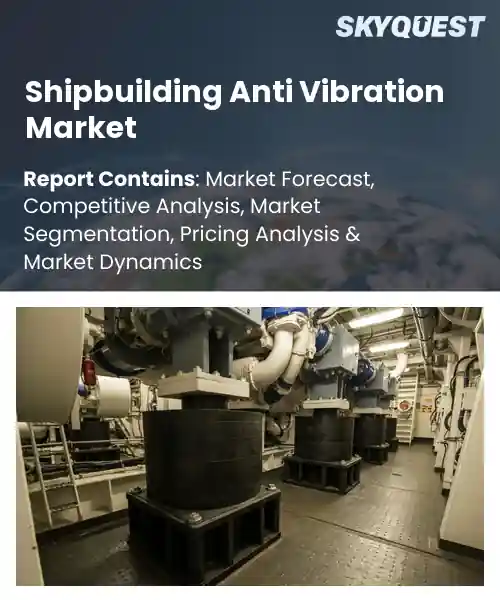
Shipbuilding Anti Vibration Market
Report ID: SQMIG20I3160
Report ID: SQMIG20I3160
[email protected]
USA +1 351-333-4748
Report ID:
SQMIG20I3160 |
Region:
Global |
Published Date: June, 2026
Pages:
157
|Tables:
181
|Figures:
79


Global Shipbuilding Anti Vibration Market size was valued at USD 1.7 Billion in 2024 and is poised to grow from USD 1.8 Billion in 2025 to USD 2.9 Billion by 2033, growing at a CAGR of 6.1% during the forecast period (2026-2033).
The global shipbuilding anti-vibration market encompasses technologies and services for the mitigation of mechanical vibrations in ships in order to maintain structural stability, crew comfort, and durability of equipment. More importantly, however, was the rise of commercial shipping and the increased strictness of regulatory bodies regarding vibration-induced fatigue. Passive dampers were used in early 2000’s designs, but hull cracking on container ships has led to the use of active vibration control systems. In a 2015 retrofit of a Panamax bulk carrier, tuned mass absorbers were found to reduce measured acceleration by 30%. This evolution is part of a larger industry shift today from reactive fixes to predictive, integrated solutions.
The development of energy efficient designs of vessels requiring precise vibration control to reduce fuel consumption and adhere to emission regulations will be the next major catalyst for the market growth. Less vibration makes for more efficient propellers and tangible savings in diesel costs on long-distance passages. Shipping lines like Maersk are installing smart anti-vibration monitoring platforms on new container ships to enable real-time adjustments that may reduce operating costs by as much as five percent. Hence, equipment manufacturers are investing in modular, IoT-enabled dampers, which will create opportunities for cross-industry collaboration and higher adoption rates across the world in the next decade as regulatory pressure increases.
How is AI-driven automation improving vibration reduction in modern shipbuilding?
Modern shipbuilding is being revolutionized by AI-powered automation that leverages real-time sensor data and predictive algorithms to dynamically modulate dampening systems and mitigate vibration. Machine learning models can analyze hull vibrations during construction and sea trials and find patterns that a human engineer might miss. This allows the isolation mounts, acoustic panels and structural supports to be proactively tuned to reduce the test cycle and improve passenger comfort. This technique also reduces waste of material due to optimization of the components before the final installation. As the industry moves towards digital manufacturing and higher quality standards, the deployment of these intelligent solutions is resulting in smoother workflows and faster delivery times for shipyards.
March 2024, Leading ship builder unveils AI-powered vibration mitigation platform, enhancing installation efficiency and promoting market growth through smarter, quicker production.
Market snapshot - (2026-2033)
Global Market Size
USD 1.7 Billion
Largest Segment
Anti-Vibration Mounts
Fastest Growth
Flexible Couplings
Growth Rate
6.1% CAGR
To get more insights on this market click here to Request a Free Sample Report
Global shipbuilding anti vibration market is segmented by product type, material type, application, ship type, end user, distribution channel and region. Based on product type, the market is segmented into Anti-Vibration Mounts, Vibration Isolation Pads, Flexible Couplings, Dampers and Others. Based on material type, the market is segmented into Rubber-Based Materials, Metal-Based Materials, Composite Materials, Cork & Elastomer Materials and Others. Based on application, the market is segmented into Marine Engines, Propulsion Systems, Generators & Auxiliary Equipment, HVAC Systems, Deck Machinery and Others. Based on ship type, the market is segmented into Commercial Ships, Naval Vessels, Offshore Support Vessels, Cruise Ships & Ferries and Others. Based on end user, the market is segmented into Shipbuilders, Ship Repair & Maintenance Companies, Naval & Defense Organizations and Offshore Oil & Gas Operators. Based on distribution channel, the market is segmented into OEMs, Aftermarket and Distributors & Dealers. Based on region, the market is segmented into North America, Europe, Asia Pacific, Latin America and Middle East & Africa.
The Anti-Vibration Mounts segment is leading the market due to its capacity to isolate the engines directly from the hull structures, thereby effectively reducing the transmission of forces and extending the life of the equipment. Easy to install, reliable and able to support high static loads. That’s why they are the favored choice of shipbuilders when seeking a robust solution. Hence, they are important in the design specifications, accepted in all vessel classes and are at the forefront of the anti-vibration market and thus contributing to the vessel performance in the operational cycles.
The Flexible Couplings segment is the fastest growing segment as it provides flexible torque transmission and isolates vibration and helps designers to incorporate complex machinery layouts without compromising performance. Innovations in elastomeric insert and compact design are attracting new installation scenarios, accelerating the market growth and opening opportunities for advanced vibration management.
Rubber Based Materials segment is the most dominant owing to its inherent elasticity which results in greater damping at a wider frequency range, making the segment ideal for absorbing shipboard vibrations. It is durable in harsh marine environments, can be molded into any shape desired by designers and is inexpensive to manufacture, making it even more appealing to designers. These properties make it the most preferred solution for most of the vibration isolation applications in shipbuilding industry and result in longer service intervals and less maintenance costs.
On the other hand, the Composite Materials segment is projected to witness the highest growth momentum owing to the advanced fiber reinforced composites providing a combination of high stiffness and low weight, catering to the need for lightweight vibration control solutions. They are popular with naval architects , because they are corrosion resistant , and can be designed to have certain damping characteristics . This has led to greater use on vessels and a quick growth in the market.
To get detailed segments analysis, Request a Free Sample Report
The Asia Pacific region has a unique combination of advanced engineering expertise, a rich tradition of shipbuilding, and a robust supply chain that integrates high-precision components with state-of-the-art vibration dampening technologies. The shipyards of the region have close cooperation with research institutions and a proactive regulatory environment with respect to passenger comfort and operational efficiency. With targeted investments in automation and material science, we can build high performance vessels while managing acoustic and mechanical stresses. At the same time, the concentration of major OEMs supports the rapid diffusion of best practices and continuous improvement, further cementing the region’s leadership in the provision of sophisticated anti-vibration solutions across commercial and naval platform.
Japan Shipbuilding Anti Vibration Market is the result of long history of scrupulous craftsmanship and state of the art research. Domestic manufacturers are working to improve vessel stability with advanced sensor integration and tuned mass dampers. Another source of innovation is close ties to academic labs. Japanese are the leaders in vibration control technology for high value passenger liners and advanced naval vessels. Testing standards are stringent.
The South Korea Shipbuilding Anti Vibration Market is driven by a prolific industrial ecosystem comprising of massive production capacity and rapid adoption of technology. The industry’s top shipbuilders are fitting smart monitoring systems and adaptive damping mechanisms, which are designed to alleviate structural fatigue and improve crew comfort. Strong government support can enable maritime research to develop collaborative projects and quickly convert new materials and design concepts into practical applications for anti-vibration.
Several factors are driving European growth, including stringent environmental directives, growing passenger experience expectations and the renaissance of eco-efficient vessel construction. Shipyards are under competitive pressure to provide state-of-the-art vibration isolation and acoustic attenuation solutions to stringent certification standards. Maritime engineering companies, universities and technology providers are working together to ensure a rapid transfer of modular damping systems and predictive maintenance tools. And the continent’s focus on sustainable propulsion and hybrid platforms creates new opportunities for vibration management, reinforcing Europe’s reputation for quality, compliance-driven shipbuilding practices.
Germany has a strong tradition of engineering and precision manufacturing in the Shipbuilding Anti Vibration market. Today, German shipyards cope with dynamic loads by using sophisticated finite-element analysis and specially tuned isolation mounts to ensure superior ride comfort and structural integrity. Intensive collaboration with component suppliers speeds up the introduction of lightweight composite dampers and reinforces Germany’s leadership position in high-performance vibration mitigation.
The United Kingdom Shipbuilding Anti Vibration Market is experiencing rapid adoption of new vibration control techniques in both commercial and defense vessels. Industry clusters are utilizing digital twins and real-time monitoring to optimize solution to isolation, hastening adoption of next-generation anti-vibration technology. Modular retrofits to existing fleets provide flexibility and play to the UK’s reputation for fast market response and growth.
Specialised expertise and collaborative research efforts have made the Shipbuilding Anti Vibration Market in France a booming industry. The French manufacturers have focused on acoustic comfort and low vibration propulsion systems with adaptive coupling devices and smart sensor networks. Collaborations with European research institutes are paving the way for experimental validation of innovative damping materials, positioning France as an emerging center of expertise in specialized anti-vibration solutions.
North America is strengthening its position with a robust ecosystem of defense contracts, commercial ferry operations, and tech incubators focused on maritime innovations. Shipyards in the region are installing active control systems and predictive analytics to better anticipate vibration-related wear, in keeping with a culture of operational dependability. Venture capital funding is the fuel for lightweight, high-efficiency startups. Knowledge sharing between industries by collaboration with aerospace and automotive industries. Defense demand, commercial expansion and technology entrepreneurship are converging to cement North America’s growing position on the global anti-vibration map.
The United States Shipbuilding Anti Vibration Market is supported by strong defense purchases and a booming commercial ferry industry that needs robust vibration solutions. New builds by domestic manufacturers incorporate active suppression technologies and condition‑based monitoring with an emphasis on reliability and crew safety. Partnerships with top universities speed development of next-gen smart dampers, cementing U.S. leadership in advanced anti-vibration engineering.
The Canada shipbuilding anti vibration market is driven by the demand for cold-climate vessel performance and the need for eco-friendly ferry services, leading to specialized vibration mitigation approaches. Canadian shipyards construct boats with powerful isolation mounts and insulated cabin designs to enhance passenger comfort in choppy waters. Partnerships with research institutions support the development of new composite materials, consistent with Canada’s commitment to innovative and resilient maritime solutions.
To know more about the market opportunities by region and country, click here to
Buy The Complete Report
Growing Demand For Quiet Ships
Integration Of Advanced Isolation Technologies
High Capital Investment Requirements
Complex Certification And Compliance Processes
Request Free Customization of this report to help us to meet your business objectives.
The market for anti-vibration in shipbuilding is highly competitive, with manufacturers seeking to gain competitive advantage through advanced damping and data-driven design. Competitive pressure is fuelling collaborations like ENVGO's pilot install on a research vessel and Two Small Fish Ventures' AI analytics partnership with a leading US shipyard, while firms are looking to technology-focused M&A to expand product portfolios.
SkyQuest’s ABIRAW (Advanced Business Intelligence, Research & Analysis Wing) is our Business Information Services team that Collects, Collates, Correlates, and Analyses the Data collected by means of Primary Exploratory Research backed by robust Secondary Desk research. As per SkyQuest analysis, the market is propelled by a strong demand for quieter ships as passengers and operators seek reduced cabin noise, while the integration of advanced isolation technologies such as active dampers and smart sensors further accelerates adoption. The anti‑vibration mounts segment remains dominant because it offers reliable isolation for engines and hull structures. Asia Pacific leads the market thanks to its deep shipbuilding heritage, robust supply chains and heavy investment in automation. However, the high capital investment required for sophisticated damping systems restrains smaller yards and slows broader diffusion. Together these forces shape a growth trajectory that is both opportunity‑rich and challenging.
| Report Metric | Details |
|---|---|
| Market size value in 2024 | USD 1.7 Billion |
| Market size value in 2033 | USD 2.9 Billion |
| Growth Rate | 6.1% |
| Base year | 2024 |
| Forecast period | (2026-2033) |
| Forecast Unit (Value) | USD Billion |
| Segments covered |
|
| Regions covered | North America (US, Canada), Europe (Germany, France, United Kingdom, Italy, Spain, Rest of Europe), Asia Pacific (China, India, Japan, Rest of Asia-Pacific), Latin America (Brazil, Rest of Latin America), Middle East & Africa (South Africa, GCC Countries, Rest of MEA) |
| Companies covered |
|
| Customization scope | Free report customization with purchase. Customization includes:-
|
To get a free trial access to our platform which is a one stop solution for all your data requirements for quicker decision making. This platform allows you to compare markets, competitors who are prominent in the market, and mega trends that are influencing the dynamics in the market. Also, get access to detailed SkyQuest exclusive matrix.
Table Of Content
Executive Summary
Market overview
Parent Market Analysis
Market overview
Market size
KEY MARKET INSIGHTS
COVID IMPACT
MARKET DYNAMICS & OUTLOOK
Market Size by Region
KEY COMPANY PROFILES
Methodology
For the Shipbuilding Anti Vibration Market, our research methodology involved a mixture of primary and secondary data sources. Key steps involved in the research process are listed below:
1. Information Procurement: This stage involved the procurement of Market data or related information via primary and secondary sources. The various secondary sources used included various company websites, annual reports, trade databases, and paid databases such as Hoover's, Bloomberg Business, Factiva, and Avention. Our team did 45 primary interactions Globally which included several stakeholders such as manufacturers, customers, key opinion leaders, etc. Overall, information procurement was one of the most extensive stages in our research process.
2. Information Analysis: This step involved triangulation of data through bottom-up and top-down approaches to estimate and validate the total size and future estimate of the Shipbuilding Anti Vibration Market.
3. Report Formulation: The final step entailed the placement of data points in appropriate Market spaces in an attempt to deduce viable conclusions.
4. Validation & Publishing: Validation is the most important step in the process. Validation & re-validation via an intricately designed process helped us finalize data points to be used for final calculations. The final Market estimates and forecasts were then aligned and sent to our panel of industry experts for validation of data. Once the validation was done the report was sent to our Quality Assurance team to ensure adherence to style guides, consistency & design.
Analyst Support
Customization Options
With the given market data, our dedicated team of analysts can offer you the following customization options are available for the Shipbuilding Anti Vibration Market:
Product Analysis: Product matrix, which offers a detailed comparison of the product portfolio of companies.
Regional Analysis: Further analysis of the Shipbuilding Anti Vibration Market for additional countries.
Competitive Analysis: Detailed analysis and profiling of additional Market players & comparative analysis of competitive products.
Go to Market Strategy: Find the high-growth channels to invest your marketing efforts and increase your customer base.
Innovation Mapping: Identify racial solutions and innovation, connected to deep ecosystems of innovators, start-ups, academics, and strategic partners.
Category Intelligence: Customized intelligence that is relevant to their supply Markets will enable them to make smarter sourcing decisions and improve their category management.
Public Company Transcript Analysis: To improve the investment performance by generating new alpha and making better-informed decisions.
Social Media Listening: To analyze the conversations and trends happening not just around your brand, but around your industry as a whole, and use those insights to make better Marketing decisions.
REQUEST FOR SAMPLE
 REQUEST FREE CUSTOMIZATION
Global Shipbuilding Anti Vibration Market size was valued at USD 1.7 Billion in 2024 and is poised to grow from USD 1.8 Billion in 2025 to USD 2.9 Billion by 2033, growing at a CAGR of 6.1% during the forecast period (2026-2033).
The shipbuilding anti‑vibration market is shaped by intense rivalry as manufacturers seek to differentiate through advanced damping solutions and data‑driven design. Competitive pressure has spurred collaborations such as ENVGO’s pilot installation on a research vessel and Two Small Fish Ventures’ AI analytics partnership with a major U.S. shipyard, while firms pursue technology‑focused M&A to broaden product portfolios. 'Trelleborg AB', 'Hutchinson SA', 'Parker Hannifin Corporation', 'Vibratec Akustikprodukter AB', 'GMT Rubber-Metal-Technic Ltd.', 'ACE Stoßdämpfer GmbH', 'Vulkan Couplings', 'Getzner Werkstoffe GmbH', 'Bridgestone Corporation', 'ContiTech AG', 'Kinetics Noise Control, Inc.', 'Pyrotek Inc.', 'Resistoflex Pvt. Ltd.', 'RG+ Schwingungstechnik GmbH', 'AMC Mecanocaucho', 'Tozen Corporation', 'Rosta AG', 'Marine Flexible Solutions Ltd.', 'Vicoda GmbH', 'Bilz Vibration Technology AG'
The increasing emphasis on passenger comfort and noise reduction in commercial and cruise vessels motivates shipbuilders to integrate anti‑vibration solutions early in design, as quieter cabins enhance brand reputation and customer satisfaction, prompting manufacturers to allocate resources toward advanced damping materials and engineering expertise, thereby expanding demand for specialized components and services across the global supply chain. The trend also encourages collaborative research initiatives between shipyards and academic institutions, fostering innovation in isolation techniques and further broadening market reach globally.
Smart Vibration Monitoring: The industry is rapidly adopting IoT‑enabled vibration sensors that deliver real‑time diagnostics across propulsion and auxiliary systems. Integrated platforms aggregate data, apply predictive algorithms, and trigger maintenance alerts before fatigue damages propagate. Ship owners benefit from reduced unplanned downtime, extended equipment life, and optimized crew scheduling. Suppliers are partnering with software firms to embed analytics within existing control consoles, turning vibration management from a reactive task into a continuous performance optimisation process across global fleets throughout operational cycles and strategies.
Why does Asia Pacific Dominate the Global Shipbuilding Anti Vibration Market? |@12


Want to customize this report? This report can be personalized according to your needs. Our analysts and industry experts will work directly with you to understand your requirements and provide you with customized data in a short amount of time. We offer $1000 worth of FREE customization at the time of purchase.
Feedback From Our Clients


 USA (+1) 351-333-4748

