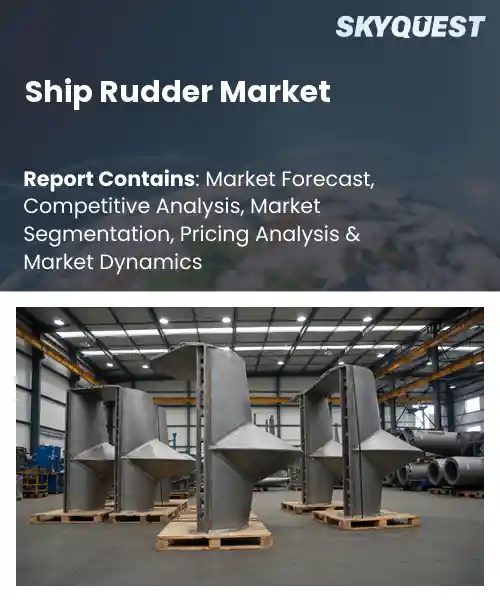
Ship Rudder Market
Report ID: SQMIG20T2038
Report ID: SQMIG20T2038
[email protected]
USA +1 351-333-4748
Report ID:
SQMIG20T2038 |
Region:
Global |
Published Date: May, 2026
Pages:
157
|Tables:
184
|Figures:
81


Global Ship Rudder Market size was valued at USD 1.19 Billion in 2024 and is poised to grow from USD 1.26 Billion in 2025 to USD 1.94 Billion by 2033, growing at a CAGR of 5.6% during the forecast period (2026-2033).
The main driver behind the market for ship rudders is an increase in demand for fuel efficiency and maneuverability, which has had an effect on designs in the field of ship construction. It encompasses the manufacturing and maintenance of both traditional and innovative ship rudder designs, ranging from flap type, Becker type to electrically operated rudders, and is significant as performance of the rudder affects fuel consumption and emissions as well as port efficiency. Designing of ship rudders has seen great improvements throughout history from simple flat plate shapes to more efficient designs owing to improvements in propulsions and increased regulations, such as retrofitting of containership rudders saving on fuel consumption.
Following the development of rudders, the regulation of reducing greenhouse emissions is another important driver for rudder advancement since increased requirements push owners to use innovations that decrease drag and enhance maneuvering abilities. In this case, manufacturers spend money on hydrodynamics and intelligent management technologies, which facilitate installation of innovative rudder technology on already manufactured bulk carriers and tankers and help save fuel during long travels and maneuvering when approaching ports. At the same time, increased construction of specialized ships like LNG carriers and offshore support vessels facilitates the introduction of rudder and thrusters installations, which, according to their application, have contributed to shortened berthing times and fewer incidents of pilotage.
How is IoT-enabled Predictive Maintenance Transforming the Ship Rudder Market?
Using IoT to facilitate predictive maintenance for ships’ rudders involves mounting sensors in rudder stocks actuators and bearings that measure their vibrations pressures and positions. It entails moving from a set time to a condition-based maintenance strategy. Currently, vessel owners and OEMs use sensors alongside digital twins and analytical tools to mitigate unexpected failures while making drydock scheduling easy. The shift in the industry is towards offering service-oriented agreements where digital monitoring services are offered in tandem with the rudders and steering systems. For instance, new installations of steering gear emphasize lifecycle cooperation while maritime digital platforms concentrate on performance monitoring and remote diagnostics.Kongsberg Maritime April 2026, Kongsberg Maritime recently streamlined its digital capabilities after becoming an independent maritime unit showing how IoT predictive maintenance capabilities are integrated into the rudder systems to enhance uptime and minimize unexpected repair costs.
Market snapshot - (2026-2033)
Global Market Size
USD 1.19 Billion
Largest Segment
Spade Rudders
Fastest Growth
Becker Rudders
Growth Rate
5.6% CAGR
To get more insights on this market click here to Request a Free Sample Report
Global ship rudder market is segmented by rudder type, material type, vessel type, application, end user, steering mechanism and region. Based on rudder type, the market is segmented into Spade Rudders, Semi-spade Rudders, Flap Rudders, Becker Rudders, Schilling Rudders, Pleuger Rudders and Others. Based on material type, the market is segmented into Steel Rudders, Aluminum Rudders, Composite Rudders and Others. Based on vessel type, the market is segmented into Cargo Ships, Tankers, Container Ships, Naval Vessels, Passenger Ships, Fishing Vessels and Others. Based on application, the market is segmented into Commercial Shipping, Naval & Defense Operations, Offshore Operations, Inland Waterway Transport and Others. Based on end user, the market is segmented into Shipbuilders, Shipping Companies, Naval Forces, Offshore Service Providers and Others. Based on steering mechanism, the market is segmented into Hydraulic Steering Systems, Electro-hydraulic Steering Systems and Electric Steering Systems. Based on region, the market is segmented into North America, Europe, Asia Pacific, Latin America and Middle East & Africa.
The Flap Rudders segment attracts attention due to the fact that flaps alter blade shape in order to create more lift and decrease induced drag resulting in less propulsive power needed and increased fuel efficiency regardless of speed. Due to adaptive hydrodynamics which help to keep better track of course and decrease engine load, shipowners prefer flap rudders to save money on operations and meet performance objectives. Control systems' progress along with retrofit possibilities also stimulate their implementation into fleets as an operational advantage.
The Becker Rudders segment is growing faster compared to other segments due to the demand for small high-lift rudders that would help improve maneuvering capabilities and provide smaller propeller loading. Their modularity allows for installation and easy cooperation with autopilot and engine optimization systems.
Electro-hydraulic Steering Systems section is dominant, since such systems are able to utilize hydraulic strength along with electronic precision, providing accurate rudder control during different operating conditions and allowing for enhanced autopilot function and troubleshooting capabilities. Such technology requires less human control and facilitates improved steering processes, ensuring safer operations, and reducing lifetime maintenance needs. It makes electro-hydraulic systems a preferred solution for shipbuilders and owners, which results in their high adoption rates.
On the other side, the electric steering system segment seems to be gaining traction at the highest rate due to increased emphasis placed by modern ships on quiet operations, elimination of leakage problems inherent in hydraulic technologies, and energy efficiency provided through electrification. It creates an opportunity for manufacturers of electric steering systems, since such equipment can be easily integrated into hybrid ship designs.
To get detailed segments analysis, Request a Free Sample Report
The dominance of the Asia Pacific region in the ship rudder market is due to the concentration of shipbuilding capacities, well-developed supply chain infrastructure, and high level of technological innovation. High density of maritime cluster formations provides better interaction between shipyards and producers of components, which decreases the production time and enhances iterative innovations. Innovation is generated by a highly qualified workforce and focused on research and development activities. Aftermarkets and retrofits ensure sustained demand after ship construction. Favorable geographical location in terms of close proximity to major shipping routes facilitates the logistic benefits. Collaboration between different stakeholders promotes quick adoption of innovative production methods and design tools.
Japan Ship Rudder Market is favored by the presence of well-established history in shipbuilding, advanced precision engineering technology, and effective coordination between the yards and componentproducers. Attention paid to the production of high-quality rudders, optimization of hydrodynamics, and usage of innovative materials guarantees high aftermarket potential. Japanese manufacturers produce rudders that are distinguished by their efficiency and reliability and can be easily integrated into the system of propulsion mechanisms.
South Korean Ship Rudder Industry features coordination with large shipbuilding projects, well-developed supply chain management, and expertise in rudder manufacturing for large commercial ships. The close collaboration between rudder manufacturers and propulsion suppliers allows for fast customization and delivery of rudders. An emphasis on automation, welding skills, and materials ensures efficiency in offshore conditions. The after-sales services and exports contribute to competitiveness.
A fast growth rate in the ship rudder market can be observed across Europe due to the increasing regulatory concerns regarding efficiency, strong prospects in the retrofit industry, and presence of significant engineering talent in maritime centers. The needs of the ferry, offshore service, and special vessels segments encourage innovations in the area of efficient rudder designs and innovative control mechanisms. An abundance of small shipbuilders and components providers allows developing customized products and using novel materials and manufacturing techniques quickly. Cooperation between design companies, scientific bodies, and manufacturers ensures continuous developments in hydrodynamics and simulations. Efficient after-sales services, geographical location, and cooperation programs contribute to translating innovations into business success in the region.
Germany Ship Rudder Market is characterized by the depth of engineering, precision production, and integration with the highly advanced propulsion system. German companies invest efforts in the development of high-tech rudder systems for modern ships through simulation-driven development processes and strict quality control measures. Thanks to its proximity to suppliers of materials used in ship rudder construction, Germany can adapt quickly to innovations, while efficient service networks ensure proper aftersales services.
The Ship Rudder Market in the United Kingdom is growing at a fast pace due to retrofit operations, demand for offshore service vessels, and increased emphasis on new control systems. With good naval engineering skills and designers, it is easy to create custom-made products. There is a lot of attention to renewable energy and ports renovation, which fuels the need for custom-made rudders and other services related to their lifecycle.
French Ship Rudder Market is being formed owing to the presence of great navy skills, professional shipyards, and innovations related to the manufacture of composite ship rudders. The partnership between design institutions and constructors aims at fulfilling the needs of offshore energy production and coastal transportation, leading to a number of specific ideas concerning rudder design. Supplier abilities and a growing after-market contribute to meeting demands both in the domestic and export markets.
The North American region is gaining competitive advantage in the ship rudder segment with shipyard modernizations, retrofit programs, and synergies created between defense procurement and commercial repairs. Improvements in control technology, materials, and automation processes are being implemented for defense and commercial segments, leading to increased dependability and longevity of products. Focus on supply chain resiliency and regional procurement leads to the development of local suppliers, and cooperation with universities and test facilities helps advance scientific discoveries. Aftermarket and services-focused approaches help reduce the time needed for maintenance, upgrades, and replacement cycles. Together, these trends lead to improvements in competitiveness, engagement in specific niches, and collaboration in more advanced product solutions.
The US Ship Rudder Market is characterized by the strong demands from the navy, high retrofit activity, and attention towards advanced control systems. Large shipbuilders and suppliers of ship components pay much attention to their integration with advanced technology of propulsion and maneuvering. The specification of advanced technologies is supported by military and civil projects. Attention to innovations, such as automation and materials, encourages the development of the aftermarket.
Ship Rudder Industry in Canada is propelled by demand from the coastal fleets, ice class ship rudders, and repair industry. Shipyards and repair facilities in the region are geared towards making products that are durable and reliable, taking into account harsh environmental conditions. There is collaboration between marine research institutions and manufacturers to develop rudder solutions specific to fishing ships, supply ships, and patrol vessels.
To know more about the market opportunities by region and country, click here to
Buy The Complete Report
Expansion of Commercial Fleet
The growth in commercial shipping vessel fleet size will boost the demand for rudders as ship owners strive for enhanced maneuverability, efficiency in energy consumption, and conformity with regulations. New ship construction projects and fleet renewal will fuel orders of improved rudder types and materials, motivating the manufacture companies to increase their production capacity and innovation. This will result in the development of products and services offered by the supply chain participants in response to demand trends in the rudder market.
Technological Advancements in Materials
Due to developments in materials science and technology, rudder makers can design rudders that are light, strong, and corrosion-resistant, hence improving boat performance and lowering their cost of ownership. Through the use of composites, better coatings, and innovative production techniques, manufacturers are motivated to produce more modern rudders. Their performance is a key driver for increased industry uptake, compelling suppliers to innovate further by developing additional products and services.
High Initial Procurement Costs
High upfront procurement costs and capital expenses incurred in using new rudder designs would discourage the use of such innovations among shipowners and smaller shipbuilding firms who would prefer to settle for cheaper old alternatives. The perceived financial risks and cost limitations would cause a preference to choose cost efficiency over better operation in the long run, and this would affect negatively the uptake of premium rudder systems and their ancillary services. Such procurement practices result in low velocity of demand and hinder production scale-up by producers.
Complex Regulatory Compliance Requirements
The growing complexity and changes in the regulations associated with the safety, emissions, and certification of ships' equipment create more work for the designers of the rudders and ship owners in terms of more tests and paperwork. The need to meet requirements requires engineering modifications and longer approval times, which may lead to late shipments and higher costs related to development. The uncertainty about various regional standards makes global sales more difficult and requires increased efforts in compliance management from suppliers which, in turn, may hamper innovation initiatives.
Request Free Customization of this report to help us to meet your business objectives.
Consolidation and fast technology differentiation characterize the global business environment of ship rudder manufacturers, which arise due to the demand of the shipowners on more fuel-efficient ships and stringent environmental regulations compelling companies to engage in performance-based competition. These organizations focus on merger and acquisitions, technological partnerships, and development of advanced digital steering systems as well as propellers and rudders; some notable examples are Nakashima Propeller’s takeover of Becker Marine Systems and Kongsberg’s efforts in DTS and PROMAS technology.
Hydrodynamic Efficiency Optimization: Players of this market have increasingly focused on rudders that minimize drag and better integrate flow within hull designs to save fuel and optimize the cost-effectiveness of voyages. Innovations in computational fluid dynamics, design, and treatment are resulting in smaller and more efficient rudders that fit specific ship designs and their intended operations. The needs of owners and yards for improved propulsion efficiency as well as maneuverability and safety requirements have encouraged efforts to develop such technologies for retrofitting and new construction.
Digital Twin and Predictive Maintenance: The adoption of digital twin technology along with condition-based monitoring is helping in extending the service life of the rudders and avoiding unexpected down times. Through the combination of sensor input and simulation results along with maintenance history, predictive maintenance and targeted inspections have become possible. The trend will also help in better cost management during the lifecycle, scheduling of dockings, and inventory management of replacement parts. Hardware and software vendors offering end-to-end solutions are marketing rudders as connected assets through their vessel digitization initiatives.
SkyQuest’s ABIRAW (Advanced Business Intelligence, Research & Analysis Wing) is our Business Information Services team that Collects, Collates, Correlates, and Analyses the Data collected by means ofPrimary Exploratory Research backed by robust Secondary Desk research.
As per SkyQuest analysis, the growth of the global ship rudder market is attributed to an increasing need for energy-efficient and agile ships, and the development of new technologies in materials helps open upavenues for more lightweight yet stronger rudder systems. The high costs involved in the initial acquisition of rudder products is one major factor that poses a barrier despite the evident long-term advantages. Asia Pacific is considered to dominate this market because of the region's significant ship manufacturing activities and seamless integration with suppliers. The segment that stands out the most in terms of performance and adaptability is the Flap Rudders.
| Report Metric | Details |
|---|---|
| Market size value in 2024 | USD 1.19 Billion |
| Market size value in 2033 | USD 1.94 Billion |
| Growth Rate | 5.6% |
| Base year | 2024 |
| Forecast period | (2026-2033) |
| Forecast Unit (Value) | USD Billion |
| Segments covered |
|
| Regions covered | North America (US, Canada), Europe (Germany, France, United Kingdom, Italy, Spain, Rest of Europe), Asia Pacific (China, India, Japan, Rest of Asia-Pacific), Latin America (Brazil, Rest of Latin America), Middle East & Africa (South Africa, GCC Countries, Rest of MEA) |
| Companies covered |
|
| Customization scope | Free report customization with purchase. Customization includes:-
|
To get a free trial access to our platform which is a one stop solution for all your data requirements for quicker decision making. This platform allows you to compare markets, competitors who are prominent in the market, and mega trends that are influencing the dynamics in the market. Also, get access to detailed SkyQuest exclusive matrix.
Table Of Content
Executive Summary
Market overview
Parent Market Analysis
Market overview
Market size
KEY MARKET INSIGHTS
COVID IMPACT
MARKET DYNAMICS & OUTLOOK
Market Size by Region
KEY COMPANY PROFILES
Methodology
For the Ship Rudder Market, our research methodology involved a mixture of primary and secondary data sources. Key steps involved in the research process are listed below:
1. Information Procurement: This stage involved the procurement of Market data or related information via primary and secondary sources. The various secondary sources used included various company websites, annual reports, trade databases, and paid databases such as Hoover's, Bloomberg Business, Factiva, and Avention. Our team did 45 primary interactions Globally which included several stakeholders such as manufacturers, customers, key opinion leaders, etc. Overall, information procurement was one of the most extensive stages in our research process.
2. Information Analysis: This step involved triangulation of data through bottom-up and top-down approaches to estimate and validate the total size and future estimate of the Ship Rudder Market.
3. Report Formulation: The final step entailed the placement of data points in appropriate Market spaces in an attempt to deduce viable conclusions.
4. Validation & Publishing: Validation is the most important step in the process. Validation & re-validation via an intricately designed process helped us finalize data points to be used for final calculations. The final Market estimates and forecasts were then aligned and sent to our panel of industry experts for validation of data. Once the validation was done the report was sent to our Quality Assurance team to ensure adherence to style guides, consistency & design.
Analyst Support
Customization Options
With the given market data, our dedicated team of analysts can offer you the following customization options are available for the Ship Rudder Market:
Product Analysis: Product matrix, which offers a detailed comparison of the product portfolio of companies.
Regional Analysis: Further analysis of the Ship Rudder Market for additional countries.
Competitive Analysis: Detailed analysis and profiling of additional Market players & comparative analysis of competitive products.
Go to Market Strategy: Find the high-growth channels to invest your marketing efforts and increase your customer base.
Innovation Mapping: Identify racial solutions and innovation, connected to deep ecosystems of innovators, start-ups, academics, and strategic partners.
Category Intelligence: Customized intelligence that is relevant to their supply Markets will enable them to make smarter sourcing decisions and improve their category management.
Public Company Transcript Analysis: To improve the investment performance by generating new alpha and making better-informed decisions.
Social Media Listening: To analyze the conversations and trends happening not just around your brand, but around your industry as a whole, and use those insights to make better Marketing decisions.
REQUEST FOR SAMPLE
 REQUEST FREE CUSTOMIZATION
Global Ship Rudder Market size was valued at USD 1.19 Billion in 2024 and is poised to grow from USD 1.26 Billion in 2025 to USD 1.94 Billion by 2033, growing at a CAGR of 5.6% during the forecast period (2026-2033).
Consolidation and rapid technology differentiation define the competitive landscape for global ship rudder suppliers, driven by shipowner demand for fuel efficiency and stricter emissions rules that force performance-led competition. Players pursue acquisitions, joint engineering partnerships, and digital steering and integrated propeller-rudder innovation; examples include Nakashima Propeller’s acquisition of Becker Marine Systems, Kongsberg’s DTS and PROMAS integrations, and Hyundai’s Avikus autonomy push. 'Navier: Established in 2019, their main objective is designing and manufacturing all-electric hydrofoiling vessels and foil control systems to reduce drag and improve operational efficiency. Recent development: the company closed a multi-million seed round led by Global Founders Capital in 2022, launched the Navier 30 hydrofoiling electric boat into pilot production in late 2022, and ran corporate pilot services and field tests with partners such as Stripe during 2023 to advance commercialization and systems integration.', 'Avikus: Established in 2021, their main objective is developing integrated autonomous navigation and control systems that enable collision avoidance, docking assist, and automated rudder actuation for commercial and yacht markets. Recent development: backed by Hyundai Heavy Industries, Avikus has commercialized a deep-learning navigation assistant with 360-degree sensing, dynamic object detection and virtual bumper functions, and is scaling supply and in-water installation options to target fleet deployments and OEM integrations.', 'Wärtsilä', 'Kongsberg Maritime', 'Rolls-Royce Marine', 'SCHOTTEL Group', 'Becker Marine Systems', 'Nakashima Propeller', 'Kawasaki Heavy Industries', 'Damen Shipyards Group', 'MAN Energy Solutions', 'Kobelt Manufacturing', 'Nufoss Services', 'Ulstein Group', 'Niigata Power Systems', 'Teignbridge Propellers International', 'BVT Surface Fleet', 'Brunvoll', 'Fincantieri', 'L&T Shipbuilding', 'Thrustmaster of Texas', 'Hydromaster Propulsion'
Expansion of commercial shipping fleets increases demand for new and replacement rudder systems, as vessel owners seek improved maneuverability, fuel efficiency, and regulatory compliance. Newbuild programs and fleet renewals stimulate procurement of advanced rudder designs and materials, encouraging manufacturers to scale production and innovate. Suppliers respond with product development, customization, and expanded service offerings, which reinforces market growth through greater adoption of modern rudder technologies and by creating longer term maintenance and upgrade service opportunities across commercial sectors and supporting associated aftermarket ecosystems.
Hydrodynamic Efficiency Optimization: Companies are prioritizing rudder designs that reduce drag and improve flow integration with hullforms to lower fuel consumption and improve voyage economics. Advances in computational fluid dynamics, refined shaping, and surface treatments are enabling more compact, efficient rudders tailored to vessel types and operational profiles. Shipowners and yards seek retrofit and newbuild options that enhance propulsion efficiency while supporting manoeuvrability and safety. Collaborations between designers, classification societies, and operators are accelerating adoption of performance driven rudder solutions across commercial fleets.
Region 1: Why does Asia Pacific Dominate the Global Ship Rudder Market? |@12


Want to customize this report? This report can be personalized according to your needs. Our analysts and industry experts will work directly with you to understand your requirements and provide you with customized data in a short amount of time. We offer $1000 worth of FREE customization at the time of purchase.
Feedback From Our Clients


 USA (+1) 351-333-4748

