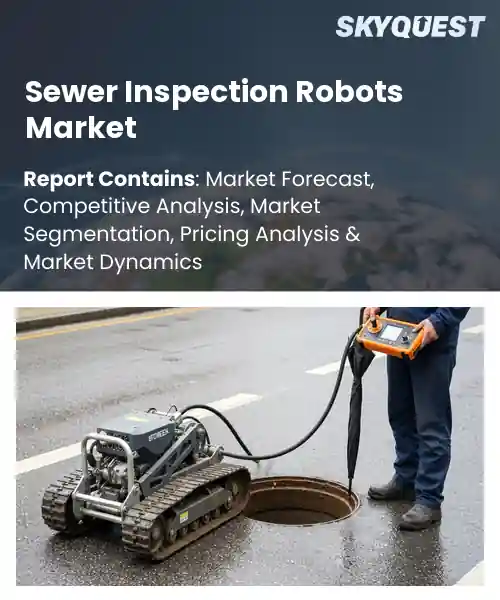
Sewer Inspection Robots Market
Report ID: SQMIG20I3176
Report ID: SQMIG20I3176
[email protected]
USA +1 351-333-4748
Report ID:
SQMIG20I3176 |
Region:
Global |
Published Date: June, 2026
Pages:
157
|Tables:
173
|Figures:
79


Global Sewer Inspection Robots Market size was valued at USD 2.3 Billion in 2024 and is poised to grow from USD 2.5 Billion in 2025 to USD 4.8 Billion by 2033, growing at a CAGR of 8.5% during the forecast period (2026-2033).
Growing investments in wastewater infrastructure, increasing adoption of predictive maintenance, rising urbanization, advancements in robotic inspection technologies, and stringent environmental regulations are driving sales of sewer inspection robots.
Greater use of robotic inspection systems that utilize high-definition cameras, laser scanners and remote monitoring techniques is allowing utilities to detect and diagnose defects more precisely while decreasing the reliance on human resources. Furthermore, increased spending on smart water systems, proactive maintenance initiatives, and electronic asset management software is contributing to market development. Moreover, ongoing enhancements in autonomous movement, defect recognition using artificial intelligence, and the application of big data analytics for real-time analysis is further boosting the operational efficacy and inspection process of these systems. Moreover, expanding government spending on the upgrade of sewage and wastewater systems represents another important growth driver. High demand for efficient inspection of aging sewer infrastructure, coupled with increasing emphasis on reducing maintenance costs and improving worker safety, is expected to primarily drive sewer inspection robot market growth.
On the contrary, high equipment acquisition costs, complex deployment in aging pipeline networks, shortage of skilled operators, and maintenance challenges associated with robotic systems are anticipated to slow down sewer inspection robot market penetration across the study period and beyond.
How are AI and IoT Integration Enhancing Efficiency of Sewer Inspection Robots?
Artificial Intelligence (AI) and Internet of Things (IoT) are revolutionizing the sewer inspection robot industry by providing faster, safer, and more precise pipeline inspections. Machine learning algorithms are applied to analyze the raw camera images and identify the defects such as corrosion, cracks, and sludge buildup in shorter inspection time compared to traditional manual inspection procedures. IoT enabled sensors provide instant transmission of the inspection data to cloud-based platforms and enable utility companies to perform monitoring of the pipeline conditions and plan predictive maintenance and robotic fleet management accordingly.
Market snapshot - (2026-2033)
Global Market Size
USD 2.3 Billion
Largest Segment
Fastest Growth
Growth Rate
8.5% CAGR
To get more insights on this market click here to Request a Free Sample Report
Global sewer inspection robots market is segmented by robot type, pipe diameter, application, component, end user, mobility type and region. Based on robot type, the market is segmented into crawler inspection robots, floating inspection robots, hybrid inspection robots, and others. Based on pipe diameter, the market is segmented into small diameter pipes, medium diameter pipes, and large diameter pipes. Based on application, the market is segmented into sewer inspection, stormwater drain inspection, industrial pipeline inspection, and others. Based on component, Hardware, Software, Services. Based on end user, the market is segmented into municipal utilities, industrial facilities, inspection service providers, and others. Based on mobility type, the market is segmented into tethered robots and untethered robots. Based on region, the market is segmented into North America, Europe, Asia Pacific, Latin America, and Middle East & Africa.
The tethered robots segment is estimated to lead the global sewer inspection robot market revenue generation across the study period. They produce power without interruption and transmit data back to the user without any delay during operation unlike commonly used battery-operated systems. This feature avoids the latent time in changing failed batteries, enabling utilities to insist on tethered options for long sewer runs where access is less frequent. The capability of supporting slightly heavier sensor set-ups can also be translated into results in better diagnostics, instilling confidence in all stakeholders.}
Meanwhile, untethered robots segment emerges as the fastest growing due to the smaller size, which allows it to access tight and curved pipelines that were impractical for big machines. As improvements are made with AI-driven path planning and smaller scale sensors, expansion and potential market revenue will grow.
The municipal wastewater management segment is estimated to account for the highest global sewer inspection robot market share going forward. Municipal agencies struggle to sustain aging sewer networks and simultaneously satisfy stringent disposal orders. Perennially tracking these networks with inspection robots cuts inefficient remediations and mitigates risks of public health, and this fact renders them inevitable for extensive sewer systems. The magnitude of municipal networks triggers significant procurement budgets, compelling vendors to customize resilient, regulatory-compliant offerings that relate to public-sector deliverables.
On the other hand, industrial facility maintenance segment is witnessing the strongest growth momentum as per this sewer inspection robot market forecast, where manufacturers use robotic inspection to circumvent lead times, and are relatively isolated. Growing convergence of predictive analytics with robot data enables proactive maintenance methodologies, and with it leaps forward in market expansion, and value propositions for industrial operators.
To get detailed segments analysis, Request a Free Sample Report
A mature municipal infrastructure, strong safety regulations, and substantial investment in robotics research are helping boost the dominance of this region. The combination of North America’s high density utility infrastructure with a focus on asset integrity create the ideal environment for the adoption of cutting-edge inspection technologies. The presence of collaborative ecosystems that link manufacturers, academia, and service providers drive innovation and decrease the time to develop and deploy the technology. In addition, the presence of public sector agencies that have a culture of early technology adoption creates additional demand, while the existence of mature supply chains provide for the reliable delivery and support of the technology. In addition, the competitive environment drives the continual enhancement of sensing capability and autonomous navigation for solutions to ensure that they are in compliance with the evolving regulatory environment. Finally, the existence of financial incentives for the modernization of the infrastructure further encourages the procurement of the technology and reinforces the leadership position that North America has in the worldwide sewer inspection robot market.
Demand for sewer inspection robot in United States benefits from a robust federal funding framework that encourages adoption of advanced maintenance solutions across municipal networks. High concentration of technology hubs fosters rapid integration of cutting‑edge sensors and AI‑driven analytics, while seasoned service providers offer comprehensive training and support. Consequently, utilities experience enhanced operational efficiency and reduced downtime, reinforcing the United States as a benchmark for deployment excellence in the sector overall.
Sewer inspection robots market in Canada is shaped by proactive provincial policies that prioritize sustainable wastewater management and infrastructure resilience. Research programs of the collaborative nature between equipment providers and universities have hastened the composition of durable platforms into the expertise adapted to cold condition. Service firms promote controllable contracts of maintenance allowing for early detection of any defects and the cheaper reparations.4 Ensuring the municipality operators faith enhances an unchanged big need for robotic inspection devices across the nation the present day.
Stringent environmental directives, sophisticated municipal upgrade programs, and a tradition of engineering excellence helps support demand for sewer inspection robots in the region going forward. To achieve their goals regarding reducing emissions and preventing the contamination of water, municipal authorities in Europe have been integrating both automated inspection into their sewer networks, and thereby extending the life of the pipelines. The establishment of close collaboration between well-established manufacturers and research institutions has led to the rapid integration of high-resolution imaging and predictive analytics. In addition, funding sources from both national and Union level, reduce the barriers to the adoption of technology; and the presence of a highly skilled technical workforce, facilitates rapid implementation and continual optimization. Overall, all these elements combine to make Europe a center for innovation and the vitality of the sewer inspection robotics market. Another benefit to the robotic deployment is that the regulatory authorities in Europe have developed clear guidelines for the deployment of robotic systems, providing ease of compliance and facilitating greater acceptance by municipalities of different sizes within many urban areas. The use of modular design helps to provide greater flexibility in meeting the differing sizes and types of pipes and soil conditions, resulting in shorter deployment times.
Sewer inspection robot demand in Germany is underpinned by a strong industrial base and rigorous standards that drive precision engineering of inspection platforms. Federal incentives support the retrofitting of aging sewer networks, while collaborative clusters link manufacturers with specialized software developers. The focus on high-performance data analytics enables utilities to predict failures and optimize maintenance schedules, reinforcing Germany reputation as a leading adopter of sophisticated robotic solutions for municipal durability.
Sewer inspection robot sales in United Kingdom gains momentum through proactive regulatory frameworks that mandate regular pipeline assessments and encourage digital transformation. Research universities in the UK collaborate with local manufacturers improving autonomous navigation and real-time imaging and pilot projects show water companies relatively quick paybacks. This environment facilitates the penetration of the UK market and makes it a vibrant market for new inspection technologies to be adopted by the public sector.
Sewer inspection robots market in France is emerging as municipalities seek sustainable solutions to modernize extensive underground networks. Government funded initiatives give money for pilot applications for robotics companies forming partnerships for technology with companies outside of France. Concentration in small automatic units that are ergonomically designed to pass through centuries-old, tight city streets focus on establishing an early user base to show the effective usage in the beginning, eventually ramping the market in the country today.
Rapid urbanization, heightened focus on public health, and a surge in smart city initiatives are expected to boost investments in sewer inspection robots across the region. Governments in the Asia Pacific have been investing in automation solutions to help meet the challenges posed by expanding sewer systems and a lack of available manual labor. Many electronic manufacturers have close relationships with engineering companies making available small low-cost robots with sophisticated sensor capabilities. In addition, Governments are providing incentives and funding public/private partnerships to facilitate transfer of technology and increase the number of pilot projects using robotic technologies at scale. The emphasis on modular design facilitates customization to accommodate a variety of pipe diameters and soil conditions, thus expediting deployment. Additionally, the increased awareness of environmental responsibility is driving utilities to implement robotic technologies, promoting the transition from reactive to proactive maintenance in municipalities throughout the Asia Pacific region.
Sewer inspection robots market in Japan reflects integration of precision manufacturing and advanced electronics, delivering reliable inspection units suited to complex underground layouts. Government initiatives promote robotics to mitigate labor shortages and enhance safety in densely populated municipalities. Partnerships between research institutes and firms focus on miniaturization and high‑resolution sensing, enabling thorough assessments of narrow and aged sewer sections. This emphasis supports adoption and continual refinement of robotic solutions nationwide.
Sewer inspection robot adoption in South Korea benefits from an electronics sector and policies that prioritize maintenance of utilities. Working with universities, manufactures are finding ways to put AI diagnostics and data transfer capabilities into small robotic platforms. Incentive schemes aid water agencies to replace manual inspections with robotic and1s safer and efficient method of inspection. This depth and governmental support approaches propel growth and creates South Korea, the world's sewer inspection robotics hub.
To know more about the market opportunities by region and country, click here to
Buy The Complete Report
Growing Smart City Initiatives
Advancements In Autonomous Navigation
High Initial Capital Expenditure
Complex Regulatory Approval Processes
Request Free Customization of this report to help us to meet your business objectives.
The competitive landscape is shaped by rapid AI‑driven innovation and strategic scaling as firms vie for municipal contracts; SewerAI’s seed‑funded vision platform and Energy Robotics’ rebranding to Korial with Series A financing illustrate how technology upgrades and corporate restructuring are used to capture market share, while partnerships with utility agencies accelerate field deployment and create barriers for new entrants.
SkyQuest’s ABIRAW (Advanced Business Intelligence, Research & Analysis Wing) is our Business Information Services team that Collects, Collates, Correlates, and Analyses the Data collected by means of Primary Exploratory Research backed by robust Secondary Desk research.
As per SkyQuest analysis, increasing adoption of predictive maintenance, and rising urbanization are anticipated to drive the demand for sewer inspection robots going forward. However, high equipment acquisition costs and complex deployment in aging pipeline networks are slated to slow down the adoption of sewer inspection robots in the future. North America is slated to spearhead the demand for sewer inspection robots owing to aging underground infrastructure, substantial investments in smart water management, stringent environmental regulations, and widespread adoption of advanced robotic inspection technologies. AI-powered defect detection and integration of IoT-enabled predictive maintenance platforms are anticipated to be key trends driving the sewer inspection robot industry across the study period and beyond.
| Report Metric | Details |
|---|---|
| Market size value in 2024 | USD 2.3 Billion |
| Market size value in 2033 | USD 4.8 Billion |
| Growth Rate | 8.5% |
| Base year | 2024 |
| Forecast period | (2026-2033) |
| Forecast Unit (Value) | USD Billion |
| Segments covered |
|
| Regions covered | North America (US, Canada), Europe (Germany, France, United Kingdom, Italy, Spain, Rest of Europe), Asia Pacific (China, India, Japan, Rest of Asia-Pacific), Latin America (Brazil, Rest of Latin America), Middle East & Africa (South Africa, GCC Countries, Rest of MEA) |
| Companies covered |
|
| Customization scope | Free report customization with purchase. Customization includes:-
|
To get a free trial access to our platform which is a one stop solution for all your data requirements for quicker decision making. This platform allows you to compare markets, competitors who are prominent in the market, and mega trends that are influencing the dynamics in the market. Also, get access to detailed SkyQuest exclusive matrix.
Table Of Content
Executive Summary
Market overview
Parent Market Analysis
Market overview
Market size
KEY MARKET INSIGHTS
COVID IMPACT
MARKET DYNAMICS & OUTLOOK
Market Size by Region
KEY COMPANY PROFILES
Methodology
For the Sewer Inspection Robots Market, our research methodology involved a mixture of primary and secondary data sources. Key steps involved in the research process are listed below:
1. Information Procurement: This stage involved the procurement of Market data or related information via primary and secondary sources. The various secondary sources used included various company websites, annual reports, trade databases, and paid databases such as Hoover's, Bloomberg Business, Factiva, and Avention. Our team did 45 primary interactions Globally which included several stakeholders such as manufacturers, customers, key opinion leaders, etc. Overall, information procurement was one of the most extensive stages in our research process.
2. Information Analysis: This step involved triangulation of data through bottom-up and top-down approaches to estimate and validate the total size and future estimate of the Sewer Inspection Robots Market.
3. Report Formulation: The final step entailed the placement of data points in appropriate Market spaces in an attempt to deduce viable conclusions.
4. Validation & Publishing: Validation is the most important step in the process. Validation & re-validation via an intricately designed process helped us finalize data points to be used for final calculations. The final Market estimates and forecasts were then aligned and sent to our panel of industry experts for validation of data. Once the validation was done the report was sent to our Quality Assurance team to ensure adherence to style guides, consistency & design.
Analyst Support
Customization Options
With the given market data, our dedicated team of analysts can offer you the following customization options are available for the Sewer Inspection Robots Market:
Product Analysis: Product matrix, which offers a detailed comparison of the product portfolio of companies.
Regional Analysis: Further analysis of the Sewer Inspection Robots Market for additional countries.
Competitive Analysis: Detailed analysis and profiling of additional Market players & comparative analysis of competitive products.
Go to Market Strategy: Find the high-growth channels to invest your marketing efforts and increase your customer base.
Innovation Mapping: Identify racial solutions and innovation, connected to deep ecosystems of innovators, start-ups, academics, and strategic partners.
Category Intelligence: Customized intelligence that is relevant to their supply Markets will enable them to make smarter sourcing decisions and improve their category management.
Public Company Transcript Analysis: To improve the investment performance by generating new alpha and making better-informed decisions.
Social Media Listening: To analyze the conversations and trends happening not just around your brand, but around your industry as a whole, and use those insights to make better Marketing decisions.
REQUEST FOR SAMPLE
 REQUEST FREE CUSTOMIZATION
Global Sewer Inspection Robots Market size was valued at USD 2.3 Billion in 2024 and is poised to grow from USD 2.5 Billion in 2025 to USD 4.8 Billion by 2033, growing at a CAGR of 8.5% during the forecast period (2026-2033).
The competitive landscape is shaped by rapid AI‑driven innovation and strategic scaling as firms vie for municipal contracts; SewerAI’s seed‑funded vision platform and Energy Robotics’ rebranding to Korial with Series A financing illustrate how technology upgrades and corporate restructuring are used to capture market share, while partnerships with utility agencies accelerate field deployment and create barriers for new entrants. 'IBAK Helmut Hunger GmbH & Co. KG', 'CUES Inc.', 'Envirosight LLC', 'Rausch GmbH', 'Deep Trekker Inc.', 'Mini-Cam Ltd.', 'iPEK International GmbH', 'RedZone Robotics, Inc.', 'Subsite Electronics', 'RICO GmbH', 'Inspector Systems Rainer Hitzel GmbH', 'Hathorn Corporation', 'Rovver X Ltd.', 'Vivax-Metrotech Corporation', 'Kummert GmbH', 'Riezler Inspektionssysteme GmbH & Co. KG', 'RSM Lining Supplies Global Ltd.', 'Troglotech Ltd.', 'Pearpoint Inc.', 'Scanprobe Techniques Ltd.'
Municipalities are increasingly implementing smart city frameworks that integrate advanced sensor networks and automated maintenance systems, creating a strong demand for robotic solutions capable of navigating complex underground utilities. Sewer inspection robots provide real‑time data, reduce manual labor exposure, and improve accuracy of defect detection, aligning with objectives of operational efficiency and public safety. This alignment encourages utilities to allocate budget toward robotic platforms, fostering market expansion as cities strive to modernize infrastructure while meeting sustainability and regulatory expectations globally.
Ai-Driven Predictive Maintenance: Deploying AI algorithms within sewer inspection robots enables continuous analysis of video feeds and sensor data, allowing the system to anticipate pipe failures before they become critical. This predictive capability reduces unplanned downtime, optimizes maintenance schedules, and extends asset lifespans. Operators benefit from actionable insights that guide targeted interventions, while municipalities experience lower operational costs and improved public safety. The shift toward intelligent, self‑learning platforms marks a fundamental evolution in infrastructure monitoring and supports compliance with emerging environmental standards globally.
Why does North America Dominate the Global Sewer Inspection Robots Market? |@12


Want to customize this report? This report can be personalized according to your needs. Our analysts and industry experts will work directly with you to understand your requirements and provide you with customized data in a short amount of time. We offer $1000 worth of FREE customization at the time of purchase.
Feedback From Our Clients


 USA (+1) 351-333-4748

