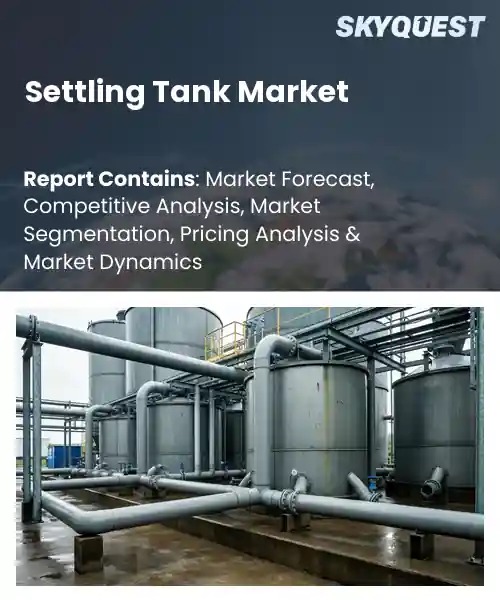
Settling Tank Market
Report ID: SQMIG25G2033
Report ID: SQMIG25G2033
[email protected]
USA +1 351-333-4748
Report ID:
SQMIG25G2033 |
Region:
Global |
Published Date: April, 2026
Pages:
157
|Tables:
114
|Figures:
77


Global Settling Tank Market size was valued at USD 4.1 Billion in 2024 and is poised to grow from USD 4.43 Billion in 2025 to USD 8.2 Billion by 2033, growing at a CAGR of 8.0% during the forecast period (2026-2033).
The primary driver of the settling tank market is the accelerating demand for reliable water and wastewater treatment infrastructure, which reflects growing urbanization, stricter environmental regulations, and rising industrial discharge volumes. Settling tanks, called clarifiers or sedimentation basins, form the backbone of primary and secondary treatment processes by removing suspended solids to protect downstream filters. Over recent decades the market evolved from large municipal gravity tanks to compact, high-efficiency designs used in food processing and mining, as firms adopted modular solutions to reduce footprint and lifecycle costs. For example, municipalities globally have upgraded clarifiers to improve compliance and operational efficiency.A decisive factor shaping global settling tank growth is technological advances in design and process control, which drive efficiency gains and lower operating costs, thereby encouraging investment. When manufacturers add automated flow equalization, wear-resistant coatings, and improved sludge scraping, plant operators see less downtime and reduced chemical consumption, which accelerates retrofits in municipal and industrial facilities. Consequently suppliers can bundle clarifiers with sludge thickeners and anaerobic digesters, creating biogas revenue. For example, mining operations adopt inclined plate settlers to meet strict discharge standards and breweries use compact tanks to recover solids and reclaim water, illustrating how technology yields opportunities globally.
How is IoT-enabled monitoring enhancing efficiency in the settling tank market?
IoT enabled monitoring transforms settling tank operations by combining continuous sensors for level turbidity dissolved oxygen and sludge blanket depth with cloud based analytics and remote dashboards. This real time visibility lets operators detect stratification or rising solids early and adjust flows or rake operation before performance degrades. The market is shifting from manual sampling toward automated condition based control to meet stricter discharge requirements and lower operating expense. Examples include sensor triggered sludge extraction remote alarming to prevent overflow and analytics driven desludging schedules. These changes improve uptime reduce energy use and extend equipment life while supporting compliance.Endress+Hauser March 2025, launched the Micropilot FWR30 cloud connected radar level sensor with NB IoT connectivity and remote dashboards. By providing continuous remote level data and cloud analytics the product reduces site visits shortens response times and helps operators time desludging more effectively which enhances settling tank efficiency and lowers operating costs.
Market snapshot - (2026-2033)
Global Market Size
USD 4.1 Billion
Largest Segment
Fixed
Fastest Growth
Portable
Growth Rate
8.0% CAGR
To get more insights on this market click here to Request a Free Sample Report
Global settling tank market is segmented by tank type, product form, material, application and region. Based on tank type, the market is segmented into Fixed and Portable. Based on product form, the market is segmented into Bags, Tubes and Curved Tower. Based on material, the market is segmented into PVC and Stainless Steel. Based on application, the market is segmented into Indoor and Outdoor. Based on region, the market is segmented into North America, Europe, Asia Pacific, Latin America and Middle East & Africa.
Bags segment dominates because its simplicity and adaptability make it the preferred choice for a range of settling tank installations. Bag designs enable rapid installation and removal, which reduces operational downtime and simplifies routine cleaning. Their compatibility with multiple materials and tank geometries lowers customization burdens, so operators favor them for maintenance workflows. Regulatory compliance is easier to manage with disposable or replaceable bag elements, driving adoption across uses.
However, Tubes are witnessing rapid growth as manufacturers innovate modular and high throughput tube settlers that boost clarification efficiency in compact footprints. Their adaptability to retrofit projects and to portable tanks enhances adoption, while material improvements and simplified maintenance practices expand usable applications and attract new operators, accelerating market opportunities.
Stainless Steel segment leads because its superior corrosion resistance and structural integrity extend equipment lifespans under harsh settling tank conditions. The material's resistance to chemical attack and wear reduces maintenance frequency and lowers total lifecycle disruptions, which appeals to operators in demanding applications. Ease of cleaning and sanitization improves compliance with strict effluent quality requirements, driving specification of stainless steel where long term reliability and consistent performance are priorities.
However, PVC is emerging as the most rapidly expanding material choice due to its lower upfront cost and lightweight handling that suit portable settling tank designs. Advances in PVC formulations improve chemical resistance and durability, while simplified fabrication reduces lead times, broadening applicability and enabling quicker deployment that catalyzes market expansion.
To get detailed segments analysis, Request a Free Sample Report
Asia Pacific commands a leading role driven by a confluence of industrial breadth, rapid urban infrastructure development and concentrated manufacturing prowess in key markets such as Japan and South Korea. Strong regional emphasis on upgrading wastewater and process treatment capabilities, paired with policy focus on environmental protection, stimulates demand for both conventional and advanced settling solutions. A dense supplier ecosystem, competitive manufacturing costs and willingness to adopt modular, automated systems enable scale and localized customization. Cross border collaboration, technology transfer and a robust aftermarket and maintenance culture further consolidate position, allowing solution providers to tailor offerings for diverse end use sectors ranging from municipal utilities to heavy industry, supporting ongoing replacement and upgrade cycles. Robust research and development ecosystems and skilled engineering talent accelerate innovation, while established logistics networks support regional supply chains and export orientation.
Settling Tank Market in Japan reflects a mature industrial ecosystem that prioritizes reliability, innovation and precision engineering. Manufacturers emphasize compact, high-efficiency designs tailored for constrained sites and strict regulatory compliance. Demand is driven by upgrades in water treatment, industrial effluent management and municipal infrastructure modernization. Strong supplier networks and focus on technological refinement support long term adoption of advanced settling tank solutions across diversified end use sectors and operational resilience.
Settling Tank Market in South Korea is shaped by strong industrial demand, urban wastewater priorities and a focus on compact, high performance treatment systems. Local manufacturers collaborate with global technology providers to integrate automation and advanced materials. Emphasis on rapid deployment, maintenance efficiency and environmental compliance encourages adoption of modular settling tank variants for both municipal and industrial customers. Policy alignment and skilled engineering capacity strengthen market readiness, solution customization.
Rapid expansion in North America is propelled by a combination of infrastructure renewal agendas, stringent environmental expectations and technological modernization across municipal and industrial water treatment segments. The United States and Canada exhibit strong emphasis on replacing aging assets and integrating energy efficient, low maintenance solutions, which fosters demand for versatile settling tank configurations. Increasing interest in automation, remote monitoring and modular fabrication supports faster deployment and lower lifecycle costs. Collaboration between engineering firms, technology vendors and local authorities accelerates specification of advanced clarifiers and settling units tailored to specific waste streams. Additionally, availability of financing mechanisms for infrastructure projects and growing attention to resilience and regulatory compliance reinforce investment in upgraded treatment assets and aftermarket services. A skilled technical workforce and growing partnerships with research institutions further stimulate localized innovation and adoption.
Settling Tank Market in United States focuses on infrastructure renewal, resilience and operational efficiency. Municipal and industrial buyers prioritize systems that reduce footprint and improve solids management. Vendors emphasize automated control, remote monitoring and modular fabrication to accelerate installation and simplify maintenance. Procurement increasingly values proven lifecycle performance and comprehensive support models that combine equipment supply with service agreements to ensure reliable long term operation and transparent vendor accountability mechanisms.
Settling Tank Market in Canada is influenced by regional infrastructure priorities, strong environmental standards and emphasis on operational efficiency in remote and urban contexts. Buyers seek modular, low maintenance settling solutions that adapt to varied site conditions. Suppliers focus on durable materials, simplified installation and integrated monitoring to reduce lifecycle costs. Collaborative procurement and partnerships with engineering firms support tailored solutions for municipal utilities, resource extraction and industrial process applications.
Europe is reinforcing its role through a focus on regulatory-driven upgrades, technological refinement and integration of energy efficient designs that align with circular economy objectives. Germany, United Kingdom and France demonstrate strengths in engineering expertise, bespoke fabrication and rigorous standards that elevate equipment performance and lifecycle sustainability. Emphasis on resource recovery, sludge reduction and process intensification encourages adoption of advanced settling concepts and hybrid solutions. Collaboration among utilities, research institutions and equipment manufacturers drives pilot initiatives and knowledge exchange, while contracting models that favor long term serviceability promote investment in higher quality units with robust aftermarket support and system optimization capabilities. Digitalization and remote monitoring augment operational transparency, while standardization of components supports scalable production and international competitiveness. Strong vocational training and engineering centers nurture expertise that enables complex project delivery.
Settling Tank Market in Germany benefits from engineering capabilities, strong manufacturing networks and stringent environmental standards that prioritize durability and efficiency. Demand emphasizes solutions with high materials integrity, energy efficient operation and precise process control. Local suppliers provide tailored designs and integrated service contracts, while collaboration with research institutes advances applications and validation. Procurement favors long term reliability and maintainability, supporting investment in settling technologies for municipal and industrial uses.
Settling Tank Market in United Kingdom is shaped by regulatory emphasis on water quality, modernization of municipal infrastructure and demand for compact, low maintenance systems. Suppliers adapt offerings for urban retrofit and industrial process conditions requiring flexible operational profiles. Integration of digital monitoring and predictive maintenance enhances asset performance and reduces downtime. Public and private stakeholders favor solutions with clear lifecycle benefits, encouraging service oriented contracts and collaborative delivery models.
Settling Tank Market in France is driven by efforts to improve water reuse, reduce sludge volumes and enhance treatment efficiency across municipal sectors. Demand favors adaptable designs that balance performance with modest footprint and simplified maintenance. French suppliers emphasize integrated solutions combining mechanical reliability with energy efficient operation and digital oversight. Cooperation between utilities, technology vendors and engineering consultancies facilitates pilot projects and tailored implementations that address local regulatory priorities.
To know more about the market opportunities by region and country, click here to
Buy The Complete Report
Urbanization and Industrial Expansion
Stringent Environmental Regulations
High Capital and Maintenance Costs
Limited Skilled Workforce Availability
Request Free Customization of this report to help us to meet your business objectives.
Competition in the global settling tank market is sharpening as incumbents consolidate and face pressure from agile water tech entrants offering rapid, compact clarification alternatives. Key competition drivers include regulatory tightening and municipal capacity constraints that force onsite pretreatment. Firms execute concrete moves such as Parkson integrating Meurer Research to expand plate settler capability and Veolia forming regional delivery partnerships, while startups commercialize automated clarification reactors.
Top Player’s Company Profile
Recent Developments
SkyQuest’s ABIRAW (Advanced Business Intelligence, Research & Analysis Wing) is our Business Information Services team that Collects, Collates, Correlates, and Analyses the Data collected by means of Primary Exploratory Research backed by robust Secondary Desk research. As per SkyQuest analysis, the global settling tank market is propelled by accelerating demand for reliable water and wastewater treatment driven by urbanization and tighter environmental regulations, while rapid adoption of IoT-enabled monitoring and automated controls acts as a secondary driver by improving uptime and lowering operating costs. A key restraint remains high capital and ongoing maintenance costs for large-scale installations, which can slow procurement and retrofits. Asia Pacific emerges as the dominating region due to industrial growth, infrastructure investment and competitive manufacturing, and the bags product-form is the dominating segment because of rapid installation, ease of maintenance and regulatory-friendly disposable designs. Overall, market momentum balances innovation with cost pressures.
| Report Metric | Details |
|---|---|
| Market size value in 2024 | USD 4.1 Billion |
| Market size value in 2033 | USD 8.2 Billion |
| Growth Rate | 8.0% |
| Base year | 2024 |
| Forecast period | (2026-2033) |
| Forecast Unit (Value) | USD Billion |
| Segments covered |
|
| Regions covered | North America (US, Canada), Europe (Germany, France, United Kingdom, Italy, Spain, Rest of Europe), Asia Pacific (China, India, Japan, Rest of Asia-Pacific), Latin America (Brazil, Rest of Latin America), Middle East & Africa (South Africa, GCC Countries, Rest of MEA) |
| Companies covered |
|
| Customization scope | Free report customization with purchase. Customization includes:-
|
To get a free trial access to our platform which is a one stop solution for all your data requirements for quicker decision making. This platform allows you to compare markets, competitors who are prominent in the market, and mega trends that are influencing the dynamics in the market. Also, get access to detailed SkyQuest exclusive matrix.
Table Of Content
Executive Summary
Market overview
Parent Market Analysis
Market overview
Market size
KEY MARKET INSIGHTS
COVID IMPACT
MARKET DYNAMICS & OUTLOOK
Market Size by Region
KEY COMPANY PROFILES
Methodology
For the Settling Tank Market, our research methodology involved a mixture of primary and secondary data sources. Key steps involved in the research process are listed below:
1. Information Procurement: This stage involved the procurement of Market data or related information via primary and secondary sources. The various secondary sources used included various company websites, annual reports, trade databases, and paid databases such as Hoover's, Bloomberg Business, Factiva, and Avention. Our team did 45 primary interactions Globally which included several stakeholders such as manufacturers, customers, key opinion leaders, etc. Overall, information procurement was one of the most extensive stages in our research process.
2. Information Analysis: This step involved triangulation of data through bottom-up and top-down approaches to estimate and validate the total size and future estimate of the Settling Tank Market.
3. Report Formulation: The final step entailed the placement of data points in appropriate Market spaces in an attempt to deduce viable conclusions.
4. Validation & Publishing: Validation is the most important step in the process. Validation & re-validation via an intricately designed process helped us finalize data points to be used for final calculations. The final Market estimates and forecasts were then aligned and sent to our panel of industry experts for validation of data. Once the validation was done the report was sent to our Quality Assurance team to ensure adherence to style guides, consistency & design.
Analyst Support
Customization Options
With the given market data, our dedicated team of analysts can offer you the following customization options are available for the Settling Tank Market:
Product Analysis: Product matrix, which offers a detailed comparison of the product portfolio of companies.
Regional Analysis: Further analysis of the Settling Tank Market for additional countries.
Competitive Analysis: Detailed analysis and profiling of additional Market players & comparative analysis of competitive products.
Go to Market Strategy: Find the high-growth channels to invest your marketing efforts and increase your customer base.
Innovation Mapping: Identify racial solutions and innovation, connected to deep ecosystems of innovators, start-ups, academics, and strategic partners.
Category Intelligence: Customized intelligence that is relevant to their supply Markets will enable them to make smarter sourcing decisions and improve their category management.
Public Company Transcript Analysis: To improve the investment performance by generating new alpha and making better-informed decisions.
Social Media Listening: To analyze the conversations and trends happening not just around your brand, but around your industry as a whole, and use those insights to make better Marketing decisions.
REQUEST FOR SAMPLE
 REQUEST FREE CUSTOMIZATION


Want to customize this report? This report can be personalized according to your needs. Our analysts and industry experts will work directly with you to understand your requirements and provide you with customized data in a short amount of time. We offer $1000 worth of FREE customization at the time of purchase.
Feedback From Our Clients


 USA (+1) 351-333-4748

