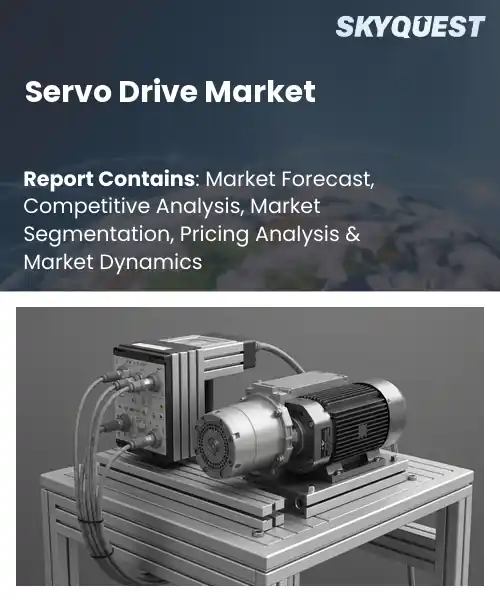
Servo Drive Market
Report ID: SQMIG20D2661
Report ID: SQMIG20D2661
[email protected]
USA +1 351-333-4748
Report ID:
SQMIG20D2661 |
Region:
Global |
Published Date: June, 2026
Pages:
157
|Tables:
94
|Figures:
76


Global Servo Drive Market size was valued at USD 490.52 Billion in 2024 and is poised to grow from USD 514.8 Billion in 2025 to USD 757.7 Billion by 2033, growing at a CAGR of 4.95% during the forecast period (2026-2033).
The main driver behind the servo drive market growth is mostly just the need for precise, high-speed motion control across automated industries, like in real plants not theoretical ones. Servo drives end up managing torque, position, and velocity for motors, and they sit right at the center of robotics, CNC machinery , and automated assembly lines.
Another influential factor is the way IIoT plus real-time networks have reshaped demand. Once manufacturers start adopting connected sensors and EtherCAT communications, they typically ask for drives that include embedded analytics. That way equipment health can be watched continuously and failures can be estimated ahead of time, so unplanned downtime drops and operating costs follow it downward. On top of that, stricter energy rules have pushed suppliers toward regenerative braking and more efficient power stages. the net effect is lower consumption in conveyor setups and multi-axis machines. These results can be caught in e-commerce distribution centers where AGVs lean on compact drives, and also in CNC shops where predictive tuning helps reduce setup time and boosts throughput.
IoT improves predictive maintenance in the servo drive industry by supporting continuous condition monitoring and better decision making. the big pieces usually include built in sensing inside the drives, real time telemetry streaming , edge analytics, and cloud based pattern matching. Many vendors now ship diagnostics that catch faults before they fully fail, so remote teams can sort priorities and adjust maintenance schedules faster. this shifts the market away from reactive “fix it when it breaks” service toward models tied to outcomes, plus faster commissioning. in practice, some drives already report temperature, vibration, and torque movement trends. then the systems use that data to reduce wiring complexity, cut down on extra on-site sensors, and improve overall machine availability.
Market snapshot - (2026-2033)
Global Market Size
USD 490.52 Billion
Largest Segment
AC Drive
Fastest Growth
AC Drive
Growth Rate
4.95% CAGR
To get more insights on this market click here to Request a Free Sample Report
The global servo drive market is segmented by drive, voltage, end-user and region. Based on drive, the market is segmented into AC Drive, DC Drive and Others. Based on voltage, the market is segmented into Low (up to 1kV), Medium (1kV-6.6kV), High (Above 6.6kV) and Others. Based on end-user, the market is segmented into Industrial Machinery & Equipment, Semiconductors & Electronics, Automotive, Healthcare, Printing & Packaging Equipment and Others. Based on region, the market is segmented into North America, Europe, Asia Pacific, Latin America and Middle East & Africa.
As per the servo drive market analysis, the AC Drive segment basically runs the show because it ends up being compatible with induction and synchronous motors, plus these advanced vector and field oriented control techniques give steadier torque handling and quicker responsiveness , which is what servo work needs. There is also this proven reliability and mature integration with PLCs and industrial networks, so the whole system feels less complicated and the service side is easier, so OEMs tend to lean that way. And, because it supports a broad power range plus many motion patterns, it keeps getting picked across established automation lines, which helps it stay market leader like in a very direct way.
On the other hand DC Drive is expanding faster, mainly because more people want compact low voltage precision actuation for specialized robotics and for legacy retrofit projects, so companies are putting more money back in. Improvements in brushless DC control, and energy saving motor designs, make integration feel less painful , which then enables newer small format builds and mobile uses. That basically unlocks fresh pathways across high precision pockets where there is need of that performance.
According to the servo drive market forecast, For Industrial Machinery & Equipment, that segment tends to dominate since coordinated multi axis motion control is heavy , and the productivity targets are strict, so servo drives become a necessity for CNC machines, packaging lines and factory robotics. Machine builders and drive suppliers also have strong working relationships, meaning they can craft tuned solutions and keep long product life cycles going. That lowers the adoption friction a lot. Reliability and serviceability for capital equipment then translates into repeat ordering and deeper integration, so the position stays strong.
Meanwhile, Semiconductors & Electronics is the fastest growing slice because automation keeps spreading across wafer handling, testing, and assembly . In that world ultra high precision matters and low vibration is not optional. So when miniaturization and higher throughput show up, suppliers have to innovate toward compact, high bandwidth servo options, and that becomes a real differentiator. This also opens up product lines that are more application specific, and overall it broadens the market.
To get detailed segments analysis, Request a Free Sample Report
As per the servo drive market regional forecast, Asia Pacific dominance shows this convergence of dense manufacturing power , advanced electronics supply chains , and really strong clusters in robotics and automotive engineering . The region gets traction from deep vertical integration among component suppliers , system integrators , and original equipment manufacturers that care about precision motion control. There’s also local pull from semiconductor, consumer electronics, and factory automation sectors, so it turns into a continuous innovation loop, pushing specialization and those scale perks. There are established industrial automation giants side by side with quicker, agile local startup teams, and that speeds up prototyping and commercialization of compact , high performance solutions . Add supportive industrial policy , broad supplier ecosystems , and a skilled engineering talent pool, and it just reinforces the region’s ability to deliver dependable, cost effective servo drive products for both domestic use and export markets.
Japan Servo Drive Market
The Servo Drive industry in Japan is basically supported by close integration with precision electronics , automotive systems , and factory automation. Strong domestic OEM presence, plus a culture of incremental innovation, boosts high specification demand and makes collaboration between control suppliers and system integrators feel tight. Supply chain maturity and a capable engineering workforce allow faster prototyping and rollout of advanced servo solutions across semiconductor, robotics, and industrial equipment segments, with a heavy emphasis on reliability and lifecycle support.
South Korea Servo Drive Market
The Servo Drive Market in South Korea benefits from a more concentrated strength in electronics manufacturing, consumer devices and next level robotics. Local suppliers tend to focus on high speed, compact form factors, and tight OEM collaboration, which helps drive tailored solutions . A proactive industrial ecosystem supports quick motion control integration across assembly lines , semiconductor production, and precision equipment. There’s also emphasis on export competitiveness and aftersales service, so adoption increases and long term partnerships stay stronger across regional and global supply networks.
The rapid servo drive market penetration in North America comes from manufacturing modernization , widespread robotics adoption, and motion control spreading across multiple industry verticals , plus a solid systems integration and aftermarket ecosystem . Demand from automotive electrification , aerospace , medical devices, and precision equipment is pushing companies to invest in modular , high performance servo solutions . Reshoring moves, along with supply chain resilience priorities, has increased local procurement and customization needs. Mature distribution channels, engineering services and automation consultancies also make it easier to launch deployment , and retrofit projects. When OEMs and control suppliers collaborate closely, and there are innovation hubs involved , the region can deliver customized options that lean into reliability , energy efficiency and smooth integration with factory control architectures, and that keeps North America strong in advanced motion control use cases.
United States Servo Drive Market
The Servo Drive Market in the United States shows strong demand for high performance , scalable motion control solutions across automotive , aerospace , and manufacturing. There’s a solid ecosystem of system integrators and engineering firms that supports deployments and custom configurations. Procurement patterns are shaped by energy efficiency goals, retrofit modernization , and integration with digital control platforms. Also, proximity to research centers and industry consortiums improves innovation, and helps support development of specialized servo products for tough industrial requirements.
Canada Servo Drive Market
The Servo Drive Market in Canada tends to lean into niche manufacturing, automation for resource sectors, and a close working relationship with system integrators for tailored motion solutions. OEMs and engineering service providers place a priority on reliability and energy efficient operation. The market benefits from strong connections to North American supply chains and from growing interest in retrofit solutions, those that extend equipment life while improving throughput and precision across different industrial applications. Services and ongoing support help keep momentum, too.
Europe is, like, pushing ahead on industrial digitalization and keeping a firm stance on energy efficiency priorities while also leaning on a long standing habit of precision engineering. In the region, OEMs and automation vendors tend to stress modular, interoperable approaches that mesh into factory control systems, and also link up with enterprise digitization programs. The policy and regulatory attention on sustainability, plus lifecycle performance, nudges the creation of lower loss and more serviceable products along with durable aftermarket models. Meanwhile cooperation between research organizations, industrial clusters, and system integrators helps speed up application focused innovation across automotive, transport, manufacturing, and energy. With a service ecosystem that’s already grown up, and a clear emphasis on customization plus standards compliance, suppliers can tackle difficult scenarios while still holding onto reliability and day to day operational performance.
Germany Servo Drive Market
The Servo Drive Market in Germany is shaped by precision engineering, automotive manufacture , and industrial automation. Integrators usually team up with OEMs to deliver strong, customizable motion control solutions for tough production setups. The priority on energy efficiency, durability and smooth integration with plant control systems steers product design decisions. Research connections and experienced engineering talent help with adaptation for complex segments such as automotive and machinery. This keeps Germany position as a leader in motion control intact.
United Kingdom Servo Drive Market
The Servo Drive Market in the United Kingdom leans toward flexible, service oriented motion control offerings for aerospace, precision engineering and advanced manufacturing. System integrators often focus on retrofit solutions, modular components and close integration with digital production platforms. Suppliers place attention on lifecycle support and compliance with local standards, which supports confidence in continuous operation. Collaboration between research institutions and industry helps nurture niche innovation in robotics and controls , reinforcing UK capability in specialized servo applications.
France Servo Drive Market
The Servo Drive Market in France blends strengths in precision equipment and transport systems, which helps drive adoption of modern motion control. Suppliers tend to highlight modular design, energy efficient operation, and alignment with European standards. That makes it easier to integrate into complex systems like rail, aerospace and factory automation. Industry groups, research institutes, and integrators collaborating together supports customization for specific requirements. A well developed service network, plus a focus on lifecycle performance, encourages uptake across these applications.
To know more about the market opportunities by region and country, click here to
Buy The Complete Report
Rising Demand For Industrial Automation
Advances In Motor Control Technology
High Initial Investment Costs
Complexity In System Integration
Request Free Customization of this report to help us to meet your business objectives.
Competitive pressure in the global servo drive arena revolves around integrated , compact setups and motion control that’s software enabled more or less. A lot of manufacturers keep going after acquisitions and strategic deals , just to bolt on connectivity plus safety functions , like HMS Networks buying Red Lion Controls and OEMs extending safety and network bits into drive families they already sell. Meanwhile startups and longer standing players try to edge in via IO Link alignment and compact actuator modules, to catch both OEM orders and retrofit projects.
Top Player’s Company Profile
Recent Developments in the Servo Drive Market
SkyQuest’s ABIRAW (Advanced Business Intelligence, Research & Analysis Wing) is our Business Information Services team that Collects, Collates, Correlates, and Analyses the Data collected by means of Primary Exploratory Research backed by robust Secondary Desk research.
As per SkyQuest analysis, the global servo drive market is pushed mainly by the need for accurate high-speed movement control across automated sectors , so robotics, CNC, and assembly setups start using it more. Another momentum factor is the rise in IIoT and edge based motion intelligence, this supports predictive maintenance and near-real-time coordination, which cuts down downtime and operating expenses. Still, the upfront investment cost stays high and that becomes a real holdback for some cost-sensitive manufacturers. Asia Pacific is still the leading region, mainly because there are dense manufacturing clusters plus semiconductor groups nearby. For technology, the AC Drive segment leads overall, because it fits a wide range of motors, has mature control techniques , and has a reliability track record that makes integration easier for OEMs.
| Report Metric | Details |
|---|---|
| Market size value in 2024 | USD 490.52 Billion |
| Market size value in 2033 | USD 757.7 Billion |
| Growth Rate | 4.95% |
| Base year | 2024 |
| Forecast period | (2026-2033) |
| Forecast Unit (Value) | USD Billion |
| Segments covered |
|
| Regions covered | North America (US, Canada), Europe (Germany, France, United Kingdom, Italy, Spain, Rest of Europe), Asia Pacific (China, India, Japan, Rest of Asia-Pacific), Latin America (Brazil, Rest of Latin America), Middle East & Africa (South Africa, GCC Countries, Rest of MEA) |
| Companies covered |
|
| Customization scope | Free report customization with purchase. Customization includes:-
|
To get a free trial access to our platform which is a one stop solution for all your data requirements for quicker decision making. This platform allows you to compare markets, competitors who are prominent in the market, and mega trends that are influencing the dynamics in the market. Also, get access to detailed SkyQuest exclusive matrix.
Table Of Content
Executive Summary
Market overview
Parent Market Analysis
Market overview
Market size
KEY MARKET INSIGHTS
COVID IMPACT
MARKET DYNAMICS & OUTLOOK
Market Size by Region
KEY COMPANY PROFILES
Methodology
For the Servo Drive Market, our research methodology involved a mixture of primary and secondary data sources. Key steps involved in the research process are listed below:
1. Information Procurement: This stage involved the procurement of Market data or related information via primary and secondary sources. The various secondary sources used included various company websites, annual reports, trade databases, and paid databases such as Hoover's, Bloomberg Business, Factiva, and Avention. Our team did 45 primary interactions Globally which included several stakeholders such as manufacturers, customers, key opinion leaders, etc. Overall, information procurement was one of the most extensive stages in our research process.
2. Information Analysis: This step involved triangulation of data through bottom-up and top-down approaches to estimate and validate the total size and future estimate of the Servo Drive Market.
3. Report Formulation: The final step entailed the placement of data points in appropriate Market spaces in an attempt to deduce viable conclusions.
4. Validation & Publishing: Validation is the most important step in the process. Validation & re-validation via an intricately designed process helped us finalize data points to be used for final calculations. The final Market estimates and forecasts were then aligned and sent to our panel of industry experts for validation of data. Once the validation was done the report was sent to our Quality Assurance team to ensure adherence to style guides, consistency & design.
Analyst Support
Customization Options
With the given market data, our dedicated team of analysts can offer you the following customization options are available for the Servo Drive Market:
Product Analysis: Product matrix, which offers a detailed comparison of the product portfolio of companies.
Regional Analysis: Further analysis of the Servo Drive Market for additional countries.
Competitive Analysis: Detailed analysis and profiling of additional Market players & comparative analysis of competitive products.
Go to Market Strategy: Find the high-growth channels to invest your marketing efforts and increase your customer base.
Innovation Mapping: Identify racial solutions and innovation, connected to deep ecosystems of innovators, start-ups, academics, and strategic partners.
Category Intelligence: Customized intelligence that is relevant to their supply Markets will enable them to make smarter sourcing decisions and improve their category management.
Public Company Transcript Analysis: To improve the investment performance by generating new alpha and making better-informed decisions.
Social Media Listening: To analyze the conversations and trends happening not just around your brand, but around your industry as a whole, and use those insights to make better Marketing decisions.
REQUEST FOR SAMPLE
 REQUEST FREE CUSTOMIZATION
Global Servo Drive Market size was valued at USD 490.52 Billion in 2024 and is poised to grow from USD 514.8 Billion in 2025 to USD 757.7 Billion by 2033, growing at a CAGR of 4.95% during the forecast period (2026-2033).
Competitive pressure in the global servo drive market centers on integrated, compact solutions and software-enabled motion control. Manufacturers pursue acquisitions and strategic deals to add connectivity and safety capabilities, as seen in HMS Networks' purchase of Red Lion Controls and OEMs extending safety and network features in existing drive lines. Startups and incumbents compete with IO-Link integration and compact actuator modules to capture OEM and retrofit demand. 'Yaskawa Electric Corporation', 'Mitsubishi Electric Corporation', 'Fanuc Corporation', 'Siemens AG', 'Rockwell Automation', 'ABB', 'Schneider Electric', 'Delta Electronics', 'Panasonic Holdings Corporation', 'Bosch', 'Nidec Corporation', 'Omron Corporation', 'Parker Hannifin Corporation', 'Emerson Electric', 'Regal Rexnord', 'Danfoss', 'Beckhoff Automation', 'Lenze', 'Kollmorgen', 'Fuji Electric'
Rising demand for industrial automation increases the need for precise, efficient motion control solutions that servo drives provide. Manufacturers seek improved throughput, consistent product quality, and flexible production lines, which servo drives enable through accurate positioning and torque control. As industries pursue higher automation levels, the preference for servo-based systems grows because they support complex motion profiles and seamless integration with sensors and controllers. This alignment between operational objectives and servo capabilities encourages investment in these drives, fostering greater adoption across sectors that prioritize productivity and adaptability.
𝐄𝐝𝐠𝐞 𝐌𝐨𝐭𝐢𝐨𝐧 𝐈𝐧𝐭𝐞𝐥𝐥𝐢𝐠𝐞𝐧𝐜𝐞: Integration of servo drives with edge computing enables localized motion intelligence and faster closed-loop decision making, supporting predictive maintenance and adaptive control strategies that reduce unplanned downtime. Manufacturers increasingly deploy on-device analytics to optimize performance, customize motion profiles, and accelerate commissioning while preserving bandwidth. This trend drives demand for interoperable, secure interfaces and modular software architectures that allow seamless collaboration with industrial IoT platforms and enterprise orchestration, fostering production flows and faster response to changing process requirements across automation applications.
Why does Asia Pacific Dominate the Global Servo Drive Market? |@12


Want to customize this report? This report can be personalized according to your needs. Our analysts and industry experts will work directly with you to understand your requirements and provide you with customized data in a short amount of time. We offer $1000 worth of FREE customization at the time of purchase.
Feedback From Our Clients


 USA (+1) 351-333-4748

