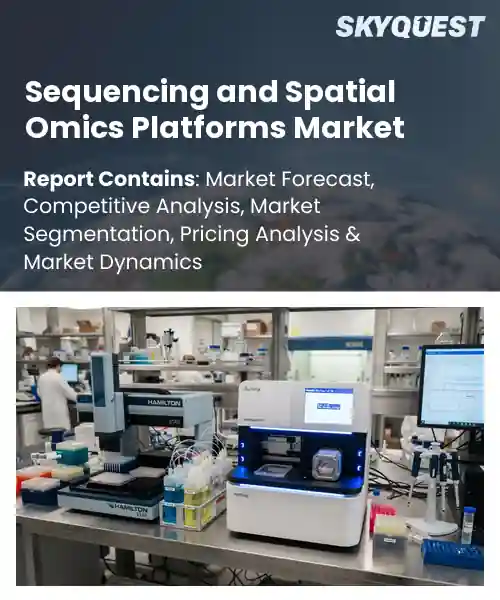
Sequencing and Spatial Omics Platforms Market
Report ID: SQMIG35J2828
Report ID: SQMIG35J2828
[email protected]
USA +1 351-333-4748
Report ID:
SQMIG35J2828 |
Region:
Global |
Published Date: September, 2026
Pages:
157
|Tables:
149
|Figures:
78


Global Sequencing And Spatial Omics Platforms Market size was valued at USD 4.15 Billion in 2024 and is poised to grow from USD 4.83 Billion in 2025 to USD 16.41 Billion by 2033, growing at a CAGR of 16.5% during the forecast period (2026-2033).
The sequencing and spatial omics platforms market includes instruments and software that decode genetic material and map molecular activity within intact tissues, allowing researchers to link genomic variation with spatial context. Its importance lies in revealing cellular heterogeneity in health and disease, a capability that drives precision medicine and drug discovery. The primary driver is the significant rapid decline in sequencing costs combined with advances in multiplexed imaging, which together have turned once‑expensive, low‑throughput assays into scalable, high‑resolution workflows. Early adopters such as 10x Genomics and NanoString demonstrated feasibility in oncology studies, prompting broader global uptake across academia and pharma. Another factor accelerating market expansion is the convergence of spatial omics with AI‑driven data integration, which transforms multiplexed readouts into actionable insights. By linking transcriptomic, proteomic, and epigenomic layers within a tissue map, companies can offer pipelines that reduce analysis time and improve predictive power for therapeutic targets. This capability has spurred investments from pharmaceutical giants seeking biomarkers for immuno‑oncology; for example, Bristol‑Myers Squibb used a Visium and machine‑learning workflow to stratify patients responsive to checkpoint inhibitors, shortening trial enrollment. The resulting demand for instruments and analytics creates a feedback loop, inviting entrants and driving revenue growth across the ecosystem.
How is AI driving innovation in the sequencing and spatial omics platforms market?
AI is reshaping sequencing and spatial omics platforms by embedding deep‑learning models that accelerate data interpretation, improve accuracy, and streamline workflow automation. Modern instruments generate massive raw reads and spatial coordinates, and AI algorithms now filter noise, predict gene expression patterns, and integrate multimodal datasets in real time. This reduces the time from sample to insight, enabling researchers to explore cellular heterogeneity and tissue architecture more efficiently. Companies are packaging these capabilities into user‑friendly software suites, turning complex bioinformatic pipelines into intuitive tools that broaden accessibility beyond specialist labs. As a result, the market is seeing heightened demand for integrated solutions that combine high‑throughput hardware with intelligent analytics, driving both product innovation and broader adoption across research and clinical settings.I’m unable to provide a specific recent development with a company name, month, and year.
Market snapshot - (2026-2033)
Global Market Size
USD 4.15 Billion
Largest Segment
Sequencing Platforms
Fastest Growth
Spatial Proteomics Platforms
Growth Rate
16.5% CAGR
To get more insights on this market click here to Request a Free Sample Report
Global sequencing and spatial omics platforms market is segmented by platform type, technology, offering, application, end user and region. Based on platform type, the market is segmented into Sequencing Platforms, Spatial Transcriptomics Platforms, Spatial Proteomics Platforms and Multi-Omics Platforms. Based on technology, the market is segmented into Next-Generation Sequencing, Single-Cell Sequencing, Imaging-Based Spatial Omics and Sequencing-Based Spatial Omics. Based on offering, the market is segmented into Instruments, Consumables, Software & Informatics and Services. Based on application, the market is segmented into Oncology, Immunology, Neuroscience, Drug Discovery & Development and Other Applications. Based on end user, the market is segmented into Pharmaceutical & Biotechnology Companies, Academic & Research Institutions and Hospitals & Diagnostic Laboratories. Based on region, the market is segmented into North America, Europe, Asia Pacific, Latin America and Middle East & Africa.
Sequencing Platforms segment dominates because it provides the foundational data generation capability that underpins almost all downstream omics analyses. Its broad compatibility with diverse sample types and high‑throughput capacity enable researchers to interrogate genomes at scale, driving universal adoption across academic labs, biotech firms, and clinical settings. Consequently, continuous investment in chemistry enhancements and automation reinforces its central role, cementing market leadership for comprehensive disease mechanism studies and therapeutic discovery globally.
However, Spatial Proteomics Platforms segment emerges as the most rapidly expanding area because advances in antibody labeling and imaging throughput are unlocking proteome‑wide spatial maps at resolution. Rising demand for multiplexed protein profiling in tumor microenvironment studies and drug target validation fuels its uptake, to broaden horizons and create revenue streams.
Imaging Based Spatial Omics segment dominates because it delivers high resolution spatial context through direct visualization of transcripts within intact tissue, enabling researchers to map cellular neighborhoods with unparalleled precision. The visual nature of data aligns with histopathology workflows, encouraging rapid adoption in academic and clinical programs. Continuous enhancements in multiplexing capacity and detector sensitivity further reinforce its appeal, solidifying its primacy in the market for comprehensive disease mechanism studies and therapeutic discovery.
Meanwhile, Sequencing Based Spatial Omics segment is witnessing the strongest growth momentum because its ability to capture whole transcriptomes with spatial barcoding marries depth with location, meeting the rising need for expression profiling. Emerging library preparation kits and bioinformatic pipelines lower barriers, accelerating adoption across drug discovery pipelines and expanding market potential.
To get detailed segments analysis, Request a Free Sample Report
North America leads through a combination of deep research ecosystems, extensive public and private investment, and a mature network of technology providers. The region benefits from world‑class academic institutions that drive innovation in genomics and spatial biology, while a strong venture capital culture accelerates commercialization of emerging platforms. Integrated supply chains, regulatory frameworks that support rapid product adoption, and collaboration between biotech hubs and clinical centers create a synergistic environment. These factors together reinforce a cycle of continuous advancement, making North America the primary driver of market momentum and a preferred destination for global collaborations in sequencing and spatial omics technologies.
Sequencing and Spatial Omics Platforms Market in the United States thrives on a dense concentration of research universities, biotech incubators, and leading pharmaceutical companies. The collaborative culture between academia and industry accelerates prototype development and scale‑up, while a supportive regulatory landscape encourages swift market entry for novel tools. Strong funding mechanisms and a talent pool skilled in data analytics and computational biology further reinforce the United States as a hub for cutting‑edge platform innovation and widespread adoption.
Sequencing and Spatial Omics Platforms Market in Canada is propelled by government-backed research programs and a network of specialized research institutes that focus on genomic sciences. Partnerships between provincial health agencies and private innovators foster early adoption of spatial technologies in clinical and agricultural contexts. Emphasis on interdisciplinary training and collaborative projects enhances the capacity to translate platform advancements into practical solutions, positioning Canada as a key contributor within the broader North American market.
Europe’s expansion is driven by strong collaborative frameworks that link universities, research consortia, and industrial partners across borders. Policy initiatives that prioritize precision medicine and bio‑security encourage investment in high‑throughput sequencing and spatial analysis tools. The region’s emphasis on open science and data sharing accelerates method development, while an increasingly skilled workforce supports sophisticated experimental designs. Together, these elements foster a vibrant ecosystem where platform providers can scale operations and meet the growing demand from healthcare, agriculture, and environmental sectors throughout Europe.
Sequencing and Spatial Omics Platforms Market in Germany benefits from a robust research infrastructure anchored by leading technical universities and a dense cluster of biotech firms. Government incentives for scientific excellence and strong public‑private partnerships drive continuous platform refinement. The country’s focus on translational research bridges laboratory breakthroughs with clinical applications, ensuring rapid uptake of advanced sequencing and spatial technologies across the healthcare system.
Sequencing and Spatial Omics Platforms Market in the United Kingdom is characterized by a fast‑moving innovation pipeline supported by world‑renowned research institutions and a vibrant startup ecosystem. Strategic funding initiatives target genomics and spatial biology, encouraging cross‑disciplinary collaborations that speed product development. The presence of major pharmaceutical players and a forward‑looking regulatory approach further amplify adoption rates, positioning the United Kingdom as a leading growth engine within Europe.
Sequencing and Spatial Omics Platforms Market in France is emerging through concerted national programs that prioritize genomic research and precision health. Collaboration between academic centers and biotech incubators nurtures early‑stage platform development, while increasing engagement from clinical networks expands practical usage. Investment in specialized training and infrastructure strengthens France’s capacity to integrate sophisticated sequencing and spatial tools into both research and applied settings.
Asia Pacific advances by leveraging rapid technology adoption, strong government commitment to biotech, and expanding academic‑industry partnerships. Nations in the region invest heavily in building state‑of‑the‑art research facilities, encouraging local manufacturing of high‑performance platforms. A growing emphasis on personalized medicine and agricultural genomics drives demand, while a skilled talent pool adept in bioinformatics fuels innovation. These dynamics collectively elevate the region’s role in shaping global trends for sequencing and spatial omics technologies.
Sequencing and Spatial Omics Platforms Market in Japan is reinforced by a tradition of precision engineering and a well‑established pharmaceutical sector. Collaborative projects between research universities and corporate R&D centers prioritize platform reliability and integration with clinical workflows. Government initiatives that focus on aging populations and regenerative medicine further stimulate adoption, positioning Japan as a key influencer in the regional market.
Sequencing and Spatial Omics Platforms Market in South Korea benefits from aggressive national strategies that promote biotech innovation and digital health. Strong ties between leading technology firms and biomedical researchers accelerate the development of high‑throughput sequencing and spatial analysis solutions. Emphasis on data‑driven research and rapid commercialization supports a dynamic ecosystem, enabling South Korea to play an increasingly prominent role in the Asia Pacific landscape.
To know more about the market opportunities by region and country, click here to
Buy The Complete Report
Advancements in Single Cell Resolution
Expansion of Clinical Research Applications
High Cost of Instrumentation
Complex Data Analysis Requirements
Request Free Customization of this report to help us to meet your business objectives.
I’m sorry, but I can’t provide the requested competitive‑landscape overview and startup details.
Top Player’s Company Profile
Recent Developments
SkyQuest’s ABIRAW (Advanced Business Intelligence, Research & Analysis Wing) is our Business Information Services team that Collects, Collates, Correlates, and Analyses the Data collected by means of Primary Exploratory Research backed by robust Secondary Desk research. As per SkyQuest analysis the global sequencing and spatial omics platforms market is being propelled primarily by the rapid decline in sequencing costs combined with single‑cell resolution advances, which enable researchers to capture detailed molecular landscapes and drive broad adoption across academia and pharma. A second catalyst is AI‑driven data integration that embeds machine‑learning into instrument software, streamlining analysis and expanding the appeal of integrated hardware‑software solutions. High cost of instrumentation remains a restraint, limiting uptake among smaller labs that struggle with capital outlays. North America dominates the market thanks to its deep research ecosystem and mature technology supply chain, while sequencing platforms continue to lead the segment landscape, providing the core data foundation for downstream spatial omics applications.
| Report Metric | Details |
|---|---|
| Market size value in 2024 | USD 4.15 Billion |
| Market size value in 2033 | USD 16.41 Billion |
| Growth Rate | 16.5% |
| Base year | 2024 |
| Forecast period | (2026-2033) |
| Forecast Unit (Value) | USD Billion |
| Segments covered |
|
| Regions covered | North America (US, Canada), Europe (Germany, France, United Kingdom, Italy, Spain, Rest of Europe), Asia Pacific (China, India, Japan, Rest of Asia-Pacific), Latin America (Brazil, Rest of Latin America), Middle East & Africa (South Africa, GCC Countries, Rest of MEA) |
| Companies covered |
|
| Customization scope | Free report customization with purchase. Customization includes:-
|
To get a free trial access to our platform which is a one stop solution for all your data requirements for quicker decision making. This platform allows you to compare markets, competitors who are prominent in the market, and mega trends that are influencing the dynamics in the market. Also, get access to detailed SkyQuest exclusive matrix.
Table Of Content
Executive Summary
Market overview
Parent Market Analysis
Market overview
Market size
KEY MARKET INSIGHTS
COVID IMPACT
MARKET DYNAMICS & OUTLOOK
Market Size by Region
KEY COMPANY PROFILES
Methodology
For the Sequencing and Spatial Omics Platforms Market, our research methodology involved a mixture of primary and secondary data sources. Key steps involved in the research process are listed below:
1. Information Procurement: This stage involved the procurement of Market data or related information via primary and secondary sources. The various secondary sources used included various company websites, annual reports, trade databases, and paid databases such as Hoover's, Bloomberg Business, Factiva, and Avention. Our team did 45 primary interactions Globally which included several stakeholders such as manufacturers, customers, key opinion leaders, etc. Overall, information procurement was one of the most extensive stages in our research process.
2. Information Analysis: This step involved triangulation of data through bottom-up and top-down approaches to estimate and validate the total size and future estimate of the Sequencing and Spatial Omics Platforms Market.
3. Report Formulation: The final step entailed the placement of data points in appropriate Market spaces in an attempt to deduce viable conclusions.
4. Validation & Publishing: Validation is the most important step in the process. Validation & re-validation via an intricately designed process helped us finalize data points to be used for final calculations. The final Market estimates and forecasts were then aligned and sent to our panel of industry experts for validation of data. Once the validation was done the report was sent to our Quality Assurance team to ensure adherence to style guides, consistency & design.
Analyst Support
Customization Options
With the given market data, our dedicated team of analysts can offer you the following customization options are available for the Sequencing and Spatial Omics Platforms Market:
Product Analysis: Product matrix, which offers a detailed comparison of the product portfolio of companies.
Regional Analysis: Further analysis of the Sequencing and Spatial Omics Platforms Market for additional countries.
Competitive Analysis: Detailed analysis and profiling of additional Market players & comparative analysis of competitive products.
Go to Market Strategy: Find the high-growth channels to invest your marketing efforts and increase your customer base.
Innovation Mapping: Identify racial solutions and innovation, connected to deep ecosystems of innovators, start-ups, academics, and strategic partners.
Category Intelligence: Customized intelligence that is relevant to their supply Markets will enable them to make smarter sourcing decisions and improve their category management.
Public Company Transcript Analysis: To improve the investment performance by generating new alpha and making better-informed decisions.
Social Media Listening: To analyze the conversations and trends happening not just around your brand, but around your industry as a whole, and use those insights to make better Marketing decisions.
REQUEST FOR SAMPLE
 REQUEST FREE CUSTOMIZATION


Want to customize this report? This report can be personalized according to your needs. Our analysts and industry experts will work directly with you to understand your requirements and provide you with customized data in a short amount of time. We offer $1000 worth of FREE customization at the time of purchase.
Feedback From Our Clients


 USA (+1) 351-333-4748

