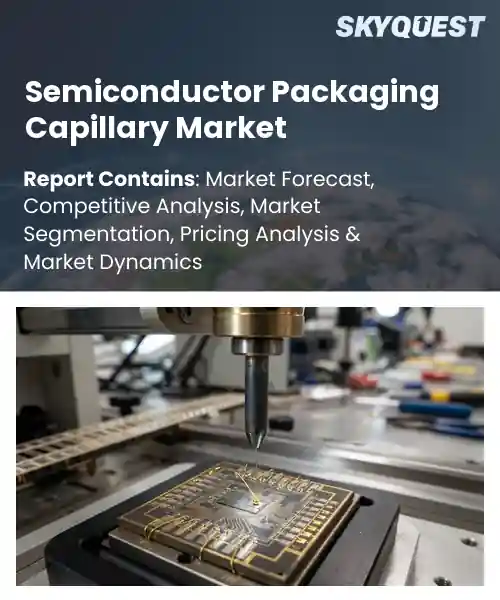
Semiconductor Packaging Capillary Market
Report ID: SQMIG45N2285
Report ID: SQMIG45N2285
[email protected]
USA +1 351-333-4748
Report ID:
SQMIG45N2285 |
Region:
Global |
Published Date: September, 2026
Pages:
157
|Tables:
147
|Figures:
78


Global Semiconductor Packaging Capillary Market size was valued at USD 680.0 Million in 2024 and is poised to grow from USD 722.84 Million in 2025 to USD 1178.45 Million by 2033, growing at a CAGR of 6.3% during the forecast period (2026-2033).
The global semiconductor packaging capillary market supplies the microscopic tubes that convey liquid epoxy, solder paste or under‑fill material during advanced chip encapsulation. These capillaries enable precise deposition in flip‑chip, wafer‑level packaging and system‑in‑package processes, which are essential for achieving higher interconnect density and thermal performance. Historically, the market emerged in the early 2000s as manufacturers shifted from wire bonding to ball‑grid‑array and fan‑out technologies, prompting demand for finer, more reliable fluid delivery. Recent adoption of 5‑nm and 3‑nm nodes has amplified the need for sub‑10‑micron capillaries, reinforcing the segment’s strategic importance in sustaining Moore’s Law and future technology roadmaps. The dominant growth factor now stems from the rapid expansion of high‑bandwidth memory (HBM) and artificial‑intelligence accelerators, which require interposers that depend on capillary‑fed under‑fill to maintain signal integrity. As data centers scale, manufacturers such as Samsung and TSMC integrate capillary‑based dispensing in their 2.5‑D and 3‑D stacking lines, reducing void formation and improving thermal pathways. This operational efficiency translates into lower yield loss, enabling AI chips that meet stringent latency targets. Consequently, suppliers of engineered capillaries experience rising orders, while players invest in coating technologies to further shrink tube diameters, unlocking applications in automotive lidar and advanced edge‑computing modules.
How is AI-driven automation impacting yield and cost efficiency in semiconductor packaging capillary markets?
AI driven automation is reshaping semiconductor packaging capillary processes by linking sensor data with machine learning models that predict optimal flow rates and temperature settings. This integration enables real time adjustment of dispensing parameters, which directly lifts defect free yields and trims material consumption. Operators now rely on predictive maintenance alerts that prevent nozzle wear before it causes scrap, and adaptive control loops keep bead placement consistent across large wafers. The result is a smoother production flow that shortens cycle time while lowering labor intensity, positioning the capillary segment to meet the rising demand for advanced chip architectures.Kulicke & Soffa announced a new AI enabled capillary dispensing system in April 2024, which automates nozzle alignment and adjusts pressure on the fly, delivering higher yield and reduced waste. This breakthrough demonstrates how intelligent automation can accelerate market growth and cost efficiency in semiconductor packaging.
Market snapshot - (2026-2033)
Global Market Size
USD 680.0 Million
Largest Segment
Underfill Capillaries
Fastest Growth
Dispensing Capillaries
Growth Rate
6.3% CAGR
To get more insights on this market click here to Request a Free Sample Report
Global semiconductor packaging capillary market is segmented by product type, material, packaging technology, application, end user and region. Based on product type, the market is segmented into Underfill Capillaries, Dispensing Capillaries and Other Packaging Capillaries. Based on material, the market is segmented into Ceramic, Carbide, Metal and Other Materials. Based on packaging technology, the market is segmented into Flip-Chip Packaging, Wafer-Level Packaging, Advanced IC Packaging and Other Packaging Technologies. Based on application, the market is segmented into Underfill Dispensing, Adhesive Dispensing, Encapsulation and Other Applications. Based on end user, the market is segmented into Semiconductor Manufacturers, OSAT Providers and Electronics Manufacturers. Based on region, the market is segmented into North America, Europe, Asia Pacific, Latin America and Middle East & Africa.
Underfill Capillaries segment dominates because they provide essential void free adhesion between die and substrate, ensuring mechanical stability required for high density interconnects. Their ability to flow into fine pitch gaps and cure without compromising electrical performance makes them the preferred choice for leading edge packages. Consequently designers rely on these capillaries to meet reliability standards, driving their preeminence in the market. These capabilities also support long term device endurance, reinforcing their leadership position.
However, Dispensing Capillaries segment is witnessing the strongest growth momentum because emerging 3D integration techniques demand precise material placement at smaller scales. Innovations in tip geometry and fluid dynamics enable these capillaries to handle viscous inks and nanoparticles, opening opportunities in packaging. This adoption fuels market expansion and creates avenues for suppliers.
Ceramic segment dominates because its high thermal conductivity and chemical inertness allow capillaries to endure intense processing environments while preserving dimensional precision. The material’s rigidity prevents deformation during high temperature cycles, ensuring accurate fluid delivery. These attributes also improve device reliability and lower failure rates, which are essential for high performance chips. Consequently manufacturers prioritize ceramic capillaries for critical interconnects, reinforcing its leading market position.
Meanwhile, Metal segment is emerging as the key high growth area because its superior electrical conductivity supports power dense packaging formats. Advances in machining and surface treatment enable walled metal capillaries that handle conductive inks, meeting the needs of next generation interconnects. This uptake expands market scope and creates revenue streams for suppliers focusing on metal based solutions.
To get detailed segments analysis, Request a Free Sample Report
Asia Pacific leads the global semiconductor packaging capillary market due to a confluence of advanced manufacturing ecosystems, deep R&D capabilities, and strong supply chain integration. The region hosts world‑class foundries and packaging specialists that continuously push the limits of miniaturization and performance, fostering demand for high‑precision capillary solutions. Close collaboration between semiconductor designers, equipment makers, and material suppliers accelerates technology transfer and reduces time‑to‑market. Government initiatives that emphasize high‑tech innovation and strategic investments in next‑generation packaging further reinforce the competitive edge. Additionally, the concentration of major electronics manufacturers creates a robust domestic demand base, enabling economies of scale and driving continuous improvement in capillary design and reliability. The region’s emphasis on collaborative standards development and its proactive approach to environmental sustainability also attract global partners seeking reliable and eco‑conscious capillary technologies.
Semiconductor Packaging Capillary Market in Japan benefits from a long‑standing tradition of precision engineering and a dense network of specialized component manufacturers. Close ties between leading chip designers and capillary suppliers enable rapid co‑development of bespoke solutions that meet stringent performance criteria. Strong intellectual property protection encourages innovation, while collaborative research programs with universities drive advances in material science and micro‑fabrication techniques, reinforcing Japan’s reputation for high‑quality capillary products globally.
Semiconductor Packaging Capillary Market in South Korea is propelled by an integrated semiconductor ecosystem that couples leading memory manufacturers with capillary equipment firms. Government‑backed innovation clusters foster collaboration, accelerating the translation of research into commercial capillary designs. Emphasis on cost efficiency and high throughput aligns with the region’s focus on production, while investment in materials enhances reliability and performance, solidifying South Korea’s role as a key supplier of capillary solutions.
The rapid expansion of the semiconductor packaging capillary market in North America is fueled by a dynamic blend of innovation‑centric ecosystems, strong demand for high‑performance computing, and substantial investment in advanced packaging technologies. Leading design houses and fabless companies collaborate closely with capillary equipment manufacturers to develop bespoke solutions that support heterogeneous integration and three‑dimensional stacking. Robust venture capital activity and government programs that prioritize semiconductor resilience accelerate the commercialization of next‑generation capillary designs. Additionally, the presence of major cloud service providers and data‑center operators creates a persistent need for miniaturized, high‑density interconnects, prompting manufacturers to enhance capillary precision and throughput. The region’s emphasis on sustainability also drives the adoption of environmentally friendly materials and processes within capillary production, reinforcing its position as a hub for cutting‑edge packaging innovation continually.
Semiconductor Packaging Capillary Market in United States is driven by a concentration of leading semiconductor design firms and a vibrant ecosystem of specialized equipment suppliers. Close collaboration between chip architects and capillary manufacturers accelerates the development of high‑precision tools required for advanced packaging formats. Strong intellectual property frameworks and substantial funding support continuous innovation, while the demand from cloud computing and automotive electronics sectors sustains a pipeline of capillary applications.
Semiconductor Packaging Capillary Market in Canada benefits from a strong research university network and a growing cluster of niche capillary component firms. Collaborative programs between academic institutions and industry accelerate the translation of material science breakthroughs into practical capillary designs. Emphasis on high‑reliability solutions aligns with Canada’s focus on aerospace, telecommunications, and quantum computing initiatives, fostering a specialized demand for precision capillary technologies that complement the North American regional ecosystem.
Europe is strengthening its position in the semiconductor packaging capillary market through coordinated investment in research collaborations, a focus on high‑value niche applications, and a commitment to sustainable manufacturing practices. Leading automotive and industrial electronics manufacturers partner with capillary technology providers to develop solutions that meet stringent reliability and thermal performance standards. The region’s strong regulatory framework encourages the adoption of environmentally responsible materials, prompting innovators to create low‑impact capillary processes. Academic institutions across key countries contribute cutting‑edge material science and micro‑fabrication expertise, feeding a pipeline of advanced capillary designs. Moreover, Europe’s emphasis on standardization and cross‑border cooperation facilitates the rapid diffusion of best practices, enabling the continent to capture a growing share of the global high‑performance packaging ecosystem continually.
Semiconductor Packaging Capillary Market in Germany is anchored by a robust network of precision engineering firms and a strong automotive electronics sector. Close cooperation between capillary equipment manufacturers and leading chip designers accelerates the development of high‑reliability solutions required for power electronics and advanced driver‑assistance systems. Government‑supported research initiatives focus on novel materials and additive manufacturing techniques, fostering continuous improvement in capillary performance and sustainability for the market and beyond.
Semiconductor Packaging Capillary Market in United Kingdom benefits from a vibrant cluster of micro‑technology firms and strong academic research in materials science. Partnerships between universities and capillary equipment suppliers accelerate the translation of innovative coatings and precision machining techniques into commercial products. The UK’s focus on aerospace and defense electronics drives demand for ultra‑reliable capillary solutions, while sustainability initiatives encourage the adoption of recyclable materials and energy‑efficient manufacturing processes continually.
Semiconductor Packaging Capillary Market in France is reinforced by a strong tradition of precision manufacturing and a growing emphasis on high‑density interconnects for telecommunications and medical devices. Collaborative projects between French research institutes and capillary technology firms focus on developing ultra‑fine nozzle geometries and low‑contamination processes. The national push for green manufacturing drives the integration of eco‑friendly materials, positioning France as a leader in sustainable capillary solutions for semiconductor packaging.
To know more about the market opportunities by region and country, click here to
Buy The Complete Report
Rising Demand for High‑Performance Devices
The surge in consumer electronics, automotive electronics, and data center infrastructure creates sustained pressure for components that deliver higher speed, lower power consumption, and greater functionality. Semiconductor manufacturers respond by integrating more functions into single chips, which in turn mandates sophisticated packaging solutions such as capillary encapsulation. This packaging offers superior thermal management and electrical performance, enabling designers to meet stringent specifications. Consequently, the growing need for high‑performance devices directly fuels demand for advanced capillary packaging, supporting market expansion globally.
Advancements in Miniaturization Technologies
Innovations in three‑dimensional integration and system‑in‑package architectures demand increasingly dense interconnects and reliable thermal pathways. Capillary packaging provides a precise method for delivering conductive or insulating fluids directly to critical junctions, enhancing signal integrity and heat dissipation. By enabling tighter chip stacking and reducing footprint, this technology aligns with manufacturers’ goals of delivering compact, high‑functionality products. As design cycles accelerate, the ability of capillary solutions to support rapid prototyping and scalable production further encourages adoption, thereby significantly driving market momentum.
High Capital Investment Requirements
Capillary packaging equipment requires specialized machinery, cleanroom environments, and highly trained personnel, resulting in substantial upfront expenditure for semiconductor manufacturers. The need to integrate these capabilities into existing production lines often involves extensive facility upgrades and long lead times for equipment procurement. Smaller firms or those operating on thin margins may find such financial commitments prohibitive, leading them to postpone or avoid investment in capillary technologies. This cost barrier consequently slows broader market adoption and limits growth potential across the industry.
Complex Environmental Compliance Standards
Capillary processes often involve the use of chemicals and fluids that are subject to stringent environmental regulations across multiple jurisdictions. Manufacturers must implement comprehensive waste‑management protocols, obtain permits, and conduct regular audits to demonstrate compliance, which adds operational complexity and increases ongoing expenses. The uncertainty surrounding future regulatory tightening can also deter investment decisions, as firms anticipate the need for additional controls or material substitutions. Consequently, heightened compliance obligations act as a deterrent, constraining market expansion and influencing product development timelines.
Request Free Customization of this report to help us to meet your business objectives.
The semiconductor packaging capillary market is shaped by intense competition among established equipment suppliers and emerging innovators. Companies such as Entegris and MKS Instruments are accelerating growth through strategic acquisitions of niche technology firms and forming joint development agreements with leading chip manufacturers. Recent partnerships focus on integrating advanced capillary dispensing solutions into 3D‑IC and heterogeneous integration processes, while technology innovation targets higher throughput and sub‑micron precision to meet the demands of next‑generation semiconductor devices.
Top Player’s Company Profile
Recent Developments
SkyQuest’s ABIRAW (Advanced Business Intelligence, Research & Analysis Wing) is our Business Information Services team that Collects, Collates, Correlates, and Analyses the Data collected by means of Primary Exploratory Research backed by robust Secondary Desk research. As per SkyQuest analysis the global semiconductor packaging capillary market is projected to grow at a 6.3 % CAGR, driven primarily by the rising demand for high‑performance devices that require advanced thermal and electrical management, while a second driver comes from rapid advances in miniaturization and 3‑D integration that push the need for ever finer fluid‑delivery tooling. The market is constrained by the high capital investment required for specialized capillary equipment and clean‑room upgrades, which can deter smaller players. Asia Pacific dominates the landscape thanks to its dense manufacturing ecosystem and strong R&D support, and underfill capillaries remain the leading segment due to their critical role in providing void‑free adhesion in high‑density interconnects.
| Report Metric | Details |
|---|---|
| Market size value in 2024 | USD 680.0 Million |
| Market size value in 2033 | USD 1178.45 Million |
| Growth Rate | 6.3% |
| Base year | 2024 |
| Forecast period | (2026-2033) |
| Forecast Unit (Value) | USD Million |
| Segments covered |
|
| Regions covered | North America (US, Canada), Europe (Germany, France, United Kingdom, Italy, Spain, Rest of Europe), Asia Pacific (China, India, Japan, Rest of Asia-Pacific), Latin America (Brazil, Rest of Latin America), Middle East & Africa (South Africa, GCC Countries, Rest of MEA) |
| Companies covered |
|
| Customization scope | Free report customization with purchase. Customization includes:-
|
To get a free trial access to our platform which is a one stop solution for all your data requirements for quicker decision making. This platform allows you to compare markets, competitors who are prominent in the market, and mega trends that are influencing the dynamics in the market. Also, get access to detailed SkyQuest exclusive matrix.
Table Of Content
Executive Summary
Market overview
Parent Market Analysis
Market overview
Market size
KEY MARKET INSIGHTS
COVID IMPACT
MARKET DYNAMICS & OUTLOOK
Market Size by Region
KEY COMPANY PROFILES
Methodology
For the Semiconductor Packaging Capillary Market, our research methodology involved a mixture of primary and secondary data sources. Key steps involved in the research process are listed below:
1. Information Procurement: This stage involved the procurement of Market data or related information via primary and secondary sources. The various secondary sources used included various company websites, annual reports, trade databases, and paid databases such as Hoover's, Bloomberg Business, Factiva, and Avention. Our team did 45 primary interactions Globally which included several stakeholders such as manufacturers, customers, key opinion leaders, etc. Overall, information procurement was one of the most extensive stages in our research process.
2. Information Analysis: This step involved triangulation of data through bottom-up and top-down approaches to estimate and validate the total size and future estimate of the Semiconductor Packaging Capillary Market.
3. Report Formulation: The final step entailed the placement of data points in appropriate Market spaces in an attempt to deduce viable conclusions.
4. Validation & Publishing: Validation is the most important step in the process. Validation & re-validation via an intricately designed process helped us finalize data points to be used for final calculations. The final Market estimates and forecasts were then aligned and sent to our panel of industry experts for validation of data. Once the validation was done the report was sent to our Quality Assurance team to ensure adherence to style guides, consistency & design.
Analyst Support
Customization Options
With the given market data, our dedicated team of analysts can offer you the following customization options are available for the Semiconductor Packaging Capillary Market:
Product Analysis: Product matrix, which offers a detailed comparison of the product portfolio of companies.
Regional Analysis: Further analysis of the Semiconductor Packaging Capillary Market for additional countries.
Competitive Analysis: Detailed analysis and profiling of additional Market players & comparative analysis of competitive products.
Go to Market Strategy: Find the high-growth channels to invest your marketing efforts and increase your customer base.
Innovation Mapping: Identify racial solutions and innovation, connected to deep ecosystems of innovators, start-ups, academics, and strategic partners.
Category Intelligence: Customized intelligence that is relevant to their supply Markets will enable them to make smarter sourcing decisions and improve their category management.
Public Company Transcript Analysis: To improve the investment performance by generating new alpha and making better-informed decisions.
Social Media Listening: To analyze the conversations and trends happening not just around your brand, but around your industry as a whole, and use those insights to make better Marketing decisions.
REQUEST FOR SAMPLE
 REQUEST FREE CUSTOMIZATION


Want to customize this report? This report can be personalized according to your needs. Our analysts and industry experts will work directly with you to understand your requirements and provide you with customized data in a short amount of time. We offer $1000 worth of FREE customization at the time of purchase.
Feedback From Our Clients


 USA (+1) 351-333-4748

