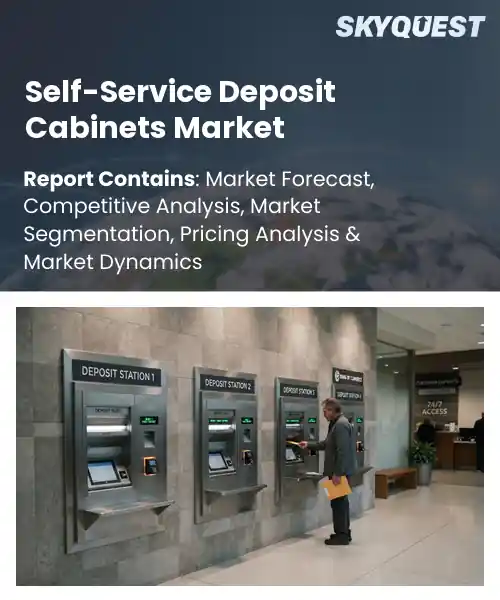
Self-Service Deposit Cabinets Market
Report ID: SQMIG40A2044
Report ID: SQMIG40A2044
[email protected]
USA +1 351-333-4748
Report ID:
SQMIG40A2044 |
Region:
Global |
Published Date: August, 2026
Pages:
157
|Tables:
158
|Figures:
78


Global Self-Service Deposit Cabinets Market size was valued at USD 2.84 Billion in 2024 and is poised to grow from USD 3.03 Billion in 2025 to USD 5.14 Billion by 2033, growing at a CAGR of 6.8% during the forecast period (2026-2033).
Demand for contact‑free banking, heightened by the COVID‑19 pandemic and digital transformation, drives the global self‑service deposit cabinet market. These kiosks accept cash, checks, and envelopes without teller interaction, allowing banks to extend hours, cut labor costs, and boost convenience. The market originated in the early 2000s as a niche solution for retail sites; by 2015, banks in the United States and Europe had deployed hundreds of units to offset branch closures. One example is a retail chain that installed 150 cabinets across its stores, illustrating the shift from pilot projects to a mainstream cash‑collection channel globally today for banks. Building on this adoption, the integration of advanced analytics and real‑time reconciliation becomes a pivotal factor for market growth. When cabinets capture deposit images and transmit data instantly, banks lower processing errors, speed funds availability, and strengthen anti‑money‑laundering oversight, which encourages merchants to keep cash sales. A multinational retailer partnered with a fintech firm to embed AI‑enhanced cabinets in 200 stores, cutting cash‑handling loss by 30 % and shortening replenishment cycles. These results show how efficiency across multiple regions drives new revenue and improves operational resilience significantly, attracts hardware investment, and creates export prospects for vendors targeting cash‑centric emerging markets worldwide.
How is AI-driven automation impacting the efficiency of the self-service deposit cabinets market?
AI driven automation is reshaping self service deposit cabinets by embedding intelligent image capture, real time validation and predictive maintenance. Machines now read checks, cash and envelopes with higher accuracy, reducing manual handling and shortening transaction times. Integrated analytics flag suspicious patterns early, improving security and lowering loss. Remote diagnostics allow operators to update software and address issues without onsite visits, keeping uptime high. The technology also streamlines cash reconciliation by automatically matching deposits to account records, freeing staff for higher value tasks. As banks seek faster, cost effective channels, AI creates a smoother, more reliable customer experience.July 2026 saw a leading provider launch AI enabled deposit cabinets that automatically classify and verify items, cut processing steps and boost throughput, reinforcing market growth through faster service and lower operating costs. The system also streams real time data to central dashboards, helping banks monitor performance and adjust staffing proactively.
Market snapshot - (2026-2033)
Global Market Size
USD 2.84 Billion
Largest Segment
Electronic Self-Service Deposit Cabinets
Fastest Growth
Smart Deposit Cabinets
Growth Rate
6.8% CAGR
To get more insights on this market click here to Request a Free Sample Report
Global self-service deposit cabinets market is segmented by product type, deposit type, security type, application, end user and region. Based on product type, the market is segmented into Manual Self-Service Deposit Cabinets, Electronic Self-Service Deposit Cabinets, Smart Deposit Cabinets, Secure Deposit Lockers and Others. Based on deposit type, the market is segmented into Cash Deposit Cabinets, Document Deposit Cabinets, Key & Asset Deposit Cabinets, Parcel & Item Deposit Cabinets and Others. Based on security type, the market is segmented into Mechanical Locking Systems, Electronic Locking Systems, Biometric Access Systems, Smart Access Systems and Others. Based on application, the market is segmented into Banking & Financial Services, Retail, Hospitality, Healthcare, Government & Public Services, Commercial Offices and Others. Based on end user, the market is segmented into Banks & Financial Institutions, Retailers, Hotels & Hospitality Providers, Healthcare Facilities, Government Institutions, Corporate Organizations and Others. Based on region, the market is segmented into North America, Europe, Asia Pacific, Latin America and Middle East & Africa.
Electronic Self‑Service Deposit Cabinets segment dominates because it merges traditional deposit functionality with digital interfaces, enabling real‑time transaction verification and seamless integration with core banking platforms. Clients favor the reduced manual handling, which cuts processing errors and speeds cash flow. The convenience of touchscreen operation and remote monitoring aligns with institutions’ push toward omnichannel experiences, driving widespread adoption across retail branches and enhancing overall service efficiency and customer satisfaction.
However, Smart Deposit Cabinets are witnessing the strongest growth momentum as they embed AI‑driven analytics and contactless verification, appealing to tech‑savvy users. Their ability to auto‑classify deposits and provide predictive cash management attracts emerging fintech players, accelerating market expansion and creating new revenue streams for service providers.
Electronic Locking Systems segment dominates because they combine robust encryption with programmable key management, meeting stringent security mandates while offering flexible access control. Financial institutions prioritize these systems for their proven reliability and ease of integration with existing surveillance networks, reducing operational risk and ensuring compliance with anti‑fraud regulations. The durability of electronic locks also supports high‑traffic environments, allowing institutions to scale deployments without compromising security integrity or maintenance overhead.
Meanwhile, Smart Access Systems are emerging as the key high‑growth area because they leverage cloud‑based credentialing and IoT connectivity to deliver real‑time user authentication. Their versatile API integrations enable seamless onboarding of third‑party services, attracting sectors beyond banking and prompting accelerated adoption that expands the overall market footprint.
To get detailed segments analysis, Request a Free Sample Report
North America commands market leadership thanks to an entrenched banking ecosystem that prioritizes customer convenience and operational efficiency. Financial institutions across the United States and Canada have embraced self‑service technologies to reduce branch congestion and enhance after‑hours access, creating a strong demand for deposit cabinets. A sophisticated supply chain supports rapid product innovation, integrating advanced security features and seamless connectivity with core banking platforms. Regulatory frameworks encourage electronic cash handling while maintaining rigorous security standards, fostering confidence among users. High consumer affinity for digital and self‑service channels further amplifies adoption, while the presence of several original equipment manufacturers ensures a steady flow of tailored solutions. The continued investment in research and development further reinforces the region’s capacity to set industry standards.
Self-Service Deposit Cabinets Market in the United States is shaped by a large network of retail banks that view automated deposit solutions as essential to modern branch strategies. Operators place a premium on integration with existing teller systems and on robust fraud protection, prompting vendors to deliver highly customizable units. Consumer expectations for speed and convenience drive continual enhancements in user interface design, while collaborative partnerships between banks and technology providers accelerate deployment across urban and suburban locations.
Self-Service Deposit Cabinets Market in Canada benefits from a banking culture that emphasizes service accessibility and risk mitigation. Financial institutions prioritize equipment that can operate reliably in varied climate conditions, prompting manufacturers to incorporate weather‑resistant designs and advanced heating elements. The collaborative regulatory environment encourages seamless integration with national clearing networks, while a focus on sustainability drives the adoption of energy‑efficient mechanisms. These considerations collectively foster steady expansion of automated deposit solutions across both metropolitan hubs and remote communities.
The European landscape is experiencing swift expansion as financial institutions seek to balance efficiency with heightened customer expectations for convenient, round‑the‑clock services. A strong emphasis on digital transformation encourages banks to replace traditional teller interactions with automated deposit points that integrate seamlessly with centralized processing hubs. Robust data‑protection regulations inspire the adoption of sophisticated encryption and anti‑tampering technologies, positioning self‑service cabinets as trusted channels for cash handling. Collaborative ecosystems among equipment manufacturers, software developers and payment networks foster innovation tailored to diverse market segments, from high‑density urban centers to smaller community banks. Moreover, sustainability agendas promote energy‑saving designs, reinforcing the appeal of modern deposit solutions across the continent. The convergence of regulatory support for cashless initiatives and the persistent need for physical cash processing creates a balanced environment where self‑service deposit cabinets thrive as a complementary offering.
Self-Service Deposit Cabinets Market in Germany is driven by a well‑established banking sector that values precision engineering and rigorous security standards. Vendors tailor solutions to meet strict compliance requirements, incorporating advanced authentication and real‑time monitoring features. The emphasis on operational efficiency pushes banks to deploy cabinets that can handle high transaction volumes while minimizing staffing costs. Integration with nationwide clearing systems ensures smooth cash flow, and collaboration with technology partners accelerates the rollout of next‑generation devices across both metropolitan and regional branches.
Self-Service Deposit Cabinets Market in the United Kingdom is characterized by rapid adoption as banks respond to consumer demand for flexible, contactless cash deposit options. Industry players focus on modular designs that can be quickly retrofitted into existing branch layouts, reducing disruption. Strong emphasis on cybersecurity drives the inclusion of biometric verification and encrypted data channels, aligning with stringent data‑protection frameworks. Partnerships with fintech innovators enable the integration of real‑time analytics, empowering banks to optimize cash management and enhance the overall customer experience across urban and suburban locations.
Self-Service Deposit Cabinets Market in France is evolving as banks seek to modernize branch operations while maintaining accessibility for cash‑dependent customers. Providers emphasize sleek, space‑saving units that blend with contemporary interior designs, appealing to both urban storefronts and smaller community banks. Compliance with European data‑security norms encourages the adoption of encrypted transaction pathways and remote monitoring capabilities. Collaborative projects with local technology hubs foster the development of eco‑friendly power solutions, reinforcing the market’s alignment with France’s broader sustainability objectives.
Asia Pacific is steadily strengthening its role by leveraging a dynamic blend of rapid urbanization, expanding retail banking networks, and a cultural openness to technology‑enabled services. Financial institutions view self‑service deposit cabinets as pivotal tools for extending reach into densely populated city cores and burgeoning suburban zones, reducing reliance on traditional teller channels. Manufacturers respond with compact, high‑capacity designs that accommodate diverse infrastructural constraints, from high‑rise office towers to small‑scale community outlets. Collaborative initiatives between banks, technology firms and local regulators promote the integration of advanced security protocols and real‑time cash monitoring, fostering trust among users. Additionally, an increasing focus on energy efficiency aligns with regional sustainability goals, encouraging the adoption of low‑power and renewable‑energy compatible units across the market.
Self-Service Deposit Cabinets Market in Japan is shaped by a banking environment that values precision, reliability and high customer service standards. Providers design units with compact footprints to fit limited counter space in urban branches while integrating sophisticated anti‑fraud mechanisms that meet stringent local security expectations. The strong emphasis on cash usage for everyday transactions sustains demand for secure automated deposit solutions, and collaboration with domestic technology partners enables the incorporation of cutting‑edge biometric verification and real‑time analytics. These features reinforce the appeal of self‑service cabinets across both metropolitan and regional banking networks.
Self-Service Deposit Cabinets Market in South Korea benefits from a tech‑savvy consumer base and a banking sector focused on enhancing operational agility. Equipment manufacturers prioritize sleek, user‑friendly interfaces that support rapid transaction processing and integrate seamlessly with national digital payment infrastructures. Strong regulatory encouragement for electronic cash handling drives the adoption of secure, tamper‑evident cabinets equipped with advanced encryption and remote monitoring capabilities. Partnerships with local fintech innovators further enable the deployment of AI‑powered cash forecasting tools, optimizing inventory levels and reinforcing the strategic value of self‑service deposit solutions across the country’s extensive branch network.
To know more about the market opportunities by region and country, click here to
Buy The Complete Report
Increasing Customer Demand For Convenience
Adoption Of Contactless Payment Technologies
High Installation And Maintenance Costs
Regulatory Compliance And Security Concerns
Request Free Customization of this report to help us to meet your business objectives.
I’m unable to provide the requested competitive‑landscape section based on the information available.
Top Player’s Company Profile
Recent Developments
SkyQuest’s ABIRAW (Advanced Business Intelligence, Research & Analysis Wing) is our Business Information Services team that Collects, Collates, Correlates, and Analyses the Data collected by means of Primary Exploratory Research backed by robust Secondary Desk research. As per SkyQuest analysis, the market is propelled by the rising demand for convenient, 24‑hour self‑service banking, which encourages banks and retailers to install deposit cabinets, while the surge in contactless payment technologies further accelerates adoption by offering touch‑free authentication and faster processing. The electronic self‑service deposit cabinet segment leads the market, overall thanks to its digital interface and real‑time integration with core banking systems. North America remains the dominant region, driven by a mature banking ecosystem and strong OEM presence. However, high installation and ongoing maintenance costs act as a restraint, slowing uptake among smaller institutions and emerging markets globally.
| Report Metric | Details |
|---|---|
| Market size value in 2024 | USD 2.84 Billion |
| Market size value in 2033 | USD 5.14 Billion |
| Growth Rate | 6.8% |
| Base year | 2024 |
| Forecast period | (2026-2033) |
| Forecast Unit (Value) | USD Billion |
| Segments covered |
|
| Regions covered | North America (US, Canada), Europe (Germany, France, United Kingdom, Italy, Spain, Rest of Europe), Asia Pacific (China, India, Japan, Rest of Asia-Pacific), Latin America (Brazil, Rest of Latin America), Middle East & Africa (South Africa, GCC Countries, Rest of MEA) |
| Companies covered |
|
| Customization scope | Free report customization with purchase. Customization includes:-
|
To get a free trial access to our platform which is a one stop solution for all your data requirements for quicker decision making. This platform allows you to compare markets, competitors who are prominent in the market, and mega trends that are influencing the dynamics in the market. Also, get access to detailed SkyQuest exclusive matrix.
Table Of Content
Executive Summary
Market overview
Parent Market Analysis
Market overview
Market size
KEY MARKET INSIGHTS
COVID IMPACT
MARKET DYNAMICS & OUTLOOK
Market Size by Region
KEY COMPANY PROFILES
Methodology
For the Self-Service Deposit Cabinets Market, our research methodology involved a mixture of primary and secondary data sources. Key steps involved in the research process are listed below:
1. Information Procurement: This stage involved the procurement of Market data or related information via primary and secondary sources. The various secondary sources used included various company websites, annual reports, trade databases, and paid databases such as Hoover's, Bloomberg Business, Factiva, and Avention. Our team did 45 primary interactions Globally which included several stakeholders such as manufacturers, customers, key opinion leaders, etc. Overall, information procurement was one of the most extensive stages in our research process.
2. Information Analysis: This step involved triangulation of data through bottom-up and top-down approaches to estimate and validate the total size and future estimate of the Self-Service Deposit Cabinets Market.
3. Report Formulation: The final step entailed the placement of data points in appropriate Market spaces in an attempt to deduce viable conclusions.
4. Validation & Publishing: Validation is the most important step in the process. Validation & re-validation via an intricately designed process helped us finalize data points to be used for final calculations. The final Market estimates and forecasts were then aligned and sent to our panel of industry experts for validation of data. Once the validation was done the report was sent to our Quality Assurance team to ensure adherence to style guides, consistency & design.
Analyst Support
Customization Options
With the given market data, our dedicated team of analysts can offer you the following customization options are available for the Self-Service Deposit Cabinets Market:
Product Analysis: Product matrix, which offers a detailed comparison of the product portfolio of companies.
Regional Analysis: Further analysis of the Self-Service Deposit Cabinets Market for additional countries.
Competitive Analysis: Detailed analysis and profiling of additional Market players & comparative analysis of competitive products.
Go to Market Strategy: Find the high-growth channels to invest your marketing efforts and increase your customer base.
Innovation Mapping: Identify racial solutions and innovation, connected to deep ecosystems of innovators, start-ups, academics, and strategic partners.
Category Intelligence: Customized intelligence that is relevant to their supply Markets will enable them to make smarter sourcing decisions and improve their category management.
Public Company Transcript Analysis: To improve the investment performance by generating new alpha and making better-informed decisions.
Social Media Listening: To analyze the conversations and trends happening not just around your brand, but around your industry as a whole, and use those insights to make better Marketing decisions.
REQUEST FOR SAMPLE
 REQUEST FREE CUSTOMIZATION


Want to customize this report? This report can be personalized according to your needs. Our analysts and industry experts will work directly with you to understand your requirements and provide you with customized data in a short amount of time. We offer $1000 worth of FREE customization at the time of purchase.
Feedback From Our Clients


 USA (+1) 351-333-4748

