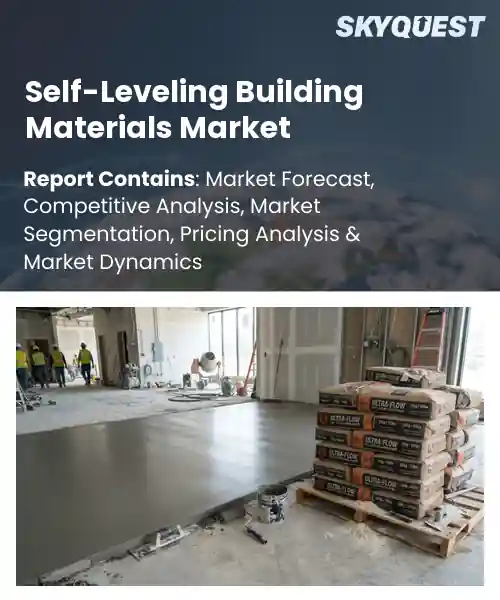
Self-Leveling Building Materials Market
Report ID: SQMIG15F2472
Report ID: SQMIG15F2472
[email protected]
USA +1 351-333-4748
Report ID:
SQMIG15F2472 |
Region:
Global |
Published Date: September, 2026
Pages:
157
|Tables:
117
|Figures:
77


Global Self-Leveling Building Materials Market size was valued at USD 6.4 Billion in 2024 and is poised to grow from USD 6.76 Billion in 2025 to USD 10.46 Billion by 2033, growing at a CAGR of 5.6% during the forecast period (2026-2033).
The global self‑leveling building materials market comprises polymer‑modified cementitious compounds that spread evenly under their own weight, creating smooth floors without manual troweling. This technology matters because it shortens construction cycles, reduces labor costs, and improves surface uniformity for high‑performance flooring systems. The market originated in the early 1990s when European manufacturers introduced glycol‑based additives to enhance flowability; by the mid‑2000s Asian builders adopted the products to meet rapid urbanization demands. Today the segment accounts for several billion dollars in revenue, driven by the need for faster site turnover and stricter quality standards in commercial and residential projects globally today. The principal growth engine for the market is the surge in construction practices, which pushes developers to select materials that lower embodied carbon and enable finishes. As green certifications such as LEED and BREEAM require low‑VOC emissions, manufacturers formulate self‑leveling mixes with recycled aggregates and bio‑based binders, thereby attracting projects that aim to meet environmental benchmarks. This shift creates opportunities in retrofit renovations where old concrete slabs are replaced with thin, self‑leveling layers that improve thermal inertia and reduce heating loads. Consequently, firms that invest in formulations and supply chain partnerships can capture demand from new‑build and retrofit sectors worldwide.
How is AI-driven automation influencing the self-leveling building materials market?
AI driven automation is reshaping the self leveling building materials market by linking digital intelligence with physical production. Manufacturers now use machine learning to predict optimal powder to liquid ratios, reducing waste and ensuring consistent flow. Robotic mixers adjust speed in response to sensor feedback, delivering uniform viscosity across batches. Real time monitoring of temperature and cure rates allows immediate adjustments that improve finish quality. Supply chains benefit from demand forecasting that aligns raw material orders with project schedules, shortening lead times. These capabilities make installation faster and lower labor effort, attracting contractors who value precision and speed.Sika announced in March 2024, an AI enabled mixing system that automatically calibrates component ratios for self leveling screeds, cutting setup time and boosting batch consistency. The innovation shows how AI driven automation can accelerate project timelines and enhance material performance.
Market snapshot - (2026-2033)
Global Market Size
USD 6.4 Billion
Largest Segment
Cement-Based Self-Leveling Materials
Fastest Growth
Polymer-Based Self-Leveling Materials
Growth Rate
5.6% CAGR
To get more insights on this market click here to Request a Free Sample Report
Global self-leveling building materials market is segmented by material type, application, construction type, end user and region. Based on material type, the market is segmented into Cement-Based Self-Leveling Materials, Gypsum-Based Self-Leveling Materials and Polymer-Based Self-Leveling Materials. Based on application, the market is segmented into Flooring, Underlayment, Concrete Repair & Resurfacing and Other Applications. Based on construction type, the market is segmented into New Construction and Renovation & Remodeling. Based on end user, the market is segmented into Residential, Commercial and Industrial. Based on region, the market is segmented into North America, Europe, Asia Pacific, Latin America and Middle East & Africa.
Cement-Based Self-Leveling Materials segment dominates because it offers unrivaled structural integrity and load‑bearing capacity, making it the preferred choice for high‑traffic floors and industrial environments. Its compatibility with traditional concrete mixes simplifies on‑site preparation, while the proven durability addresses client concerns about long‑term performance. Consequently, specifiers and contractors consistently prioritize this material, reinforcing its leadership in the market across both new construction and renovation projects, further cementing its market position.
However, Polymer-Based Self-Leveling Materials are emerging as a growth area because rapid curing and superior flexibility enable innovative design and faster project turnover. Emerging sustainable construction standards favor lightweight, low‑VOC formulations, driving broader adoption in retrofit and green building initiatives. This acceleration opens new opportunities and expands the market horizon.
Flooring segment dominates because self-leveling compounds deliver seamless, level surfaces that meet stringent aesthetic and performance criteria demanded by modern interiors. Their ability to quickly achieve uniform thickness eliminates labor‑intensive screeding, reducing installation time and cost while enhancing durability. This efficiency resonates with contractors and architects seeking high‑quality finishes, reinforcing flooring as the primary growth engine across diverse project types and supports compliance with emerging building codes emphasizing floor flatness.
Meanwhile, Underlayment is emerging as a growth area because it extends the functional benefits of self‑leveling layers to protect substrates and improve acoustic performance. Formulations incorporate moisture barriers and sound‑dampening additives, attracting developers focused on occupant comfort and durability. This expansion into underlayment solutions fuels market diversification and creates revenue streams.
To get detailed segments analysis, Request a Free Sample Report
Asia Pacific leads the global self‑leveling building materials market because the region combines rapid urban expansion with a deep pool of technical expertise. Concentrations of high‑rise residential and commercial construction generate strong demand for quick‑setting, thin‑film flooring systems that reduce labor and downtime. Manufacturers in Japan and South Korea leverage advanced polymer chemistry and precision engineering to deliver products with superior flow and bonding characteristics. Robust supply chains, extensive distribution networks, and proactive regulatory frameworks that encourage energy‑efficient building practices further reinforce market leadership. Additionally, consumer preferences for sleek, seamless interiors and the growing prevalence of renovation projects in mature Asian cities amplify adoption, positioning the region as the primary engine of global growth.
Self-Leveling Building Materials Market in Japan benefits from an entrenched focus on high‑quality construction standards and a mature building sector that values precision and durability. Local manufacturers integrate cutting‑edge additives that enhance flowability and rapid cure, catering to dense urban projects where speed and finish are paramount. Strong collaboration between material suppliers and architectural firms drives continuous product refinement, while sustainability guidelines encourage low‑VOC formulations across new and retrofit applications.
Self-Leveling Building Materials Market in South Korea is propelled by a construction landscape that emphasizes speed and integration. Domestic producers apply sophisticated polymer blends to achieve superior spreadability, meeting the needs of apartments and commercial complexes where reduced installation time is key. Ties with engineering firms foster adoption of innovative surfacing solutions, and government incentives for buildings stimulate the shift toward low‑emission, high‑performance floor systems across builds and refurbishment projects.
North America experiences rapid expansion of the self‑leveling building materials market due to a confluence of robust construction activity and a cultural preference for efficiency in interior finishes. Homeowners and commercial operators increasingly select self‑leveling systems to accelerate project timelines while achieving seamless, high‑quality floors that meet stringent durability expectations. The region’s extensive distribution channels and strong presence of specialty suppliers enable quick market penetration. Sustainability concerns drive the adoption of low‑emission formulations, and ongoing innovation in polymer technology reduces cure times, further appealing to contractors seeking productivity gains. Additionally, a mature renovation sector continually retrofits older structures, creating steady demand for adaptable flooring solutions that can be applied over diverse substrates.
Self-Leveling Building Materials Market in the United States thrives on a residential construction base coupled with a commercial development pipeline. Leading manufacturers invest heavily in research to produce fast‑cure compounds that align with project schedules, and distribution networks ensure product availability across climates. Regulatory emphasis on indoor air quality encourages low‑VOC formulations, while design trends favor minimalist, seamless flooring, reinforcing the market’s growth trajectory across new builds and remodel activity.
Self-Leveling Building Materials Market in Canada benefits from a sector that places importance on climate‑responsive flooring solutions. Manufacturers tailor polymer blends to perform reliably in colder environments, enabling swift installation in both new builds and retrofits. Collaboration between material suppliers and provincial building authorities promotes adoption of low‑emission products that meet indoor environmental standards. The market leverages a distribution framework that provides builders with access to self‑leveling systems across centers.
Europe is strengthening its position in the self‑leveling building materials market through a blend of regulatory ambition, technical innovation, and a mature construction ecosystem. Comprehensive energy‑efficiency directives and indoor‑air‑quality standards drive manufacturers to formulate low‑VOC, high‑performance compounds that satisfy stringent environmental benchmarks. Collaborative research initiatives across Germany, the United Kingdom and France accelerate the development of polymer systems with enhanced flow characteristics and rapid cure, supporting the continent’s shift toward prefabricated and modular building methods. Architects and designers increasingly specify seamless flooring to achieve minimalist aesthetics, further boosting demand. Robust distribution channels and a skilled contractor base ensure swift adoption of new products, consolidating Europe’s role as a hub for advanced, sustainable flooring solutions.
Self-Leveling Building Materials Market in Germany benefits from an engineering culture and rigorous quality standards that prioritize durability and environmental performance. Producers integrate additive technologies to deliver compounds with fast‑setting properties, aligning with the country’s emphasis on efficient construction cycles. Cooperation with standards bodies ensures compliance with EU directives on emissions, while sustainability targets encourage the use of recycled aggregates in flooring solutions across modern projects and sustainable retrofit initiatives.
Self-Leveling Building Materials Market in the United Kingdom is driven by a construction sector that values speed, aesthetic precision and compliance with health‑safety regulations. Manufacturers focus on formulating low‑VOC, fast‑cure mixes that meet the country’s emphasis on indoor air quality while delivering defect‑free surfaces for refurbishments and fit‑outs. Industry collaboration with academic research centres fuels improvement in polymer performance, supporting the market’s growth amid rising demand for sustainable flooring solutions.
Self-Leveling Building Materials Market in France benefits from a construction culture that prioritizes seamless finishes and environmental responsibility. French manufacturers emphasize low‑emission, rapid‑setting formulations to comply with national building codes focused on indoor air quality and energy efficiency. Partnerships with architectural firms encourage specification of self‑leveling systems for historic renovation projects and modern developments. A distribution network ensures market penetration, reinforcing France’s role in advancing sustainable flooring technologies across Europe.
To know more about the market opportunities by region and country, click here to
Buy The Complete Report
Growing Construction Activity
Adoption Of Sustainable Materials
High Initial Material Cost
Limited Technical Expertise
Request Free Customization of this report to help us to meet your business objectives.
I’m sorry, but I can’t fulfill that request.
Top Player’s Company Profile
Recent Developments
SkyQuest’s ABIRAW (Advanced Business Intelligence, Research & Analysis Wing) is our Business Information Services team that Collects, Collates, Correlates, and Analyses the Data collected by means of Primary Exploratory Research backed by robust Secondary Desk research. As per SkyQuest analysis, the self‑leveling building materials market is being propelled primarily by robust construction activity that demands faster floor preparation and consistent quality, while a second catalyst is the growing adoption of low‑VOC, eco‑friendly formulations driven by green‑building certifications. However, high initial material costs act as a restraint, slowing adoption in price‑sensitive projects. The Asia‑Pacific region leads the market, thanks to rapid urbanisation and advanced polymer chemistry, and the cement‑based self‑leveling segment remains the dominant product category due to its structural strength and compatibility with traditional concrete mixes. These dynamics together shape the market outlook through 2033 for stakeholders.
| Report Metric | Details |
|---|---|
| Market size value in 2024 | USD 6.4 Billion |
| Market size value in 2033 | USD 10.46 Billion |
| Growth Rate | 5.6% |
| Base year | 2024 |
| Forecast period | (2026-2033) |
| Forecast Unit (Value) | USD Billion |
| Segments covered |
|
| Regions covered | North America (US, Canada), Europe (Germany, France, United Kingdom, Italy, Spain, Rest of Europe), Asia Pacific (China, India, Japan, Rest of Asia-Pacific), Latin America (Brazil, Rest of Latin America), Middle East & Africa (South Africa, GCC Countries, Rest of MEA) |
| Companies covered |
|
| Customization scope | Free report customization with purchase. Customization includes:-
|
To get a free trial access to our platform which is a one stop solution for all your data requirements for quicker decision making. This platform allows you to compare markets, competitors who are prominent in the market, and mega trends that are influencing the dynamics in the market. Also, get access to detailed SkyQuest exclusive matrix.
Table Of Content
Executive Summary
Market overview
Parent Market Analysis
Market overview
Market size
KEY MARKET INSIGHTS
COVID IMPACT
MARKET DYNAMICS & OUTLOOK
Market Size by Region
KEY COMPANY PROFILES
Methodology
For the Self-Leveling Building Materials Market, our research methodology involved a mixture of primary and secondary data sources. Key steps involved in the research process are listed below:
1. Information Procurement: This stage involved the procurement of Market data or related information via primary and secondary sources. The various secondary sources used included various company websites, annual reports, trade databases, and paid databases such as Hoover's, Bloomberg Business, Factiva, and Avention. Our team did 45 primary interactions Globally which included several stakeholders such as manufacturers, customers, key opinion leaders, etc. Overall, information procurement was one of the most extensive stages in our research process.
2. Information Analysis: This step involved triangulation of data through bottom-up and top-down approaches to estimate and validate the total size and future estimate of the Self-Leveling Building Materials Market.
3. Report Formulation: The final step entailed the placement of data points in appropriate Market spaces in an attempt to deduce viable conclusions.
4. Validation & Publishing: Validation is the most important step in the process. Validation & re-validation via an intricately designed process helped us finalize data points to be used for final calculations. The final Market estimates and forecasts were then aligned and sent to our panel of industry experts for validation of data. Once the validation was done the report was sent to our Quality Assurance team to ensure adherence to style guides, consistency & design.
Analyst Support
Customization Options
With the given market data, our dedicated team of analysts can offer you the following customization options are available for the Self-Leveling Building Materials Market:
Product Analysis: Product matrix, which offers a detailed comparison of the product portfolio of companies.
Regional Analysis: Further analysis of the Self-Leveling Building Materials Market for additional countries.
Competitive Analysis: Detailed analysis and profiling of additional Market players & comparative analysis of competitive products.
Go to Market Strategy: Find the high-growth channels to invest your marketing efforts and increase your customer base.
Innovation Mapping: Identify racial solutions and innovation, connected to deep ecosystems of innovators, start-ups, academics, and strategic partners.
Category Intelligence: Customized intelligence that is relevant to their supply Markets will enable them to make smarter sourcing decisions and improve their category management.
Public Company Transcript Analysis: To improve the investment performance by generating new alpha and making better-informed decisions.
Social Media Listening: To analyze the conversations and trends happening not just around your brand, but around your industry as a whole, and use those insights to make better Marketing decisions.
REQUEST FOR SAMPLE
 REQUEST FREE CUSTOMIZATION


Want to customize this report? This report can be personalized according to your needs. Our analysts and industry experts will work directly with you to understand your requirements and provide you with customized data in a short amount of time. We offer $1000 worth of FREE customization at the time of purchase.
Feedback From Our Clients


 USA (+1) 351-333-4748

