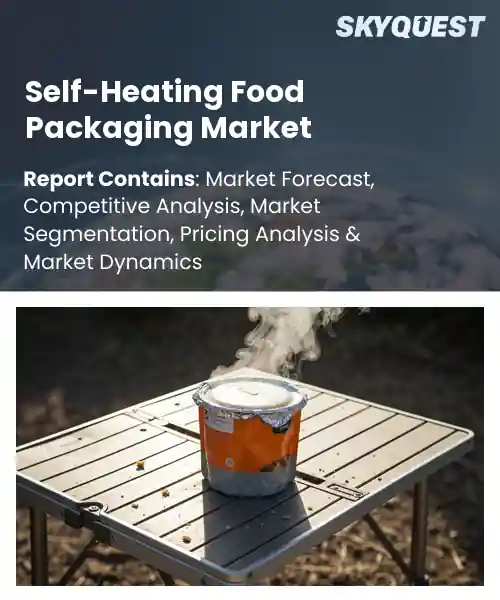
Self-Heating Food Packaging Market
Report ID: SQMIG15H2195
Report ID: SQMIG15H2195
[email protected]
USA +1 351-333-4748
Report ID:
SQMIG15H2195 |
Region:
Global |
Published Date: May, 2026
Pages:
157
|Tables:
120
|Figures:
77


Global Self-Heating Food Packaging Market size was valued at USD 82.5 Million in 2024 and is poised to grow from USD 90.27 Million in 2025 to USD 185.4 Million by 2033, growing at a CAGR of 9.42% during the forecast period (2026-2033).
Self-heating packaging combines a food compartment with an exothermic heating element that warms contents without heat. This market matters because it enables hot meals in contexts lacking cooking infrastructure, improving nutrition access and food safety for time-pressed consumers and crisis-affected populations. The primary driver is pervasive demand for convenient ready-to-eat hot meals driven by urbanization and longer commutes while also responding to frequent natural and humanitarian emergencies. Historically, flameless ration heaters designed for armed forces validated the concept and safety practices, after which manufacturers translated the systems into consumer formats sold via convenience channels and preparedness suppliers while costs declined.Building on commercialization momentum, the pivotal factor accelerating growth is technological refinement in heating chemistry and packaging integration, because systems that are safer and lighter and more efficient directly lower logistics costs and expand application scenarios. As heater chemistries become compact and non-toxic, institutional buyers such as emergency services and military procurement committees approve larger orders, which encourages retailers and meal-service providers to pilot self-heating products for commuters and outdoor enthusiasts. E-commerce and on-demand food delivery leverage these products to offer hot meals without reheating, creating new revenue streams while sustainability improvements reduce disposal burdens and unlock procurement by agencies.
How is IoT enhancing temperature control in the self-heating food packaging market?
By using tiny sensors, cloud analytics, and wireless connectivity in packages, temperature control for self-heating foods has been transformed through IoT. Key features include real-time sensing, closed-loop feedback for heating elements, and remote activation of the products. Brands are piloting and conducting commercial trials to create warm-up profile consistency and food safety while delivering and in the field by using telemetry. This increases user convenience and supply chain visibility while decreasing the need for recalls. Examples of these products are trackable beverage cans and ration packs with telemetry to allow users to monitor and make adjustments to heating reliability and improve the customer experience.
In October 2024, VariaT Technology released a Smart Heat Battery that combines app-based activation with IoT-enabled monitoring. This technology provided remote heating and real-time temperature telemetry, increasing reliability, reducing waste and enabling the growth of the market with new delivery options and outdoor use cases.
Market snapshot - (2026-2033)
Global Market Size
USD 82.5 Million
Largest Segment
Exothermic Reaction (Lime-Water)
Fastest Growth
Electrochemical Heating
Growth Rate
9.42% CAGR
To get more insights on this market click here to Request a Free Sample Report
Global self-heating food packaging market is segmented by technology, food type, end-user, distribution and region. Based on technology, the market is segmented into Exothermic Reaction (Lime-Water), Flameless Ration Heaters (FRH) and Electrochemical Heating. Based on food type, the market is segmented into Ready Meals, Beverages (Coffee, Tea), Soups & Stews and Others. Based on end-user, the market is segmented into Military & Defense, Outdoor & Adventure, Emergency Preparedness and Retail Consumers. Based on distribution, the market is segmented into Military Supply, Outdoor Retailers and Online. Based on region, the market is segmented into North America, Europe, Asia Pacific, Latin America and Middle East & Africa.
Flameless ration heaters segment with self-heating food packaging market share due to their consistent reliability and high heat output providing an on-demand heating solution which satisfies both operational and consumer convenience needs. Purchasing practices of militaries, standardization through manufacturing and volume have cumulatively resulted in lower unit costs and increased safety. The reliable flameless heating solution also simplifies logistics for packagers and suppliers providing the opportunity for greater use across packaged ready-to-eat products in addition to field environments where uniform heating performance is paramount.
As per self-heating food packaging market analysis, electrochemical heating segment is the fastest growing because of its small form factor and accurate temperature control capabilities, and integration with single serve meals and beverages. New materials and technology that promote safe to use electrode electrodes along with scalable production are helping to drive brand loyalty for consumer brands as well as create new convenience driven application opportunities in retail and on-the-go consumption markets.
As per self-heating food packaging market forecast, ready meals segment dominates because consumer demand for convenient, heat-and-eat options aligns directly with self-heating packaging capabilities, driving widespread product design and supplier focus. The ability to package complex textures and retain flavor when heated has encouraged manufacturers to prioritize ready meal formats, which simplifies distribution and retailer merchandising. This concentration accelerates investment in packaging innovation and fosters partnerships between food formulators and heating technology providers, reinforcing market leadership and growth.
As per self-heating food packaging market outlook, beverages (i.e., coffee and tea) segment is the fastest growing segment primarily due to the increasing demand from consumers for single-serve hot beverages. The introduction of compact heating systems and heat-stable barrier packaging designed specifically for beverages has created many new product opportunities for convenience store retailers and has greatly expanded the occasions for using hot beverages and everyday usage.
To get detailed segments analysis, Request a Free Sample Report
Asia Pacific region has the largest share of the market due to its mastery of technology, established habit of consuming convenience foods, and advanced manufacturing operations. Furthermore, consumers are very open to consuming prepared foods, and their active lifestyles allow for a quick transfer of new heating technologies from concept to market. This is also made possible by strong working relationships between packaging producers, food companies and logistics providers that support the quick scaling of businesses and their products. Local companies lead the way in developing compact, efficient heating systems incorporating the consumer's safety and ease of use in their designs while also setting industry standards with these heated products. Regulatory requirements and independent-laboratory testing support the validation and introduction of these products into the marketplace. Dense urban infrastructure networks and multiple retail environments facilitate the increased frequency of heated prepared meals being purchased and consumed. Innovation in material science and interest in lightweight, reusable formats enhance regional products and attract international developments, which emphasize cost-effective methods for development and commercialization.
Self-heating food packaging market will continue to thrive in Japan due to a culture focused on precision engineering and user-centric design resulting in compact, dependable methods for heating food that can be customized to meet consumer needs. The collaboration between food brands and packaging Innovators promotes rapid iteration and rollout of new products through the connectivity of convenience stores and retailers. The increased focus on food safety and quality by regulators has helped to instill confidence in consumers since domestic demand for ready-to-eat meal options continues to stimulate innovations and experimentation across multiple categories.
As per self-heating food packaging market regional outlook, South Korea has an early adopter approach and manufacturing capabilities that can rapidly bring products to market. The close working relationship between companies producing instant meal products and their packaging manufacturers allows for optimized results related to flavour preservation and convenience of reheating. The density of urban areas and the growth of the food delivery culture will create many occasions for self-heating food, yet producers focusing on exports must modify their designs to align with the taste preferences of consumers located throughout other parts of the world. The focus on durability, compact packages and compatibility with retail distribution stores will allow for sustained activity within this market.
Self-heating food packaging market has been rapidly growing in North America due to changing consumer lifestyles focusing on convenience, portability, and efficiency. With the widespread presence of retail and food services, many consumers are trying and repeating purchases. Both strong distribution and logistics networks make it possible for new products to be distributed across many different types of channels. As a result, collaboration between technology providers and established food businesses helps to quickly develop various types of solutions that suit many different taste preferences or dietary restrictions of consumers. In addition to these buyer segments, other buyers such as outdoor recreation, emergency preparedness and institutional buyers continue to add even more variety and volume to demand for self-heating food packaging products. Many companies are also developing sustainable packaging and recyclable materials, which is pushing innovation toward environmentally friendly forms of packaging while startup funding and partnerships with established manufacturers help increase commercial scale and brand visibility for many self-heating food packaging products. Regulatory clarity regarding food safety, as well as strong online retail channels, have contributed to the growing consumer confidence; thus, niche self-heating food packages could quickly reach national audiences.
US market is shaped by a wide range of consumer demand for On-the-Go, casual and emergency preparedness products which is leading to varying applications of self-heating food packaging products. Strong brand products having foodservice and retail partners are contributing to National Product Introductions and collaboration with retailers. The food packaging industry continues to innovate material applications and evaluate sustainable considerations when choosing packaging, while also utilizing eCommerce and direct-to-consumer channel opportunities for Growth for niche concepts to grow or scale from testing opportunities to proven sales potential. Product specifications are led by institutional customers, catering services, and emergency service agencies that require rugged, dependable, and functional product designs.
As per self-heating food packaging market regional forecast, Canada market is shaped by the convenience of consumers and their outdoor lifestyles promoting solutions for self-heating food packaging that suits cold surfaces and mobile eating opportunities. Providing self-heating food packaging solution providers access to regional food producers and Retailers is encouraging opportunity to provide artisanal ready-made meals that utilize convenience from self-heating food packaging. Emphasis on sustainable materials and food safety will continue to shape development of product offerings, while partnerships with National Retail Chains and distributors will offer innovators access to dispersed population and the ability to test formats across different retail venues
The self-heating food packaging market in Europe is being bolstered by a collective focus on sustainability, harmonization of regulations, and innovation in materials. Through collaboration between producers and research institutions, new lightweight and recyclable forms of self-heating food packaging are being developed to meet rigorous environmental standards while ensuring safety when heating and serving food. Retailers and food manufacturers are conducting trials using specific assortments of self-heating food packaging that appeal to various culinary preferences in multiple European countries, allowing for reverse feedback loops to refine locally based product offerings effectively.
As per self-heating food packaging industry analysis, Germany continues to centre around the engineering capabilities of Germany and the fact that there is an established, mature packaging industry will assist, and the focus on functional reliability and safety of self-heating food packaging products is paramount. The ability of developers of self-heating food packaging products to collaborate with manufacturers will continue to yield self-heating food packaging products that emphasise prioritising thermal performance and recyclability. The provision of test beds for large retail chains and foodservice operators, as well as the expectation of consistent performance from industrial users of self-heating products will ensure that there are viable new concept modelling opportunities that create new products for the self-heating food packaging market. Circular economy principles in the design of self-heating food packaging will direct manufacturers in producing recyclable and reusable self-heating food packaging products that fit consumer market expectations.
United Kingdom is growing due to busy urban living and a robust food services/retail industry that offers convenient meal solutions. Designers and manufacturers are developing compact formats that combine convenience with quality, targeting commuters and people on the go. Retailers’ commitments to sustainability are influencing both the choice of materials and recyclability and resulting in pilot programs with national chains and working with specialty meal providers to refine product fit in both main-line and premium categories.
France represents a long-standing culinary heritage that supports the demand for self-heating meals, which provide authentic, premium quality. Food brands and packaging developers work together to deliver meals that maintain texture and aroma and also provide convenience to customers looking for restaurant quality in their homes or while traveling. Retailers and grocers provide a platform for artisanal offerings, while retailers sustainability policies and consumers’ expectations are driving material and design choices toward recyclable options.
To know more about the market opportunities by region and country, click here to
Buy The Complete Report
Rising Demand For Convenience
Technological Advancements In Packaging
High Production and Material Costs
Regulatory and Safety Compliance Challenges
Request Free Customization of this report to help us to meet your business objectives.
Competition in the global self-heating food packaging industry is driven by licensing, co development and selective partnerships that let technology owners scale via contract packers while reducing go to market risk. Material and activation safety innovations are key competitive drivers because they enable integration into existing can and pouch lines. Notable recent strategic moves include Tempra Technology licensing to MRE manufacturers and HeatGenie partnering with a major packaging supplier to embed solid fuel heaters.
Recent Developments in the Self-Heating Food Packaging Market
SkyQuest’s ABIRAW (Advanced Business Intelligence, Research & Analysis Wing) is our Business Information Services team that Collects, Collates, Correlates, and Analyses the Data collected by means of Primary Exploratory Research backed by robust Secondary Desk research.
As per SkyQuest analysis, the global self-heating food packaging market growth is driven primarily by rising demand for convenience as consumers and institutions seek hot, ready-to-eat meals without external heating, and a second driver is rapid technological refinement in heating chemistry and packaging integration that improves safety, efficiency and cost profiles. A key restraint remains high production and material costs that limit price competitiveness and scale. The dominating region is Asia Pacific due to manufacturing ecosystems and strong consumer adoption and the dominating segment is flameless ration heaters which benefit from proven reliability and military-led standardization. Market momentum is reinforced by e-commerce, emergency preparedness demand and sustainability-led material innovation. A key self-heating food packaging market trend is the development of safer, more sustainable, and energy-efficient self-heating packaging systems that utilize advanced chemical heating mechanisms and eco-friendly materials.
| Report Metric | Details |
|---|---|
| Market size value in 2024 | USD 82.5 Million |
| Market size value in 2033 | USD 185.4 Million |
| Growth Rate | 9.42% |
| Base year | 2024 |
| Forecast period | (2026-2033) |
| Forecast Unit (Value) | USD Million |
| Segments covered |
|
| Regions covered | North America (US, Canada), Europe (Germany, France, United Kingdom, Italy, Spain, Rest of Europe), Asia Pacific (China, India, Japan, Rest of Asia-Pacific), Latin America (Brazil, Rest of Latin America), Middle East & Africa (South Africa, GCC Countries, Rest of MEA) |
| Companies covered |
|
| Customization scope | Free report customization with purchase. Customization includes:-
|
To get a free trial access to our platform which is a one stop solution for all your data requirements for quicker decision making. This platform allows you to compare markets, competitors who are prominent in the market, and mega trends that are influencing the dynamics in the market. Also, get access to detailed SkyQuest exclusive matrix.
Table Of Content
Executive Summary
Market overview
Parent Market Analysis
Market overview
Market size
KEY MARKET INSIGHTS
COVID IMPACT
MARKET DYNAMICS & OUTLOOK
Market Size by Region
KEY COMPANY PROFILES
Methodology
For the Self-Heating Food Packaging Market, our research methodology involved a mixture of primary and secondary data sources. Key steps involved in the research process are listed below:
1. Information Procurement: This stage involved the procurement of Market data or related information via primary and secondary sources. The various secondary sources used included various company websites, annual reports, trade databases, and paid databases such as Hoover's, Bloomberg Business, Factiva, and Avention. Our team did 45 primary interactions Globally which included several stakeholders such as manufacturers, customers, key opinion leaders, etc. Overall, information procurement was one of the most extensive stages in our research process.
2. Information Analysis: This step involved triangulation of data through bottom-up and top-down approaches to estimate and validate the total size and future estimate of the Self-Heating Food Packaging Market.
3. Report Formulation: The final step entailed the placement of data points in appropriate Market spaces in an attempt to deduce viable conclusions.
4. Validation & Publishing: Validation is the most important step in the process. Validation & re-validation via an intricately designed process helped us finalize data points to be used for final calculations. The final Market estimates and forecasts were then aligned and sent to our panel of industry experts for validation of data. Once the validation was done the report was sent to our Quality Assurance team to ensure adherence to style guides, consistency & design.
Analyst Support
Customization Options
With the given market data, our dedicated team of analysts can offer you the following customization options are available for the Self-Heating Food Packaging Market:
Product Analysis: Product matrix, which offers a detailed comparison of the product portfolio of companies.
Regional Analysis: Further analysis of the Self-Heating Food Packaging Market for additional countries.
Competitive Analysis: Detailed analysis and profiling of additional Market players & comparative analysis of competitive products.
Go to Market Strategy: Find the high-growth channels to invest your marketing efforts and increase your customer base.
Innovation Mapping: Identify racial solutions and innovation, connected to deep ecosystems of innovators, start-ups, academics, and strategic partners.
Category Intelligence: Customized intelligence that is relevant to their supply Markets will enable them to make smarter sourcing decisions and improve their category management.
Public Company Transcript Analysis: To improve the investment performance by generating new alpha and making better-informed decisions.
Social Media Listening: To analyze the conversations and trends happening not just around your brand, but around your industry as a whole, and use those insights to make better Marketing decisions.
REQUEST FOR SAMPLE
 REQUEST FREE CUSTOMIZATION
Global Self-Heating Food Packaging Market size was valued at USD 82.5 Million in 2024 and is poised to grow from USD 90.27 Million in 2025 to USD 185.4 Million by 2033, growing at a CAGR of 9.42% during the forecast period (2026-2033).
Competition in the global self-heating food packaging market is driven by licensing, co development and selective partnerships that let technology owners scale via contract packers while reducing go to market risk. Material and activation safety innovations are key competitive drivers because they enable integration into existing can and pouch lines. Notable recent strategic moves include Tempra Technology licensing to MRE manufacturers and HeatGenie partnering with a major packaging supplier to embed solid fuel heaters. 'Heat Genie', 'Hot Can (Tempra Technology)', 'Luxfer Magtech (Luxfer Holdings)', 'Lava Can', 'HeatGenie Inc.', 'Canpack Group', 'Thermotic Developments', 'CML Fiberoptics', 'Heatworks Technologies', 'Ontech Consumer Products', 'Ignite International Brands', 'Tempra Technology', 'Self-Heat LLC', 'WMF Group', 'Presto Products', 'ZestoTherm', 'HotBox Foods', 'Skande AB', 'Sunnex Kitchenware', 'iHeat Technologies'
Consumers’ growing preference for convenient, ready-to-eat meals and on-the-go eating occasions drives adoption of self-heating food packaging because it removes the need for external heating sources and reduces meal preparation time. This convenience appeal resonates with busy professionals, travelers, and outdoor enthusiasts who value portability and immediate consumption. Manufacturers and retailers respond by expanding product offerings and distribution channels to meet demand, reinforcing market momentum through broader availability and enhanced consumer awareness of practical, single-serve heating solutions. This dynamic fosters investment in novel formats and packaging designs.
Convenience-Driven Consumer Adoption: Market growth is rooted in shifting lifestyles that prioritize immediate meal solutions and seamless consumption. Consumers value packaging that delivers safe, hot food without external heating, enabling mobility across work, travel, and outdoor contexts. Retailers and foodservice operators are introducing experiential formats and co-branded offerings to capture demand, while brands emphasize easy activation, varied portioning, and flavor diversity to support premiumization and repeat purchase. Supply chain partners focus on integration and reliability to ensure consistent performance and wider retail acceptance.
Why does Asia Pacific Dominate the Global Self-Heating Food Packaging Market? |@12


Want to customize this report? This report can be personalized according to your needs. Our analysts and industry experts will work directly with you to understand your requirements and provide you with customized data in a short amount of time. We offer $1000 worth of FREE customization at the time of purchase.
Feedback From Our Clients


 USA (+1) 351-333-4748

