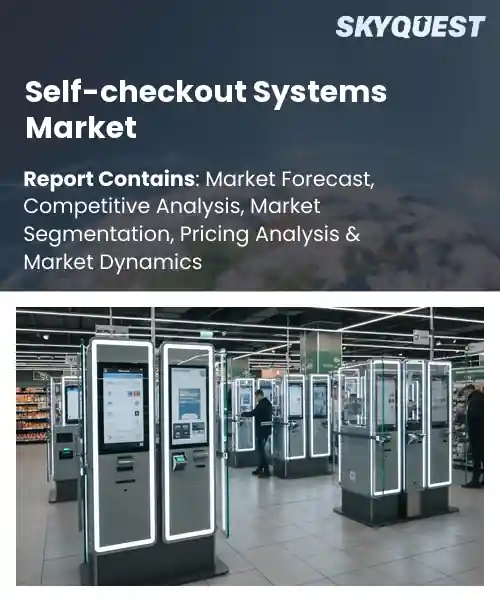
Self-checkout Systems Market
Report ID: SQMIG45F2292
Report ID: SQMIG45F2292
[email protected]
USA +1 351-333-4748
Report ID:
SQMIG45F2292 |
Region:
Global |
Published Date: May, 2026
Pages:
157
|Tables:
176
|Figures:
79


Global Self-Checkout Systems Market size was valued at USD 6.1 Billion in 2024 and is poised to grow from USD 6.78 Billion in 2025 to USD 15.86 Billion by 2033, growing at a CAGR of 11.2% during the forecast period (2026-2033).
The primary driver behind the self-checkout systems market is mounting labor cost pressure combined with consumer demand for faster, autonomous transactions that prompt retailers to redesign checkout experiences. Self-checkout refers to kiosks and software that let customers scan and pay without a cashier, and the market matters because it increases throughput while generating real-time sales and inventory data used for operational decisions. Early pilots in grocery stores appeared in the 1990s, then broader adoption followed in the 2010s as scanners and software matured, and during the COVID-19 pandemic retailers such as Walmart, Tesco and Kroger accelerated deployments to enable distancing.
A key factor driving the global self-checkout systems market is technological convergence of machine vision, cloud analytics and payment rails that improves accuracy and user experience, which reduces theft and operational friction leading to stronger returns and more rollouts. For example Amazon Go's cashierless format shows how sensor fusion eliminates scanning errors while shortening dwell time, and pharmacy chains using integrated payments plus loyalty analytics boost basket sizes through targeted offers. Because automation lowers per-transaction labor costs and yields actionable data, vendors and retailers can justify expansion into convenience stores, airports and quick-service restaurants, creating new revenue opportunities and markets.
How is AI improving loss prevention in the self-checkout systems market?
AI is improving loss prevention in the self checkout market by combining computer vision sensor fusion and behavioral analytics to spot missed scans suspicious bagging and label switching. Systems run intelligence at the edge to match visual product identity to scanned barcodes and to flag anomalous hand movements without slowing honest shoppers. Retailers must balance reducing shrink with preserving a fast experience so vendors design adaptable models that learn a store assortment and common behaviors. Established hardware and software providers now offer embedded AI for produce recognition age verification and stacked item detection which makes deployments more practical and scalable.
Trigo April 2026, the company received industry recognition for a computer vision loss prevention platform that detects missed scans concealed items and suspicious behaviors. This shows how AI driven visual recognition reduces manual checks and supports broader roll out of self checkout by improving theft detection and operational efficiency.
Market snapshot - (2026-2033)
Global Market Size
USD 6.1 Billion
Largest Segment
Hardware
Fastest Growth
Software
Growth Rate
11.2% CAGR
To get more insights on this market click here to Request a Free Sample Report
Global self-checkout systems market is segmented by component, system type, technology, application, end user, deployment type and region. Based on component, the market is segmented into Hardware, Software and Services. Based on system type, the market is segmented into Cash-Based Systems, Cashless Systems and Hybrid Systems. Based on technology, the market is segmented into Barcode Scanning, RFID-Based Systems, Computer Vision Systems and AI-Enabled Systems. Based on application, the market is segmented into Supermarkets & Hypermarkets, Convenience Stores, Department Stores, Specialty Retail Stores and Others. Based on end user, the market is segmented into Retail Chains, Grocery Stores, Hospitality Providers, Entertainment Venues and Others. Based on deployment type, the market is segmented into Standalone Systems, Wall-Mounted Systems and Mobile Self-Checkout Systems. Based on region, the market is segmented into North America, Europe, Asia Pacific, Latin America and Middle East & Africa.
AI-enabled systems segment dominates because advanced machine learning and sensor fusion enable more reliable item recognition and anomaly detection, directly reducing scanning errors and shrinkage while improving checkout speed. This capability drives retailer confidence and investment since better accuracy lowers operational losses and customer friction, and integrated analytics enable proactive inventory and fraud management, creating a clear operational and financial rationale for broad deployment across store formats.
However, barcode scanning systems are emerging as the most rapidly expanding area because their low implementation complexity, compatibility with existing point-of-sale and inventory workflows, and minimal training requirements accelerate adoption among smaller retailers and legacy operations. Growing interest in hybrid approaches that combine simple scanning with incremental automation is expanding their footprint and creating immediate opportunities for cost-effective modernization and wider market reach.
Standalone systems segment dominates because freestanding kiosks provide a turnkey, visible point of service that supports full payment options, stable hardware, and enterprise-grade integration with store networks and loss prevention systems. Their robustness and predictable user flow reduce implementation risk for large retailers, enabling consistent staff training, centralized monitoring, and scalability across multiple store formats, which in turn reinforces procurement preference for tried-and-tested deployments.
However, mobile self-checkout systems are the fastest growing area because widespread smartphone adoption, app ecosystems, and demand for contactless, personalized shopping experiences drive rapid retailer and consumer uptake. This expansion is propelled by lower per-unit deployment costs, seamless loyalty integration, and the ability to quickly roll out feature updates, accelerating innovation and opening new avenues for targeted promotions and frictionless checkout models.
To get detailed segments analysis, Request a Free Sample Report
North America leads the global self-checkout systems market owing to a combination of mature retail infrastructure, high technology adoption among merchants and consumers, and a concentrated base of major retail chains that prioritize operational efficiency. Vendors and systems integrators are well established, enabling rapid deployment across diverse store formats and seamless integration with existing point of sale ecosystems and loyalty platforms. Market momentum is reinforced by a favorable payments environment that supports card, contactless, and mobile wallets, alongside regulatory clarity around electronic transactions. Labor cost pressures and focus on customer throughput drive retailer investment in automation, while advanced analytics and remote monitoring capabilities allow continuous optimization and risk management. Together, these factors create a reinforcing cycle of innovation, scale, and adoption that sustains North America dominance.
Self-checkout Systems Market in United States is characterized by widespread deployment among large national retailers and a strong ecosystem of hardware and software suppliers. Retailers emphasize throughput, loss prevention, and seamless integration with loyalty and payment platforms. High consumer familiarity with automated checkout supports experimentation with hybrid formats and unattended models. Innovation hubs and vendor partnerships accelerate deployments, while continuous refinement of user interfaces and backend analytics enhances operational efficiency.
Self-checkout Systems Market in Canada reflects adoption by regional grocers adapting to urban shopper preferences and operational cost pressures. Solutions are tailored for bilingual environments and varied store formats, with emphasis on accessible interfaces and reliable payment integration. Cross-border technology transfers influence vendor selection, while pilot programs in metropolitan centers further inform national rollouts. Retailers focus on balancing automation with assisted service to preserve customer engagement and maintain brand differentiation.
Europe is experiencing rapid expansion of self-checkout systems driven by a convergence of retail modernization efforts, labor market dynamics, and growing consumer acceptance of automated transactions. Pan European retailers and multinational chains are standardizing checkout flows to improve efficiency and reduce in-store friction, while a healthy vendor landscape provides regionally tailored solutions that respect privacy and interoperability standards. Adoption is supported by widespread availability of contactless payments and investments in secure transaction processing. Urban density, convenience store proliferation, and omnichannel strategies encourage deployment in varied formats from compact neighborhood stores to large supermarkets. Regulatory attention to data protection and accessibility shapes implementation, prompting investments in user experience design and inclusive interfaces. Together, these elements create a fertile environment for accelerated, cross-border adoption across the region.
Self-checkout Systems Market in Germany is driven by national supermarket chains and technology providers seeking efficiency through automation. Focus is on robust engineering, durable hardware, and seamless integration with retail enterprise systems. Retailers emphasize reliability and accurate inventory reconciliation while maintaining consumer trust in automated checkout. Local vendor innovation and close collaboration with systems integrators support rapid rollouts across urban and suburban store formats with interfaces tailored to shopper expectations.
Self-checkout Systems Market in United Kingdom reflects widespread adoption by major supermarket groups and convenience chains with mature deployment models. Retailers prioritize speed, customer choice, and integrated loyalty experiences while leveraging strong vendor ecosystems for solutions. Urban store density and consumer comfort with technology support varied formats from express lanes to self-service. Performance monitoring, loss prevention, and customer assistance workflows are central to implementations that balance automation and in-store engagement.
Self-checkout Systems Market in France shows growing interest among supermarket chains as retailers modernize store experiences. Adoption is shaped by shopper expectations for assisted options and language specific interfaces, prompting tailored solution configurations. Retailers pilot hybrid models that combine assisted checkouts with self-service to address loss concerns and maintain service continuity. Vendor partnerships focus on localization and compliance with data protection norms, refining user interfaces to improve acceptance across markets.
Asia Pacific is strengthening its position in the self-checkout systems market through a blend of rapid retail modernization, strong domestic technology suppliers, and high consumer receptivity to digital payments. Major urban centers are prime testbeds for innovative checkout formats, while convenience retail and transit hubs provide scalable deployment venues. Local vendors leverage mobile wallet ubiquity and advanced system integration expertise to offer solutions that accommodate regional payment methods and language needs. Cross sector collaboration among retailers, technology firms, and payment providers accelerates integration with loyalty and e-commerce platforms. Additionally, demographic trends and operational efficiency priorities encourage automation in both high density and aging populations. Focus on localized user experience, service models that mix assisted and unattended options, and investments in remote management and analytics underpin the region wide push to capture broader market share.
Self-checkout Systems Market in Japan benefits from expectations for precision and reliability, with retailers seeking engineered solutions that integrate smoothly with operations. Demographic change and compact store formats drive interest in automation for routine transactions. Vendors emphasize quality hardware, hygiene, and user interfaces adapted to local shopper behaviors. Collaboration between retailers and technology firms enables tailored deployments in convenience stores and supermarkets, focusing on minimizing friction and preserving service quality.
Self-checkout Systems Market in South Korea is shaped by mobile payment ubiquity and a consumer base that favors fast digital transactions. Convenience store networks and urban retail formats provide venues for deployment of automated checkout. Vendors design systems for seamless mobile wallet integration and robust user authentication. Retailers blend self-service with in-store assistance to optimize throughput while maintaining strong customer service standards across dense shopping environments and near transit hubs.
To know more about the market opportunities by region and country, click here to
Buy The Complete Report
Retailers Seeking Operational Efficiency
Rising Demand For Contactless Solutions
Integration Complexity With Legacy Systems
Concerns About Theft and Loss
Request Free Customization of this report to help us to meet your business objectives.
Competitive pressure in the global self-checkout systems market stems from rapid AI and computer-vision differentiation, strategic M&A and retailer tie-ups that prioritize integrated solutions over standalone kiosks. Recent consolidation includes Instacart’s acquisition of smart-cart maker Caper, high-profile vendor partnerships such as AiFi with Carrefour and Zabka, and vendor reorganizations like NCR’s split and Voyix’s launch of new self-checkout offerings.
SkyQuest’s ABIRAW (Advanced Business Intelligence, Research & Analysis Wing) is our Business Information Services team that Collects, Collates, Correlates, and Analyses the Data collected by means of Primary Exploratory Research backed by robust Secondary Desk research.
As per SkyQuest analysis, the global self-checkout systems market is expanding rapidly, driven primarily by mounting labor cost pressures and rising consumer demand for faster autonomous transactions and further propelled by technological convergence of machine vision, cloud analytics and modern payment rails that improve accuracy and throughput. North America continues to dominate thanks to mature retail infrastructure and high technology adoption, and AI-enabled systems are the leading segment because they reduce scanning errors and strengthen loss prevention. However integration complexity with legacy POS and inventory systems remains a key restraint that slows rollouts. Vendors that simplify integration and offer cloud-native checkout-as-a-service models will capture the fastest growth.
| Report Metric | Details |
|---|---|
| Market size value in 2024 | USD 6.1 Billion |
| Market size value in 2033 | USD 15.86 Billion |
| Growth Rate | 11.2% |
| Base year | 2024 |
| Forecast period | (2026-2033) |
| Forecast Unit (Value) | USD Billion |
| Segments covered |
|
| Regions covered | North America (US, Canada), Europe (Germany, France, United Kingdom, Italy, Spain, Rest of Europe), Asia Pacific (China, India, Japan, Rest of Asia-Pacific), Latin America (Brazil, Rest of Latin America), Middle East & Africa (South Africa, GCC Countries, Rest of MEA) |
| Companies covered |
|
| Customization scope | Free report customization with purchase. Customization includes:-
|
To get a free trial access to our platform which is a one stop solution for all your data requirements for quicker decision making. This platform allows you to compare markets, competitors who are prominent in the market, and mega trends that are influencing the dynamics in the market. Also, get access to detailed SkyQuest exclusive matrix.
Table Of Content
Executive Summary
Market overview
Parent Market Analysis
Market overview
Market size
KEY MARKET INSIGHTS
COVID IMPACT
MARKET DYNAMICS & OUTLOOK
Market Size by Region
KEY COMPANY PROFILES
Methodology
For the Self-checkout Systems Market, our research methodology involved a mixture of primary and secondary data sources. Key steps involved in the research process are listed below:
1. Information Procurement: This stage involved the procurement of Market data or related information via primary and secondary sources. The various secondary sources used included various company websites, annual reports, trade databases, and paid databases such as Hoover's, Bloomberg Business, Factiva, and Avention. Our team did 45 primary interactions Globally which included several stakeholders such as manufacturers, customers, key opinion leaders, etc. Overall, information procurement was one of the most extensive stages in our research process.
2. Information Analysis: This step involved triangulation of data through bottom-up and top-down approaches to estimate and validate the total size and future estimate of the Self-checkout Systems Market.
3. Report Formulation: The final step entailed the placement of data points in appropriate Market spaces in an attempt to deduce viable conclusions.
4. Validation & Publishing: Validation is the most important step in the process. Validation & re-validation via an intricately designed process helped us finalize data points to be used for final calculations. The final Market estimates and forecasts were then aligned and sent to our panel of industry experts for validation of data. Once the validation was done the report was sent to our Quality Assurance team to ensure adherence to style guides, consistency & design.
Analyst Support
Customization Options
With the given market data, our dedicated team of analysts can offer you the following customization options are available for the Self-checkout Systems Market:
Product Analysis: Product matrix, which offers a detailed comparison of the product portfolio of companies.
Regional Analysis: Further analysis of the Self-checkout Systems Market for additional countries.
Competitive Analysis: Detailed analysis and profiling of additional Market players & comparative analysis of competitive products.
Go to Market Strategy: Find the high-growth channels to invest your marketing efforts and increase your customer base.
Innovation Mapping: Identify racial solutions and innovation, connected to deep ecosystems of innovators, start-ups, academics, and strategic partners.
Category Intelligence: Customized intelligence that is relevant to their supply Markets will enable them to make smarter sourcing decisions and improve their category management.
Public Company Transcript Analysis: To improve the investment performance by generating new alpha and making better-informed decisions.
Social Media Listening: To analyze the conversations and trends happening not just around your brand, but around your industry as a whole, and use those insights to make better Marketing decisions.
REQUEST FOR SAMPLE
 REQUEST FREE CUSTOMIZATION
Global Self-Checkout Systems Market size was valued at USD 6.1 Billion in 2024 and is poised to grow from USD 6.78 Billion in 2025 to USD 15.86 Billion by 2033, growing at a CAGR of 11.2% during the forecast period (2026-2033).
Competitive pressure in the global self-checkout systems market stems from rapid AI and computer-vision differentiation, strategic M&A and retailer tie-ups that prioritize integrated solutions over standalone kiosks. Recent consolidation includes Instacart’s acquisition of smart-cart maker Caper, high-profile vendor partnerships such as AiFi with Carrefour and Zabka, and vendor reorganizations like NCR’s split and Voyix’s launch of new self-checkout offerings. 'NCR Voyix', 'Diebold Nixdorf', 'Toshiba Global Commerce Solutions', 'Fujitsu', 'Panasonic Connect', 'ITAB Shop Concept', 'StrongPoint', 'Mashgin', 'Gilbarco Veeder-Root', 'ECR Software Corporation', 'PCMS Group', 'MetroClick', 'Kiosk Information Systems', 'Olea Kiosks', 'Advantech', 'Pyramid Computer', 'Zebra Technologies', 'Datalogic', 'Elo Touch Solutions', 'Diebold Nixdorf Retail Solutions'
Retailers prioritize solutions that reduce in-store labor requirements and speed transaction times, which directly supports investments in self-checkout systems. By enabling staff to focus on value-added tasks rather than routine scanning and payment, these systems improve perceived operational productivity and store throughput. The capability to reallocate personnel to customer service, inventory management, and merchandising reinforces economic justification for adoption. As a result, retailers view self-checkout as a practical lever to enhance store efficiency and responsiveness, thereby encouraging continued deployment and feature development.
Ai-Powered Shopper Personalization: Retailers are deploying artificial intelligence and machine learning within self-checkout systems to deliver real-time, context-aware personalization. Systems infer shopper preferences from behavior and transaction patterns to curate product suggestions, dynamic promotions, and tailored user interfaces that reduce friction. This personalization fosters higher satisfaction and repeat visits by creating seamless, intuitive experiences while enabling retailers to differentiate service. Emphasis on privacy-preserving models and transparent controls helps build trust, encouraging broader acceptance of customized interactions at checkout across digital and physical channels.
Why does North America Dominate the Global Self-checkout Systems Market? |@12


Want to customize this report? This report can be personalized according to your needs. Our analysts and industry experts will work directly with you to understand your requirements and provide you with customized data in a short amount of time. We offer $1000 worth of FREE customization at the time of purchase.
Feedback From Our Clients


 USA (+1) 351-333-4748

