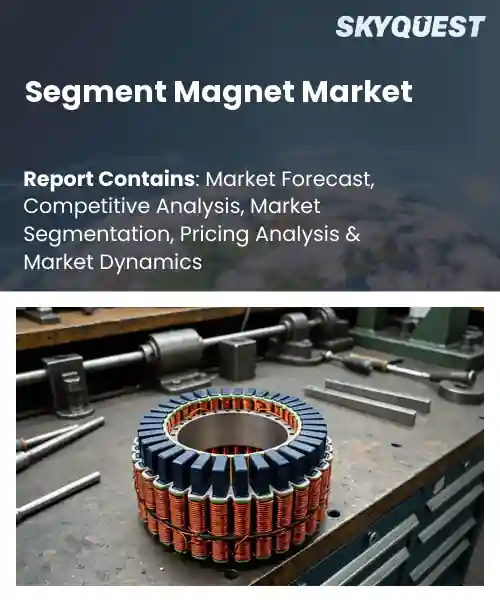
Segment Magnet Market
Report ID: SQMIG20F2036
Report ID: SQMIG20F2036
[email protected]
USA +1 351-333-4748
Report ID:
SQMIG20F2036 |
Region:
Global |
Published Date: February, 2026
Pages:
157
|Tables:
182
|Figures:
79


Global Segment Magnet Market size was valued at USD 770.2 Million in 2024 and is poised to grow from USD 807.17 Million in 2025 to USD 1174.51 Million by 2033, growing at a CAGR of 4.8% during the forecast period (2026-2033).
The global segment magnet market is experiencing continued growth due to rising needs for high-performance magnetic components across varied industries, particularly in automotive, electronics, renewable energy and industrial automation. Generally, segment magnets are constructed from materials such as ferrite, NdFeB and SmCo; they are widely utilized within motors, sensors, assemblies, and holding systems primarily because these types of magnets facilitate custom shapes with exceptional magnetic properties.
Demand for segment magnets continues to accelerate as electric vehicles (EVs) and hybrid system components require greater portions of rare earth (REE) segment magnets that provide superior efficiency and minimize space in designs. Continued growth in the utilization of wind turbines and other clean energy technologies also contributes to further accelerating the growth of this market segment because all of these applications are generally reliant on high-strength and durable magnets.
Improvements to magnet manufacturing technologies, such as enhanced sintering and coatings, continue to improve the performance, corrosion resistance, and temperature stability of these materials to make them better suited for harsher work environments. Supply chain dynamics, especially around the concentration of REE material supply sources also affect segment magnet pricing and have driven manufacturers to pursue greater amounts of material recycling and alternative materials.
How will AI-driven Design Tools Impact the Segment Magnet Market's Manufacturing Efficiency?Significantly improving manufacturability in the magnet manufacturing industry through automation will be achieved via artificial intelligence-driven design tools by automating topology and geometry exploration, integrating electromagnetic simulation earlier in the workflow, and predicting manufacturability. The main technologies that facilitate this include generative design, surrogate modeling and automated tolerance analysis.
Currently, most suppliers use multiple simulations and physical prototypes, thus, prolonging development and generating waste. AI will allow engineers to explore multiple alternatives and find segment geometries that have a good field quality while simplifying tooling. Engineers will also be able use AI-guided recipes through process to reduce rejects. In addition to the previously mentioned capabilities of AI drivendesign tools, engineers have been able to see real-world examples of AI-generated designs that facilitate assembly and shorten iteration loops.
Market snapshot - (2026-2033)
Global Market Size
USD 770.2 Million
Largest Segment
Segmental Rare Earth Magnets
Fastest Growth
Segmental Rare Earth Magnets
Growth Rate
4.8% CAGR
To get more insights on this market click here to Request a Free Sample Report
Global segment magnet market is segmented into product type, magnet material, shape, application, end-use industry, distribution channel and region. Based on product type, the market is segmented into segmental rare earth magnets, segmental ferrite magnets, segmental alnico magnets, segmental ceramic magnets and other segment magnet types. Based on magnet material, the market is segmented into neodymium iron boron (NdFeB), samarium cobalt (SmCo), ferrite, alnico and others.
Based on shape, the market is segmented into arc segment, curved segment, rectangular segment, and custom shape. Based on application, the market is segmented into electric motors & generators, sensors & actuators, magnetic couplings, magnetic bearings, MRI & medical devices and other industrial applications. Based on end-use industry, the market is segmented into automotive, consumer electronics, healthcare & medical, industrial machinery, energy & power, and others. Based on distribution channel, the market is segmented into direct OEM sales, distributors & dealers and online sales. Based on region, the market is segmented into North America, Europe, Asia Pacific, Latin America and Middle East & Africa.
How does Use of Neodymium Iron Boron Magnets Drive Performance Improvements in Magnet Applications?
As per segment magnet market outlook, the neodymium iron boron (NdFeB) segment is the largest segment because of the high magnetic energy density and coercivity of NdFeB making it possible to create smaller, lighter magnetized assemblies that can meet the increasing performance requirements for motors, sensors and couplings. The superior performance of Neodymium Iron Boron translates into an efficient, high torque compact design that engineers and Original Equipment Manufacturers (OEMs) will find attractive for their applications. Established manufacturing processes and familiarity with this type of material yield lower technical risks when designing products using Neodymium Iron Boron; thus, leading to widespread adoption among industrial users and solidifying commercial preference for this type of construction material.
As per segment magnet market analysis, the samarium cobalt (SmCo) segment has recently become the fastest growing segment of the magnetic materials market because of the superior thermal stability and corrosion resistance of SmCo; thus, allowing the use of high temperature and/or harsh environmental applications. Increasing demand among niche medical, aerospace, and energy systems has resulted in the broadening of application scopes for these materials, prompting suppliers to invest in tailored SmCo solutions that can produce new revenue streams through sales of products made using these types of magnet materials.
What Role do Distributors & Dealers Play in Expanding Magnet Market Reach?
As per segment magnet market forecast, the distributors & dealers segment leads in the industry because their large distribution networks, technical support and inventory assistance lower the friction of buying for multiple customers and give them a high level of access to the market. Furthermore, because they can combine small order sizes into larger orders, provide fast delivery, and help customers determine which type of material and shape will work best for their specific application.
The online sales segment is growing at the fastest rate due to the simplification of the digital buying process through digital procurement, configurators, and direct engineer channels. Digital buying has helped new small-volume buyers to purchase and has assisted niche suppliers with increasing their volume due to the enhanced technical resource capabilities and streamlining the logistical process when purchasing their products. Consequently, boutique suppliers will have the ability to expand at a more rapid rate and create demand for their products.
To get detailed segments analysis, Request a Free Sample Report
The Asia Pacific region is the centre of the global segmented magnet market through a combination of manufacturing capabilities, integrated supply chains, and strong downstream end-market demand in consumer electronics, automotive, and industrial equipment. Being highly clustered provides the ability for suppliers of material, component manufacturers and OEMs to work closely together, reducing development times for both new products and developing customized products. There is also a high level of technical expertise with respect to advanced materials and precision processing, which creates a high level of performance for all variants of magnets and a collaborative R&D effort between industry and research institutions promoting innovation.
Japan has a high level of concentration in segmented magnets due to precision manufacturing capabilities, advanced materials research capabilities and a very strongecosystem of automotive and robotics applications. The supply chains have been established to ensure that they all meet the highest quality standards over many production runs.
In South Korea, the segment magnet market has benefited from very strong integration between manufacturing advanced electronics, producing semiconductor equipment and the needs of the display industry. The major industrial groups within South Korea coordinate their supply chains and invest in the next generation of materials engineering to meet strict performance specifications. The focus on compactness and power density has created advancements in both the design and production process of segmented magnets.
The North America segment magnet market continued to show rapid development because of strong end-user demand, strategic investments in domestic manufacturing, and a focus on technical innovation. Demand is driven mainly due to increased requirements from electrified transportation, renewable energy systems, aerospace, and advanced industrial automation resulting in OEMs and suppliers searching for higher-performing solutions sourced from a local supply chain.
The United States segment magnet market is benefiting from the strong demand for electric vehicle production from OEM and tier suppliers. As a result of significant investment being made towards high-performance magnet solutions by OEMs and suppliers, strong support is being provided by the U.S. government and industry to develop domestic supply chains through the strengthening of local production and local sourcing of materials. Programs designed to foster collaboration between universities and national laboratories are accelerating innovation in the materials sciences and in technologies supporting capabilities and focused on providing specialized solutions tailored for specific applications.
Segment magnet markets in Canada are shaped by the presence of advanced manufacturing clusters, strong ties to the aerospace and clean technology sectors, and a focus on innovation at the material level. Local suppliers partner with OEMs to create solutions based on specific applications and enhance performance/quality. Government and industry partnerships support the adoption of technologies by allowing manufacturers to remain competitive through their specialized engineering expertise and quality-driven manufacturing practices.
The segment magnet industry is evolving rapidly as it becomes a major supplier to automotive manufacturers, especially with the rise of electric vehicles. Strategic investments in advanced processing and high-quality standards help Europe strengthen its role as an international center for magnet production. Cross-border collaboration has occurred via national excellence in engineering networks and collaborative consortia that facilitate technology transfer and advanced processing method scaling. The emphasis on sustainable sourcing and lifecycle management will lead to alternative materials and circular economies that reduce single supplier dependence. Manufacturers emphasize precision, customizability, and certification standards to meet stringent industry specifications, while rapid adoption of new product designs occurs through partnerships between OEMs, research institutions, and specialized suppliers. Supported by policy frameworks and public-private partnerships, there is growing infrastructure to support testing and pilot production, positioning Europe as a globally consistent provider of high-quality segment magnet solutions.
As per segment magnet industry analysis, Germany market leverages its long-standing foundation in precision engineering and automotive manufacturing. The existing strong supply chain networks of precision parts suppliers and machine builders support complex production capabilities while meeting the high reliability levels expected from products in both the transportation and electrical equipment markets. Working alongside technical universities and research institutions, Germany advances its materials development and testing abilities. The strong emphasis on quality management, standardization of certification, and scalable production methods allows German companies to deliver custom magnet solutions across various industries including transportation, energy, and industrial machinery.
As per segment magnet market regional forecast, UK market has a number of advantages, including strong research and development capabilities, an established innovation ecosystem, and expertise in the fields of defense and aerospace. Universities and research laboratories provide support for the development of new materials and advanced testing standards, while specialized manufacturers are involved in the design and development of custom magnet configurations and the integration of their systems. With an emphasis on certification and collaboration between suppliers and end-users, products produced in this market will be suitable for use in high-reliability applications.
As per segment magnet market regional outlook, France benefits substantially from its diverse industrial base, strong engineering capabilities and established material development programs. Suppliers are working closely with automotive and energy integrators to produce magnet solutions that meet application-specific performance criteria while also addressing applications that require high durability and energy efficiency. Small- and medium-sized enterprises are an important source of specialized manufacturing processes supported by collaborative research and development to provide a transfer of technology to other manufacturers. Because of this collaboration, French suppliers have developed a strong focus on reliability and have introduced testing and certification programs into their business practices to better serve the requirements of demanding projects and customers beyond France's borders.
To know more about the market opportunities by region and country, click here to
Buy The Complete Report
Rising Demand from Electric Vehicles
The rise in demand for electric vehicle traction motors resulting in the need for high-quality permanent magnets, has created an emphasis on the sourcing and integration of magnets by both automotive manufacturers and their vendors, which leads to increased capacity expansion and investment throughout the permanent magnet value chain. In addition, as manufacturers aim to improve the efficiency of their motors while decreasing the overall weight of vehicles, there is an increased demand for advanced magnetic material, leading to further investigations into the development of higher-performance magnetic materials and the advancement of manufacturing methods. This continued commitment to permanent magnet development by OEMs will lead to more stable long-term supplier relationships, greater production quantities, and increased technological advancement that will help promote segment magnet market growth through increasing levels of transportation electrification.
Expansion of Renewable Energy Applications
Increased demand for efficient generators that utilize high-performance permanent magnets in renewable energy projects has led to an interest by wind turbine manufacturers and utilities to secure permanent magnet supplies and invest in advanced technologies associated with permanent magnets. In addition to developing reliable and high-performance generators for wind energy, the manufacturers of wind turbines and utilities are also investing in developing a more efficient generator system, so as such, the specifications of permanent magnets will become an integral part of the design of the generators themselves. Therefore, to supply permanent magnets to developers of wind energy projects, suppliers of permanent magnets will need to adapt their manufacturing techniques and material mixes for production.
Fluctuating Raw Material Availability
Key raw material supply variations, combined with the uncertainty of future supply, typically lead to long lead times on critical input materials. This is often a barrier for manufacturers trying to expand their capacity quickly or invest in the long term. As a result, some manufacturers will engage in delaying projects or diversify the materials they use to reduce their exposure to these risks, but any of these solutions will generally slow product development cycles and complicate supply chains. Furthermore, resource uncertainty will create a more cautious procurement strategy for buyers, increase reliance on recycling and alternative materials, and otherwise hinder short-term market growth and impede adoption of magnet-intensive applications.
Limited Availability of Infrastructure for Recovery
A lack of adequate infrastructures for recovery and recycling of end-of-life magnet materials diminishes potential for secondary magnet supply; therefore, manufacturers remain reliant on virgin material sources and create a reliance on concentrated supply sources, inhibiting scale-up. As a result, the collection, separationand processing of magnet components is complex to operationalize and requires significant resources, discouraging widespread adoption of circular economy practices. These factors create an ongoing gap in the availability of reclaimed feed stocks, raise environmental and logistical issues for all stakeholders and reduce incentives for investment in closed-loop systems, thus constraining pathways for sustainable growth and continuing to prolong a reliance on extracting virgin materials.
Request Free Customization of this report to help us to meet your business objectives.
The competitive landscape of the global magnet segment is defined by firms vertically integrating into supply chains and reshoring manufacturing to establishdomestic production capacity for rare earth elements. These companies are pursuing both acquisition strategies and joint ventures, as seen with MP Materials’ efforts to increase domestic magnet manufacturing as well as Noveon’s recently secured supply agreements with motor OEMs. In addition, several startup companies are focusing on both the recycling of non-recyclable NdFeB magnets and new chemistries of NdFeB magnets as a way to displace incumbent suppliers, thus creating an opportunity for diversified sourcing.
Shift toward Rare Earth Alternatives: Manufacturers are increasing research into low rare earth and rare earth free magnetic formulations, to limit reliance on constrained supply chains while still maintaining performance. The development of materials will continue to be a priority, with research focused on material substitution, improved sintering techniques, and collaboration with component designers to optimize magnet usage and reduce material usage. Expectations from economics and legal compliance will drive investment into alternative chemistries that can be manufactured through multiple processes, so there is a range of applications within automotive, industrial, and consumer electronics.
Renewable Energy Systems Drive Demand: The continued growth of renewable energy projects will increase the overall demand for high performance magnets used in the construction of efficient generating systems, direct drive turbine designs and power conversion systems. Manufacturers will continue to seek high performance magnets with thermal stability, durability, and predictable performance for the purpose of supporting the continued reliability of these assets in harsh working conditions. This increased demand for quality magnets is driving magnet producers and system integrators to collaborate more frequently when establishing material specifications and when providing supply assurance and support services.
SkyQuest’s ABIRAW (Advanced Business Intelligence, Research & Analysis Wing) is our Business Information Services team that Collects, Collates, Correlates, and Analyses the Data collected by means of Primary Exploratory Research backed by robust Secondary Desk research.
As per SkyQuest analysis, the global segment magnet industry is poised for steady expansion driven primarily by rising demand from electric vehicle traction motors. A key driver is this EV adoption, and a second driver is expansion in renewable energy applications as turbines and generators favor efficient magnet designs. A restraint is fluctuating raw material availability that pressures costs and accelerates substitution and recycling efforts. The Dominating region is Asia Pacific due to concentrated manufacturing, integrated supply chains, and deep end-market demand. Dominating segment is Neodymium Iron Boron (NdFeB) for its superior energy density that enables smaller, higher-torque assemblies and broad industrial adoption. The segment magnet market share is largely dominated by high-performance rare-earth magnets, with neodymium-iron-boron (NdFeB) segment magnets holding the leading position due to their superior magnetic strength and efficiency. The segment magnet market trend is characterized by increasing demand for compact, high-efficiency magnetic components fueled by the electrification of transportation, expansion of renewable energy infrastructure such as wind turbines.
| Report Metric | Details |
|---|---|
| Market size value in 2024 | USD 770.2 Million |
| Market size value in 2033 | USD 1174.51 Million |
| Growth Rate | 4.8% |
| Base year | 2024 |
| Forecast period | (2026-2033) |
| Forecast Unit (Value) | USD Million |
| Segments covered |
|
| Regions covered | North America (US, Canada), Europe (Germany, France, United Kingdom, Italy, Spain, Rest of Europe), Asia Pacific (China, India, Japan, Rest of Asia-Pacific), Latin America (Brazil, Rest of Latin America), Middle East & Africa (South Africa, GCC Countries, Rest of MEA) |
| Companies covered |
|
| Customization scope | Free report customization with purchase. Customization includes:-
|
To get a free trial access to our platform which is a one stop solution for all your data requirements for quicker decision making. This platform allows you to compare markets, competitors who are prominent in the market, and mega trends that are influencing the dynamics in the market. Also, get access to detailed SkyQuest exclusive matrix.
Table Of Content
Executive Summary
Market overview
Parent Market Analysis
Market overview
Market size
KEY MARKET INSIGHTS
COVID IMPACT
MARKET DYNAMICS & OUTLOOK
Market Size by Region
KEY COMPANY PROFILES
Methodology
For the Segment Magnet Market, our research methodology involved a mixture of primary and secondary data sources. Key steps involved in the research process are listed below:
1. Information Procurement: This stage involved the procurement of Market data or related information via primary and secondary sources. The various secondary sources used included various company websites, annual reports, trade databases, and paid databases such as Hoover's, Bloomberg Business, Factiva, and Avention. Our team did 45 primary interactions Globally which included several stakeholders such as manufacturers, customers, key opinion leaders, etc. Overall, information procurement was one of the most extensive stages in our research process.
2. Information Analysis: This step involved triangulation of data through bottom-up and top-down approaches to estimate and validate the total size and future estimate of the Segment Magnet Market.
3. Report Formulation: The final step entailed the placement of data points in appropriate Market spaces in an attempt to deduce viable conclusions.
4. Validation & Publishing: Validation is the most important step in the process. Validation & re-validation via an intricately designed process helped us finalize data points to be used for final calculations. The final Market estimates and forecasts were then aligned and sent to our panel of industry experts for validation of data. Once the validation was done the report was sent to our Quality Assurance team to ensure adherence to style guides, consistency & design.
Analyst Support
Customization Options
With the given market data, our dedicated team of analysts can offer you the following customization options are available for the Segment Magnet Market:
Product Analysis: Product matrix, which offers a detailed comparison of the product portfolio of companies.
Regional Analysis: Further analysis of the Segment Magnet Market for additional countries.
Competitive Analysis: Detailed analysis and profiling of additional Market players & comparative analysis of competitive products.
Go to Market Strategy: Find the high-growth channels to invest your marketing efforts and increase your customer base.
Innovation Mapping: Identify racial solutions and innovation, connected to deep ecosystems of innovators, start-ups, academics, and strategic partners.
Category Intelligence: Customized intelligence that is relevant to their supply Markets will enable them to make smarter sourcing decisions and improve their category management.
Public Company Transcript Analysis: To improve the investment performance by generating new alpha and making better-informed decisions.
Social Media Listening: To analyze the conversations and trends happening not just around your brand, but around your industry as a whole, and use those insights to make better Marketing decisions.
REQUEST FOR SAMPLE
 REQUEST FREE CUSTOMIZATION
Global Segment Magnet Market size was valued at USD 770.2 Million in 2024 and is poised to grow from USD 807.17 Million in 2025 to USD 1174.51 Million by 2033, growing at a CAGR of 4.8% during the forecast period (2026-2033).
The competitive landscape of the global segment magnet market is shaped by vertical integration and supply chain reshoring as firms secure rare earth inputs and domestic manufacturing capacity. Firms pursue acquisitions and partnerships, for example MP Materials expanding domestic magnet production and Noveon securing supply agreements with motor manufacturers. Startups focus on recycling and novel magnet chemistries to challenge incumbents and diversify sourcing. 'Magnetica Inc.', 'NeoMagnetics', 'Apex Magnetics', 'Arnold Magnetic Technologies', 'Hitachi Metals, Ltd.', 'Magnet Solutions, LLC', 'Dura Magnetics', 'Adams Magnetic Products', 'Dexter Magnetic Technologies', 'Sura Magnetics', 'VACUUMSCHMELZE GmbH & Co. KG', 'Bunting Magnetics Co.', 'Eclipse Magnetics', 'Magsy, s.r.o.', 'Goudsmit Magnetic Systems', 'Magnetic Components', 'Magnet Offer', 'SepMag', 'Master Magnetics, Inc.', 'Sikken Magnetics'
Demand for electric vehicle traction motors has increased the need for high-performance permanent magnets, prompting automakers and suppliers to prioritize magnet sourcing and integration, which in turn stimulates capacity expansion and investment across the magnet value chain. As manufacturers seek to improve motor efficiency and reduce vehicle weight, they favor advanced magnetic materials, encouraging research into higher-performance compositions and manufacturing techniques. This sustained OEM focus fosters long-term supplier relationships, supports higher production volumes, and drives technological development that reinforces market growth through broader adoption in transportation electrification.
Shift Toward Rare Earth Alternatives: Manufacturers are intensifying research into low rare earth and rare earth free magnetic formulations to reduce dependence on constrained supply chains while preserving performance. Development priorities include material substitution, enhanced sintering techniques, closer collaboration with component designers to optimize magnet usage and reduce material intensity. This trend is driven by strategic procurement shifts, sustainability commitments, and the desire for supply resilience, prompting investment in alternative chemistries and manufacturing platforms that enable application across automotive, industrial, and consumer electronics more broadly.
The Asia Pacific region is the centre of the global segmented magnet market through a combination of manufacturing capabilities, integrated supply chains, and strong downstream end-market demand in consumer electronics, automotive, and industrial equipment.


Want to customize this report? This report can be personalized according to your needs. Our analysts and industry experts will work directly with you to understand your requirements and provide you with customized data in a short amount of time. We offer $1000 worth of FREE customization at the time of purchase.
Feedback From Our Clients


 USA (+1) 351-333-4748

