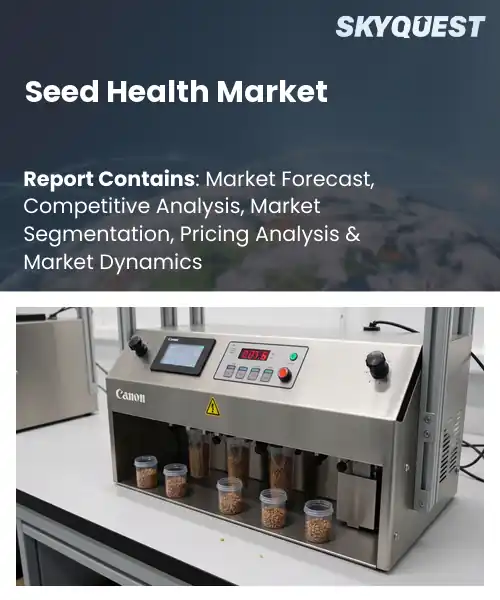
Seed Health Market
Report ID: SQMIG30H2389
Report ID: SQMIG30H2389
[email protected]
USA +1 351-333-4748
Report ID:
SQMIG30H2389 |
Region:
Global |
Published Date: March, 2026
Pages:
157
|Tables:
151
|Figures:
78


Global Seed Health Market size was valued at USD 9.5 Billion in 2024 and is poised to grow from USD 11.44 Billion in 2025 to USD 50.51 Billion by 2033, growing at a CAGR of 20.4% during the forecast period (2026-2033).
Growing incidence of seed-borne diseases, increasing demand for high-quality crop yields, rising adoption of advanced diagnostics, stricter phytosanitary regulations, and emphasis on global food security are driving sales of seed health solutions.
The rise of phytosanitary regulation enforcement and the incidence of pathogen outbreaks caused by climate change are also fueling the growth of this industry. Seed companies are investing more in quick tests such as PCR, genomic surveillance, and standardized treatment solutions to ensure regulatory compliance and export readiness. In addition, the increase in the use of biological coatings and fungicides for seeds to improve crop performance, as well as advances in digital solutions and on-site testing solutions, is driving this industry forward and reducing financial and quarantine risks. Growing pressure from plant pathogens and the need for consistent agricultural productivity coupled with a shift toward quality assurance and regulatory compliance are expected to primarily drive seed health market growth.
On the contrary, high costs of advanced diagnostic technologies, lack of technical expertise in developing regions, limited standardization in testing protocols, regulatory complexities across countries, and challenges in large-scale implementation are slated to impede seed health market penetration over the coming years.
How is AI Improving Disease Detection for Seed Health Companies?
AI is also playing an important role in improving disease detection within the seed health market. Some of the key technologies used for disease detection using AI include non-destructive imaging techniques, image analysis, and AI-based disease detection models. Currently, AI is used alongside conventional methods, not in place of conventional methods. In this context, seed companies are using AI-based tests alongside molecular tests to enhance their accuracy and reliability in disease detection.
In March 2024, Syngenta Vegetable Seeds opened a state-of-the-art Seed Health Lab in Hyderabad. This facility enhances testing capacity and supports the use of digital tools that combine imaging and AI to accelerate disease detection and improve quality control efficiency.
Market snapshot - (2026-2033)
Global Market Size
USD 9.5 Billion
Largest Segment
Seed Treatment Chemicals
Fastest Growth
Biofungicides & Biopesticides
Growth Rate
20.4% CAGR
To get more insights on this market click here to Request a Free Sample Report
Global seed health market is segmented by product type, treatment type, application, end-user, distribution channel, and region. Based on product type, the market is segmented into seed treatment chemicals, biofungicides & biopesticides, seed coatings & pellets, seed primers, and microbial inoculants. Based on treatment type, the market is segmented into chemical treatment, biological treatment, and physical treatment. Based on application, the market is segmented into cereals & grains, oilseeds & pulses, fruits & vegetables, turf & ornamental, and other crop types.
Based on end-user, the market is segmented into commercial farms, small & medium farms, agrochemical companies, seed producers, and distributors & dealers. Based on distribution channel, the market is segmented into direct sales, distributors & dealers, agro retail outlets, and online sales. Based on region, the market is segmented into North America, Europe, Asia Pacific, Latin America, and Middle East & Africa.
The microbial inoculants segment is estimated to account for the largest global seed health market share in the future. Growers and seed companies favor living biologicals that boost germination, vigor, and natural disease suppression, which helps this segment hold sway over others. The need for sustainable residue-free products with the added benefit of seed processing compatibility is driving the market for these products, which provide a significant benefit in terms of nutrient mobilization and stress tolerance that equates to stand establishment advantages.
However, biofungicides and biopesticides are emerging as the most rapidly expanding segment as per this seed health industry analysis. Advancements in formulation that enhance efficacy and shelf stability for seed applications create new opportunities via this segment. Innovation in target-specific modes of action, regulatory momentum that favors biological alternatives, and farmer acceptance are driving crop applications, propelling product development and distribution, and creating new commercial opportunities.
The seed coatings & pellets segment is projected to lead the global seed health market revenue generation in the long run. Physical encapsulation ensures strong protection for embryos, facilitates handling, and allows for uniform metering during sowing, which are essential for this segment to remain at the top. The use of a coating enables the blending of protection agents, conditioners, and valuable additives in a uniform mixture that minimizes damage from dust and seeds, as well as maximizes the efficiency of the planter, which is essential for the value of coated seeds in machine planting, especially for high-value crops.
On the other hand, seed primers are growing at the fastest rate with advances in osmopriming and biochemical conditioning for uniform emergence and stress tolerance. Improvements in application methods and increasing need for uniform emergence in challenging soils are creating opportunities for innovation in products and services, thereby increasing opportunities for seed conditioning companies.
To get detailed segments analysis, Request a Free Sample Report
Integrated ecosystem that combines advanced research institutions, mature commercial seed industries, and stringent regulatory frameworks are helping this region lead seed health demand through 2033. Advanced technical capabilities combined with extensive quality control systems used by major international seed companies and collaborative federal-state programs ranging from pathogen monitoring systems to creating innovative seed treatments have resulted in higher quality seeds being produced consistently.
Seed producers have access to a wide array of resources to promote adoption of certified seeds and biosecurity, including efficient logistics and distribution systems focused on export opportunities. The concentration of scientific knowledge and industry capability combined with stringent regulations create an environment conducive to preventing, rapidly detecting, and coordinating responses to seed health issues and support the regional leadership position.
Dense ecosystem of commercial seed producers, advanced diagnostic laboratories, and proactive regulatory oversight are supporting seed health demand in the United States. A robust supply chain infrastructure coupled with a strong engagement among the farming population is a significant contributor to the rigorous seed testing processes. The presence of a strong partnership between the private industry, testing contractors, and research institutions facilitates the adoption of state-of-the-art diagnostic techniques.
Collaborative research environment, targeted public support for seed hygiene initiatives, and a focus on certification for export quality prompts investments in seed health solutions in Canada. Ongoing relationships between industry groups, regulatory agencies, and testing laboratories continue to support risk management practices for certified seed. A regional testing infrastructure and extension programs enable the adoption of seed treatment/diagnostic services for farmers, with specialty crop producers contributing to the demand for pathogen testing.
Rigorous regulatory standards, coordinated certification systems, and a strong sustainability agenda are supporting consistent seed health demand in European countries. The boom in demand for specialty, protected and high-value crop seeds has led to increased investment in the development of tailored diagnostic services and innovations in seed treatments. The nexus between public research networks and private industry in deploying advanced molecular and imaging technologies will enhance the ability to detect seed borne pathogens, while the advocacy efforts of farmers’ associations and seed producers will encourage the adoption of best practices.
Policy support, scientific capacity and market driven demand will create an integrated growth environment across a range of crop types. Harmonization of phytosanitary requirements and implementation of quality benchmarks are also shaping seed health demand in Europe.
Concentrated advanced seed companies and established certification systems are estimated to influence procurement of seed health solutions in Germany. Active industry associations ensure quality standards are set, technology transfer is facilitated, and Germany’s position as a central European seed health competence center is consolidated. Emphasis on high-value and export-oriented crops ensures routine diagnostic work and the use of advanced detection technologies. Regional laboratory infrastructures, extension services, and a strong focus on phytosanitary practices are key advantages.
Rising private investment, an expanding network of diagnostic providers, and collaboration between startups and established breeders help support seed health demand in the country. A wide range of services, along with strong relationships with trading partners, is helping to create opportunities for rapid growth in United Kingdom. Emphasis on innovation is driving demand for molecular tests and digital monitoring technologies for seed lots. Extension services and commercial testing services are increasing producer awareness.
Stronger public research engagement, growth of testing laboratories, and heightened focus on seed quality ensures consistent seed health demand in France. Joint efforts of technology service providers and agricultural research institutes help in developing region-specific solutions to strengthen France's seed health market position in the European region. Demand for organic and special crop production is driving the need for customized seed tests and treatment options. Regional networks for extension services and cooperatives help in disseminating certification practices among farmers.
Strategic investments in diagnostic capacity, greater integration of precision agriculture technologies, and closer collaboration between public research institutions and private seed companies are supporting high seed health demand in this region. National governments have also provided support through programs that focus on enhancing accreditations in laboratories, training technical personnel, and facilitating seed certification to support local crop production as well as trade. Moreover, multinational and regional seed companies have also joined forces to develop efficient processes for screening for disease and seed quality.
Farmers in the region have demonstrated an increased level of awareness and desire for healthy seed, which will support increased use of modern detection methods, including using digital (i.e., electronic) tools to improve traceability and transparency within supply chains from growers to consumers. As a result of these combined initiatives, the Asia Pacific region will become more competitive and resilient through 2033.
Well-developed research centers, sophisticated diagnostic tools, and a focus on enhancing technologies for seed purity are driving factors for seed health adoption in Japan. A focus on certification and record-keeping ensures that there are high-quality standards for both local consumption and export. Technician training programs and electronic record systems assist with increased productivity for testing. Private sector entities are working with research centers to incorporate high-resolution molecular testing and imaging technologies for particular varieties of crops.
Emphasis on private innovation, robust biotech capabilities, and industry collaboration with national research centers are influencing seed health adoption in South Korea. Companies that focus on exporting use traceability methods and testing services. Continuous technician training is a key aspect of the market, which is a result of the public-private partnership. The use of genomics-based diagnostics and automated laboratory work processes facilitates the wide-scale implementation of efficient screening for crop seeds.
To know more about the market opportunities by region and country, click here to
Buy The Complete Report
Increased Demand For Certified Seeds
Improved awareness among growers and quality standards have led to increased demand for certified and pathogen-free seeds, which in turn has created a lucrative business for laboratories in terms of revenue generation and encouraged companies to develop advanced diagnostic and treatment techniques for seed health solutions. In this regard, it can be asserted that the seed treatment market is witnessing improved service delivery and business focus towards seed health solutions, thereby bolstering seed health market outlook.
Technological Advancements In Diagnostics
Advancements in the field of molecular assays, imaging, and automation has increased the speed and accuracy of seed health diagnostics. Such a move will reduce the uncertainties faced by the seed producers. Moreover, the confidence level will increase among the buyers, which will encourage the use of certified seeds. In addition, the advancement in the field will enable the providers to offer differentiated products, thus expanding their customer base in the crop segment. Such a move will encourage investors to invest in the industry, thus promoting demand for novel seed health solutions.
High Cost Of Advanced Technologies
Significant capital requirements to purchase and maintain advanced technologies in terms of diagnostic and treatment infrastructure may be a limiting factor for smaller seed producers and service providers. This would limit the market size. When technologies are still expensive, adoption will be biased towards larger organizations, which will further limit adoption. The issue of cost barriers may also limit new market entrants in terms of laboratory infrastructure, thereby limiting geographic expansion of seed health services.
Regulatory Complexity and Fragmentation
The existence of divergent regulatory approaches and non-standard seed health regulations across various jurisdictions generates administrative challenges for seed and service providers. The need for compliance with various approval mechanisms and test protocols generates time and operational challenges that may deter the expansion of smaller seed and service providers across borders. The existence of divergent regulations may generate divergent seed and service demand for standardized testing approaches, which may slow down the sales of seed health products in the future.
Request Free Customization of this report to help us to meet your business objectives.
Global seed health competition is driven by consolidation, commercial partnerships and platform innovation: Miraterra’s acquisition of Trace Genomics, Syngenta opening a dedicated seed health lab in Hyderabad, Flagship’s launch of Terrana’s RNA platform for seed to stem protection, and LoamBio’s microbial seed inoculum and Series A funding illustrate M&A, capex for quality control, strategic alliances and deep tech product launches reshaping market positions.
SkyQuest’s ABIRAW (Advanced Business Intelligence, Research & Analysis Wing) is our Business Information Services team that Collects, Collates, Correlates, and Analyses the Data collected by means of Primary Exploratory Research backed by robust Secondary Desk research.
As per SkyQuest analysis, rising incidence of seed-borne diseases, increasing demand for high-quality crop yields, and stricter phytosanitary regulations are anticipated to drive the demand for seed health solutions going forward. However, high costs of advanced diagnostics, lack of standardization in testing protocols, and regulatory complexities across regions are slated to slow down the adoption of seed health solutions in the future. North America is slated to spearhead the demand for seed health solutions owing to strong presence of advanced agricultural infrastructure, high adoption of molecular diagnostics, and emphasis on certified seed usage. Integration of AI-enabled disease detection, development of rapid on-site testing solutions, and advancements in molecular and genomic diagnostics are anticipated to be key trends driving the seed health market in the long run.
| Report Metric | Details |
|---|---|
| Market size value in 2024 | USD 9.5 Billion |
| Market size value in 2033 | USD 50.51 Billion |
| Growth Rate | 20.4% |
| Base year | 2024 |
| Forecast period | (2026-2033) |
| Forecast Unit (Value) | USD Billion |
| Segments covered |
|
| Regions covered | North America (US, Canada), Europe (Germany, France, United Kingdom, Italy, Spain, Rest of Europe), Asia Pacific (China, India, Japan, Rest of Asia-Pacific), Latin America (Brazil, Rest of Latin America), Middle East & Africa (South Africa, GCC Countries, Rest of MEA) |
| Companies covered |
|
| Customization scope | Free report customization with purchase. Customization includes:-
|
To get a free trial access to our platform which is a one stop solution for all your data requirements for quicker decision making. This platform allows you to compare markets, competitors who are prominent in the market, and mega trends that are influencing the dynamics in the market. Also, get access to detailed SkyQuest exclusive matrix.
Table Of Content
Executive Summary
Market overview
Parent Market Analysis
Market overview
Market size
KEY MARKET INSIGHTS
COVID IMPACT
MARKET DYNAMICS & OUTLOOK
Market Size by Region
KEY COMPANY PROFILES
Methodology
For the Seed Health Market, our research methodology involved a mixture of primary and secondary data sources. Key steps involved in the research process are listed below:
1. Information Procurement: This stage involved the procurement of Market data or related information via primary and secondary sources. The various secondary sources used included various company websites, annual reports, trade databases, and paid databases such as Hoover's, Bloomberg Business, Factiva, and Avention. Our team did 45 primary interactions Globally which included several stakeholders such as manufacturers, customers, key opinion leaders, etc. Overall, information procurement was one of the most extensive stages in our research process.
2. Information Analysis: This step involved triangulation of data through bottom-up and top-down approaches to estimate and validate the total size and future estimate of the Seed Health Market.
3. Report Formulation: The final step entailed the placement of data points in appropriate Market spaces in an attempt to deduce viable conclusions.
4. Validation & Publishing: Validation is the most important step in the process. Validation & re-validation via an intricately designed process helped us finalize data points to be used for final calculations. The final Market estimates and forecasts were then aligned and sent to our panel of industry experts for validation of data. Once the validation was done the report was sent to our Quality Assurance team to ensure adherence to style guides, consistency & design.
Analyst Support
Customization Options
With the given market data, our dedicated team of analysts can offer you the following customization options are available for the Seed Health Market:
Product Analysis: Product matrix, which offers a detailed comparison of the product portfolio of companies.
Regional Analysis: Further analysis of the Seed Health Market for additional countries.
Competitive Analysis: Detailed analysis and profiling of additional Market players & comparative analysis of competitive products.
Go to Market Strategy: Find the high-growth channels to invest your marketing efforts and increase your customer base.
Innovation Mapping: Identify racial solutions and innovation, connected to deep ecosystems of innovators, start-ups, academics, and strategic partners.
Category Intelligence: Customized intelligence that is relevant to their supply Markets will enable them to make smarter sourcing decisions and improve their category management.
Public Company Transcript Analysis: To improve the investment performance by generating new alpha and making better-informed decisions.
Social Media Listening: To analyze the conversations and trends happening not just around your brand, but around your industry as a whole, and use those insights to make better Marketing decisions.
REQUEST FOR SAMPLE
 REQUEST FREE CUSTOMIZATION
Global Seed Health Market size was valued at USD 9.5 Billion in 2024 and is poised to grow from USD 11.44 Billion in 2025 to USD 50.51 Billion by 2033, growing at a CAGR of 20.4% during the forecast period (2026-2033).
Global seed health competition is driven by consolidation, commercial partnerships and platform innovation: Miraterra’s acquisition of Trace Genomics, Syngenta opening a dedicated seed health lab in Hyderabad, Flagship’s launch of Terrana’s RNA platform for seed to stem protection, and LoamBio’s microbial seed inoculum and Series A funding illustrate M&A, capex for quality control, strategic alliances and deep tech product launches reshaping market positions. 'Seed Health Solutions', 'BioSeed Innovations', 'Germination Technologies', 'SeedWise Genetics', 'Pure Seed Labs', 'Thrive Seed Co.', 'GreenSprout Biosciences', 'AgriSeed Technologies', 'Genus Seed Corporation', 'EcoSeed Systems', 'SeedSynergy', 'Harvest Seed Network', 'VitalSeed Partners', 'SeedTech Dynamics', 'Rooted Seed Co.', 'SeedSphere Genetics', 'FieldSmart Seed Co.', 'NatureSeed Innovations', 'SeedLink Solutions', 'PlantGen Seed Company'
Improved awareness among growers and stricter quality expectations have elevated demand for certified, pathogen free seed, prompting seed producers and service providers to invest in advanced diagnostic and treatment capabilities. This demand creates reliable revenue streams for laboratories and accelerates adoption of seed health practices across supply chains, encouraging companies to expand testing capacity and develop novel sanitation methods. As a result, the market sees broadened service offerings and increased commercial focus on seed health solutions, which in turn supports sustained industry growth and innovation.
Digital Diagnostics Integration: Rapid adoption of genomic screening, remote sensing, and data platforms is enabling proactive seed health management across breeding and distribution networks. Digital diagnostics facilitate early detection of pathogens and quality deviations, streamline certification processes, and support traceability from breeder to farmer. Integration of diagnostic outputs with decision-support systems enhances targeted treatments and reduces losses while improving transparency for buyers and regulators. Providers and companies are partnering to scale diagnostic access for fragmented value chains, fostering supply systems and agronomic decision-making.
North America is Leading Seed Health Innovation around the World. Integrated ecosystem that combines advanced research institutions, mature commercial seed industries, and stringent regulatory frameworks are helping this region lead seed health demand through 2033.


Want to customize this report? This report can be personalized according to your needs. Our analysts and industry experts will work directly with you to understand your requirements and provide you with customized data in a short amount of time. We offer $1000 worth of FREE customization at the time of purchase.
Feedback From Our Clients


 USA (+1) 351-333-4748

