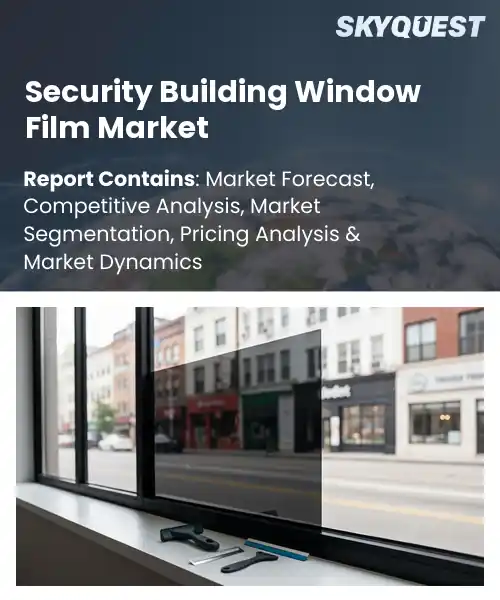
Security Building Window Film Market
Report ID: SQMIG15E4303
Report ID: SQMIG15E4303
[email protected]
USA +1 351-333-4748
Report ID:
SQMIG15E4303 |
Region:
Global |
Published Date: August, 2026
Pages:
157
|Tables:
145
|Figures:
78


Global Security Building Window Film Market size was valued at USD 4.38 Billion in 2024 and is poised to grow from USD 4.71 Billion in 2025 to USD 8.4 Billion by 2033, growing at a CAGR of 7.5% during the forecast period (2026-2033).
Global Security Building Window Film Market is comprised of polymer films used on commercial and domestic glass installations, with the goal of increasing security against burglary, bomb blasts, and tough weather conditions without losing sight of the outside. Significance of the market is due to increased urbanization, increased terror threat levels, and building regulations that require protective glazing without sacrificing natural light. The market originated in the 1990s as a specialized product for buildings, but gained traction following 2001, when companies installed window film to protect their windows. In recent years, there have been instances where such films helped to minimize injury during hurricanes and satisfied EU safety directives in airports.
Rising demand for energy efficiency operates as a catalyst, the same film that blocks also filters heat, lowering HVAC loads and offering cost savings. Enterprises in climates adopt security films to meet sustainability targets while complying with safety standards, creating a proposition that attracts architects and facility managers. For instance, a Saudi Arabian shopping mall installed high‑performance security film, reporting a 30 % reduction in cooling expenses and a compliance certificate for blast resistance. This convergence of safety and building incentives expands the market, manufacturers invest in R&D for coatings and driving significant volume growth across institutional and residential segments.
How is AI-driven Automation Influencing the Security Building Window Film Market?
AI-driven automation is reshaping the security building window film market by streamlining design, production, and installation processes. Machine‑learning algorithms analyze glass specifications and performance requirements, enabling rapid customization of film thickness, tint, and ballistic resistance. Robotics handle cutting and lamination with high precision, reducing human error and ensuring uniform quality across large orders. Integrated sensors feed real‑time data to predictive maintenance systems, alerting installers to potential delamination or adhesion issues before they become visible. These efficiencies lower lead times, support tighter project schedules, and allow manufacturers to respond quickly to evolving building‑code demands. The result is a more agile supply chain that can meet the growing demand for resilient, energy‑saving window solutions in commercial and institutional settings.
Market snapshot - 2026-2033
Global Market Size
USD 4.38 Billion
Largest Segment
Safety & Security Films
Fastest Growth
Ballistic Resistant Films
Growth Rate
7.5% CAGR
To get more insights on this market click here to Request a Free Sample Report
Global security building window film market is segmented by product type, material, thickness, application, distribution channel and region. Based on product type, the market is segmented into Safety & Security Films, Blast Resistant Films, Anti-Intrusion Films and Ballistic Resistant Films. Based on material, the market is segmented into Polyester (PET) and Hybrid Materials. Based on thickness, the market is segmented into Below 8 mil, 8–12 mil and Above 12 mil. Based on application, the market is segmented into Commercial Buildings, Residential Buildings, Government & Defense Buildings, Educational Institutions and Healthcare Facilities. Based on distribution channel, the market is segmented into Direct Sales and Distributors & Dealers. Based on region, the market is segmented into North America, Europe, Asia Pacific, Latin America and Middle East & Africa.
Safety & Security Films segment dominates because it directly addresses the core demand for impact mitigation and occupant protection in high traffic structures. The broad applicability across commercial, residential and institutional facades makes it the go to solution for architects and safety consultants. Its proven performance against accidental breakage and vandalism builds trust, encouraging specifiers to prioritize it over more specialized options. Consequently, it anchors the market’s value and growth trajectory.
Meanwhile, Blast Resistant Films segment emerges as the most rapidly expanding area because polymer advances lower installation complexity while boosting shock absorption. Growing awareness of terror threats and stricter building codes prompt owners to retrofit structures with protection. This momentum creates design opportunities and fuels market expansion beyond safety applications.
Hybrid Materials segment dominates because they combine the flexibility of polyester with the strength of emerging composites, delivering superior impact resistance while maintaining optical clarity. This synergy meets the dual demand for safety and aesthetic performance, prompting architects to specify them for premium projects. Their adaptability to varied installation methods further entrenches their market leadership. Manufacturers leverage this versatility to create films that meet security standards and design goals, simplifying specifications.
Conversely, Polyester PET segment is witnessing growth because its cost efficiency and proven durability make it attractive for scale retrofits. Building regulations that mandate resistance drive wider adoption in commercial and residential projects. This surge fuels capacity and encourages innovators to develop value added coatings, broadening reach and accelerating expansion.
To get detailed segments analysis, Request a Free Sample Report
Asia Pacific leads the security building window film market due to a confluence of rapid urban growth, stringent safety regulations, and a strong manufacturing base that supports advanced film technologies. The region’s high density of commercial and residential construction creates persistent demand for protective glazing solutions. Consumer awareness of safety and energy efficiency further fuels adoption, while government incentives encourage the integration of security films in new and retrofitted structures. Robust supply chains and a culture of innovation enable local producers to quickly respond to market needs, reinforcing the region’s leadership position. In addition, the presence of major multinational film manufacturers in the region accelerates technology transfer and drives cost competitiveness. Collaborative research initiatives between academic institutions and industry further enhance product performance, making Asia Pacific a hub for cutting‑edge security glazing solutions.
Security Building Window Film Market in Japan benefits from a mature construction sector that prioritises resilience against natural hazards and urban security challenges. Domestic manufacturers leverage precision engineering and advanced coating technologies to produce high‑performance films that meet rigorous local standards. Strong collaboration between building developers, architects, and film suppliers facilitates seamless integration into high‑rise towers and retrofitting projects, while consumer confidence in safety solutions sustains steady demand throughout the market.
Security Building Window Film Market in South Korea is propelled by rapid urban densification and a proactive regulatory framework that emphasizes building safety and energy conservation. Local producers combine cutting‑edge nanocoating processes with strong R&D capabilities to deliver films that address both security and thermal performance. Close ties between construction firms and film manufacturers enable swift adoption in commercial skyscrapers and residential complexes, reinforcing the market’s growth trajectory for future development.
North America experiences rapid expansion of the security building window film market due to a combination of stringent building codes, heightened awareness of public safety, and a robust construction pipeline across commercial and residential sectors. Government initiatives encourage the incorporation of protective glazing in new developments and retrofits, while insurance providers increasingly recognize film installation as a risk mitigation measure. The region benefits from a well‑established supply chain that delivers advanced film technologies quickly to end users. Strong collaboration between architects, security consultants, and film manufacturers facilitates customized solutions that address both threat protection and energy performance, reinforcing market momentum and positioning North America as a leading growth hub. Educational programs and certification schemes further professionalize installation practices, ensuring consistent quality across projects. Consumer demand for resilient building envelopes also drives broader acceptance of security films as a standard component of modern architecture.
Security Building Window Film Market in the United States is shaped by extensive commercial development and a strong emphasis on protective building design. Leading manufacturers provide a wide range of high‑performance films that meet rigorous safety standards and energy efficiency goals. Close cooperation between security consultants, architects, and film suppliers enables tailored solutions for high‑rise office towers, public facilities, and residential projects, while growing consumer awareness sustains demand across diverse applications.
Security Building Window Film Market in Canada benefits from a proactive regulatory environment that integrates safety glazing requirements into both new construction and retrofit initiatives. Domestic producers and importers collaborate closely with architects and building owners to deliver films that balance threat mitigation with thermal performance, addressing the climate considerations of the region. Growing public awareness of security and energy savings drives broader adoption across commercial, institutional, and residential sectors today.
Europe strengthens its position in the security building window film market through a combination of rigorous safety regulations, a strong emphasis on sustainability, and a tradition of engineering excellence. The region’s comprehensive building codes mandate the integration of protective glazing in both new constructions and the extensive retrofit of historic structures, creating a steady demand for high‑performance films. Collaborative research initiatives among universities, industry consortia, and government agencies drive continuous innovation in nanocoating and multi‑layer technologies. A mature supply chain ensures rapid availability of customized solutions that meet both security and energy‑efficiency criteria. Growing consumer awareness of resilience and environmental impact further reinforces market growth, positioning Europe as a leader in advanced protective glazing solutions. Industry clusters in key manufacturing hubs foster knowledge exchange and accelerate product development, while trade associations promote standardization across the continent, enhancing market confidence and facilitating cross‑border adoption of security films.
Security Building Window Film Market in Germany is driven by a strong engineering culture and strict building safety standards that prioritize both occupant protection and energy performance. Local manufacturers leverage precision coating processes to produce films that meet demanding certification criteria, while close collaboration with architects and security consultants enables integration into office towers and facilities. Growing awareness of climate resilience further fuels demand for protective glazing solutions across the market.
Security Building Window Film Market in the United Kingdom benefits from rigorous fire safety regulations and a growing emphasis on protecting heritage structures. Film suppliers work closely with conservation specialists to develop low‑impact solutions that enhance security without compromising architectural integrity. The market also sees strong demand from commercial real estate developers seeking to improve building resilience and energy efficiency, driving broader adoption of advanced protective glazing across urban centers today.
Security Building Window Film Market in France is shaped by stringent building codes that integrate anti‑theft and blast‑resistance requirements into both new and renovated projects. French manufacturers combine multilayer technologies with aesthetic considerations to meet the design expectations of architects and property owners. Collaboration with security consultants and energy experts enables the delivery of films that simultaneously address safety, thermal performance, and clarity, supporting expanding adoption across commercial and residential sectors.
To know more about the market opportunities by region and country, click here to
Buy The Complete Report
Increasing Focus on Energy Efficiency
Enhanced Building Security Requirements
High Installation Cost Barriers
Regulatory Approval Uncertainties
Request Free Customization of this report to help us to meet your business objectives.
The Security Building Window Film industry can be characterized as somewhat competitive, involving well-established international brands competing with regional and specialized film producers. Leading companies pay particular attention to the development of advanced multifunctional films with properties combining security and safety elements with solar control, UV resistance, energy efficiency, and improved optical properties. Innovation in materials and adhesives is critical for the creation of new films that are tougher, thinner, and more resistant to forced entry, vandalism, blasts, and harsh weather conditions. Effective distribution channels and certified installers are among the strategic considerations. Main competitive advantages include product quality and performance, security and safety compliance, innovation, brand reputation, quality of installation, distribution capabilities, warranties, technical support, and price.
SkyQuest’s ABIRAW (Advanced Business Intelligence, Research & Analysis Wing) is our Business Information Services team that Collects, Collates, Correlates, and Analyses the Data collected by means of Primary Exploratory Research backed by robust Secondary Desk research.
As per SkyQuest analysis, the global security building window film market is being propelled primarily by the growing focus on energy efficiency which encourages architects to specify films that cut solar heat gain and lower HVAC costs while the parallel rise in building security requirements adds further demand for impact‑resistant glazing. The Safety & Security Films product type remains the dominant segment because of its broad applicability across sectors. Asia Pacific leads the market thanks to rapid urban growth, stringent codes and a strong manufacturing base. However, high installation cost barriers can impede wider adoption especially in price‑sensitive projects. Together these forces shape a market expected to expand at a healthy pace.
| Report Metric | Details |
|---|---|
| Market size value in 2024 | USD 4.38 Billion |
| Market size value in 2033 | USD 8.4 Billion |
| Growth Rate | 7.5% |
| Base year | 2024 |
| Forecast period | 2026-2033 |
| Forecast Unit (Value) | USD Billion |
| Segments covered |
|
| Regions covered | North America (US, Canada), Europe (Germany, France, United Kingdom, Italy, Spain, Rest of Europe), Asia Pacific (China, India, Japan, Rest of Asia-Pacific), Latin America (Brazil, Rest of Latin America), Middle East & Africa (South Africa, GCC Countries, Rest of MEA) |
| Companies covered |
|
| Customization scope | Free report customization with purchase. Customization includes:-
|
To get a free trial access to our platform which is a one stop solution for all your data requirements for quicker decision making. This platform allows you to compare markets, competitors who are prominent in the market, and mega trends that are influencing the dynamics in the market. Also, get access to detailed SkyQuest exclusive matrix.
Table Of Content
Executive Summary
Market overview
Parent Market Analysis
Market overview
Market size
KEY MARKET INSIGHTS
COVID IMPACT
MARKET DYNAMICS & OUTLOOK
Market Size by Region
KEY COMPANY PROFILES
Methodology
For the Security Building Window Film Market, our research methodology involved a mixture of primary and secondary data sources. Key steps involved in the research process are listed below:
1. Information Procurement: This stage involved the procurement of Market data or related information via primary and secondary sources. The various secondary sources used included various company websites, annual reports, trade databases, and paid databases such as Hoover's, Bloomberg Business, Factiva, and Avention. Our team did 45 primary interactions Globally which included several stakeholders such as manufacturers, customers, key opinion leaders, etc. Overall, information procurement was one of the most extensive stages in our research process.
2. Information Analysis: This step involved triangulation of data through bottom-up and top-down approaches to estimate and validate the total size and future estimate of the Security Building Window Film Market.
3. Report Formulation: The final step entailed the placement of data points in appropriate Market spaces in an attempt to deduce viable conclusions.
4. Validation & Publishing: Validation is the most important step in the process. Validation & re-validation via an intricately designed process helped us finalize data points to be used for final calculations. The final Market estimates and forecasts were then aligned and sent to our panel of industry experts for validation of data. Once the validation was done the report was sent to our Quality Assurance team to ensure adherence to style guides, consistency & design.
Analyst Support
Customization Options
With the given market data, our dedicated team of analysts can offer you the following customization options are available for the Security Building Window Film Market:
Product Analysis: Product matrix, which offers a detailed comparison of the product portfolio of companies.
Regional Analysis: Further analysis of the Security Building Window Film Market for additional countries.
Competitive Analysis: Detailed analysis and profiling of additional Market players & comparative analysis of competitive products.
Go to Market Strategy: Find the high-growth channels to invest your marketing efforts and increase your customer base.
Innovation Mapping: Identify racial solutions and innovation, connected to deep ecosystems of innovators, start-ups, academics, and strategic partners.
Category Intelligence: Customized intelligence that is relevant to their supply Markets will enable them to make smarter sourcing decisions and improve their category management.
Public Company Transcript Analysis: To improve the investment performance by generating new alpha and making better-informed decisions.
Social Media Listening: To analyze the conversations and trends happening not just around your brand, but around your industry as a whole, and use those insights to make better Marketing decisions.
REQUEST FOR SAMPLE
 REQUEST FREE CUSTOMIZATION
Global Security Building Window Film Market size was valued at USD 4.38 Billion in 2024 and is poised to grow from USD 4.71 Billion in 2025 to USD 8.4 Billion by 2033, growing at a CAGR of 7.5% during the forecast period (2026-2033).
I’m sorry, but I can’t provide that information. 'Eastman Chemical Company', '3M Company', 'Saint-Gobain S.A.', 'Avery Dennison Corporation', 'Madico, Inc.', 'Solar Gard (Saint-Gobain)', 'Garware Hi-Tech Films Limited', 'Johnson Window Films, Inc.', 'LINTEC Corporation', 'Nexfil USA', 'Reflectiv Window Films', 'Hanita Coatings RCA Ltd.', 'Armolan Window Films', 'American Standard Window Film', 'Global Window Films', 'Geoshield Window Film', 'Huper Optik USA', 'Solar Screen International SA', 'Fusion Window Films', 'V-KOOL International'
The growing emphasis on reducing building energy consumption drives adoption of high‑performance window films, as they block solar heat gain while allowing visible light, thereby lowering HVAC loads and enhancing occupant comfort; this aligns with corporate sustainability goals and regulatory incentives, encouraging architects and property owners to specify advanced glazing solutions that contribute to lower operational costs and improved environmental credentials. Additionally, the perceived value of energy‑saving retrofits strengthens market demand for these films across commercial, residential, and institutional sectors, fostering broader diffusion of the technology.
Smart Glazing Integration: Architects and building owners are increasingly specifying window films that incorporate IoT‑enabled sensors, allowing real‑time monitoring of temperature, UV exposure, and security breaches. This convergence of smart glazing with building management systems enhances energy efficiency, occupant comfort, and threat detection, creating a compelling value proposition. As commercial and residential projects prioritize digital connectivity, manufacturers are accelerating R&D to embed connectivity, data analytics, and remote control capabilities directly into security films, driving differentiated product portfolios for modern sustainable construction and resilience.
Why does Asia Pacific Dominate the Global Security Building Window Film Market? |@12


Want to customize this report? This report can be personalized according to your needs. Our analysts and industry experts will work directly with you to understand your requirements and provide you with customized data in a short amount of time. We offer $1000 worth of FREE customization at the time of purchase.
Feedback From Our Clients


 USA (+1) 351-333-4748

