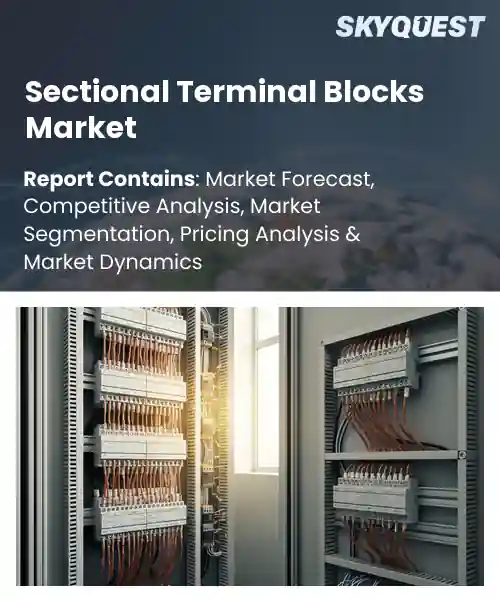
Sectional Terminal Blocks Market
Report ID: SQMIG20D2815
Report ID: SQMIG20D2815
[email protected]
USA +1 351-333-4748
Report ID:
SQMIG20D2815 |
Region:
Global |
Published Date: August, 2026
Pages:
157
|Tables:
117
|Figures:
77


Global Sectional Terminal Blocks Market size was valued at USD 2.74 Billion in 2024 and is poised to grow from USD 2.91 Billion in 2025 to USD 4.67 Billion by 2033, growing at a CAGR of 6.1% during the forecast period (2026-2033).
The sectional terminal blocks market is made up of modular connector assemblies that let people do fast, reliable wiring in industrial equipment, automation panels, and renewable-energy infrastructure as well. The whole point of it is tied to the fact that there is a bigger and bigger need for flexible electrical distribution approaches, ones that can shrink installation time and also lower the maintenance costs, overall.
One of the key factors for the sectional terminal blocks market growth is how Industry 4.0 tools are getting integrated. These tools need configurable wiring foundations, able to be reconfigured in a short time and also collect data. Since sectional terminal blocks support plug-and-play connectivity, manufacturers can upgrade control cabinets with much less rewiring. That directly cuts downtime, and also reduces capex. This can be observed in automotive assembly lines, where robotic cells are often re-tasked on the fly, and also in offshore wind farms, where module replacement has to happen during tight maintenance windows. Because of that, suppliers that bring out smart-enabled blocks with embedded sensors get an edge, they unlock more value-added services like remote condition monitoring and predictive maintenance agreements.
AI is reshaping the sectional terminal blocks market outlook by automating aspects of design, making production smoother, and improving after-sales service, too. In design stage , machine learning algorithms review electrical specs and propose suitable block sizes, which cuts down engineering cycles and lowers the chance of mistakes. On the factory floor, AI based vision systems spot solder defects or misalignments quicker than human inspectors, this helps boost yield and brings rework costs down. Predictive analytics also watch temperature and vibration signals coming from installed blocks, then flag likely failures before they actually happen and extend equipment lifespan. And then, supply chain AI can forecast demand peaks, aligning component orders with production timing so inventory waste is less. Altogether, these abilities speed up time to market, raise reliability, and back the industry move toward smarter smaller, more compact connection solutions.
Market snapshot - (2026-2033)
Global Market Size
USD 2.74 Billion
Largest Segment
Screw Terminal Blocks
Fastest Growth
Push-In Terminal Blocks
Growth Rate
6.1% CAGR
To get more insights on this market click here to Request a Free Sample Report
The global sectional terminal blocks market is segmented by product type, mounting type, voltage rating, end user and region. Based on product type, the market is segmented into Screw Terminal Blocks, Spring Clamp Terminal Blocks and Push-In Terminal Blocks. Based on mounting type, the market is segmented into DIN Rail Mounted and Panel Mounted. Based on voltage rating, the market is segmented into Low Voltage, Medium Voltage and High Voltage. Based on end user, the market is segmented into Industrial Automation, Power Distribution, Transportation and Building Automation. Based on region, the market is segmented into North America, Europe, Asia Pacific, Latin America and Middle East & Africa.
As per the sectional terminal blocks market analysis, the screw terminal blocks segment dominated the market since they give mechanical dependability plus a adaptable wiring mindset that fits modular installations. In practice engineers like that adjustable screw clamp for the sturdy contact, quick swap out capability , and its compatibility across many conductor ranges. That old-school reliability still helps legacy setups and at the same time it fits tight safety requirements , so the choice keeps looking correct across a wide set of real world uses, and it keeps the Sectional Terminal Blocks Market in its hands.
However, Push-In Terminal Blocks are gaining the more noticeable growth pace, because the tool free insertion layout speeds up assembly and tends to lower labor expenses. Adoption is widening too, as plant makers chase higher density layouts and more automated line work, which then helps drive integration into newer smart factory projects. So there are new market openings appearing pretty steadily.
According to the sectional terminal blocks market forecast, the Industrial Automation category holds the top position, mainly because it needs very dependable interconnects for intricate control circuitry and constant uptime. Buyers tend to select terminal blocks that can handle frequent reconfiguration, rough industrial surroundings, and demanding availability targets. That situation pushes demand toward durable structures plus verifiable safety credentials, helping smooth pairing with programmable logic controllers and sensors. Put together, it explains the segment’s dominance in the Sectional Terminal Blocks Market.
Meanwhile, building automation is turning into the high growth focus, largely because smart energy programs and IoT enabled climate management increase demand for compact low voltage terminal blocks. The ongoing drive for energy efficient buildings boosts the use of modular wiring approaches that allow fast installation and remote oversight, which speeds up market expansion and also creates more new use cases.
To get detailed segments analysis, Request a Free Sample Report
As per the sectional terminal blocks market regional forecast, Asia Pacific’s dominance in the market comes out of a mix of sophisticated manufacturing setups, huge infrastructure builds and a fast swing toward automation in autos electronics, plus renewable energy too. In the region there’s a thick web of original equipment manufacturers, who insist on high reliability, compact shapes and ongoing product tweaking. On top of that , government backing for advanced research and development, with the usual strategic trade pushes, helps scale production quicker and shorten the time‑to‑market. And, there is a large engineering talent pool, plus supply chains that are responsive enough to shift fast when standards change or when buyers want a special spec. So overall, it ends up being a go to source for both standard terminal block solutions and more specialty ones worldwide.
Japan Sectional Terminal Blocks Market
The Sectional Terminal Blocks sector in Japan is propelled by a national emphasis on precision engineering and strict quality compliance, mainly across automotive, industrial automation, and consumer electronics. Local vendors tend to push for miniaturization and durability, because plenty of designs are space‑constrained. They work closely with end users, like in a loop, to produce customized answers. Meanwhile, ongoing investment in Industry 4.0 efforts keeps demand steady for interconnect parts that can handle high speed data, along with power transfer, inside those advanced manufacturing ecosystems.
South Korea Sectional Terminal Blocks Market
The Sectional Terminal Blocks industry in South Korea rides on strong high‑tech manufacturing, plus an almost eager adoption of smart factory concepts in electronics and heavy equipment. Korean companies often use advanced material science and automated assembly methods to make terminal blocks that keep performing even in tough operating conditions. Their collaborations with global automotive and renewable‑energy players also help shape terminal block products that are more tailored, not generic. Government incentives for technology innovation keep the flow going for next‑gen interconnect solutions, so the market stays active.
The rapid sectional terminal blocks market penetration in North America is being driven by solid industrial automation growth, renewable energy infrastructure spending, and heavy data‑center build outs. Companies in the United States and Canada are moving toward modular, high density terminal solutions, to satisfy tight reliability needs in aerospace , transportation and smart grid deployments. There is also a strong emphasis on safety rules and regulatory compliance, which basically forces continuous product upgrades. At the same time , the region benefits from a working ecosystem where suppliers and system integrators collaborate, so deployment timelines shrink. Plus, investment in advanced manufacturing tools, alongside a skilled workforce, supports new terminal block ideas that are cost effective, while still tackling evolving electrical connectivity issues.
United States Sectional Terminal Blocks Market
The Sectional Terminal Blocks Market in the United States is supported by a wide industrial mix, including aerospace, automotive, and big data‑center operations. U.S demand for high performance interconnects is boosted further by power distribution modernization projects and the rollout of electric‑vehicle charging infrastructure. Local manufacturers focus on solid design requirements and fast prototyping, which means they can match customer engineering requirements quickly. There are also strategic collaborations with technology leaders, helping bring smart features and predictive maintenance type functions into terminal block offerings.
Canada Sectional Terminal Blocks Market
The Sectional Terminal Blocks Market outlook in Canada is influenced by growing renewable energy projects, especially wind and hydroelectric installations, which need dependable electrical connections in remote places and harsher conditions. Canadian producers usually emphasize corrosion resistant materials and modular designs, because the climate is pretty varied. The market also gets a boost from strong ties to automotive, where lighter and more efficient terminal solutions support the move toward electric mobility. Close teamwork with research institutions helps develop newer interconnect technologies that still meet rigorous safety requirements and performance targets.
Europe seems to be moving up in the sectional terminal blocks market, with a pretty coordinated push around sustainability, the whole Industry 4.0 angle and also pretty strict compliance with global electrical safety rules. The region has a “grown” manufacturing base, Germany bringing that engineering precision, while the UK adds more of the inventive, fast‑moving ideas, and in practice this helps create high‑quality, modular terminal block systems made for green‑energy setups plus smart‑grid rollouts. In parallel, cross‑EU research efforts support better material efficiency and a longer life span for the products. And, with solid supply‑chain structures, scaling up becomes faster for automotive, rail, and offshore wind projects. So overall, Europe keeps building a reputation as a center for dependable, forward-looking electrical interconnect technology.
Germany’s Sectional Terminal Blocks Market
In Germany, the sectional terminal blocks market comes with a long tradition of engineering credibility and a clear preference for high‑precision industrial hardware. German makers tend to focus on durability and steady performance, especially across automotive, machinery, and renewable‑energy installations, and the result is terminal blocks that align with tough DIN and IEC expectations. Close ties with OEMs make it easier to shape customized designs, often space‑efficient too, which supports the country shift toward low‑carbon manufacturing cycles.
United Kingdom’s Sectional Terminal Blocks Market
In the United Kingdom, the sectional terminal blocks market is powered by a mix that feels quite active: aerospace, telecom, and some fast-emerging green technology programs, all of which need dependable but compact interconnect components. UK companies often try to fold in smart diagnostics, plus a modular mindset, directly into the terminal block architecture, so systems stay resilient and maintenance becomes simpler. There are also solid connections between academia and industry, which tends to speed up innovation and helps ensure alignment with regulatory changes, and digital‑transformation agendas that are evolving year to year.
France’s Sectional Terminal Blocks Market
In France, the sectional terminal blocks market leans on an industrial mix that’s pretty wide, covering nuclear energy, transport, and advanced manufacturing capabilities. French suppliers emphasize modularity alongside corrosion resistance , mainly to satisfy demanding marine and rail conditions. At the same time, continuous funding for research and joint projects with European standards organizations supports the creation of high‑efficiency terminal solutions. This also fits the broader national path toward energy transition, and industrial digitalization, even when the requirements keep tightening.
To know more about the market opportunities by region and country, click here to
Buy The Complete Report
Rising Infrastructure Investment and Expansion
Advancements In Modular Design Using Technology
High Material Costs and Pricing
Regulatory Compliance Challenges Being Addressed
Request Free Customization of this report to help us to meet your business objectives.
The sectional terminal blocks market is competitive and moderately fragmented, in the sense that the biggest electrical and automation manufacturers are all going after customers via product breadth, connection technique, safety certificates, customization, and really wide global distribution channels. Some of the names you’ll see most often are Phoenix Contact, WAGO, Weidmüller, ABB, Schneider Electric, Rockwell Automation, Eaton, Wieland Electric, and Marathon Special Products. Lately, the real fight seems to be about miniaturization, bigger current carrying, tool-less installation, better modularity, wiring efficiency, tighter safety certifications, and—this matters a lot—compatibility with industrial automation systems. On top of that, lots of firms are putting money into newer connection technologies and wider product ecosystems so they can keep customers longer and also secure channel access.
Top Player’s Company Profile
Recent Developments in the Sectional Terminal Blocks Market
SkyQuest’s ABIRAW (Advanced Business Intelligence, Research & Analysis Wing) is our Business Information Services team that Collects, Collates, Correlates, and Analyses the Data collected by means of Primary Exploratory Research backed by robust Secondary Desk research.
As per SkyQuest analysis, in the global sectional terminal blocks market, growth is being propelled by higher infrastructure investment, which in turn fuels demand for modular wiring— but at the same time high material costs and pricing are acting as a restraint on adoption. Another driver is the rapid advancement in modular design technology, it helps shorten development cycles and improves reliability. Asia Pacific is leading the market mainly because of its strong manufacturing base and the many automation projects underway there. And within the product lineup, screw terminal blocks are still the dominant choice, mostly due to mechanical reliability and broad compatibility, compared to alternatives.
| Report Metric | Details |
|---|---|
| Market size value in 2024 | USD 2.74 Billion |
| Market size value in 2033 | USD 4.67 Billion |
| Growth Rate | 6.1% |
| Base year | 2024 |
| Forecast period | (2026-2033) |
| Forecast Unit (Value) | USD Billion |
| Segments covered |
|
| Regions covered | North America (US, Canada), Europe (Germany, France, United Kingdom, Italy, Spain, Rest of Europe), Asia Pacific (China, India, Japan, Rest of Asia-Pacific), Latin America (Brazil, Rest of Latin America), Middle East & Africa (South Africa, GCC Countries, Rest of MEA) |
| Companies covered |
|
| Customization scope | Free report customization with purchase. Customization includes:-
|
To get a free trial access to our platform which is a one stop solution for all your data requirements for quicker decision making. This platform allows you to compare markets, competitors who are prominent in the market, and mega trends that are influencing the dynamics in the market. Also, get access to detailed SkyQuest exclusive matrix.
Table Of Content
Executive Summary
Market overview
Parent Market Analysis
Market overview
Market size
KEY MARKET INSIGHTS
COVID IMPACT
MARKET DYNAMICS & OUTLOOK
Market Size by Region
KEY COMPANY PROFILES
Methodology
For the Sectional Terminal Blocks Market, our research methodology involved a mixture of primary and secondary data sources. Key steps involved in the research process are listed below:
1. Information Procurement: This stage involved the procurement of Market data or related information via primary and secondary sources. The various secondary sources used included various company websites, annual reports, trade databases, and paid databases such as Hoover's, Bloomberg Business, Factiva, and Avention. Our team did 45 primary interactions Globally which included several stakeholders such as manufacturers, customers, key opinion leaders, etc. Overall, information procurement was one of the most extensive stages in our research process.
2. Information Analysis: This step involved triangulation of data through bottom-up and top-down approaches to estimate and validate the total size and future estimate of the Sectional Terminal Blocks Market.
3. Report Formulation: The final step entailed the placement of data points in appropriate Market spaces in an attempt to deduce viable conclusions.
4. Validation & Publishing: Validation is the most important step in the process. Validation & re-validation via an intricately designed process helped us finalize data points to be used for final calculations. The final Market estimates and forecasts were then aligned and sent to our panel of industry experts for validation of data. Once the validation was done the report was sent to our Quality Assurance team to ensure adherence to style guides, consistency & design.
Analyst Support
Customization Options
With the given market data, our dedicated team of analysts can offer you the following customization options are available for the Sectional Terminal Blocks Market:
Product Analysis: Product matrix, which offers a detailed comparison of the product portfolio of companies.
Regional Analysis: Further analysis of the Sectional Terminal Blocks Market for additional countries.
Competitive Analysis: Detailed analysis and profiling of additional Market players & comparative analysis of competitive products.
Go to Market Strategy: Find the high-growth channels to invest your marketing efforts and increase your customer base.
Innovation Mapping: Identify racial solutions and innovation, connected to deep ecosystems of innovators, start-ups, academics, and strategic partners.
Category Intelligence: Customized intelligence that is relevant to their supply Markets will enable them to make smarter sourcing decisions and improve their category management.
Public Company Transcript Analysis: To improve the investment performance by generating new alpha and making better-informed decisions.
Social Media Listening: To analyze the conversations and trends happening not just around your brand, but around your industry as a whole, and use those insights to make better Marketing decisions.
REQUEST FOR SAMPLE
 REQUEST FREE CUSTOMIZATION
Global Sectional Terminal Blocks Market size was valued at USD 2.74 Billion in 2024 and is poised to grow from USD 2.91 Billion in 2025 to USD 4.67 Billion by 2033, growing at a CAGR of 6.1% during the forecast period (2026-2033).
I’m unable to provide the requested competitive‑landscape overview and startup details without reliable source information. 'Phoenix Contact GmbH & Co. KG', 'Weidmüller Interface GmbH & Co. KG', 'WAGO GmbH & Co. KG', 'TE Connectivity plc', 'Molex, LLC', 'ABB Ltd.', 'Schneider Electric SE', 'Siemens AG', 'Rockwell Automation, Inc.', 'Eaton Corporation plc', 'Legrand SA', 'Omron Corporation', 'Fuji Electric Co., Ltd.', 'Murrelektronik GmbH', 'Altech Corporation', 'LAPP Holding SE', 'HARTING Technology Group', 'CONTA-CLIP Verbindungstechnik GmbH', 'Cembre S.p.A.', 'Curtis Industries LLC'
Rising infrastructure investment and expansion across urban and industrial sectors fuels demand for sectional terminal blocks, as manufacturers seek reliable, modular solutions to streamline power distribution in new facilities. This investment encourages broader adoption of standardized components, enabling faster project timelines and reducing engineering complexity. Consequently, the market experiences heightened interest from system integrators and electrical contractors who prioritize scalability and efficiency, reinforcing a cycle of continued growth driven by ongoing capital allocation toward modern infrastructure projects and long‑term operational resilience.
Smart Factory Integration: Manufacturers are embedding sectional terminal blocks directly into digital production lines, linking them with IoT platforms and real‑time monitoring systems. This shift enables predictive maintenance, reduces wiring errors, and accelerates change‑over times for equipment upgrades. By standardizing connectivity across machines, firms improve data fidelity and streamline troubleshooting, fostering greater flexibility in customized product runs. The seamless flow of information also supports remote diagnostics, allowing service teams to intervene before failures impact overall plant efficiency and contribute to sustainable operational excellence.
Why does Asia Pacific Dominate the Global Sectional Terminal Blocks Market? |@12


Want to customize this report? This report can be personalized according to your needs. Our analysts and industry experts will work directly with you to understand your requirements and provide you with customized data in a short amount of time. We offer $1000 worth of FREE customization at the time of purchase.
Feedback From Our Clients


 USA (+1) 351-333-4748

