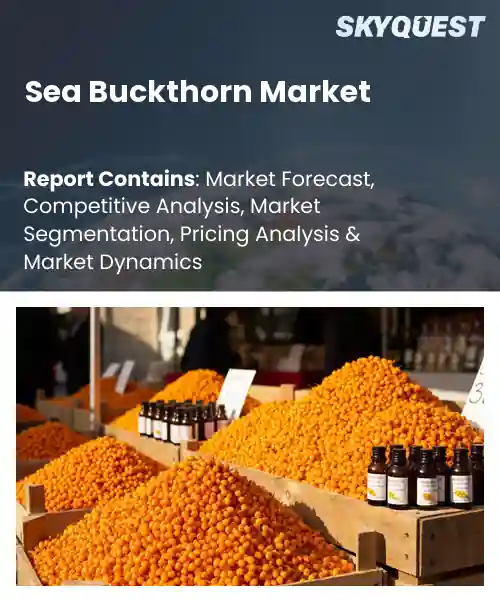
Sea Buckthorn Market
Report ID: SQMIG30I2827
Report ID: SQMIG30I2827
[email protected]
USA +1 351-333-4748
Report ID:
SQMIG30I2827 |
Region:
Global |
Published Date: February, 2026
Pages:
157
|Tables:
145
|Figures:
78


Global Sea Buckthorn Market size was valued at USD 396.20 Billion in 2024 and is poised to grow from USD 440.97 Billion in 2025 to USD 1038.41 Billion by 2033, growing at a CAGR of 11.3% during the forecast period (2026-2033).
Rising consumer demand for natural, nutrient dense ingredients is the key trend driving the global sea buckthorn sector, as growing health awareness and clean label preferences. This will support the current trend of sea buckthorn containing high concentrations of vitamins, carotenoids and omega fatty acids for both diet and skin health through addressing consumer’s growing concern for healthy diets.
Scientific validation of sea buckthorn’s bioactive profile is the key factor unlocking global growth because clinical studies have reduced buyer uncertainty and encouraged formulators to adopt the ingredient. As manufacturers add oils and extracts into anti-aging cosmetics, immune support supplements and fortified beverages, higher purchase volumes justify investment in harvesting equipment and cold storage, which increases processing yields and product consistency. Real world cases include Chinese nutraceutical firms launching standardized capsules, European skincare brands marketing carotenoid rich serums and Russian producers exporting pressed oil, and these flows create clear opportunities for certification led premium positioning and value chain integration.
Internet of Things technologies improve supply chain transparency in the sea buckthorn market by linking field sensors, batch tags and cloud platforms to create real time visibility. The main components are condition monitoring during harvesting/transporting the crop; digital records of provenance from the farm to the processor. The current state shows growing interest because sea buckthorn is often harvested in remote regions and requires rapid cold chain handling for nutrient retention. Examples range from farm sensors reporting temperature and humidity to electronic tagging in processing lines that let brands trace oil and juice to specific harvests and cultivars.
In October 2025, for their project with sea buckthorn in Guizhou, Shanghai Gofun implemented an IoT-based blending line and tracing system that records multiple qualities at different processing stages using batch tags to connect them. This development increases the reliability of suppliers, enabling exporters to consistently deliver premium products and promoting market expansion.
Market snapshot - (2026-2033)
Global Market Size
USD 396.2 Billion
Largest Segment
Liquid Form
Fastest Growth
Powder Form
Growth Rate
11.3% CAGR
To get more insights on this market click here to Request a Free Sample Report
Global sea buckthorn market is segmented by form, sea buckthorn products, application, end user, distribution channel and region. Based on form, the market is segmented into liquid form, powder form, and solid form. Based on sea buckthorn products, the market is segmented into juice, oil, powder, capsules, and extracts. Based on application, the market is segmented into dietary supplement, pharmaceuticals, cosmetics and personal care and food and beverages. Based on end user, the market is segmented into household users and commercial users. Based on distribution channel, the market is segmented into online stores and offline stores. Based on region, the market is segmented into North America, Europe, Asia Pacific, Latin America and Middle East & Africa.
Based on global sea buckthorn market forecast, juice segment dominates because it occupies the most accessible consumer-facing form of sea buckthorn, fitting naturally into beverages and functional food formulations. The ease of incorporating and familiarity with this product help support the strong retail placement and brand investment of this product by processors optimizing extraction and shelf stability. Retail consumers see the visibility of this product, the demand for the product in the consumer marketplace pulls through the supply chain, encouraging distributors/manufacturers to prioritize juice offerings and expand product availability.
However, oil is the most rapidly expanding product in sea buckthorn markets as cosmetics and therapeutic uses surge. The concentration of bioactive compounds and the flexible formulation process are leading to new opportunities for product innovation and premium product development, encouraging investors to invest in new extraction techniques and generating additional high-value channels for producers and brands.
Online stores segment leads because e-commerce platforms enable targeted discovery and direct access to niche sea buckthorn products, lowering barriers for small brands and new formulations. The digital marketing strategy as well as the use of subscription models establish "repeat purchase engines". In addition, the use of flexible assortment and consumer reviews is helping to develop greater consumer confidence in new ingredient claims. As a result of these consumer purchase dynamics, producers are encouraged to focus on an online business strategy; expand their range of SKU's; and rapidly develop additional assortments through multiple avenues of consumer purchasing.
Meanwhile, offline stores are the most rapidly expanding distribution channel for sea buckthorn as retailers broaden natural product assortments and emphasize experiential merchandising. In-store sampling and knowledgeable staff enhance consumer trust in novel ingredients, prompting brand collaborations and creating scalable wholesale routes that unlock mainstream retail placements and wider category penetration.
To get detailed segments analysis, Request a Free Sample Report
As per the global sea buckthorn market growth, Asia Pacific dominance stems from a convergence of favorable agroclimatic conditions, deep-rooted traditional use of botanicals, and integrated value chain capabilities that support consistent supply and quality. Knowledge of how to grow crops and handle them after they have been harvested within regions leads to secure flows of raw materials for processors and formulators who create natural cosmetics or nutraceuticals with highly evolved extraction and stabilization techniques. Domestic consumer market growth and demand for natural health and beauty products provide a solid foundation on which to build new products within this market. Increased collaboration between research institutions and industry participants leads to faster development and improved quality assurance through the sharing of knowledge.
Sea buckthorn market in Japan emphasizes high-quality sourcing, strict safety protocols, and sophisticated formulation techniques. Primary goals for domestic corporations are traceability, as well as betterment of premium cosmetic products or functional materials. Coordinate efforts among firms and research facilities aid the development of innovative product uses/cases via improvement to functionality, as well as for creating a greater sensory experience from the products being marketed. Distributors tend to focus on traditional stores, but boutique manufacturers offer product variety through properly branded and produced products.
Sea buckthorn market share in South Korea benefits from strong consumer interest in natural skincare and functional foods, driving demand for concentrated extracts and innovative formats. Rapidly developing products and easily adapting to trends, will be complemented through partnerships with local clinical researchers to validate product benefits and support claims of being premium. Modern day manufacturing hubs allow the manufacturer to have the ability to scale flexibly and provide quality assurance throughout manufacturing processes.
Based on sea buckthorn market regional forecasts, rapid expansion in Europe is driven by rising consumer interest in natural, locally sourced ingredients and by a vibrant product innovation ecosystem that translates botanical appeal into diverse consumer offerings. Well-developed regulation frameworks and a focus on food safety and labelling have created an established level of confidence that has allowed products based on sea buckthorn to gain shelf space across higher-end cosmetics, clinical dermaceuticals, and functional food categories. Retailers and specialty distributors are actively selecting provenance-driven brands for their stores, while research partnerships with universities substantiate efficacy claims. These factors collectively help to improve market visibility, stimulate new entrants, and create a balance between large-scale commercialization and small-scale artisan producers that contribute to the depth of categories across this area, as well as to the sustainability stories that appeal to consumers.
Sea buckthorn market trends in Germany is anchored by established cultivation, robust processing, and integrated supply chain infrastructure. Quality control and standardizing domestic companies ensures sea buckthorn ingredients can be used in pharmaceutical products and premium skin care products. The certainty consumers have in 'certified products' gives rise to retail acceptance across both pharmacy channels and specialty channels. Technical expertise is further developed by collaborating with growers, processors, as well as research facilities, which provides a strong foundation for leading value-added market segments.
Sea buckthorn market growth in United Kingdom is driven by strong consumer interest in clean label and sustainably sourced botanicals. Agile brand companies are using online retail and boutique channels to introduce new formats of sea buckthorn products; established brand companies are refreshing product portfolios by using sea buckthorn extract as a fruiting ingredient. Start-up and retail companies work closely together to allow for market testing of new products and to scale successful concepts to the mass market.
Sea buckthorn market in France is emerging through artisanal producers and niche brands that highlight botanical provenance and sensory quality. Natural textures and subtle flavor blends are very popular with French formulators, and sea buckthorn has been successfully used by both gourmet and beauty product manufacturers. The growing interest shown by both chefs and perfumers has increased the prestige of this ingredient, and the creation of regional co-ops promoting traceable sources and small-batch production are also helping to elevate sea buckthorn's status.
As per sea buckthorn market regional analysis, North America is strengthening its position through coordinated efforts in cultivation innovation, product development, and expanding consumer awareness about botanical ingredients. Growers are using varietal selection and sustainable agronomy to produce higher-quality fruit while processors are implementing extraction and preservation methods that preserve the bioactive properties of the fruit. Brand owners are emphasizing the need for clinical substantiation, transparent sourcing narratives, and offering a variety of formats to appeal to both beauty and health consumers. The growth of both retail and e-commerce distribution channels has enabled brand owners to establish a much broader distribution network, and collaboration efforts between academic institutions and businesses are helping to accelerate the validation and commercialization of new product applications.
Sea buckthorn market revenue in United States shows growing interest from both nutraceutical and personal care sectors seeking distinctive botanical ingredients. Companies in the domestic market are focusing on clinical validation and clean label claims to distinguish their products from others, and also investing in processing technologies that will keep active compounds intact. The marketing of these products highlight their traceability and sustainability to attract informed consumers. Collaborations with research institutions provide the basis for evidence-based positioning to allow all product formats into retail and targeted specialist channels.
Sea buckthorn market penetration in Canada is shaped by emphasis on sustainable agriculture and clean processing methods that resonate with environmentally conscious consumers. Cooperatives that are made mutually of growers foster production in smaller batches, while manufacturers emphasizing care and low-impact methods in the extraction process of their products produce functional ingredients. Further to this, businesses that benefit from these supply chains utilize local culture and regional indigenous knowledge partnerships as a means of building authentic businesses.
To know more about the market opportunities by region and country, click here to
Buy The Complete Report
Rising Demand for Natural Products
Expansion Of Functional Food Applications
Cultivation Supply Limitations
Regulatory Standardization Challenges
Request Free Customization of this report to help us to meet your business objectives.
The global sea buckthorn market outlook exhibits a moderately fragmented competitive landscape, driven by rising demand for natural nutraceutical and cosmetic ingredients. SeabuckWonders, W.S. Badger Company Inc., Natures Aid Ltd., SIBU and Weleda AG are all competing in product variety and organically. For example, SeabuckWonders provides science-based nutritional supplements, and Weleda AG sells premium-quality skin care products that are produced organically. Together, both companies enhance their brand positioning and increase their applicability across wellness categories.
SkyQuest’s ABIRAW (Advanced Business Intelligence, Research & Analysis Wing) is our Business Information Services team that Collects, Collates, Correlates, and Analyses the Data collected by means of Primary Exploratory Research backed by robust Secondary Desk research.
As per SkyQuest analysis, the growth behind global sea buckthorn industry is rising consumer demand for natural, nutrient-dense ingredients is a key driver, while cultivation supply limitations act as a restraint. Asia Pacific remains in the dominating region, and the juice segment is the dominating segment. A second driver is scientific validation and clinical studies that increase formulators' confidence and open premium channels. Market momentum is supported by growing retail visibility, online subscription models and brand storytelling that enhance trust and repeat purchases. These factors as well as the advancements made in e-commerce and supply chain have resulted in turning the sea buckthorn from a traditional herbal remedy and into mainstream products for wellness / cosmetic / food use. However, to successfully eliminate sustainable growth by way of agronomy (i.e., farming), cold chain (transportation of temperature-controlled goods), and regulatory standardization will require investment from industry players.
| Report Metric | Details |
|---|---|
| Market size value in 2024 | USD 396.2 Billion |
| Market size value in 2033 | USD 1038.41 Billion |
| Growth Rate | 11.3% |
| Base year | 2024 |
| Forecast period | (2026-2033) |
| Forecast Unit (Value) | USD Billion |
| Segments covered |
|
| Regions covered | North America (US, Canada), Europe (Germany, France, United Kingdom, Italy, Spain, Rest of Europe), Asia Pacific (China, India, Japan, Rest of Asia-Pacific), Latin America (Brazil, Rest of Latin America), Middle East & Africa (South Africa, GCC Countries, Rest of MEA) |
| Companies covered |
|
| Customization scope | Free report customization with purchase. Customization includes:-
|
To get a free trial access to our platform which is a one stop solution for all your data requirements for quicker decision making. This platform allows you to compare markets, competitors who are prominent in the market, and mega trends that are influencing the dynamics in the market. Also, get access to detailed SkyQuest exclusive matrix.
Table Of Content
Executive Summary
Market overview
Parent Market Analysis
Market overview
Market size
KEY MARKET INSIGHTS
COVID IMPACT
MARKET DYNAMICS & OUTLOOK
Market Size by Region
KEY COMPANY PROFILES
Methodology
For the Sea Buckthorn Market, our research methodology involved a mixture of primary and secondary data sources. Key steps involved in the research process are listed below:
1. Information Procurement: This stage involved the procurement of Market data or related information via primary and secondary sources. The various secondary sources used included various company websites, annual reports, trade databases, and paid databases such as Hoover's, Bloomberg Business, Factiva, and Avention. Our team did 45 primary interactions Globally which included several stakeholders such as manufacturers, customers, key opinion leaders, etc. Overall, information procurement was one of the most extensive stages in our research process.
2. Information Analysis: This step involved triangulation of data through bottom-up and top-down approaches to estimate and validate the total size and future estimate of the Sea Buckthorn Market.
3. Report Formulation: The final step entailed the placement of data points in appropriate Market spaces in an attempt to deduce viable conclusions.
4. Validation & Publishing: Validation is the most important step in the process. Validation & re-validation via an intricately designed process helped us finalize data points to be used for final calculations. The final Market estimates and forecasts were then aligned and sent to our panel of industry experts for validation of data. Once the validation was done the report was sent to our Quality Assurance team to ensure adherence to style guides, consistency & design.
Analyst Support
Customization Options
With the given market data, our dedicated team of analysts can offer you the following customization options are available for the Sea Buckthorn Market:
Product Analysis: Product matrix, which offers a detailed comparison of the product portfolio of companies.
Regional Analysis: Further analysis of the Sea Buckthorn Market for additional countries.
Competitive Analysis: Detailed analysis and profiling of additional Market players & comparative analysis of competitive products.
Go to Market Strategy: Find the high-growth channels to invest your marketing efforts and increase your customer base.
Innovation Mapping: Identify racial solutions and innovation, connected to deep ecosystems of innovators, start-ups, academics, and strategic partners.
Category Intelligence: Customized intelligence that is relevant to their supply Markets will enable them to make smarter sourcing decisions and improve their category management.
Public Company Transcript Analysis: To improve the investment performance by generating new alpha and making better-informed decisions.
Social Media Listening: To analyze the conversations and trends happening not just around your brand, but around your industry as a whole, and use those insights to make better Marketing decisions.
REQUEST FOR SAMPLE
 REQUEST FREE CUSTOMIZATION
Global Sea Buckthorn Market size was valued at USD 396.2 Billion in 2024 and is poised to grow from USD 440.97 Billion in 2025 to USD 1038.41 Billion by 2033, growing at a CAGR of 11.3% during the forecast period (2026-2033).
Competitive dynamics in the global sea buckthorn market hinge on ingredient houses, consumer brands, and vertically integrated regional harvesters competing on traceability, raw material control, and clinical validation. Buyers demand certified origin and evidence based claims. Firms pursue supply chain partnerships with Himalayan cooperatives, clinical research investments as by WellWith, and technology led low temperature processing and traceability as offered by Youhero and ingredient buyers like Symrise. 'Seabuckwonders', 'Sibu', 'Badger Balm', 'Weleda', 'Natures Aid', 'Natura Health Products', 'Sea Buckthorn Harvest', 'Sea Buckthorn Company', 'Himalaya', 'Peter Rabbit Organics', 'Udo's Choice', 'Berry Good', 'Terra Firma Farm', 'Pranarom', 'Sunkist Sea Buckthorn', 'Cattier', 'Bioearth', 'Anthony's Goods', 'NutraBlast', 'Wild Foods'
Sea buckthorn benefits from growing consumer preference for natural, plant based ingredients and clean label products, which encourages manufacturers to select it as a distinctive botanical component; its rich nutrient profile and perceived efficacy in skin and wellness formulations prompt product developers to incorporate it across categories, drive brand positioning, and support premium pricing strategies, while stimulating investment in cultivation and processing capacity as firms seek reliable sources and value added extracts to satisfy demand for recognizable, nature derived functional ingredients. This narrative strengthens long term market interest.
Premium Wellness Ingredient Demand: Growing consumer focus on natural, multifunctional botanicals is driving sea buckthorn adoption across skincare, nutraceuticals, and functional foods. Brands position its antioxidant rich profile and unique fatty acid composition as premium differentiators, enabling storytelling around provenance and holistic wellbeing. Increased demand motivates product line extensions and premium pricing strategies, encouraging collaboration between growers and manufacturers to ensure traceability and consistent quality. Market players emphasize clean label formulations and enhancement to meet expectations and strengthen brand loyalty in competitive wellness segments.
As per the global sea buckthorn market growth, Asia Pacific dominance stems from a convergence of favorable agroclimatic conditions, deep-rooted traditional use of botanicals, and integrated value chain capabilities that support consistent supply and quality.


Want to customize this report? This report can be personalized according to your needs. Our analysts and industry experts will work directly with you to understand your requirements and provide you with customized data in a short amount of time. We offer $1000 worth of FREE customization at the time of purchase.
Feedback From Our Clients


 USA (+1) 351-333-4748

