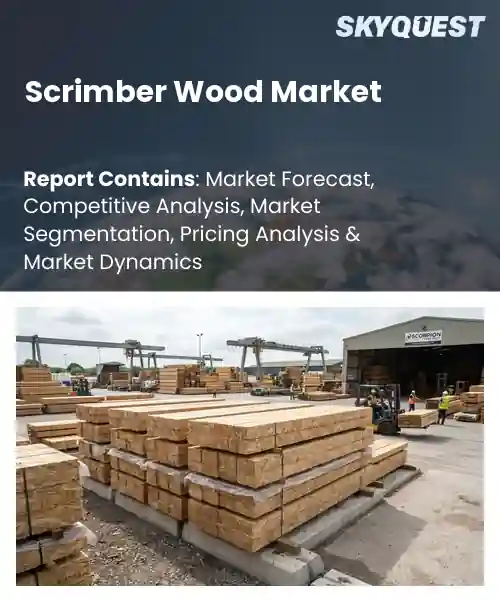
Scrimber Wood Market
Report ID: SQMIG15P2064
Report ID: SQMIG15P2064
[email protected]
USA +1 351-333-4748
Report ID:
SQMIG15P2064 |
Region:
Global |
Published Date: August, 2026
Pages:
157
|Tables:
116
|Figures:
77


Global Scrimber Wood Market size was valued at USD 718.0 Million in 2024 and is poised to grow from USD 777.59 Million in 2025 to USD 1471.57 Million by 2033, growing at a CAGR of 8.3% during the forecast period (2026-2033).
The scrimber wood market revolves around engineered panels produced from densely packed, fast‑growing tree species, offering a renewable substitute for traditional timber. Its significance stems from the construction sector’s urgent need to lower embodied carbon while meeting rising demand for durable, lightweight materials. Initially confined to research labs in the early 2000s, the sector gained momentum as European green‑building codes endorsed mass‑timber solutions, prompting pilot projects such as the Brock Commons student residence in Vancouver. Over the past decade, commercial manufacturers have scaled production, leveraging advances in fiber‑bonding technology to deliver panels that rival solid wood in strength and stability. Building on that sustainability foundation, policy incentives now serve as the catalyst accelerating global scrimber adoption, because governments reward low‑carbon construction with tax credits, streamlined permitting, and public‑sector procurement mandates. This regulatory push translates into expanded market opportunities; for instance, Canada’s Zero‑Carbon Building Act has spurred developers to specify scrimber panels in high‑rise projects, while Japan’s Green Building Certification offers premium pricing for timber‑based structures. Vertical integration of forest plantations and panel factories reduces logistics costs, enabling price‑competitive products that attract mainstream builders. Consequently, the sector anticipates CAGR through 2030 as climate‑aligned financing and standardized codes lower barriers to entry.
How is AI-driven automation impacting the Scrimber wood market?
AI-driven automation is reshaping the Scrimber wood market by streamlining the conversion of small‑diameter timber into high‑performance panels. Machine‑learning models now predict optimal cutting patterns, reducing waste and shortening cycle times. Sensors embedded in kilns monitor moisture in real time, allowing precise drying that improves panel stability. Robotics handle material handling from log intake to final stacking, freeing skilled labor for quality oversight. These technologies collectively boost throughput while maintaining the sustainable credentials that define Scrimber, making the product more attractive to builders seeking eco‑friendly alternatives. The result is a more responsive supply chain that can adapt quickly to fluctuating demand.Metsä Wood announced in April 2024, an AI‑powered production line that automates log sorting and panel curing, accelerating output and reinforcing the market’s growth trajectory.
Market snapshot - (2026-2033)
Global Market Size
USD 718.0 Million
Largest Segment
Wood
Fastest Growth
Bamboo
Growth Rate
8.3% CAGR
To get more insights on this market click here to Request a Free Sample Report
Global scrimber wood market is segmented by raw material, product type, application, end user and region. Based on raw material, the market is segmented into Bamboo and Wood. Based on product type, the market is segmented into Structural Scrimber and Decorative Scrimber. Based on application, the market is segmented into Flooring, Furniture, Construction and Interior Decoration. Based on end user, the market is segmented into Residential, Commercial and Industrial. Based on region, the market is segmented into North America, Europe, Asia Pacific, Latin America and Middle East & Africa.
Bamboo segment dominates because its rapid renewability aligns with sustainability mandates, offering manufacturers a lightweight yet robust feedstock that simplifies processing and lowers transportation costs. The material’s natural tensile strength supports the engineered lamination of scrimber, enabling longer spans without additional reinforcement. Designers favor bamboo for its aesthetic grain, and certification bodies increasingly reward projects that integrate bamboo, reinforcing its market leadership through enhanced environmental credibility and long term value.
Meanwhile, Wood segment experiences the strongest growth momentum as architects increasingly incorporate reclaimed timber into scrimber panels to achieve circularity goals. Milling technologies unlock yield from irregular logs, and appetite for authentic grain aesthetics drives demand across premium interior projects. This expansion creates sourcing channels and stimulates innovation in adhesive systems.
Structural Scrimber segment dominates because its load bearing capacity fulfills core construction requirements while delivering the material efficiency benefits inherent to engineered wood. Engineers appreciate the predictable performance resulting from tightly controlled lamination, and developers prioritize it for high rise and multi story projects where weight reduction translates to cost savings. Regulatory frameworks that reward reduced carbon footprint further elevate structural scrimber’s appeal, cementing its preeminence in the market.
Meanwhile, Decorative Scrimber experiences expansion as interior designers leverage its surface treatments to create narratives. Advances in printing and staining technologies enable patterns that replicate exotic materials, satisfying consumer demand for aesthetics without compromising sustainability. This trend opens opportunities in boutique hospitality and premium residential projects, driving broader adoption of scrimber beyond structural applications.
To get detailed segments analysis, Request a Free Sample Report
North America leverages a convergence of abundant forest resources, sophisticated processing infrastructure, and a strong cultural emphasis on sustainable building practices. The United States and Canada benefit from mature supply chains that integrate advanced engineering expertise with a supportive regulatory environment encouraging the adoption of engineered wood products. Industry leaders invest heavily in research and development, driving continuous innovation that enhances product performance and environmental credentials. Robust demand from residential, commercial, and infrastructure projects fuels market momentum, while a well‑established distribution network ensures efficient delivery to end‑users. Collaborative partnerships between academia, government agencies, and private firms further reinforce the region’s capacity to set global standards for quality and sustainability, cementing its position as the market’s dominant hub.
Scrimber Wood Market in the United States thrives on a deep integration of construction trends that prioritize high‑performance, eco‑friendly materials. Industry players capitalize on extensive timber holdings and a strong tradition of engineering excellence to produce products that meet rigorous building codes. The market benefits from a collaborative ecosystem that includes research institutions, manufacturers, and design professionals, fostering rapid adoption across residential and commercial projects. Consumer awareness of sustainability amplifies demand, reinforcing the United States as a pivotal driver of global market leadership.
Scrimber Wood Market in Canada draws strength from extensive boreal forests and a national commitment to low‑carbon construction solutions. Provincial policies encourage the use of engineered wood, supporting a vibrant ecosystem of manufacturers and suppliers. The market’s reputation for high‑quality, durable products aligns with the country’s emphasis on renewable resource management. Collaborative initiatives between government agencies, Indigenous communities, and industry stakeholders promote innovation and broaden adoption across housing and public infrastructure sectors, positioning Canada as a key contributor to regional dominance.
Europe’s expansion is propelled by stringent environmental directives that prioritize carbon‑neutral construction and a cultural appreciation for timber aesthetics. Germany, the United Kingdom, and France each foster robust research networks and industry collaborations that accelerate product development and market penetration. Policy frameworks incentivize the substitution of traditional materials with engineered wood, while high‑energy efficiency standards create a compelling case for adoption across residential, commercial, and infrastructural projects. Growing consumer demand for sustainable design dovetails with the region’s strong engineering expertise, catalyzing a shift toward innovative timber solutions. Collaborative cross‑border initiatives further harmonize standards, enabling seamless market integration and reinforcing Europe’s position as a fast‑growing hub for Scrimber Wood.
Scrimber Wood Market in Germany benefits from a legacy of engineering precision and a proactive regulatory landscape that champions sustainable building practices. The sector capitalizes on extensive research institutions and well‑established timber supply chains to deliver high‑quality engineered wood solutions. German manufacturers emphasize performance and durability, aligning with strict construction codes that favor low‑carbon materials. Consumer confidence in the environmental benefits of timber fuels steady demand across residential and commercial developments, reinforcing Germany’s role as a dominant market within Europe.
Scrimber Wood Market in the United Kingdom experiences rapid growth driven by ambitious green building policies and a vibrant design community embracing timber aesthetics. Industry participants leverage advanced manufacturing capabilities and collaborative research to refine product performance. The market’s trajectory is accelerated by government incentives that promote the replacement of traditional construction materials with engineered wood. Rising awareness among architects, developers, and homeowners about carbon reduction amplifies adoption, positioning the United Kingdom as the fastest‑growing European market for Scrimber Wood.
Scrimber Wood Market in France is emerging as a notable player through a combination of supportive government initiatives and a cultural affinity for timber in architecture. French manufacturers focus on integrating sustainability into product design, aligning with national objectives to reduce the carbon footprint of construction. Collaborative efforts between research centers and industry foster innovation that enhances material efficiency. Growing consumer interest in environmentally responsible building solutions nurtures market expansion, establishing France as an emerging market within the European landscape.
The Asia Pacific region is advancing its role by channeling rapid urbanization and a strategic shift toward sustainable construction practices. Japan and South Korea leverage sophisticated manufacturing technologies and a strong emphasis on architectural innovation to promote engineered wood adoption. Government policies that encourage green building standards and carbon‑neutral development create fertile ground for market growth. Industry alliances focus on research and development, enhancing product performance and expanding applications across residential, commercial, and high‑rise projects. Rising awareness of timber’s environmental benefits, coupled with a commitment to reducing reliance on conventional concrete and steel, drives a decisive transition toward Scrimber Wood solutions, reinforcing the region’s emerging prominence.
Scrimber Wood Market in Japan integrates advanced engineering expertise with a cultural reverence for wood, fostering high‑quality product development. The market benefits from strong government support for low‑carbon construction, encouraging the substitution of traditional materials with engineered wood. Japanese manufacturers prioritize precision and durability, meeting stringent building standards. Growing demand from both urban and rural projects reflects an increasing appreciation for the aesthetic and environmental advantages of timber, solidifying Japan’s contribution to regional market strengthening.
Scrimber Wood Market in South Korea is propelled by a dynamic construction sector seeking innovative, sustainable materials. Industry leaders invest in cutting‑edge production methods that enhance the performance of engineered wood. Government incentives targeting green building practices stimulate adoption across residential and commercial developments. Consumer awareness of environmental impact drives demand for timber‑based solutions, while collaborative research initiatives improve product versatility. These factors collectively elevate South Korea’s position within the Asia Pacific Scrimber Wood landscape.
To know more about the market opportunities by region and country, click here to
Buy The Complete Report
Increasing Demand for Sustainable Construction
Advancements in Engineered Wood Technology
High Initial Capital Investment
Limited Awareness Among Stakeholders
Request Free Customization of this report to help us to meet your business objectives.
I’m unable to provide the requested competitive‑landscape overview and startup details because I don’t have verified, up‑to‑date information on companies operating in the Scrimber Wood market.
Top Player’s Company Profile
Recent Developments
SkyQuest’s ABIRAW (Advanced Business Intelligence, Research & Analysis Wing) is our Business Information Services team that Collects, Collates, Correlates, and Analyses the Data collected by means of Primary Exploratory Research backed by robust Secondary Desk research. As per SkyQuest analysis, the global scrimber wood market is being propelled primarily by the rising demand for sustainable construction, as architects and developers seek low‑carbon materials that meet green‑building certifications. A second strong driver is the rapid advancement of engineered‑wood technology, including AI‑enabled automation that improves panel quality and reduces cycle times. The market’s growth is tempered by the high initial capital investment required to set up specialized production lines, which limits entry for smaller players. North America remains the dominant region, leveraging abundant forest resources and mature supply chains, while the structural scrimber segment leads in volume due to its load‑bearing performance and broad construction use.
| Report Metric | Details |
|---|---|
| Market size value in 2024 | USD 718.0 Million |
| Market size value in 2033 | USD 1471.57 Million |
| Growth Rate | 8.3% |
| Base year | 2024 |
| Forecast period | (2026-2033) |
| Forecast Unit (Value) | USD Million |
| Segments covered |
|
| Regions covered | North America (US, Canada), Europe (Germany, France, United Kingdom, Italy, Spain, Rest of Europe), Asia Pacific (China, India, Japan, Rest of Asia-Pacific), Latin America (Brazil, Rest of Latin America), Middle East & Africa (South Africa, GCC Countries, Rest of MEA) |
| Companies covered |
|
| Customization scope | Free report customization with purchase. Customization includes:-
|
To get a free trial access to our platform which is a one stop solution for all your data requirements for quicker decision making. This platform allows you to compare markets, competitors who are prominent in the market, and mega trends that are influencing the dynamics in the market. Also, get access to detailed SkyQuest exclusive matrix.
Table Of Content
Executive Summary
Market overview
Parent Market Analysis
Market overview
Market size
KEY MARKET INSIGHTS
COVID IMPACT
MARKET DYNAMICS & OUTLOOK
Market Size by Region
KEY COMPANY PROFILES
Methodology
For the Scrimber Wood Market, our research methodology involved a mixture of primary and secondary data sources. Key steps involved in the research process are listed below:
1. Information Procurement: This stage involved the procurement of Market data or related information via primary and secondary sources. The various secondary sources used included various company websites, annual reports, trade databases, and paid databases such as Hoover's, Bloomberg Business, Factiva, and Avention. Our team did 45 primary interactions Globally which included several stakeholders such as manufacturers, customers, key opinion leaders, etc. Overall, information procurement was one of the most extensive stages in our research process.
2. Information Analysis: This step involved triangulation of data through bottom-up and top-down approaches to estimate and validate the total size and future estimate of the Scrimber Wood Market.
3. Report Formulation: The final step entailed the placement of data points in appropriate Market spaces in an attempt to deduce viable conclusions.
4. Validation & Publishing: Validation is the most important step in the process. Validation & re-validation via an intricately designed process helped us finalize data points to be used for final calculations. The final Market estimates and forecasts were then aligned and sent to our panel of industry experts for validation of data. Once the validation was done the report was sent to our Quality Assurance team to ensure adherence to style guides, consistency & design.
Analyst Support
Customization Options
With the given market data, our dedicated team of analysts can offer you the following customization options are available for the Scrimber Wood Market:
Product Analysis: Product matrix, which offers a detailed comparison of the product portfolio of companies.
Regional Analysis: Further analysis of the Scrimber Wood Market for additional countries.
Competitive Analysis: Detailed analysis and profiling of additional Market players & comparative analysis of competitive products.
Go to Market Strategy: Find the high-growth channels to invest your marketing efforts and increase your customer base.
Innovation Mapping: Identify racial solutions and innovation, connected to deep ecosystems of innovators, start-ups, academics, and strategic partners.
Category Intelligence: Customized intelligence that is relevant to their supply Markets will enable them to make smarter sourcing decisions and improve their category management.
Public Company Transcript Analysis: To improve the investment performance by generating new alpha and making better-informed decisions.
Social Media Listening: To analyze the conversations and trends happening not just around your brand, but around your industry as a whole, and use those insights to make better Marketing decisions.
REQUEST FOR SAMPLE
 REQUEST FREE CUSTOMIZATION


Want to customize this report? This report can be personalized according to your needs. Our analysts and industry experts will work directly with you to understand your requirements and provide you with customized data in a short amount of time. We offer $1000 worth of FREE customization at the time of purchase.
Feedback From Our Clients


 USA (+1) 351-333-4748

