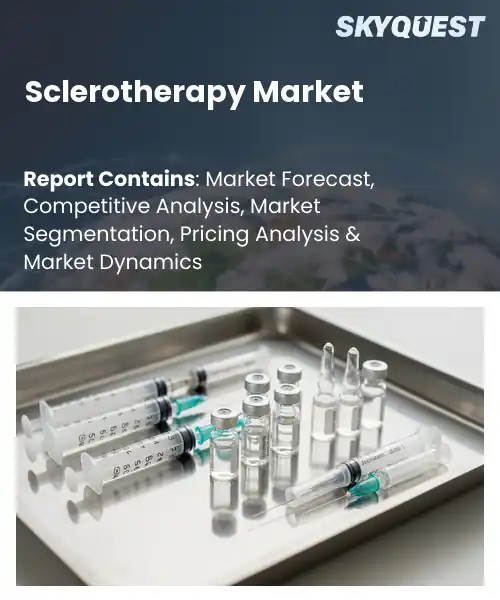
Sclerotherapy Market
Report ID: SQMIG35D2441
Report ID: SQMIG35D2441
[email protected]
USA +1 351-333-4748
Report ID:
SQMIG35D2441 |
Region:
Global |
Published Date: May, 2026
Pages:
157
|Tables:
118
|Figures:
77


Global Sclerotherapy Market size was valued at USD 1.52 Billion in 2024 and is poised to grow from USD 1.63 Billion in 2025 to USD 2.85 Billion by 2033, growing at a CAGR of 7.22% during the forecast period (2026-2033).
The primary driver of the sclerotherapy market is rising prevalence of venous diseases coupled with increasing demand for minimally invasive aesthetic treatments. Sclerotherapy refers to injection of sclerosant agents into varicose and spider veins to induce fibrosis and vessel closure; it matters because it offers lower risk and shorter recovery compared with surgical ligation, expanding clinician and patient acceptance globally. Over the past two decades clinicians have adopted foam formulations and ultrasound guidance, improving efficacy and enabling treatment of deeper refluxing veins. Subsequently health insurers recognized procedures, increasing procedural volumes and encouraging manufacturers to invest in injectables and training programs.An essential growth factor is technological refinement of sclerosant formulations and delivery methods because improved safety profiles increase clinician confidence and referrals. For example foam polidocanol has enabled treatment of larger trunks with lower injected volumes, which shortens procedure times and raises clinic throughput; as throughput increases revenue per treatment supports investment in ambulatory clinics and consumables. Concurrent expansion of training programs and clearer reimbursement pathways causes general practitioners and phlebologists to adopt sclerotherapy into routine care, thereby increasing access. Telemedicine triage and aesthetic demand from aging populations further channel patients to minimally invasive clinics, strengthening device and drug sales.
How is AI enhancing clinical outcomes and market growth in the sclerotherapy market?
AI is improving clinical outcomes and supporting market growth in sclerotherapy by refining imaging guidance, patient selection, treatment planning and follow up. Key aspects include AI enhanced ultrasound interpretation for clearer vein mapping, decision support that helps tailor sclerosant choice and volume, and predictive models that flag patients at higher risk of recurrence. The current state shows growing use of AI driven imaging and workflow tools in outpatient vascular clinics to boost consistency and reduce procedure time. With rising demand for minimally invasive venous care, these AI driven improvements make sclerotherapy more efficient and clinically reliable, encouraging wider adoption and investment.InVera Medical April 2026, received US clearance for its InVera Infusion Device which improves sclerosant delivery. Paired with AI powered ultrasound and predictive analytics this advancement sharpens vein targeting, streamlines treatment planning and enhances post procedure monitoring. The combined effect supports better patient outcomes and helps accelerate market adoption and clinic efficiency.
Market snapshot - (2026-2033)
Global Market Size
USD 1.52 Billion
Largest Segment
Foam Sclerotherapy
Fastest Growth
Foam Sclerotherapy
Growth Rate
7.22% CAGR
To get more insights on this market click here to Request a Free Sample Report
Global sclerotherapy market is segmented by type, indication, sclerosant agent, end-user and region. Based on type, the market is segmented into Liquid Sclerotherapy, Foam Sclerotherapy and Visual Sclerotherapy. Based on indication, the market is segmented into Varicose Veins, Spider Veins (Telangiectasias), Hemorrhoids and Esophageal Varices. Based on sclerosant agent, the market is segmented into Sodium Tetradecyl Sulfate, Polidocanol and Hypertonic Saline. Based on end-user, the market is segmented into Vascular Clinics, Hospitals and Dermatology Practices. Based on region, the market is segmented into North America, Europe, Asia Pacific, Latin America and Middle East & Africa.
What role does foam sclerotherapy play in improving treatment outcomes in the sclerotherapy market? |@12
Foam Sclerotherapy segment dominates because clinicians favor foam for treating larger and refluxing veins due to its superior displacing effect and enhanced contact with vein walls, which improves occlusion outcomes and reduces retreatment needs. This clinical advantage drives clinician preference and referral patterns, supports adoption in vascular clinics and hospitals, and aligns with minimally invasive care trends, thereby concentrating procedure volume and supplier focus on foam based techniques and delivery systems.
However, Liquid Sclerotherapy is rapidly expanding because its simplicity and versatility boost adoption in aesthetic and dermatology practices, enabling efficient treatment of spider veins and small tributaries. New sclerosant formulations and improved administration techniques, combined with simplified training, accelerate provider uptake and create expanded outpatient treatment opportunities.
How is polidocanol reshaping clinical preferences in the sclerotherapy market? |@12
Polidocanol segment dominates because its favorable safety and tolerability profile makes it the preferred sclerosant across aesthetic and clinical practices, reducing procedure discomfort and minimizing complications, which boosts clinician confidence and patient acceptance. This therapeutic reliability encourages broader use in dermatology practices and vascular clinics, drives formulary and protocol standardization, incentivizes manufacturer investment in optimized formulations and delivery systems, and supports minimally invasive outpatient workflows and strengthens long term adoption patterns.
Meanwhile, Hypertonic Saline is witnessing strong growth as clinicians adopt it for cost sensitive indications and broader clinical uses, fueled by renewed clinical interest and improvements in delivery compatibility. Simpler handling, evolving protocols, and clearer safety guidance accelerate acceptance, creating new procedural options and procurement opportunities for providers and device manufacturers.
To get detailed segments analysis, Request a Free Sample Report
Why does North America Dominate the Global Sclerotherapy Market? |@12
North America dominates the global sclerotherapy market through a combination of deep clinical expertise, well developed healthcare infrastructure, and active participation by major medical device and pharmaceutical companies. The region benefits from mature outpatient procedural networks and established pathways that support adoption of minimally invasive venous therapies. Strong clinical research ecosystems and collaboration between academic centers and industry facilitate innovation in sclerosant formulations and delivery techniques. High patient awareness, widely available specialist training, and pragmatic engagement with regulatory stakeholders further enable standardization of practice and efficient commercialization, creating an environment where new products and procedural refinements are rapidly validated and adopted across diverse clinical settings.
United States Sclerotherapy Market |@12
Sclerotherapy Market in the United States benefits from concentrated private and academic clinical expertise, a mature aesthetic procedural ecosystem, and integrated reimbursement pathways that support procedural adoption. High patient awareness, broad availability of trained specialists, and active participation of domestic and multinational medical device and pharmaceutical companies accelerate innovation in sclerosant formulations and delivery techniques. Collaboration between clinical centers and industry fosters real world evidence generation and standardization of practice.
Canada Sclerotherapy Market |@12
Sclerotherapy Market in Canada reflects strong integration between public healthcare institutions and specialized outpatient clinics, enabling widespread access to minimally invasive venous therapies. Emphasis on physician training, regional centers of excellence, and pragmatic clinical guidelines supports consistent procedural quality. Market dynamics are influenced by selective reimbursement frameworks, collaborative research efforts, and growing patient demand for cosmetically oriented treatments, encouraging incremental adoption of advanced sclerosants and adjunctive technologies across urban settings.
What is Driving the Rapid Expansion of Sclerotherapy Market in Europe? |@12
The rapid expansion of the sclerotherapy market in Europe is driven by advancing clinical capabilities, coordinated regulatory approaches, and increasing patient interest in minimally invasive venous treatments across public and private care settings. Strong research centers and professional societies support evidence generation and dissemination of best practices, while local manufacturers and multinational companies work to tailor product offerings to regional clinical preferences. Diverse reimbursement landscapes create multiple access points for care, and targeted clinician education is improving procedural competency. Urban specialty clinics and partnerships between industry and academic institutions further accelerate adoption of novel sclerosants and delivery systems, supporting market maturation and regional leadership in clinical protocols.
Germany Sclerotherapy Market |@12
Sclerotherapy Market in Germany benefits from concentrated clinical expertise in vascular medicine, a mature outpatient procedural network, and active academic centers that drive clinical practice and evidence development. Strong ties between local industry and international suppliers support consistent product availability, while structured clinician training and reimbursement frameworks promote reliable service delivery. These elements combine to position Germany as a focal market for advancement in sclerosant techniques and standardized venous care.
United Kingdom Sclerotherapy Market |@12
Sclerotherapy Market in United Kingdom is expanding thanks to a growing private aesthetic sector, rising patient interest in cosmetic venous treatments, and targeted professional training that strengthens practitioner skills. A receptive regulatory climate and active participation by local and multinational companies support quicker market entry for novel sclerosant options. Urban clinic networks and evolving payment approaches broaden service access, encouraging wider adoption of advanced treatment techniques across varied care environments.
France Sclerotherapy Market |@12
Sclerotherapy Market in France is emerging through integration of venous therapies within public hospitals and private clinics, supported by growing clinical interest and localized research initiatives. Professional societies and evolving guidelines are enhancing practitioner competencies, while manufacturers tailor products to local clinical preferences. Rising patient awareness and selective reimbursement pathways are gradually expanding access, encouraging a transition from niche utilization to broader procedural adoption in therapeutic and cosmetic care settings.
How is Asia Pacific Strengthening its Position in Sclerotherapy Market? |@12
Asia Pacific is strengthening its position in the sclerotherapy market through expanding clinical capacity, rising patient demand for cosmetic and therapeutic venous care, and increasing engagement by regional manufacturers alongside international firms. Investment in specialized clinics, focused professional education, and local clinical research is raising standards and practitioner expertise. Regulatory pathways and market access strategies are evolving to accommodate innovative sclerosant products and delivery systems. Cross border collaborations and knowledge exchange with established markets accelerate adoption of best practices, while urban centers act as hubs for technology introduction and training, enabling the region to play an increasingly important role in global clinical innovation.
Japan Sclerotherapy Market |@12
Sclerotherapy Market in Japan reflects rigorous clinical standards, strong emphasis on evidence based practice, and methodical regulatory evaluation that prioritize safety. Domestic manufacturers collaborate with international partners to refine products within a cautious adoption environment. Focused practitioner training and concentrated urban specialist networks support high quality procedural delivery. Patient expectations for safety and efficacy shape conservative yet durable uptake, with academic centers contributing to clinical validation and best practice dissemination.
South Korea Sclerotherapy Market |@12
Sclerotherapy Market in South Korea is driven by a vibrant aesthetic medicine culture, rapid uptake of innovative treatment methods, and a dense network of specialized private clinics that prioritize procedural refinement. Clinicians display strong technical expertise supported by targeted training programs and collaboration with local and global manufacturers. Consumer demand for aesthetic outcomes and clinic pathways encourages adoption of advanced sclerosants and technologies, positioning South Korea as an influential adopter.
To know more about the market opportunities by region and country, click here to
Buy The Complete Report
Drivers |@12
Rising Prevalence Of Venous Disorders
Advances In Sclerotherapy Techniques
Restraints |@12
Regulatory Approval And Compliance Burdens
Limited Reimbursement And Coverage
Request Free Customization of this report to help us to meet your business objectives.
Competition in the global sclerotherapy market centres on consolidation, regulatory-backed product differentiation and delivery innovation. Incumbents pursue targeted acquisitions to secure sclerosant platforms and procedural systems, exemplified by BD’s 2021 purchase of Venclose and Boston Scientific’s 2019 acquisition of BTG which added Varithena. Startups accelerate clinical adoption through strategic asset purchases and partnerships, exemplified by Healiva and FeelTect.
Top Player’s Company Profile
Recent Developments
SkyQuest’s ABIRAW (Advanced Business Intelligence, Research & Analysis Wing) is our Business Information Services team that Collects, Collates, Correlates, and Analyses the Data collected by means of Primary Exploratory Research backed by robust Secondary Desk research. As per SkyQuest analysis, the global sclerotherapy market is driven by rising prevalence of venous disorders as one key driver and by advances in sclerotherapy techniques as a second driver, while one restraint remains limited reimbursement and coverage that can curb access and provider investment. North America is the dominating region due to mature clinical networks and strong industry presence, and foam sclerotherapy is the dominating segment because of superior outcomes for larger refluxing veins. Overall, continued product innovation, training expansion and AI-enabled imaging are expected to sustain adoption, and manufacturer investment will shape competitive dynamics, but reimbursement clarity will be critical for broader market penetration.
| Report Metric | Details |
|---|---|
| Market size value in 2024 | USD 1.52 Billion |
| Market size value in 2033 | USD 2.85 Billion |
| Growth Rate | 7.22% |
| Base year | 2024 |
| Forecast period | (2026-2033) |
| Forecast Unit (Value) | USD Billion |
| Segments covered |
|
| Regions covered | North America (US, Canada), Europe (Germany, France, United Kingdom, Italy, Spain, Rest of Europe), Asia Pacific (China, India, Japan, Rest of Asia-Pacific), Latin America (Brazil, Rest of Latin America), Middle East & Africa (South Africa, GCC Countries, Rest of MEA) |
| Companies covered |
|
| Customization scope | Free report customization with purchase. Customization includes:-
|
To get a free trial access to our platform which is a one stop solution for all your data requirements for quicker decision making. This platform allows you to compare markets, competitors who are prominent in the market, and mega trends that are influencing the dynamics in the market. Also, get access to detailed SkyQuest exclusive matrix.
Table Of Content
Executive Summary
Market overview
Parent Market Analysis
Market overview
Market size
KEY MARKET INSIGHTS
COVID IMPACT
MARKET DYNAMICS & OUTLOOK
Market Size by Region
KEY COMPANY PROFILES
Methodology
For the Sclerotherapy Market, our research methodology involved a mixture of primary and secondary data sources. Key steps involved in the research process are listed below:
1. Information Procurement: This stage involved the procurement of Market data or related information via primary and secondary sources. The various secondary sources used included various company websites, annual reports, trade databases, and paid databases such as Hoover's, Bloomberg Business, Factiva, and Avention. Our team did 45 primary interactions Globally which included several stakeholders such as manufacturers, customers, key opinion leaders, etc. Overall, information procurement was one of the most extensive stages in our research process.
2. Information Analysis: This step involved triangulation of data through bottom-up and top-down approaches to estimate and validate the total size and future estimate of the Sclerotherapy Market.
3. Report Formulation: The final step entailed the placement of data points in appropriate Market spaces in an attempt to deduce viable conclusions.
4. Validation & Publishing: Validation is the most important step in the process. Validation & re-validation via an intricately designed process helped us finalize data points to be used for final calculations. The final Market estimates and forecasts were then aligned and sent to our panel of industry experts for validation of data. Once the validation was done the report was sent to our Quality Assurance team to ensure adherence to style guides, consistency & design.
Analyst Support
Customization Options
With the given market data, our dedicated team of analysts can offer you the following customization options are available for the Sclerotherapy Market:
Product Analysis: Product matrix, which offers a detailed comparison of the product portfolio of companies.
Regional Analysis: Further analysis of the Sclerotherapy Market for additional countries.
Competitive Analysis: Detailed analysis and profiling of additional Market players & comparative analysis of competitive products.
Go to Market Strategy: Find the high-growth channels to invest your marketing efforts and increase your customer base.
Innovation Mapping: Identify racial solutions and innovation, connected to deep ecosystems of innovators, start-ups, academics, and strategic partners.
Category Intelligence: Customized intelligence that is relevant to their supply Markets will enable them to make smarter sourcing decisions and improve their category management.
Public Company Transcript Analysis: To improve the investment performance by generating new alpha and making better-informed decisions.
Social Media Listening: To analyze the conversations and trends happening not just around your brand, but around your industry as a whole, and use those insights to make better Marketing decisions.
REQUEST FOR SAMPLE
 REQUEST FREE CUSTOMIZATION


Want to customize this report? This report can be personalized according to your needs. Our analysts and industry experts will work directly with you to understand your requirements and provide you with customized data in a short amount of time. We offer $1000 worth of FREE customization at the time of purchase.
Feedback From Our Clients


 USA (+1) 351-333-4748

