
School Bus Market
Report ID: SQMIG25C2186
Report ID: SQMIG25C2186
[email protected]
USA +1 351-333-4748
Report ID:
SQMIG25C2186 |
Region:
Global |
Published Date: May, 2025
Pages:
190
|Tables:
88
|Figures:
68


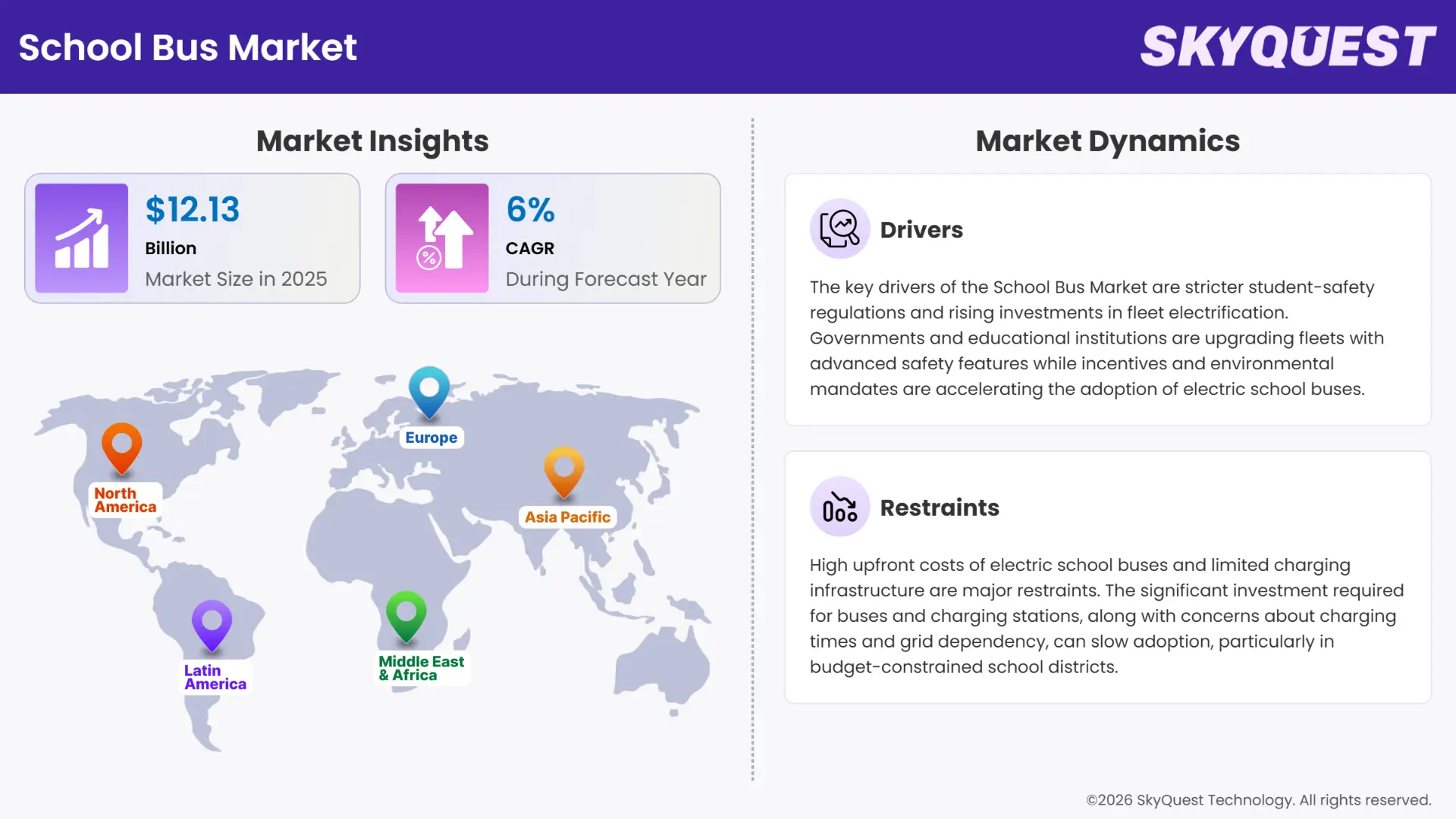
Global School Bus Market size was valued at USD 11.45 Billion in 2024 and is poised to grow from USD 12.13 Billion in 2025 to USD 19.34 Billion by 2033, growing at a CAGR of 6% during the forecast period (2026–2033).
Key Takeaways: Market Trends & Insights
The school bus market is undergoing significant transformation, primarily driven by the growing demand for sustainability, safety, and technological advancements in transportation. Traditionally dominated by diesel-powered vehicles, the market is shifting toward greener solutions, with electric school buses leading the charge. This transition is largely fueled by government regulations and incentives, which encourage the adoption of electric vehicles to reduce carbon emissions and enhance energy efficiency.
The growing school bus market trend towards smart school bus solutions is revolutionizing fleet management and enhancing safety standards. These improvements not only enhance safety for children but also optimize fleet management for school districts, reducing operational costs and improving efficiency. The rising environmental concerns and the push for sustainable transportation present opportunities for electric school buses. These vehicles offer zero emissions, reducing the carbon footprint of school districts. Governments and organizations are introducing incentives and regulations to promote the adoption of electric school buses, creating lucrative opportunities for manufacturers. Additionally, the trend toward autonomous driving has the potential to revolutionize school bus transportation, improving safety and reducingoperationalcosts.
How is Artificial Intelligence Enhancing the Safety and Efficiency of School Bus Routes In 2024?
AI is revolutionizing route optimization for school buses, allowing for smarter, more efficient scheduling and navigation. In 2024, AI-powered systems use real-time traffic data and historical patterns to determine the quickest and safest routes, reducing fuel consumption and ensuring timely arrivals. This technology also integrates with GPS to provide alerts to parents and school authorities if buses are running late, improving communication and safety.
AI-driven fleet management systems have become essential in optimizing school bus operations. These systems allow for real-time monitoring of the bus fleet, including vehicle performance, location tracking, and driver behavior.
To get more insights on this market click here to Request a Free Sample Report
Global School Bus Market is segmented by Propulsion, Class, End-use, Seating Capacity, Drive System, Safety Features and region. Based on Propulsion, the market is segmented into Diesel, Hybrid, Electric and CNG. Based on Class, the market is segmented into Type A, Type B, Type C and Type D. Based on End-use, the market is segmented into School district, Private contractor and Charter services. Based on Seating Capacity, the market is segmented into Less than 10, 10-20, 21-30, 31-40 and 40 or more.
Based on Drive System, the market is segmented into 4x2, 4x4, 6x4 and 6x6. Based on Safety Features, the market is segmented into Advanced Driver Assistance Systems (ADAS), Electronic Stability Control (ESC), Anti-lock Braking System (ABS), Seatbelts and Cameras. Based on region, the market is segmented into North America, Europe, Asia Pacific, Latin America and Middle East & Africa.
As per global school bus market analysis, diesel remains the dominant segment, primarily due to its long-established infrastructure, cost-effectiveness, and high availability in many regions. Diesel buses are widely used across the globe, especially in regions where electric or hybrid alternatives have not yet achieved large-scale adoption. They are well-suited for long distances, and diesel technology has evolved over time to meet more stringent emissions standards.
As per global school bus market outlook, the electric segment is the fastest growing in recent years, driven by increasing environmental concerns, government incentives, and regulations aimed at reducing emissions. Electric school buses offer several advantages over their diesel counterparts, including zero tailpipe emissions, lower operational costs (due to fewer moving parts), and a quieter, smoother ride.
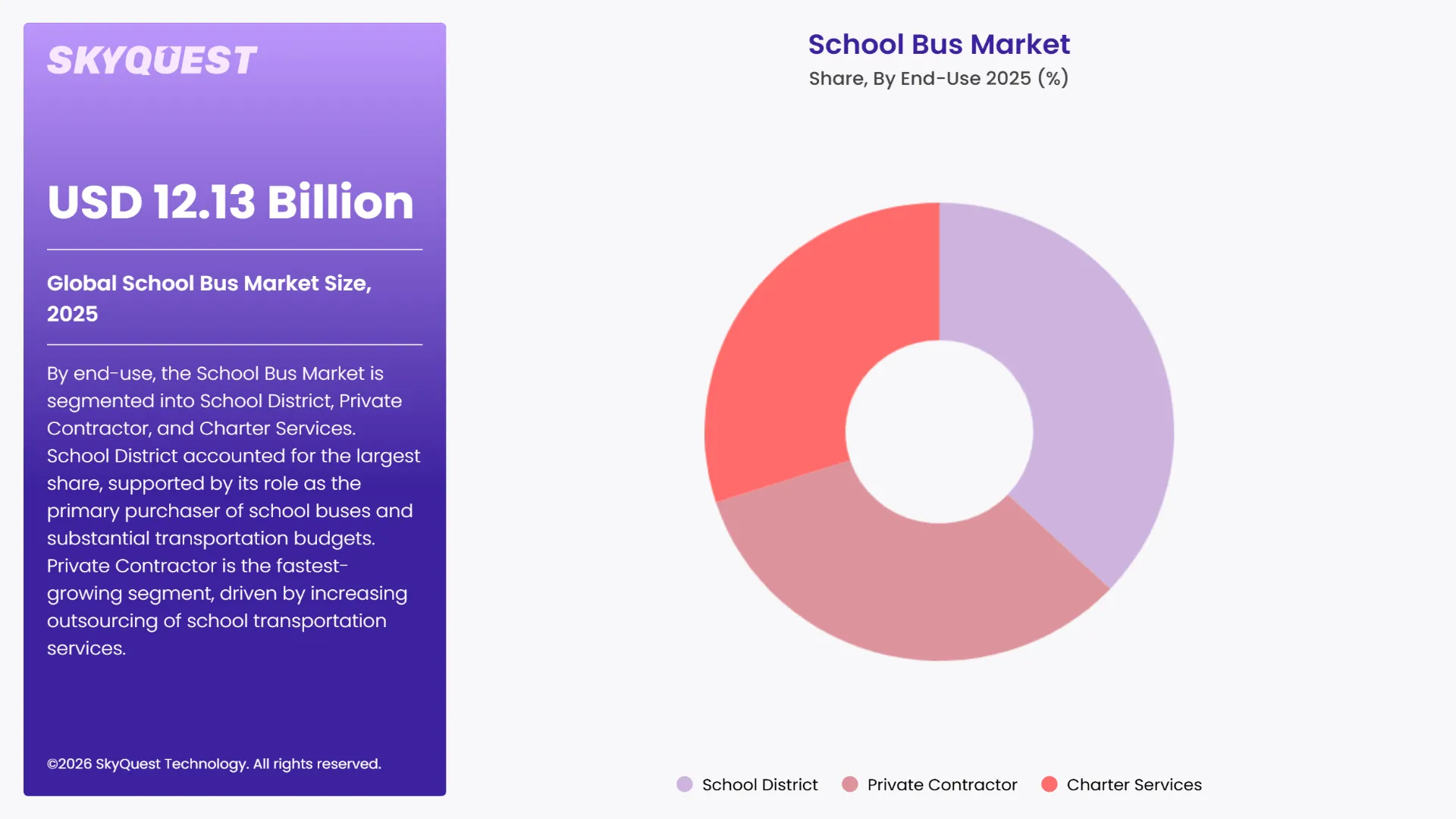
As per school bus market outlook, the school district remains the dominant segment. They are the primary purchasers of school buses, especially in regions with public education systems. School districts typically have long-term contracts for transportation services, with significant budgets allocated to purchasing and maintaining fleets of buses to serve a large number of students. This segment benefits from government funding, which further supports its market dominance.
As per the global school bus market forecast, the private contractor segment is growing rapidly, driven by the increasing outsourcing of school bus services. Many school districts are opting to contract with private companies for school transportation, as it can offer cost savings and efficiency. Private contractors manage school bus fleets, route planning, and staffing, while school districts retain oversight and regulation. The rise in this segment is also fueled by the need for flexible, scalable transportation solutions in larger urban areas or regions with fluctuating student populations.
To get detailed segments analysis, Request a Free Sample Report
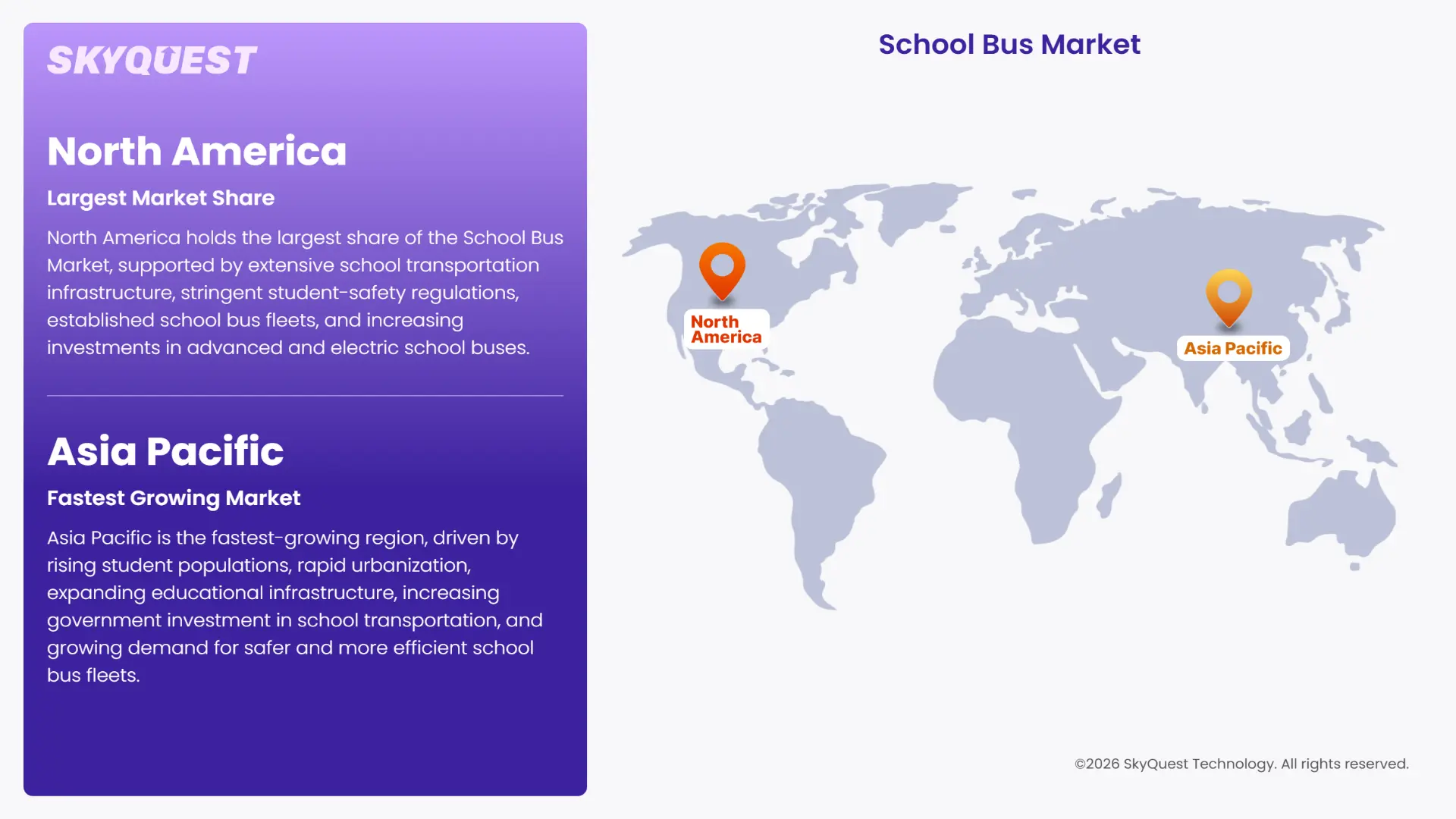
As per regional forecast, North America remains the dominant region in the school bus market due to the size and well-established infrastructure of the school transportation systems in the U.S. and Canada. The push for electric buses is particularly strong in the U.S., with numerous state and federal programs aimed at funding the transition from traditional diesel-powered buses to electric ones.
The U.S. school bus market remains one of the largest globally, with a strong emphasis on safety standards, electrification, and fleet modernization. The U.S. government’s increasing focus on green initiatives has resulted in incentives for electric school buses, driving growth in the EV segment. Companies like Blue Bird Corporation and IC Bus continue to dominate the market, with an increasing shift toward electric buses.
Canada is also seeing a steady shift toward electric school buses, with several provinces introducing green initiatives and funding to encourage fleet upgrades. As with the U.S., Canadian school districts are exploring solutions to reduce carbon emissions, with the government introducing regulations to support the adoption of electric vehicles.
As per industry analysis, Asia-Pacific is witnessing rapid growth in the school bus market, especially with rising urbanization and a push for more sustainable transportation systems. Countries like Japan and South Korea are embracing technological advancements such as electric and hybrid buses to meet environmental goals. Government incentives for electric vehicles play a critical role in driving growth in this region.
Japan’s school bus market is growing, with a significant shift towards smart transportation solutions. Japanese manufacturers are focusing on introducing efficient, eco-friendly school buses equipped with the latest technology to meet growing urbanization needs. Companies like Isuzu and Toyota are leading the charge, particularly in hybrid and electric vehicles.
South Korea is investing in electric vehicles, including school buses. The government is actively supporting the adoption of electric vehicles to reduce air pollution, making the country one of the key players in the electric school bus market in Asia. The introduction of smart and electric buses aligns with the government's broader sustainability goals.
As per regional outlook, Europe is focusing heavily on sustainability and the transition to electric vehicles, and this extends to the school bus sector. Germany, the UK, and Italy are at the forefront of these initiatives, with government policies supporting the shift to electric buses and a commitment to reducing carbon emissions. These nations are seeing increased collaboration between government agencies and private companies to create a greener future for school transportation.
Germany has been a leader in the electric vehicle market and is now shifting its focus to school buses. With a strong environmental policy and funding programs for eco-friendly vehicles, the German market is poised for significant growth in the electric school bus segment. Major manufacturers like MAN and Mercedes-Benz are expected to lead the electric school bus adoption.
The UK is increasing its commitment to reducing carbon emissions in transportation, and electric school buses are a significant part of this push. Government funding and support for electric vehicle adoption are fostering growth in this market. Leading players like Daimler and ADL are involved in the transition.
Italy is also focused on reducing emissions, with a growing interest in electric and hybrid school buses. The country is prioritizing environmental sustainability, and as part of its commitment to the Paris Agreement, Italy is gradually shifting its school transportation fleets toward greener alternatives. Companies such as Iveco are active in this transition.
To know more about the market opportunities by region and country, click here to
Buy The Complete Report
Growing Emphasis on Student Safety Regulations
Rising Investments in Electrification of School Fleets
High Upfront Costs of Electric Buses
Limited Charging Infrastructure
Request Free Customization of this report to help us to meet your business objectives.
In 2024, the global school bus industry remains highly competitive, with both traditional players and new entrants focusing on advancements in sustainability, electrification, and technological innovations. Leading players such as Forest River, Collins Bus Corporation, and Blue Bird Corporation continue to dominate, leveraging their established distribution channels and expertise in manufacturing traditional and electric buses. The competitive landscape has been marked by several strategic mergers and acquisitions, such as the sale of Collins Bus Corporation from REV Group to Forest River and the strategic partnership between Lion Electric and Thomas Built Buses to advance electric vehicle (EV) school buses.
Innovation is central to the competitive dynamics of this market, as traditional bus manufacturers pivot toward electric school buses, driven by government policies on reducing carbon emissions. Companies like IC Bus and Volvo Buses are actively investing in electric bus technology, while Lion Electric stands out as a pioneer in the electric school bus segment. This market is also seeing increasing interest from startups that bring fresh approaches to clean transportation solutions for school districts.
Integration of Telematics and Fleet Management Systems
Collaboration Between Public Entities and Private Manufacturers
SkyQuest’s ABIRAW (Advanced Business Intelligence, Research & Analysis Wing) is our Business Information Services team that Collects, Collates, Correlates, and Analyses the Data collected by means of Primary Exploratory Research backed by robust Secondary Desk research.
As per SkyQuest analysis, the market growth is driven by increasing emphasis on quality and safety evaluation by leading regulatory organizations in the bus industry. As regulatory bodies tighten standards for safety and reliability, bus manufacturers are turning to advanced memory solutions to meet these requirements. These memories play a crucial role in enhancing the performance and safety features of next-gen buses. The increasing number of school enrollments with the rise in the demand for a large number of schools and adequate infrastructure in the education sector, which includes transportation and other amenities, creates a positive impact on the market. The transition around electric school buses (ESBs) is growing across the globe as school districts are adapting to transition to this cleaner and healthier technology, which is also funded by the various governments as they are recognizing the benefits of electric vehicles (EVs) and are implementing various fiscal incentives to stimulate their adoption.
| Report Metric | Details |
|---|---|
| Market size value in 2024 | USD 11.45 Billion |
| Market size value in 2033 | USD 19.34 Billion |
| Growth Rate | 6% |
| Base year | 2024 |
| Forecast period | 2026–2033 |
| Forecast Unit (Value) | USD Billion |
| Segments covered |
|
| Regions covered | North America (US, Canada), Europe (Germany, France, United Kingdom, Italy, Spain, Rest of Europe), Asia Pacific (China, India, Japan, Rest of Asia-Pacific), Latin America (Brazil, Rest of Latin America), Middle East & Africa (South Africa, GCC Countries, Rest of MEA) |
| Companies covered |
|
| Customization scope | Free report customization with purchase. Customization includes:-
|
To get a free trial access to our platform which is a one stop solution for all your data requirements for quicker decision making. This platform allows you to compare markets, competitors who are prominent in the market, and mega trends that are influencing the dynamics in the market. Also, get access to detailed SkyQuest exclusive matrix.
Table Of Content
Executive Summary
Market overview
Parent Market Analysis
Market overview
Market size
KEY MARKET INSIGHTS
COVID IMPACT
MARKET DYNAMICS & OUTLOOK
Market Size by Region
KEY COMPANY PROFILES
Methodology
For the School Bus Market, our research methodology involved a mixture of primary and secondary data sources. Key steps involved in the research process are listed below:
1. Information Procurement: This stage involved the procurement of Market data or related information via primary and secondary sources. The various secondary sources used included various company websites, annual reports, trade databases, and paid databases such as Hoover's, Bloomberg Business, Factiva, and Avention. Our team did 45 primary interactions Globally which included several stakeholders such as manufacturers, customers, key opinion leaders, etc. Overall, information procurement was one of the most extensive stages in our research process.
2. Information Analysis: This step involved triangulation of data through bottom-up and top-down approaches to estimate and validate the total size and future estimate of the School Bus Market.
3. Report Formulation: The final step entailed the placement of data points in appropriate Market spaces in an attempt to deduce viable conclusions.
4. Validation & Publishing: Validation is the most important step in the process. Validation & re-validation via an intricately designed process helped us finalize data points to be used for final calculations. The final Market estimates and forecasts were then aligned and sent to our panel of industry experts for validation of data. Once the validation was done the report was sent to our Quality Assurance team to ensure adherence to style guides, consistency & design.
Analyst Support
Customization Options
With the given market data, our dedicated team of analysts can offer you the following customization options are available for the School Bus Market:
Product Analysis: Product matrix, which offers a detailed comparison of the product portfolio of companies.
Regional Analysis: Further analysis of the School Bus Market for additional countries.
Competitive Analysis: Detailed analysis and profiling of additional Market players & comparative analysis of competitive products.
Go to Market Strategy: Find the high-growth channels to invest your marketing efforts and increase your customer base.
Innovation Mapping: Identify racial solutions and innovation, connected to deep ecosystems of innovators, start-ups, academics, and strategic partners.
Category Intelligence: Customized intelligence that is relevant to their supply Markets will enable them to make smarter sourcing decisions and improve their category management.
Public Company Transcript Analysis: To improve the investment performance by generating new alpha and making better-informed decisions.
Social Media Listening: To analyze the conversations and trends happening not just around your brand, but around your industry as a whole, and use those insights to make better Marketing decisions.
REQUEST FOR SAMPLE
 REQUEST FREE CUSTOMIZATION
Global School Bus Market size was valued at USD 11.45 Billion in 2024 and is poised to grow from USD 12.13 Billion in 2025 to USD 19.34 Billion by 2033, growing at a CAGR of 6% during the forecast period (2026–2033).
Key vendors include Lion Electric Company, GreenPower Motor Company Inc., Yutong Bus Co., Ltd., Zhongtong Bus Holding Co., Ltd., Tata Motors Limited, Ashok Leyland Limited, Eicher Motors Limited, Anhui Ankai Automobile Co., Ltd., King Long United Automotive Industry Co., Ltd., BYD Company Limited, NFI Group Inc., AB Volvo, MAN Truck & Bus SE, Hino Motors Ltd., Isuzu Motors Ltd., Mitsubishi Fuso Truck and Bus Corporation, Toyota Motor Corporation, and General Motors Company.
The key driver of the School Bus Market is increasing focus on student safety and stricter transportation regulations. Governments and schools are investing in safer, more reliable school buses and advanced safety technologies to protect students and improve transportation efficiency.
A key trend is the integration of telematics and fleet management systems. Modern school buses are increasingly using real-time vehicle tracking, driver monitoring, route optimization, maintenance alerts, and parent-facing mobile apps to improve safety, efficiency, and fleet management.
North America accounted for the largest share of the School Bus Market, supported by extensive school transportation infrastructure, stringent student-safety regulations, strong government initiatives, and high adoption of advanced school bus technologies and fleet-management solutions.


Want to customize this report? This report can be personalized according to your needs. Our analysts and industry experts will work directly with you to understand your requirements and provide you with customized data in a short amount of time. We offer $1000 worth of FREE customization at the time of purchase.
Feedback From Our Clients


 USA (+1) 351-333-4748

