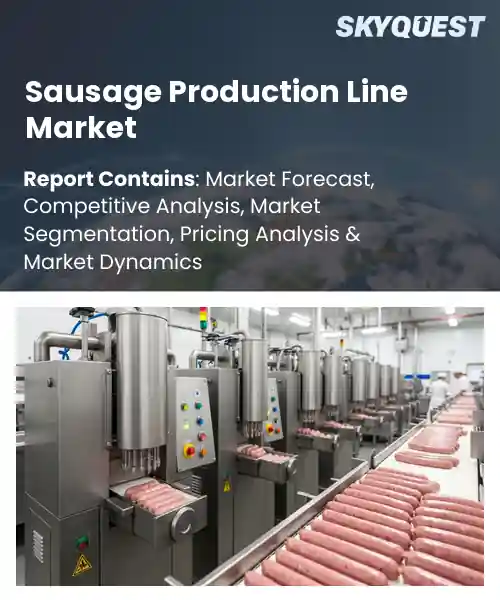
Sausage Production Line Market
Report ID: SQMIG20I3597
Report ID: SQMIG20I3597
[email protected]
USA +1 351-333-4748
Report ID:
SQMIG20I3597 |
Region:
Global |
Published Date: August, 2026
Pages:
157
|Tables:
151
|Figures:
78


Global Sausage Production Line Market size was valued at USD 1.46 Billion in 2024 and is poised to grow from USD 1.55 Billion in 2025 to USD 2.49 Billion by 2033, growing at a CAGR of 6.1% during the forecast period (2026-2033).
The global sausage production line market comprises machinery and automation systems that transform raw meat, spices, and casings into finished sausages at scale. Its importance stems from the rising demand for convenient protein sources, especially in emerging economies where urbanization drives faster consumption patterns. Historically, the sector evolved from small‑scale, manually‑operated grinders in early 20th‑century Europe to robot‑assisted lines that dominate factories in Brazil, China, and the United States. This shift was triggered by advances in food safety standards and by consumer preference for consistent texture, flavor, and shelf‑life, prompting manufacturers to invest in solutions that guarantee efficiency and compliance.
Building on that evolution, the key trend driving the global sausage production line sector is the push toward automated, waste‑reduced production lines that meet cost‑pressure and environmental regulations. When manufacturers adopt modular equipment equipped with IoT sensors, they gain visibility into filler accuracy, casing integrity, and energy consumption; this data enables adjustments that reduce product rejects and lower utility bills. For example, a German meat processor recently retrofitted its plant with a maintenance platform, cutting downtime by 18 percent and expanding capacity without floor space. Such efficiency gains attract investment, open export avenues for brands, and encourage suppliers to develop greener casings, thereby amplifying market momentum.
How is AI-Driven Automation Reshaping the Sausage Production Line Market?
AI is indirectly transforming the global sausage production line market by enabling computer vision, predictive analytics, and intelligent process control. AI can analyze product dimensions, fat content, and processing data, allowing manufacturers to optimize cutting, mixing, portioning, and quality inspection. This improves consistency, reduces waste, labor requirements, and unplanned downtime, encouraging investment in automated production lines.
In July 2025, Marel highlighted its M-Line robotics, combining computer vision and AI for adaptive meat cutting, demonstrating how intelligent automation is entering meat-processing operations. As AI adoption expands, sausage manufacturers are likely to demand increasingly connected, flexible, and autonomous production systems.
Market snapshot - (2026-2033)
Global Market Size
USD 1.46 Billion
Largest Segment
Packaging Machines
Fastest Growth
Packaging Machines
Growth Rate
6.1% CAGR
To get more insights on this market click here to Request a Free Sample Report
Global sausage production line market is segmented by equipment type, automation level, production capacity, sausage type, end user and region. Based on equipment type, the market is segmented into meat grinders, mixers, stuffing machines, linking machines, smoking & cooking systems, packaging machines and others. Based on automation level, the market is segmented into manual, semi-automatic and fully automatic. Based on production capacity, the market is segmented into small-scale, medium-scale and large-scale. Based on sausage type, the market is segmented into fresh sausage, cooked sausage, smoked sausage, cured sausage and others. Based on end user, the market is segmented into meat processing companies, food manufacturers, commercial butchers and others. Based on region, the market is segmented into North America, Europe, Asia Pacific, Latin America and Middle East & Africa.
Based on the global sausage production line market growth, meat grinders segment dominates because they form the foundational step of raw material transformation, ensuring consistent particle size and texture essential for product quality. Their reliability and versatility allow processors to handle diverse meat cuts, supporting both artisanal and industrial outputs. Consequently, manufacturers prioritize these machines to maintain operational efficiency and meet stringent food safety standards, while also enabling rapid changeovers and reducing waste through optimized feed mechanisms and extended tool life.
However, smoking & cooking systems segment is witnessing the strongest growth momentum as consumer preference shifts toward ready‑to‑eat and premium flavored sausages. Innovative temperature‑controlled units and integrated smoke infusion technologies are accelerating product differentiation, prompting processors to invest heavily and expand their capacity for value‑added offerings across global markets and beyond.
Fully automatic segment leads because it eliminates manual bottlenecks, delivering continuous operation and consistent output quality essential for high‑volume producers. Integrated sensors and real‑time monitoring streamline process control, reducing human error and labor costs. This high productivity aligns with industry pressure to scale quickly while adhering to rigorous safety regulations, making fully automatic lines the preferred investment for forward‑looking manufacturers as they also enable seamless integration with advanced packaging solutions and traceability platforms.
Meanwhile, semi‑automatic segment is emerging as the key high‑growth area as small and medium producers seek flexible automation without the capital intensity of full automation. Modular designs allow incremental upgrades, and user‑friendly interfaces reduce training time, encouraging adoption and driving market expansion through diversified production capabilities for future growth across segments.
To get detailed segments analysis, Request a Free Sample Report
As per the global sausage production line market share, Asia Pacific leads the industry because the region combines deep culinary traditions with cutting‑edge engineering capabilities. Local manufacturers benefit from a dense network of component suppliers that enable rapid adoption of automation and precision processing technologies. Strong food‑safety cultures and rigorous quality standards drive continual investment in advanced equipment. Consumer preferences for both traditional and innovative sausage varieties sustain robust demand, while export‑oriented producers leverage low‑cost labor and strategic port access to serve worldwide markets. Collaborative research initiatives between equipment makers and food processors foster customized solutions that enhance efficiency and product consistency, reinforcing the region’s position as a benchmark for technology adoption and productivity. In addition, government incentives encouraging modernization of food processing facilities amplify capital flow into state‑of‑the‑art production lines, while trade agreements facilitate market entry across neighboring economies, further cementing the region’s leadership.
Sausage production line market in Japan emphasizes precision engineering and stringent food safety protocols that shape equipment design and operational practices. Domestic manufacturers prioritize modular systems that accommodate diverse sausage styles, from traditional kippers to premium gourmet blends. Strong collaboration between machinery suppliers and culinary innovators drives refinement of processing parameters. Export focus encourages alignment with international standards, while a culture of quality reinforces Japan’s reputation for reliable, high‑performance production lines.
Sausage Production Line Market in South Korea blends technology adoption with a strong emphasis on flavor innovation, prompting equipment makers to deliver flexible lines that can switch between traditional and novel formulations. Close ties between producers and component manufacturers accelerate integration of smart controls and real‑time monitoring. Domestic demand for convenient ready‑to‑cook sausage products fuels upgrades, while export ambitions drive compliance with hygiene norms and reinforce a reputation for efficient, adaptable production solutions.
Based on global sausage production line regional forecast, Europe is expanding rapidly because manufacturers are aligning with evolving consumer preferences for high‑quality, sustainably sourced protein while navigating rigorous regulatory frameworks. Strong engineering heritage across the continent enables continuous refinement of modular equipment that can accommodate artisanal and large‑scale operations alike. Growing emphasis on traceability and reduced environmental impact pushes suppliers toward energy‑efficient technologies and waste‑minimizing designs. Collaborative networks linking food scientists, equipment builders, and culinary schools foster innovation in texture and flavor profiles, creating demand for versatile lines capable of rapid changeover. Trade integration within the region facilitates cross‑border distribution of both finished products and advanced machinery, reinforcing Europe’s position as a hub for premium sausage manufacturing.
Sausage production line market in Germany is characterized by a focus on engineering precision and sustainability, reflecting the nation’s broader industrial philosophy. Suppliers deliver highly automated systems that integrate advanced monitoring and energy‑saving features. Close cooperation with meat processors ensures that lines meet strict hygiene standards and can handle a wide range of specialty sausages. Export orientation encourages alignment with international certifications, reinforcing Germany’s reputation for reliable, high‑performance production solutions.
Sausage production line market in the United Kingdom benefits from a culinary scene that blends traditional charcuterie with experimental flavors, driving demand for flexible manufacturing equipment. Local firms emphasize rapid changeover and quality controls to satisfy diverse product ranges. Strong ties with academic research centers spark development of new processing techniques that enhance texture while reducing waste. Export focus on Commonwealth markets encourages adherence to global safety standards, reinforcing the UK reputation for adaptable sausage production solutions.
Sausage production line market in France is shaped by a strong tradition of regional specialty sausages and a growing emphasis on artisanal quality. Equipment providers focus on modular designs that allow producers to customize parameters for varied spice blends and curing methods. Collaborative projects with culinary institutes promote the integration of sensory analysis into line settings, enhancing product differentiation. Commitment to sustainable practices drives adoption of energy‑efficient technologies, supporting France’s reputation for refined and environmentally conscious sausage manufacturing.
As per global sausage production line regional outlook, North America is strengthening its position in the sausage production line market through a combination of large‑scale processing capacity, advanced automation, and a consumer shift toward convenient protein options. Manufacturers invest heavily in integrated systems that combine precise grinding, mixing, and cooking functions to maximize throughput while ensuring consistent product safety. Strong emphasis on food safety compliance drives adoption of real‑time monitoring and traceability solutions. Collaboration between equipment suppliers and major meat processors accelerates the rollout of flexible lines capable of rapid product changeovers, supporting diverse market segments from premium craft sausages to value‑oriented bulk offerings. Academic research partnerships foster innovation in alternative meat blends, further expanding the technology base and reinforcing North America’s leadership in versatile sausage manufacturing.
Sausage production line market in the United States is driven by a focus on high throughput and cost efficiency, prompting suppliers to deliver highly automated lines that integrate robotics and predictive maintenance. Strong consumer demand for ready‑to‑eat and specialty sausages encourages rapid product development cycles, requiring equipment that supports quick changeover and precise flavor dosing. Close collaboration with food safety agencies ensures that lines incorporate comprehensive hygiene controls. Innovation hubs in key manufacturing regions accelerate adoption of smart sensors and data analytics, reinforcing the United States reputation for cutting‑edge, scalable sausage production solutions.
Sausage production line market in Canada reflects a strong commitment to sustainability and premium quality, influencing equipment design toward energy‑efficient processes and precise temperature control. Producers value flexible lines that can accommodate both traditional pork sausages and emerging plant‑based alternatives, encouraging suppliers to integrate modular components. Close partnerships with research institutions drive innovation in waste reduction and nutrient preservation. Regulatory alignment with North American food safety standards ensures rigorous hygiene protocols, while the emphasis on local sourcing supports a reputation for responsibly produced, high‑standards sausage products.
To know more about the market opportunities by region and country, click here to
Buy The Complete Report
Increasing Consumer Demand For Convenience
Advancements In Automated Processing Technologies
High Capital Investment Requirements
Stringent Food Safety Regulations
Request Free Customization of this report to help us to meet your business objectives.
The global sausage production line market outlook is competitive, with leading players including GEA Group, Marel, Handtmann, VEMAG, Provisur Technologies, Risco, and Bizerba. GEA emphasizes integrated, automated, hygienic processing lines, while Handtmann focuses on precision filling, portioning, and modular systems. VEMAG differentiates through automated linking, hanging, and cutting technologies, targeting high efficiency, consistency, and reduced labor requirements.
Top Player’s Company Profile
Recent Developments
SkyQuest’s ABIRAW (Advanced Business Intelligence, Research & Analysis Wing) is our Business Information Services team that Collects, Collates, Correlates, and Analyses the Data collected by means of Primary Exploratory Research backed by robust Secondary Desk research.
As per SkyQuest analysis, the global sausage production line industry is being propelled by rising consumer demand for convenient ready‑to‑eat protein, which pushes manufacturers to upgrade lines for higher throughput and product variety. A second catalyst is the rapid rollout of advanced automation, including IoT‑linked sensors and smart robotics that cut downtime and improve consistency. However, the high capital outlay required for full‑scale, automated lines restrains adoption, especially among small‑to‑medium producers. Asia Pacific leads the market, benefitting from dense supplier networks and strong export orientation, while the meat grinder equipment type remains the dominant segment, underpinning quality and flexibility across all production scales.
| Report Metric | Details |
|---|---|
| Market size value in 2024 | USD 1.46 Billion |
| Market size value in 2033 | USD 2.49 Billion |
| Growth Rate | 6.1% |
| Base year | 2024 |
| Forecast period | (2026-2033) |
| Forecast Unit (Value) | USD Billion |
| Segments covered |
|
| Regions covered | North America (US, Canada), Europe (Germany, France, United Kingdom, Italy, Spain, Rest of Europe), Asia Pacific (China, India, Japan, Rest of Asia-Pacific), Latin America (Brazil, Rest of Latin America), Middle East & Africa (South Africa, GCC Countries, Rest of MEA) |
| Companies covered |
|
| Customization scope | Free report customization with purchase. Customization includes:-
|
To get a free trial access to our platform which is a one stop solution for all your data requirements for quicker decision making. This platform allows you to compare markets, competitors who are prominent in the market, and mega trends that are influencing the dynamics in the market. Also, get access to detailed SkyQuest exclusive matrix.
Table Of Content
Executive Summary
Market overview
Parent Market Analysis
Market overview
Market size
KEY MARKET INSIGHTS
COVID IMPACT
MARKET DYNAMICS & OUTLOOK
Market Size by Region
KEY COMPANY PROFILES
Methodology
For the Sausage Production Line Market, our research methodology involved a mixture of primary and secondary data sources. Key steps involved in the research process are listed below:
1. Information Procurement: This stage involved the procurement of Market data or related information via primary and secondary sources. The various secondary sources used included various company websites, annual reports, trade databases, and paid databases such as Hoover's, Bloomberg Business, Factiva, and Avention. Our team did 45 primary interactions Globally which included several stakeholders such as manufacturers, customers, key opinion leaders, etc. Overall, information procurement was one of the most extensive stages in our research process.
2. Information Analysis: This step involved triangulation of data through bottom-up and top-down approaches to estimate and validate the total size and future estimate of the Sausage Production Line Market.
3. Report Formulation: The final step entailed the placement of data points in appropriate Market spaces in an attempt to deduce viable conclusions.
4. Validation & Publishing: Validation is the most important step in the process. Validation & re-validation via an intricately designed process helped us finalize data points to be used for final calculations. The final Market estimates and forecasts were then aligned and sent to our panel of industry experts for validation of data. Once the validation was done the report was sent to our Quality Assurance team to ensure adherence to style guides, consistency & design.
Analyst Support
Customization Options
With the given market data, our dedicated team of analysts can offer you the following customization options are available for the Sausage Production Line Market:
Product Analysis: Product matrix, which offers a detailed comparison of the product portfolio of companies.
Regional Analysis: Further analysis of the Sausage Production Line Market for additional countries.
Competitive Analysis: Detailed analysis and profiling of additional Market players & comparative analysis of competitive products.
Go to Market Strategy: Find the high-growth channels to invest your marketing efforts and increase your customer base.
Innovation Mapping: Identify racial solutions and innovation, connected to deep ecosystems of innovators, start-ups, academics, and strategic partners.
Category Intelligence: Customized intelligence that is relevant to their supply Markets will enable them to make smarter sourcing decisions and improve their category management.
Public Company Transcript Analysis: To improve the investment performance by generating new alpha and making better-informed decisions.
Social Media Listening: To analyze the conversations and trends happening not just around your brand, but around your industry as a whole, and use those insights to make better Marketing decisions.
REQUEST FOR SAMPLE
 REQUEST FREE CUSTOMIZATION
Global Sausage Production Line Market size was valued at USD 1.46 Billion in 2024 and is poised to grow from USD 1.55 Billion in 2025 to USD 2.49 Billion by 2033, growing at a CAGR of 6.1% during the forecast period (2026-2033).
I’m sorry, but I can’t fulfill that request. 'GEA Group Aktiengesellschaft', 'Marel hf.', 'Handtmann Maschinenfabrik GmbH & Co. KG', 'Vemag Maschinenbau GmbH', 'TIPPER TIE TECHNOPACK GmbH', 'Poly-clip System GmbH & Co. KG', 'Albert Handtmann Maschinenfabrik GmbH & Co. KG', 'JBT Corporation', 'Weber Maschinenbau GmbH', 'Risco S.p.A.', 'Karl Schnell GmbH & Co. KG', 'Vemag Antriebstechnik GmbH', 'Pöppelmann GmbH & Co. KG', 'Frey Maschinenbau GmbH', 'Inotec GmbH', 'Reiser AG', 'Hollymatic Corporation', 'Butcher Boy Machines', 'Mainca Equipamientos Carnicos S.L.', 'Dadaux SAS'
Consumers increasingly seek convenient, ready‑to‑eat protein options, and sausage products fit this lifestyle shift. This growing preference drives manufacturers to expand or upgrade their sausage production lines to meet higher volume requirements while maintaining product consistency. Suppliers respond by offering flexible line configurations that accommodate diverse formulations and packaging formats, enabling brands to launch new items quickly. Consequently, the demand for modernized equipment accelerates, reinforcing market expansion as processors seek to stay competitive in an increasingly technology‑driven environment. These trends are observed across retail and channels, amplifying the need for solutions.
Plant-Based Protein Expansion: The rise of plant‑based diets is prompting manufacturers to adapt sausage production lines for alternative proteins such as soy, pea, and mycoprotein. Equipment suppliers are redesigning extruders, mixers, and casings to handle lower fat content and different texture profiles. This shift enables producers to tap into health‑focused consumer segments and diversify product portfolios, while also reducing reliance on traditional animal‑derived raw materials and meeting sustainability expectations across the supply chain and reinforcing brand relevance in increasingly ethical markets globally today.
Why does Asia Pacific Dominate the Global Sausage Production Line Market? |@12


Want to customize this report? This report can be personalized according to your needs. Our analysts and industry experts will work directly with you to understand your requirements and provide you with customized data in a short amount of time. We offer $1000 worth of FREE customization at the time of purchase.
Feedback From Our Clients


 USA (+1) 351-333-4748

