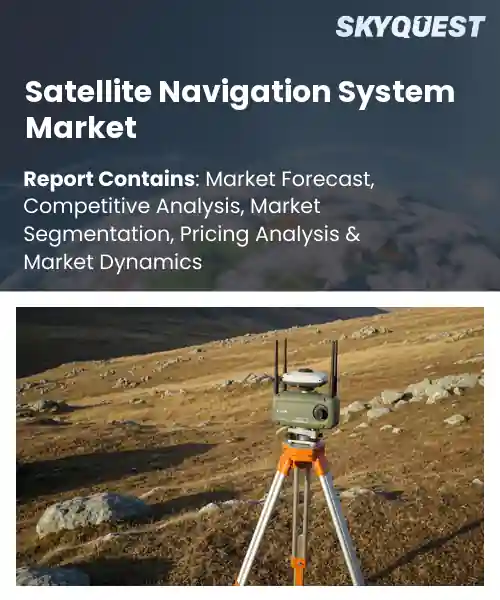
Satellite Navigation System Market
Report ID: SQMIG20A2610
Report ID: SQMIG20A2610
[email protected]
USA +1 351-333-4748
Report ID:
SQMIG20A2610 |
Region:
Global |
Published Date: May, 2026
Pages:
157
|Tables:
185
|Figures:
79


Global Satellite Navigation System Market size was valued at USD 61.1 Billion in 2024 and is poised to grow from USD 63.91 Billion in 2025 to USD 91.59 Billion by 2033, growing at a CAGR of 4.6% during the forecast period (2026-2033).
The satellite navigation system industry comprises global positioning, navigation and timing services delivered through constellations such as GPS, GLONASS, Galileo and BeiDou, with augmentation, receivers and value added software. Its primary driver is the relentless demand for precise, affordable location and timing across consumer, industrial and government sectors, which has evolved from military origins into ubiquitous civilian use. Today, applications ranging from aviation and maritime safety to ride hailing and precision agriculture illustrate why this market matters.Building on civilian reliance, a key growth factor is the exponential increase in connected devices and accuracy and resilience requirements, which creates demand for advanced receivers, augmentation and value added services.
As smartphones, autonomous vehicles, drones and precision agriculture systems require centimeter level positioning, vendors respond with multi constellation chipsets, RTK and PPP corrections and sensor fusion, lowering costs and enabling new services such as autonomous navigation and field level variable rate application. Regulatory mandates for safety and 5G network timing further compel infrastructure investment, so providers monetize corrections, resilient PNT offerings and SaaS analytics that convert positioning into revenue.
How is AI enhancing positioning accuracy in the satellite navigation system market?
AI improves positioning accuracy by combining three complementary capabilities. The market is moving toward integrated chipset level AI and edge machine learning so providers can offer more reliable and consistent positioning for autonomous vehicles drones and precision agriculture.
Point One Navigation in February 2026, announced a partnership to expand centimetre accurate positioning across Europe using sensor fusion and physical AI. This development shows how AI enabled fusion and networked corrections boost efficiency and market adoption by improving reliability and reducing time to obtain a precise fix.
Market snapshot - (2026-2033)
Global Market Size
USD 61.1 Billion
Largest Segment
Global Navigation Satellite Systems
Fastest Growth
Satellite-based Augmentation Systems
Growth Rate
4.6% CAGR
To get more insights on this market click here to Request a Free Sample Report
Global satellite navigation system market is segmented by system type, component, application, end-use industry, technology, platform and region. Based on system type, the market is segmented into Global Navigation Satellite Systems, Regional Navigation Satellite Systems, Satellite-based Augmentation Systems and Differential Navigation Systems. Based on component, the market is segmented into Hardware, Software and Services. Based on application, the market is segmented into Automotive Navigation, Aviation Navigation, Marine Navigation, Defense & Military Navigation, Surveying & Mapping, Agriculture Guidance Systems, Location-based Services and Others. Based on end-use industry, the market is segmented into Automotive, Aerospace & Defense, Marine, Agriculture, Construction, Consumer Electronics, Logistics & Transportation and Others. Based on technology, the market is segmented into GPS, GLONASS, Galileo, BeiDou, NavIC and Multi-constellation Systems. Based on platform, the market is segmented into Portable Navigation Systems, Embedded Navigation Systems and Wearable Navigation Devices. Based on region, the market is segmented into North America, Europe, Asia Pacific, Latin America and Middle East & Africa.
Global navigation satellite systems segment dominates because their extensive space and ground infrastructure provides the foundational positioning, navigation and timing backbone used across industries. Broad compatibility with receivers, established interoperability standards and deep OEM and service provider integration create a large installed base that shapes product roadmaps. This mature ecosystem reduces deployment risk, supports diverse use cases from transportation to surveying, and attracts investment that reinforces technology leadership and market preference.
As per satellite navigation system market outlook, satellite based augmentation systems are emerging as the most rapidly expanding area, driven by rising demand for high precision corrections in safety critical aviation and precision agriculture. Regulatory emphasis on certified accuracy, increasing integration with modern receivers and new commercial services spur adoption, enabling specialized applications and creating avenues for premium services, value added applications and service layer monetization.
As per satellite navigation system market analysis, multi-constellation Systems segment dominates because combining signals from multiple constellations materially improves availability, positioning continuity and resistance to signal blockage. Device manufacturers and service providers favor this approach to reduce single-source vulnerabilities and to meet diverse application requirements from automotive to critical infrastructure. Broader signal diversity simplifies certification paths for robust products, accelerates integration into consumer and industrial platforms, and fosters ecosystem investments that perpetuate adoption.
As per satellite navigation system market forecast, BeiDou is witnessing the strongest growth momentum as providers and device makers integrate its unique signals and augmentation features to serve new commercial use cases. Targeted industry partnerships, expanding compatibility in chips and growing interest in alternate signal types are driving rapid incorporation, unlocking specialized services for timing, messaging and precision applications and catalyzing new vendor opportunities.
To get detailed segments analysis, Request a Free Sample Report
As per satellite navigation system industry analysis, Asia Pacific region leads the market due to strong industrial ecosystems, concentrated manufacturing capabilities, quick adoption of technology and coordinated policy support. The positioning modules are quickly integrated into smartphones, automobiles and industrial equipment in large consumer electronics clusters and automotive supply chains. Regional focus on R&D leads to breakthroughs in component downsizing, multi constellation receivers and software defined navigation. marine and logistics activity is driving the demand for marine and fleet tracking systems, while agriculture and construction sectors are adopting precise navigation to enhance production. The collaboration among regional system providers, chipmakers and service operators will lead to efficient commercialization paths that reinforce market leadership and build resilient supply networks across the area. Urbanization and smart city programs are driving demand for high precision location services and enabling public-private collaborations that speed deployment.
The presence of an electronics manufacturing base together with superior research capabilities that promote the development and integration of high precision receivers in automobile and rail systems are driving the Japanese Satellite Navigation System Market. Quick product iterations are possible thanks to established supply chains and an incremental innovation culture. The robust demand from marine navigation and urban transportation projects, collaborative industry research and solid regulatory frameworks are sustaining the complex ecosystem for end to end navigation solutions.
South Korea is driven by strong semiconductor and telecommunications sectors that stimulate development of positioning modules and navigation services. Integration with mobile platforms and smart infrastructure initiatives promotes local innovation. Electronics manufacturers and system integrators work together with service providers to develop solutions for automotive, logistics and public safety use cases. Policy support for technology adoption and industry cooperation creates a competitive environment for navigation goods.
North America is growing rapidly driven by a strong innovation environment, strong commercial demand and wide deployment across defence, aerospace and civilian applications. With an established supply base of chipset makers, software developers and systems integrators, product development and market readiness are accelerated. We provide robust augmentation services and resilient positioning solutions through strong partnership between industry, research institutions and service operators. The ubiquitous use in linked vehicles, logistics, mapping and location based services generates a continuous demand for better accuracy and reliable performance. Regulatory clarity and active private investment continue to accelerate the development of new navigation technologies and customized solutions for the enterprise and consumer markets. Big civil engineering projects and the exact timing needed for telecommunications make the need for solid sources of positioning and timing even greater. Public procurement and strategic alliances can facilitate scalable pilots and broader adoption across sectors.
United States is supported by extensive aerospace and defense knowledge, leading chipset design labs and a mix of startups and established enterprises. Demand from autonomous vehicle programs, logistics carriers and precision agriculture is driving development of powerful receivers and augmentation services. Run active public procurement and research ecosystems to encourage interoperability testing and standards alignment. Private investment and commercial satellite activity has backed the wide market for enhanced navigation technologies.
Canada leverages a strong geospatial industry, extensive need for remote and maritime positioning, and collaboration between vendors, research institutions. Demand from resource extraction, surveying and transportation sectors encourages adoption of receivers and augmentation services tailored for challenging environments. Government procurement and innovation clusters support deployments. Close ties between system integrators and end users enable customized solutions for forestry, mining, offshore operations and national infrastructure management.
With concerted investment in regional infrastructure, a strong focus on interoperability and active cooperation between business, research institutes and public bodies, Europe is expanding its position in the satellite navigation system market. European efforts develop independent capabilities and value added services that supplement global navigation constellations, and standardized methodologies enable cross border deployment across transport, maritime and aviation sectors. The development of safety essential navigation products is supported by a dense network of aerospace suppliers, specialist integrators and professional engineering personnel. Industry consortia and public procurement are targeting resilience and cybersecurity, therefore increasing the commercialization of augmentation services, precise timing applications and integrated solutions customized to regulatory and operational requirements across different markets. An increased need for urban mobility, automated transport and connected infrastructure is the key driver for the development of downstream services and novel business models. Fast validation and scaling of novel navigation applications through cross sector pilots and continental testing facilities.
Germany market is powered by the strong automotive and precision engineering sectors, which are focused on integrating high accuracy positioning into cars and equipment. System integrators and testing facilities facilitate the creation of robust receivers and augmentation solutions for safety essential applications. Manufacturers, research centers and standards bodies work closely together to support interoperability. Localized customisation and dependable implementation are being driven across the country by demand from the logistics, rail and manufacturing sectors.
As per satellite navigation system market regional forecast, United Kingdom draws on a strong services sector, navigation software companies, academic research advancing positioning technologies. Precise location integration across urban mobility, maritime safety and aviation is supported by industry consortia and standards engagement. Small firms and system integrators develop bespoke augmentation and monitoring services for complex environments. Public procurement and international partnerships enable testing, certification and broader adoption in commercial and public sector applications.
As per satellite navigation system market regional outlook, France builds on a strong aerospace industry, research institutions and integrators focusing on reliable positioning and augmentation services. Collaboration between public agencies and private firms supports development of safety critical navigation systems for aviation, rail and maritime sectors. Innovation clusters foster SMEs creating tailored solutions for timing, precision agriculture and urban mobility. Strategic procurement and cross sector pilots help validate technologies and accelerate operational adoption.
To know more about the market opportunities by region and country, click here to
Buy The Complete Report
Growing Use Of Satellite Navigation
Technological Advancements In Receivers
Regulatory And Spectrum Challenges
High Implementation And Maintenance Costs
Request Free Customization of this report to help us to meet your business objectives.
Competitive landscape is shifting as incumbents and new entrants race to commercialize resilient PNT via M&A, partnerships and LEO innovations. Examples include Iridium acquiring a satellite time and location specialist and startups advancing LEO PNT prototypes. Market drivers tied to competition include demand for GPS resilience from autonomous systems and critical infrastructure, prompting strategic acquisitions, tech partnerships and focused R and D demonstrations.
SkyQuest’s ABIRAW (Advanced Business Intelligence, Research & Analysis Wing) is our Business Information Services team that Collects, Collates, Correlates, and Analyses the Data collected by means of Primary Exploratory Research backed by robust Secondary Desk research.
As per SkyQuest analysis, the global satellite navigation system market growth is propelled by growing demand for precise, affordable location and timing across consumer, industrial and government sectors as a key driver, while regulatory and spectrum challenges serve as a major restraint. The dominating region is Asia Pacific, supported by manufacturing scale and rapid technology adoption, and the dominating segment is global navigation satellite systems due to their foundational infrastructure and interoperability. A second driver is technological advancements in receivers and AI-enabled sensor fusion that improve accuracy and resilience, enabling new applications from autonomous vehicles to precision agriculture and monetizable correction services. The global satellite navigation system market trend is experiencing robust growth, driven by the increasing adoption of location-based services, expanding deployment of connected and autonomous vehicles, and rising demand for precise positioning, navigation, and timing (PNT) solutions across transportation, defense, aviation, agriculture and telecommunications sectors.
| Report Metric | Details |
|---|---|
| Market size value in 2024 | USD 61.1 Billion |
| Market size value in 2033 | USD 91.59 Billion |
| Growth Rate | 4.6% |
| Base year | 2024 |
| Forecast period | (2026-2033) |
| Forecast Unit (Value) | USD Billion |
| Segments covered |
|
| Regions covered | North America (US, Canada), Europe (Germany, France, United Kingdom, Italy, Spain, Rest of Europe), Asia Pacific (China, India, Japan, Rest of Asia-Pacific), Latin America (Brazil, Rest of Latin America), Middle East & Africa (South Africa, GCC Countries, Rest of MEA) |
| Companies covered |
|
| Customization scope | Free report customization with purchase. Customization includes:-
|
To get a free trial access to our platform which is a one stop solution for all your data requirements for quicker decision making. This platform allows you to compare markets, competitors who are prominent in the market, and mega trends that are influencing the dynamics in the market. Also, get access to detailed SkyQuest exclusive matrix.
Table Of Content
Executive Summary
Market overview
Parent Market Analysis
Market overview
Market size
KEY MARKET INSIGHTS
COVID IMPACT
MARKET DYNAMICS & OUTLOOK
Market Size by Region
KEY COMPANY PROFILES
Methodology
For the Satellite Navigation System Market, our research methodology involved a mixture of primary and secondary data sources. Key steps involved in the research process are listed below:
1. Information Procurement: This stage involved the procurement of Market data or related information via primary and secondary sources. The various secondary sources used included various company websites, annual reports, trade databases, and paid databases such as Hoover's, Bloomberg Business, Factiva, and Avention. Our team did 45 primary interactions Globally which included several stakeholders such as manufacturers, customers, key opinion leaders, etc. Overall, information procurement was one of the most extensive stages in our research process.
2. Information Analysis: This step involved triangulation of data through bottom-up and top-down approaches to estimate and validate the total size and future estimate of the Satellite Navigation System Market.
3. Report Formulation: The final step entailed the placement of data points in appropriate Market spaces in an attempt to deduce viable conclusions.
4. Validation & Publishing: Validation is the most important step in the process. Validation & re-validation via an intricately designed process helped us finalize data points to be used for final calculations. The final Market estimates and forecasts were then aligned and sent to our panel of industry experts for validation of data. Once the validation was done the report was sent to our Quality Assurance team to ensure adherence to style guides, consistency & design.
Analyst Support
Customization Options
With the given market data, our dedicated team of analysts can offer you the following customization options are available for the Satellite Navigation System Market:
Product Analysis: Product matrix, which offers a detailed comparison of the product portfolio of companies.
Regional Analysis: Further analysis of the Satellite Navigation System Market for additional countries.
Competitive Analysis: Detailed analysis and profiling of additional Market players & comparative analysis of competitive products.
Go to Market Strategy: Find the high-growth channels to invest your marketing efforts and increase your customer base.
Innovation Mapping: Identify racial solutions and innovation, connected to deep ecosystems of innovators, start-ups, academics, and strategic partners.
Category Intelligence: Customized intelligence that is relevant to their supply Markets will enable them to make smarter sourcing decisions and improve their category management.
Public Company Transcript Analysis: To improve the investment performance by generating new alpha and making better-informed decisions.
Social Media Listening: To analyze the conversations and trends happening not just around your brand, but around your industry as a whole, and use those insights to make better Marketing decisions.
REQUEST FOR SAMPLE
 REQUEST FREE CUSTOMIZATION
Global Satellite Navigation System Market size was valued at USD 61.1 Billion in 2024 and is poised to grow from USD 63.91 Billion in 2025 to USD 91.59 Billion by 2033, growing at a CAGR of 4.6% during the forecast period (2026-2033).
Competitive landscape is shifting as incumbents and new entrants race to commercialize resilient PNT via M&A, partnerships and LEO innovations. Examples include Iridium acquiring a satellite time and location specialist and startups advancing LEO PNT prototypes. Market drivers tied to competition include demand for GPS resilience from autonomous systems and critical infrastructure, prompting strategic acquisitions, tech partnerships and focused R and D demonstrations. 'Garmin', 'Trimble', 'TomTom', 'Hexagon', 'Qualcomm', 'Broadcom', 'MediaTek', 'u-blox', 'Thales Group', 'Honeywell International', 'Raytheon Technologies', 'Furuno Electric', 'Topcon Corporation', 'Septentrio', 'NavCom Technology', 'Cobham', 'General Dynamics', 'L3Harris Technologies', 'Mitsubishi Electric', 'Rockwell Collins'
Growing use of satellite navigation for a wide range of commercial and governmental functions motivates suppliers to expand capabilities and offerings, directly supporting market growth. As logistics, autonomous systems, precision agriculture, public safety, and network synchronization increasingly rely on reliable positioning and timing, providers respond with diversified products, software enhancements, and tailored services to meet varied operational needs. This sustained, application driven demand encourages continued research, ecosystem partnerships, and deployment of new receivers and value added services, enabling vendors to scale production and broaden market reach.
Urban Location-Based Services: Rapid urbanization and demand for smart-city applications are driving adoption of high-accuracy satellite navigation integrated with complementary sensors and networks. Service providers are focusing on seamless indoor-outdoor handoff, contextualized navigation for transit, micromobility and asset tracking, and privacy-aware location monetization models. Collaboration between public authorities and private operators is enabling scalable deployments, while platform differentiation centers on low-latency positioning, interoperability with communication infrastructures, and user-centric services that enhance safety, efficiency and urban livability. Ecosystem partnerships accelerate tailored applications for citizens.
Why does Asia Pacific Dominate the Global Satellite Navigation System Market? |@12


Want to customize this report? This report can be personalized according to your needs. Our analysts and industry experts will work directly with you to understand your requirements and provide you with customized data in a short amount of time. We offer $1000 worth of FREE customization at the time of purchase.
Feedback From Our Clients


 USA (+1) 351-333-4748

