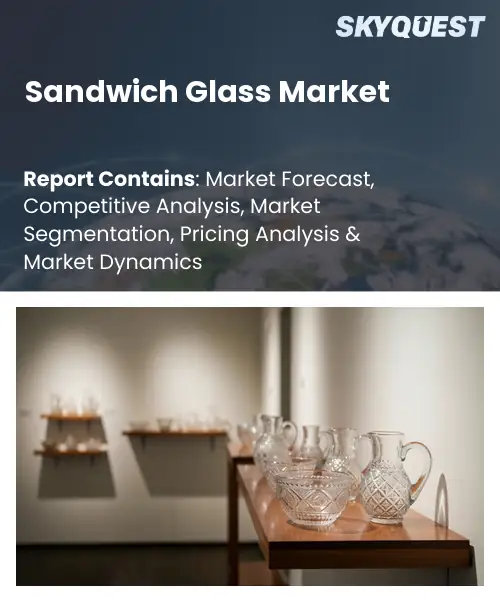
Sandwich Glass Market
Report ID: SQMIG15F2316
Report ID: SQMIG15F2316
[email protected]
USA +1 351-333-4748
Report ID:
SQMIG15F2316 |
Region:
Global |
Published Date: April, 2026
Pages:
157
|Tables:
116
|Figures:
77


Global Sandwich Glass Market size was valued at USD 2.1 Billion in 2024 and is poised to grow from USD 2.22 Billion in 2025 to USD 3.49 Billion by 2033, growing at a CAGR of 5.8% during the forecast period (2026-2033).
As a research analyst the sandwich glass market is the sector producing laminated multi-layer glazing that combines glass sheets with polymeric interlayers to improve safety, acoustics and thermal performance. Its primary driver is regulatory and consumer demand for occupant protection and building resilience after decades of urbanization increased glazing use. Historically the market evolved from early laminated safety glass introduced for automotive windshields into sophisticated architectural facades and specialty security applications, exemplified by high-rise curtain walls and armored vehicle glazing. This evolution matters because improved materials reduce injury, meet codes and enable new design aesthetics that reshape construction and mobility.Principal factor shaping the global sandwich glass market is technological advancement in interlayer materials and lamination processes because enhanced polymers improve strength, clarity and UV resistance and thereby unlock applications limited by prior performance. As manufacturers adopt ionoplast interlayers and autoclave-free continuous lamination, production yields rise and per-unit costs fall, causing wider uptake in electric vehicle glazing, solar module encapsulation and blast-resistant façades. For example, EV manufacturers use lightweight laminated glass to lower vehicle mass while preserving safety, and solar firms integrate glass to boost panel durability. These dynamics create opportunities for retrofit programs, vertically integrated suppliers and regional expansion.
How is automation improving manufacturing efficiency in the Sandwich glass market?
Automation is transforming sandwich glass manufacturing by standardizing layered assembly and removing repetitive manual steps. Key aspects include robotic handling of fragile panes, automated spacer application, optimized cutting with nesting algorithms and AI driven scheduling. The current state shows fabricators adopting intelligent conveyors, furnace monitoring and batch optimization to reduce waste, improve yield and ensure consistent interlayer bonding. Market pressure from labor shortages and rising demand for high performance laminated and insulated products is accelerating adoption. Automated lines boost throughput, cut rework and allow producers to deliver complex sandwich configurations with greater repeatability and lower operating strain.Forel February 2026, introduced the Dura Line with automated spacer application and integrated gas filling that streamlines insulated sandwich assembly. This real world development shortens cycle times, reduces manual touchpoints and helps scale laminated product output through robotics and centralized controls.
Market snapshot - (2026-2033)
Global Market Size
USD 2.1 Billion
Largest Segment
Laminated Glass
Fastest Growth
Laminated Glass
Growth Rate
5.8% CAGR
To get more insights on this market click here to Request a Free Sample Report
Global sandwich glass market is segmented by product type, application, end user, sales channel and region. Based on product type, the market is segmented into Tempered Glass, Laminated Glass and Annealed Glass. Based on application, the market is segmented into Residential Use, Commercial Use and Automotive Use. Based on end user, the market is segmented into Architects, Construction Firms and Manufacturers. Based on sales channel, the market is segmented into Direct Sales and Distributors. Based on region, the market is segmented into North America, Europe, Asia Pacific, Latin America and Middle East & Africa.
Tempered Glass segment dominates because its thermal strengthening creates high residual stress that markedly improves impact resistance and dimensional stability within sandwich glass assemblies. This predictable toughness reduces handling and installation failures and simplifies safety specification for designers and engineers, making it a preferred core for laminated constructions. Manufacturers and fabricators favor tempered cores for reliable breakage behavior and optical clarity, supporting widespread specification across demanding applications.
However, Laminated Glass is the fastest growing product type because its post-breakage integrity and acoustic plus security benefits broaden applications in façades and protected glazing. Advances in interlayer materials enable tailored thermal, sound and security performance, driving specification changes and creating opportunities for specialty interlayers and bespoke fabrication services that accelerate future market expansion.
Distributors segment dominates because wide wholesale networks and project-focused logistics provide the local inventory, cut-to-size coordination and just-in-time delivery that sandwich glass projects require. Their technical sales teams advise on glazing performance and installation needs, reducing procurement risk for contractors and manufacturers. This distribution capability allows rapid response to complex build schedules and varied specifications, effectively enabling market access for diverse product formulations and finishing options.
However, Direct Sales is the fastest growing channel as manufacturers deepen customer relationships to deliver bespoke sandwich glass solutions and integrated project services. Direct engagement streamlines specification, accelerates technical iteration and supports bundled offerings, while digital quotation and fulfillment reduce procurement friction, improve margins and encourage firms to scale direct capabilities into broader application areas.
To get detailed segments analysis, Request a Free Sample Report
Asia Pacific dominates the global Sandwich Glass Market because regional manufacturing ecosystems combine material supply, specialized production capabilities and integrated supply chains that favor complex laminated and insulated glass assemblies. Robust demand across electronics, automotive glazing and architectural applications encourages local value chains to innovate on materials, lamination techniques and light management. Strategic collaboration between component suppliers and fabricators accelerates product customization for regional OEMs. Concentrated technical expertise and targeted investment in advanced processing equipment enable efficient scale up from prototype to high volume production. Market actors benefit from proximity to major consumer electronics clusters and dense automotive platforms, which sustains a steady pipeline of specification updates and drives adoption of next generation sandwich glass solutions.
Sandwich Glass Market in Japan benefits from close integration with advanced electronics manufacturing, precise fabrication tolerances and emphasis on surface quality for display and imaging applications. Local suppliers and fabricators work closely with OEMs to refine lamination processes and optical performance. The environment favors high mix low volume production, rapid iteration on material formulations and stringent quality assurance protocols that support premium applications and continuous refinement of sandwich glass design.
Sandwich Glass Market in South Korea is driven by strong linkage to consumer electronics clusters, emphasis on thin, lightweight glazing and collaborative R D between material innovators and assemblers. Manufacturers focus on rapid prototyping, integration with touch and sensor layers and durability testing for mobile platforms. Supply chain agility and proximity to regional fabrication hubs enable quick specification updates and tailored lamination solutions for demanding device and speciality display applications.
Rapid expansion of the Sandwich Glass Market in Europe is underpinned by demand from architectural glazing, automotive premium segments and renewable energy applications that require reliable laminated solutions. Strong standards and regulatory frameworks encourage suppliers to prioritize safety, durability and environmental performance, prompting material innovation and supply chain coordination. European fabricators leverage advanced manufacturing practices, customization capabilities and established testing infrastructure to serve complex project requirements. Collaborative clusters around research institutions and specialty glass manufacturers support technical validation and adoption. Access to diverse end use sectors and emphasis on lifecycle considerations reinforce investment in high quality sandwich glass systems tailored to regional specifications. Established distribution networks and specialist fabrication partners also enable efficient project delivery across multiple countries, helping suppliers meet bespoke architectural and industrial requirements with shorter lead times and consistent quality.
Sandwich Glass Market in Germany benefits from a strong engineering tradition, quality assurance culture and integrated supply networks that prioritize performance and safety. Fabricators and material specialists collaborate with architectural and automotive clients to deliver certified laminated and insulated solutions. Emphasis on sustainability and recyclability stimulates use of durable materials and process optimization. The market favors precision manufacturing, testing protocols and user partnerships that support complex glazing projects across industries.
Sandwich Glass Market in the United Kingdom benefits from dynamic construction activity, strong design services and a growing focus on performance glazing for retrofit and new build projects. Innovation hubs and specialist fabricators adapt sandwich constructions for heritage compatible solutions and modern façades. Emphasis on light control, acoustic performance and sustainability drives tailored lamination and interlayer choices. The market favors flexible production capabilities, project delivery and alignment with architectural specifications.
Sandwich Glass Market in France is characterized by strong architectural tradition, emphasis on aesthetic integration and growing demand for high performance glazing in cultural and commercial projects. Local processors and designers collaborate to balance optical clarity, solar control and structural requirements through tailored interlayer and lamination choices. The market supports artisanal approaches alongside industrial fabrication, enabling custom facades and specialty solutions that meet designer specifications and evolving sustainability considerations priorities.
North America is strengthening its position in the Sandwich Glass Market through integration of advanced manufacturing technologies, close collaboration with automotive and architectural OEMs and growing emphasis on performance optimization for regional applications. Suppliers invest in flexible production platforms that support diverse lamination techniques and specialty interlayers suited to harsh environmental and safety requirements. Cross sector partnerships accelerate adaptation of sandwich glass for transportation, commercial construction and specialty displays. Testing infrastructure and certification practices enhance market credibility, while supply chain diversification and targeted technical services enable faster specification response and increased adoption by key end users. Regional technical centers and partnerships with materials research groups support incremental performance improvements and enable producers to tailor sandwich glass offerings for regional climatic and regulatory needs, strengthening competitiveness.
Sandwich Glass Market in the United States benefits from proximity to major automotive and aerospace manufacturers, demand for high performance safety glazing and testing certification resources. Fabricators emphasize scalable production, material qualification and integration with sensor and display technologies. Collaborative development with end users supports lamination approaches for transportation and architectural projects. The market values supply chain resilience, technical support services and adaptability to stringent regional performance and durability requirements.
Sandwich Glass Market in Canada draws on combination of engineering expertise, building standards and focus on performance under varied climatic conditions. Fabricators and material suppliers tailor lamination strategies for thermal management, impact resistance and acoustic comfort in commercial and residential projects. The market supports collaboration with research institutions to validate material performance and encourages adaptable production approaches that meet regional code requirements and client expectations for longevity and environmental performance.
To know more about the market opportunities by region and country, click here to
Buy The Complete Report
Rising Demand For Architectural Applications
Preference For Lightweight Structural Materials
High Production and Material Costs
Complex Regulatory and Certification Requirements
Request Free Customization of this report to help us to meet your business objectives.
The sandwich glass competitive landscape is shaped by technology-led differentiation and supply consolidation, with incumbents using targeted acquisitions, co-development and licensing to secure vacuum insulated glazing and recycling capabilities. Strategic examples include Cardinal’s purchase of AGC’s North American assets, AGC’s machine and supply-chain partnerships for insulating glass reuse, and Saint Gobain’s public roll-out of vacuum glazing prototypes, forcing firms to pursue M&A, licensing deals and manufacturing partnerships to protect margins and IP.
Top Player’s Company Profile
Recent Developments
SkyQuest’s ABIRAW (Advanced Business Intelligence, Research & Analysis Wing) is our Business Information Services team that Collects, Collates, Correlates, and Analyses the Data collected by means of Primary Exploratory Research backed by robust Secondary Desk research. As per SkyQuest analysis, the global sandwich glass market is being driven by regulatory and consumer demand for occupant protection and building resilience, and further accelerated by technological advances in interlayer materials and lamination processes that enable lighter, higher-performance glazing. However high production and material costs remain a key restraint limiting faster adoption in price-sensitive projects. Asia Pacific continues to dominate the market supported by integrated manufacturing ecosystems and strong demand across automotive, electronics and construction sectors, while tempered glass is the leading product segment due to its predictable breakage behavior and enhanced impact resistance. Market opportunities center on automation, retrofit solutions and sustainability-focused material innovation.
| Report Metric | Details |
|---|---|
| Market size value in 2024 | USD 2.1 Billion |
| Market size value in 2033 | USD 3.49 Billion |
| Growth Rate | 5.8% |
| Base year | 2024 |
| Forecast period | (2026-2033) |
| Forecast Unit (Value) | USD Billion |
| Segments covered |
|
| Regions covered | North America (US, Canada), Europe (Germany, France, United Kingdom, Italy, Spain, Rest of Europe), Asia Pacific (China, India, Japan, Rest of Asia-Pacific), Latin America (Brazil, Rest of Latin America), Middle East & Africa (South Africa, GCC Countries, Rest of MEA) |
| Companies covered |
|
| Customization scope | Free report customization with purchase. Customization includes:-
|
To get a free trial access to our platform which is a one stop solution for all your data requirements for quicker decision making. This platform allows you to compare markets, competitors who are prominent in the market, and mega trends that are influencing the dynamics in the market. Also, get access to detailed SkyQuest exclusive matrix.
Table Of Content
Executive Summary
Market overview
Parent Market Analysis
Market overview
Market size
KEY MARKET INSIGHTS
COVID IMPACT
MARKET DYNAMICS & OUTLOOK
Market Size by Region
KEY COMPANY PROFILES
Methodology
For the Sandwich Glass Market, our research methodology involved a mixture of primary and secondary data sources. Key steps involved in the research process are listed below:
1. Information Procurement: This stage involved the procurement of Market data or related information via primary and secondary sources. The various secondary sources used included various company websites, annual reports, trade databases, and paid databases such as Hoover's, Bloomberg Business, Factiva, and Avention. Our team did 45 primary interactions Globally which included several stakeholders such as manufacturers, customers, key opinion leaders, etc. Overall, information procurement was one of the most extensive stages in our research process.
2. Information Analysis: This step involved triangulation of data through bottom-up and top-down approaches to estimate and validate the total size and future estimate of the Sandwich Glass Market.
3. Report Formulation: The final step entailed the placement of data points in appropriate Market spaces in an attempt to deduce viable conclusions.
4. Validation & Publishing: Validation is the most important step in the process. Validation & re-validation via an intricately designed process helped us finalize data points to be used for final calculations. The final Market estimates and forecasts were then aligned and sent to our panel of industry experts for validation of data. Once the validation was done the report was sent to our Quality Assurance team to ensure adherence to style guides, consistency & design.
Analyst Support
Customization Options
With the given market data, our dedicated team of analysts can offer you the following customization options are available for the Sandwich Glass Market:
Product Analysis: Product matrix, which offers a detailed comparison of the product portfolio of companies.
Regional Analysis: Further analysis of the Sandwich Glass Market for additional countries.
Competitive Analysis: Detailed analysis and profiling of additional Market players & comparative analysis of competitive products.
Go to Market Strategy: Find the high-growth channels to invest your marketing efforts and increase your customer base.
Innovation Mapping: Identify racial solutions and innovation, connected to deep ecosystems of innovators, start-ups, academics, and strategic partners.
Category Intelligence: Customized intelligence that is relevant to their supply Markets will enable them to make smarter sourcing decisions and improve their category management.
Public Company Transcript Analysis: To improve the investment performance by generating new alpha and making better-informed decisions.
Social Media Listening: To analyze the conversations and trends happening not just around your brand, but around your industry as a whole, and use those insights to make better Marketing decisions.
REQUEST FOR SAMPLE
 REQUEST FREE CUSTOMIZATION


Want to customize this report? This report can be personalized according to your needs. Our analysts and industry experts will work directly with you to understand your requirements and provide you with customized data in a short amount of time. We offer $1000 worth of FREE customization at the time of purchase.
Feedback From Our Clients


 USA (+1) 351-333-4748

