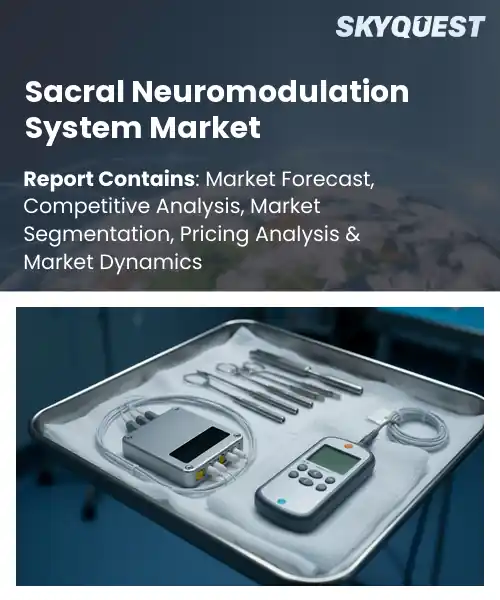
Sacral Neuromodulation System Market
Report ID: SQMIG35A3299
Report ID: SQMIG35A3299
[email protected]
USA +1 351-333-4748
Report ID:
SQMIG35A3299 |
Region:
Global |
Published Date: February, 2026
Pages:
157
|Tables:
146
|Figures:
78


Global Sacral Neuromodulation System Market size was valued at USD 1.52 Billion in 2024 and is poised to grow from USD 1.71 Billion in 2025 to USD 4.32 Billion by 2033, growing at a CAGR of 12.3% during the forecast period (2026-2033).
The sacral neuromodulation system market is primarily driven by an unmet clinical need for refractory pelvic floor disorders and its development from a niche therapy to a mainstream treatment. The sacral neuromodulation system modulates the sacral nerve roots through an implanted pulse generator and leads to provide sustained symptom improvement for overactive bladder, urinary retention, and fecal incontinence in patients who have failed conservative treatments. This is important because these conditions place a significant personal and economic burden on patients and their families, especially as we age. Over decades devices have advanced from first generation InterStim systems to smaller, rechargeable, MRI compatible implants by vendors, increasing adoption across hospitals and clinics today.
As adoption rises a key trend driving the global sacral neuromodulation sector is continuous device innovation which drives clinician confidence, payer support, and broader indications in a chain of cause and effect. Improvements such as MRI compatibility, smaller rechargeable generators, and refined lead placement reduce complications and total cost of care, prompting hospitals to implement therapy pathways. In practice a patient with refractory overactive bladder who receives a rechargeable IPG avoids repeat replacement surgeries, experiences fewer hospital visits, and generates favorable cost utility data that supports reimbursement. Consequently manufacturers and providers can enter emerging markets, thereby creating additional growth opportunities.
How is AI Enhancing Clinical Outcomes in the Sacral Neuromodulation System Market?
AI is improving clinical outcomes in sacral neuromodulation through smarter sensing, personalized programming, adaptive stimulation, and remote monitoring. Key aspects are AI driven signal analysis that identifies meaningful sacral nerve responses, algorithms that tailor stimulation to individual symptoms, and cloud-based platforms that support clinician decisions. The market is shifting toward miniaturized smart implants and companion devices, which makes continuous data collection practical. Clinically this can shorten the time to effective therapy and make follow up more patient friendly. Real world examples include lead sensing research and new integrated device concepts that illustrate how data driven workflows enhance care.
Medtronic in April 2025 presented interim PEER 2 findings showing sacral lead sensing could enable automated adjustments based on objective nerve responses. This supports faster optimization and fewer in clinic reprogramming visits which improves efficiency and helps broader adoption.
Market snapshot - (2026-2033)
Global Market Size
USD 1.52 Billion
Largest Segment
Implantable Devices
Fastest Growth
External Devices
Growth Rate
12.3% CAGR
To get more insights on this market click here to Request a Free Sample Report
Global sacral neuromodulation system market is segmented by device type, indication, patient group, end user, distribution channel and region. Based on device type, the market is segmented into implantable devices and external devices. Based on indication, the market is segmented into urinary incontinence, overactive bladder (OAB), fecal incontinence, urinary retention, chronic pelvic pain & related disorders and others. Based on patient group, the market is segmented into pediatric, adult and geriatric. Based on end user, the market is segmented into hospitals & large medical centers, ambulatory surgical centers (ascs), specialty clinics and research & academic institutes. Based on distribution channel, the market is segmented into direct sales and indirect sales. Based on region, the market is segmented into North America, Europe, Asia Pacific, Latin America and Middle East & Africa.
Based on the global sacral neuromodulation system market forecast, implantable devices segment dominates because they deliver sustained neuromodulation with proven clinical durability and clinician confidence, making them the primary therapeutic choice for refractory pelvic dysfunction. The advanced programmability and the connection to chronic care pathways encourage doctors to adopt devices and develop them further, as established relationships with payors and established algorithms/flow of care procedures encourage hospitals to invest. The relationship between these causes and effects will yield increased volume of procedures performed, support the development of long-term follow-up programs, and direct research and development efforts toward implant-related innovation, making implantation-related technologies increasingly integral to treatment algorithms.
However, external devices are emerging as the most rapidly expanding area due to their non-invasive profile and lower procedural burden, attracting patients and providers seeking reversible options. Innovation in wearable stimulations and remote programming continues to be created with advanced outpatient adoption processes and incorporation into conservative treatment paths allowing faster uptake and new entry points into neuromodulation treatment.
Hospitals & large medical centers segment leads because they concentrate surgical expertise, multidisciplinary care teams, and the procedural infrastructure required for complex sacral neuromodulation interventions. Clinicians trust and payers are engaged due to their ability to combine outpatient and inpatient processes, handle perioperative planning, assist with long-term follow-up, and support clinical research. These healthcare organizations then become a center for referrals, allowing for high volumes of procedures, creating specialized education programs and building supplier relationships that promote market leadership.
Meanwhile, ambulatory surgical centers are the fastest growing care setting as they offer lower overhead, streamlined scheduling, and patient preference for outpatient procedures. Device manufacturers have developed ASC-optimized products due to these changes (ASCs focus on minimally invasive processes, shorter recovery periods, etc.), which have changed the way devices are implanted. A growing trend in ASC device development has increased access to ASCs, decreased cost per procedure for ASCs, and opened up additional channels of adoption.
To get detailed segments analysis, Request a Free Sample Report
As per the global sacral neuromodulation system market analysis, North America leads the industry due to a combination of favorable healthcare infrastructure, concentrated clinical expertise, and strong commercial ecosystems. The adoption of devices for urological disorders and related medical procedures will be supported by a solid reimbursement environment, an established path for referrals to specialists, and an overall high prevalence of both urological procedures and specialized treatment centers for the care of pelvic disorders such as an overactive bladder (OAB) and stress urinary incontinence (SUI). Furthermore, large device companies will maintain their large presence in the industry by providing training, network support, and aftercare models to improve patient outcomes for these devices. The industry will also provide both a mature regulatory environment and an active relationship among clinicians, payers, and manufacturers that will expedite technological development as well as evidence of clinical efficacy.
Sacral neuromodulation system market in the United States is characterized by advanced clinician networks, widespread hospital adoption, and extensive reimbursement frameworks that enable procedural access. A large number of specialized urology and pelvic floor clinics will improve the educational process for doctors, and develop newer technology to be used in devices that help treat these ailments. Because manufacturers now have invested significantly in education, after-care, and collaborative research opportunities, we will see an increase in the use of models for long-term success and the ability to implement other complex care maps throughout the country, than previously existed due to the strong presence in the marketplace.
Sacral neuromodulation system market in Canada reflects a coordinated healthcare delivery environment with emphasis on specialist centers and integrated care pathways. Provincial funding models and referral networks support concentrated procedural experience in hospitals. The partnership of clinicians and device manufacturers enhances training and aftercare processes. Continued implementation of patient awareness initiatives, as well as clinical leadership in urology and pelvic health, has contributed to a steady increase in these services, while access considerations and geographic areas determine regional centers of excellence and service delivery models.
Europe sacral neuromodulation system market is expanding rapidly due to growing clinical acceptance, supportive reimbursement landscapes in many markets, and increased cross border collaboration among specialist centers. Enhanced guideline development and regional clinical networks facilitate standardized patient pathways and multidisciplinary management of pelvic floor disorders. Localized research initiatives and stronger relationships between device makers and clinical opinion leaders accelerate technology adaptation and tailored training programs. Market entry by established and emerging manufacturers, combined with focused clinician education and patient advocacy, is raising awareness and access. Payers’ diverse payment models provide different go-to-market strategies for commercial products, and the expansion of regional centres of excellence (COEs) and collaboration for clinical trials enhances physician acceptance of new technologies, thus enabling broader adoption of the new technology in the entire healthcare system. In addition, the fragmented nature of the market creates opportunities for developing differentiated value propositions and partnerships that facilitate localized adoption.
Sacral neuromodulation system market in Germany benefits from comprehensive hospital networks, well developed specialist training programs, and structured referral pathways that reinforce clinical volumes and expertise. Strong relationships between clinical centers and manufacturers enable implementation of technology updates and robust post implant care. Multidisciplinary management of pelvic floor disorders occurs through national guidelines and through specialized centers of excellence. Clinical research activity provides an evidence base for practice and supports related activity in regionally adopted evidence thereafter.
Sacral neuromodulation system market in the United Kingdom is characterized by growing clinical adoption across specialized centers, integration of multidisciplinary pelvic health services, and clinician education initiatives. Collaboration between public health systems and specialists is improving referral pathways. Combined public and private provision supports accessibility and device choice, while focused research and outcome reporting are enhancing clinician confidence and fostering incorporation of advanced neuromodulation into standard clinical practice across regions.
Sacral neuromodulation system market in France is emerging through concentrated initiatives in specialist hospitals and building clinical expertise in pelvic health. Growing clinician interest, coupled with research activity, is improving patient pathways and informing best practice. Manufacturers are engaging with their clinical networks to develop educational and post-implantation care models. Their businesses can leverage this to maximize their reimbursement through increased patient understanding of the products offered. As a result of these changing dynamics, there is growing collaboration in the establishment of multi-disciplinary service delivery models and the development of multi-institutional research projects at regional centers.
Asia Pacific is strengthening its position in the sacral neuromodulation system market through a combination of expanding clinical expertise, targeted training programs, and growing collaboration between global manufacturers and local healthcare providers. The amount of money manufacturers are putting into back into education resources for healthcare providers, clinician workshops and service infrastructure, will result in a greater understanding of the value of neuromodulation devices by both providers and patients. With the increasing knowledge of neuromodulation medicine through both focused clinical research studies and localized demonstration projects, clinicians are becoming more informed about how best to use neuromodulation solutions in their practice. Along with the increased knowledge base, improvement in reimbursement structures in select markets, and recent establishment of local/regional Centers Of Excellence, will expand the number of individuals able to benefit from neuromodulation solutions. Digital health capabilities through remote programable devices will improve the clinical followup care after surgical implantation of neuromodulation devices.
Sacral neuromodulation system market in Japan is supported by advanced clinical infrastructure, specialist training, and active engagement between hospitals and device manufacturers. The adoption of clinical methods will be facilitated by a clinician’s experience with neuromodulation equipment and solid preventative care procedures post-implantation. The national interest in innovative technological developments, along with a commitment to research, contributes to providing scientific support for new technology and improving their efficacy.
Sacral neuromodulation system market in South Korea is advancing through strong hospital capabilities, specialist expertise, and active collaboration between clinical centers and technology providers. Proactive clinician training and focused clinical studies are improving patient selection and implant management. Regional partnerships are enabling distribution and service models that are personalized for the needs of each region. Increasing awareness of minimally invasive neuromodulation therapies combined with digital healthcare integration also support increased clinical adoption and continued evolution of care delivery systems.
To know more about the market opportunities by region and country, click here to
Buy The Complete Report
Advances In Implant Technology
Rapid improvements in device design, materials, and battery efficiency have increased the safety profile and longevity of sacral neuromodulation systems, encouraging clinician confidence and broader clinical adoption. With smaller size and better programmability, improvements in patient comfort also lead to increased willingness for physicians to recommend devices due to ease of use by patients as well as more opportunities to accept the device by patients. These technological advances enable management of a wider range of refractory pelvic and bladder conditions, improving perceived therapeutic value and strengthening investment in product development and market expansion by manufacturers and healthcare providers.
Increased Clinical Awareness Worldwide
Growing recognition among clinicians and patients of sacral neuromodulation as an effective option for refractory urinary and bowel dysfunction has broadened referral patterns and demand for diagnostic evaluation, fostering uptake of therapy. As awareness of implantation increases both through developed networks of physicians and/or clinical practice and through advocacy from patients to obtain an evaluation for an implantable device, physicians have increased their willingness and ability to provide such recommendations based on increased supportive resources from the manufacturers and expanded service availability through the manufacturer network. Overall, the development of these processes has helped support the global sacral neuromodulation system market growth of manufacturers seeking to provide even more services for the implantation of devices and has also created a demand for medical professionals to continue providing support for the implantable device.
High Device and Procedure Costs
Due to higher expense for acquiring and using sacral neuromodulation systems, there may be limited number of providers who are able to adopt these systems; thus limiting the number of patients who have access to them in their respective environments. The factors of how reimbursement policies and where facilities may be required to perform their own implantation and the need for additional follow up post implant are all contributing factors to the overall cost of care, and how payers and providers are making decisions. When costs become the primary determining factor concerning a patient’s treatment option, clinicians tend to focus on other less expensive conservative treatments rather than adopting device-based treatments, even when evidence supports that they would be beneficial for both patients and providers.
Limited Insurance Reimbursement Coverage
Restricted or inconsistent insurance reimbursement for sacral neuromodulation procedures and follow up care creates uncertainty for providers and patients, reducing willingness to pursue device therapy. Where coverage criteria are narrow or approval processes are complex, clinicians may face administrative burdens and delayed treatment initiation, discouraging referrals. Patients confronted with potential out of pocket expenses may opt for less costly alternatives, diminishing demand. This reimbursement environment can also disincentivize health systems from investing in training and necessary resources, constraining broader clinical program development and market penetration.
Request Free Customization of this report to help us to meet your business objectives.
Competition in the global sacral neuromodulation system market outlook is intensifying as incumbent OEMs execute strategic M&A and startups push device miniaturization and closed loop capabilities. The purchase of Axonics by Boston Scientific combined the two leading portfolio companies in urology. There has been movement in regulatory approvals for miniaturized implants, so many investors are focusing on integrated iSNM platforms that include various iSNM devices/features. Diagnostic and commercialization partnerships such as Laborie’s backing of Bright Uro are tightening clinical pathways and adoption.
SkyQuest’s ABIRAW (Advanced Business Intelligence, Research & Analysis Wing) is our Business Information Services team that Collects, Collates, Correlates, and Analyses the Data collected by means of Primary Exploratory Research backed by robust Secondary Desk research.
As per SkyQuest analysis, the global sacral neuromodulation system industry is positioned for sustained expansion, driven primarily by continuous device innovation as the key driver improving safety, programmability and MRI compatibility, and supported by digital health integration as a second driver that enables remote monitoring and personalized programming. Market growth is tempered by high device and procedure costs, a significant restraint that can hinder access and reimbursement. Implantable devices remain the dominating segment due to clinical durability and established care pathways, while North America is the dominating region owing to mature reimbursement, specialized clinical centers and strong commercial ecosystems, supporting broader adoption.
| Report Metric | Details |
|---|---|
| Market size value in 2024 | USD 1.52 Billion |
| Market size value in 2033 | USD 4.32 Billion |
| Growth Rate | 12.3% |
| Base year | 2024 |
| Forecast period | (2026-2033) |
| Forecast Unit (Value) | USD Billion |
| Segments covered |
|
| Regions covered | North America (US, Canada), Europe (Germany, France, United Kingdom, Italy, Spain, Rest of Europe), Asia Pacific (China, India, Japan, Rest of Asia-Pacific), Latin America (Brazil, Rest of Latin America), Middle East & Africa (South Africa, GCC Countries, Rest of MEA) |
| Companies covered |
|
| Customization scope | Free report customization with purchase. Customization includes:-
|
To get a free trial access to our platform which is a one stop solution for all your data requirements for quicker decision making. This platform allows you to compare markets, competitors who are prominent in the market, and mega trends that are influencing the dynamics in the market. Also, get access to detailed SkyQuest exclusive matrix.
Table Of Content
Executive Summary
Market overview
Parent Market Analysis
Market overview
Market size
KEY MARKET INSIGHTS
COVID IMPACT
MARKET DYNAMICS & OUTLOOK
Market Size by Region
KEY COMPANY PROFILES
Methodology
For the Sacral Neuromodulation System Market, our research methodology involved a mixture of primary and secondary data sources. Key steps involved in the research process are listed below:
1. Information Procurement: This stage involved the procurement of Market data or related information via primary and secondary sources. The various secondary sources used included various company websites, annual reports, trade databases, and paid databases such as Hoover's, Bloomberg Business, Factiva, and Avention. Our team did 45 primary interactions Globally which included several stakeholders such as manufacturers, customers, key opinion leaders, etc. Overall, information procurement was one of the most extensive stages in our research process.
2. Information Analysis: This step involved triangulation of data through bottom-up and top-down approaches to estimate and validate the total size and future estimate of the Sacral Neuromodulation System Market.
3. Report Formulation: The final step entailed the placement of data points in appropriate Market spaces in an attempt to deduce viable conclusions.
4. Validation & Publishing: Validation is the most important step in the process. Validation & re-validation via an intricately designed process helped us finalize data points to be used for final calculations. The final Market estimates and forecasts were then aligned and sent to our panel of industry experts for validation of data. Once the validation was done the report was sent to our Quality Assurance team to ensure adherence to style guides, consistency & design.
Analyst Support
Customization Options
With the given market data, our dedicated team of analysts can offer you the following customization options are available for the Sacral Neuromodulation System Market:
Product Analysis: Product matrix, which offers a detailed comparison of the product portfolio of companies.
Regional Analysis: Further analysis of the Sacral Neuromodulation System Market for additional countries.
Competitive Analysis: Detailed analysis and profiling of additional Market players & comparative analysis of competitive products.
Go to Market Strategy: Find the high-growth channels to invest your marketing efforts and increase your customer base.
Innovation Mapping: Identify racial solutions and innovation, connected to deep ecosystems of innovators, start-ups, academics, and strategic partners.
Category Intelligence: Customized intelligence that is relevant to their supply Markets will enable them to make smarter sourcing decisions and improve their category management.
Public Company Transcript Analysis: To improve the investment performance by generating new alpha and making better-informed decisions.
Social Media Listening: To analyze the conversations and trends happening not just around your brand, but around your industry as a whole, and use those insights to make better Marketing decisions.
REQUEST FOR SAMPLE
 REQUEST FREE CUSTOMIZATION
Global Sacral Neuromodulation System Market size was valued at USD 1.52 Billion in 2024 and is poised to grow from USD 1.71 Billion in 2025 to USD 4.32 Billion by 2033, growing at a CAGR of 12.3% during the forecast period (2026-2033).
Competition in the sacral neuromodulation market is intensifying as incumbent OEMs execute strategic M&A and startups push device miniaturization and closed loop capabilities. Boston Scientific’s acquisition of Axonics expanded major urology portfolios while regulatory progress for ultra-miniaturized implants has shifted investor interest toward integrated iSNM platforms. Diagnostic and commercialization partnerships such as Laborie’s backing of Bright Uro are tightening clinical pathways and adoption. 'Medtronic', 'Boston Scientific', 'Nevro Corp', 'Axonics Modulation Technologies', 'Nuvectra Corporation', 'Stimwave Technologies', 'Coloplast', 'Intrapace', 'Uroplasty', 'Cogentix Medical', 'ReCor Medical', 'EndoStim', 'Saluda Medical', 'Accessa Medical', 'Calmare Therapeutics', 'Pelvital', 'Neuromodulation Technologies', 'BioElectronics Corporation', 'Iota Biosciences', 'Titan Medical'
Rapid improvements in device design, materials, and battery efficiency have increased the safety profile and longevity of sacral neuromodulation systems, encouraging clinician confidence and broader clinical adoption. Enhanced programming flexibility and smaller form factors facilitate implantation and patient comfort, which in turn supports wider clinician recommendation and patient acceptance. These technological advances enable management of a wider range of refractory pelvic and bladder conditions, improving perceived therapeutic value and strengthening investment in product development and market expansion by manufacturers and healthcare providers.
Wireless Rechargeable Devices: The sacral neuromodulation market is shifting toward wireless, rechargeable implants that prioritize patient comfort, reduced surgical footprint, and simplified maintenance. Manufacturers are focusing on compact form factors and user-friendly charging workflows, enabling longer device service life and fewer replacement interventions. Clinicians value programmability and ease of implantation, while patients benefit from discreet profiles and reduced procedural burden. This trend encourages competitive differentiation through design innovation, battery management, and interoperability, accelerating adoption in centers that emphasize patient-centered care and streamlined therapy delivery.
As per the global sacral neuromodulation system market analysis, North America leads the industry due to a combination of favorable healthcare infrastructure, concentrated clinical expertise, and strong commercial ecosystems.


Want to customize this report? This report can be personalized according to your needs. Our analysts and industry experts will work directly with you to understand your requirements and provide you with customized data in a short amount of time. We offer $1000 worth of FREE customization at the time of purchase.
Feedback From Our Clients


 USA (+1) 351-333-4748

