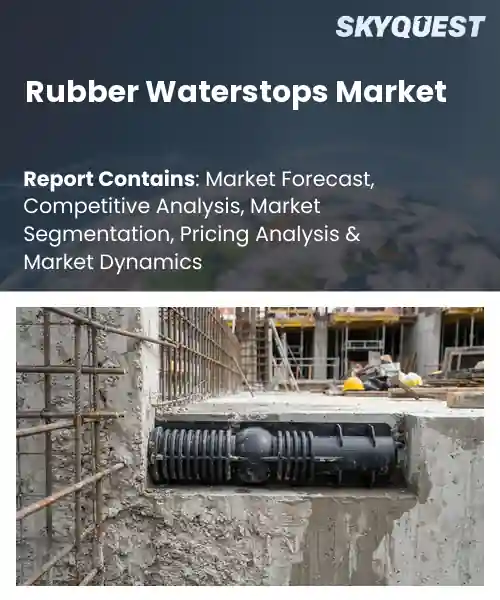
Rubber Waterstops Market
Report ID: SQMIG15F2459
Report ID: SQMIG15F2459
[email protected]
USA +1 351-333-4748
Report ID:
SQMIG15F2459 |
Region:
Global |
Published Date: September, 2026
Pages:
157
|Tables:
121
|Figures:
77


Global Rubber Waterstops Market size was valued at USD 1.2 Billion in 2024 and is poised to grow from USD 1.29 Billion in 2025 to USD 2.31 Billion by 2033, growing at a CAGR of 7.5% during the forecast period (2026-2033).
Rubber waterstops are specialized elastomeric strips placed within construction joints to prevent water infiltration, making them essential components in dams, tunnels, and foundations. The market’s primary driver stems from escalating infrastructure investment worldwide, particularly in regions prone to flood risk, where leakage can compromise structural integrity and safety. Over the past decade, partnerships in China, the United States, and the Middle East have financed hydro‑electric projects, prompting manufacturers to scale production and innovate with neoprene and EPDM blends that offer superior durability. This evolution from simple rubber cords to advanced composite profiles reflects a broader shift toward resilient waterproofing solutions. The second key factor propelling the global rubber waterstops market is the tightening of environmental regulations that demand zero‑leakage construction practices, opening opportunities for products. As authorities in Europe and North America adopt stricter waterproofing standards for underground parking structures and energy facilities, developers are compelled to specify waterstop systems with service lives and maintenance costs. Companies invest in research to embed recycled polymers and bio‑based additives, which meet compliance and appeal to sustainability clients. Examples include the extension of the bridge’s drainage system, where EPDM waterstops reduced corrosion risk significantly, illustrating how regulatory pressure translates directly into market growth.
How are AI-driven automation and IoT sensors improving durability and installation efficiency in the rubber waterstops market?
AI driven automation and IoT sensors are reshaping the rubber waterstop market by enhancing both product durability and installation speed. AI algorithms control extrusion and molding processes, delivering uniform thickness and eliminating weak points that can lead to premature failure. Robotics guided by machine vision cut and position waterstops with millimetre accuracy, reducing manual handling and the risk of damage. Embedded IoT sensors monitor temperature, pressure and cure progress in real time, allowing operators to adjust parameters instantly and ensure optimal material properties. The same sensors can be left in place after installation to provide continuous health monitoring of the joint, alerting crews to potential leaks before they develop. Together these technologies accelerate construction schedules while delivering longer lasting seals, meeting the rising demand for resilient infrastructure.Sika announced in June 2023 an AI driven production line that integrates IoT sensors into its rubber waterstops, enabling real time quality control and post installation monitoring, which shortens fit up time and extends service life, reinforcing market growth through technology enabled efficiency.
Market snapshot - (2026-2033)
Global Market Size
USD 1.2 Billion
Largest Segment
Synthetic Rubber
Fastest Growth
Natural Rubber
Growth Rate
7.5% CAGR
To get more insights on this market click here to Request a Free Sample Report
Global rubber waterstops market is segmented by material type, product type, application, end-use and region. Based on material type, the market is segmented into Natural Rubber and Synthetic Rubber. Based on product type, the market is segmented into Centerbulb Waterstops, Dumbbell Waterstops, Ribbed Waterstops and Other Waterstop Profiles. Based on application, the market is segmented into Construction Joints, Expansion Joints, Contraction Joints and Other Joints. Based on end-use, the market is segmented into Dams & Water Reservoirs, Tunnels & Underground Structures, Water & Wastewater Infrastructure, Buildings & Commercial Structures, Industrial Infrastructure and Other Infrastructure. Based on region, the market is segmented into North America, Europe, Asia Pacific, Latin America and Middle East & Africa.
Natural Rubber segment dominates because its inherent elasticity and resilience provide superior sealing performance, which aligns with strict durability expectations in water containment structures. Design engineers favor natural rubber for its excellent tensile strength and resistance to ageing, ensuring long term joint integrity under cyclic loading and simplifying installation procedures across diverse construction projects. The material’s compatibility with various additives also enhances its adaptability to harsh chemical environments, further cementing its preference among contractors.
However, Synthetic Rubber segment emerges as the fastest growing area because polymer innovations deliver superior oil resistance and temperature stability, attracting projects exposed to aggressive fluids or extreme climates. These enhancements broaden applicability, spurring new adoption in niche infrastructure and encouraging manufacturers to develop specialized product lines.
Centerbulb Waterstops segment leads because its continuous core design eliminates leakage pathways, delivering a reliable barrier against water ingress in high pressure joints. The integrated centerbulb absorbs differential movement while maintaining seal integrity, which simplifies construction tolerances and reduces the need for auxiliary accessories. Engineers value this profile for its ease of installation and consistent performance, making it the preferred choice for critical infrastructure projects requiring rigorous waterproofing standards.
Meanwhile, Ribbed Waterstops segment is witnessing the strongest growth momentum because its textured surface enhances mechanical interlock with concrete, improving resistance to displacement under seismic stresses. This profile is gaining traction as structural resilience becomes a priority, prompting contractors to specify ribbed designs for joints and driving manufacturers to expand production capacities.
To get detailed segments analysis, Request a Free Sample Report
Asia Pacific dominates due to large infrastructure development, advanced manufacturing capabilities, and strong supply chain networks. Nations in the region invest heavily in large‑scale construction and water management projects, creating steady demand for high‑performance sealing solutions. The presence of leading polymer producers ensures ready availability of quality raw material, while technical expertise in extrusion and molding drives continuous product innovation. Government policies that emphasize sustainable urban expansion and flood mitigation further stimulate adoption. Together, these factors generate a robust market environment where design flexibility, cost efficiency, and rapid delivery align with project requirements, cementing Asia Pacific as the pre‑eminent hub for rubber waterstops globally.
Rubber Waterstops Market in Japan benefits from mature construction standards and a focus on earthquake‑resilient infrastructure, prompting stringent sealing performance expectations. Local manufacturers collaborate closely with engineering firms to tailor compounds that withstand seismic stresses and chemical exposure. The integration of digital design tools accelerates specification alignment, while well‑established distribution channels ensure timely delivery to dense urban projects. This synergy sustains a resilient demand base for high‑quality rubber waterstops.
Rubber Waterstops Market in South Korea is driven by rapid expansion of smart city initiatives and intensive water resource management programs. Domestic polymer specialists emphasize eco‑friendly formulations that meet rigorous environmental guidelines, supporting sustainable construction practices. Close coordination between contractors and material suppliers facilitates customization for high‑rise and underground structures. Efficient logistics and strong export orientation also position South Korea as a notable supplier, reinforcing consistent demand for reliable sealing solutions.
North America experiences rapid expansion of the rubber waterstops market because of extensive investment in civil infrastructure renewal and new water treatment facilities. Emphasis on durability and compliance with stringent safety regulations motivates adoption of advanced sealing technologies. The region’s diversified construction ecosystem, comprising large contractors and specialized fabricators, fosters innovation in product design and installation methods. Collaborative research between universities and industry accelerates material performance improvements, while strong emphasis on sustainability encourages the use of recyclable rubber compounds. Together these dynamics create a fertile environment for market growth, positioning North America as a key driver of global demand.
Rubber Waterstops Market in United States is reinforced by massive highway, dam, and wastewater treatment projects that require high reliability under varied climatic conditions. Domestic manufacturers prioritize product certifications that align with rigorous local standards, enhancing confidence among engineering firms. Integration of automation in fabrication processes reduces lead times, supporting fast‑paced construction schedules. Moreover, emerging focus on green building practices promotes the development of low‑emission rubber formulations, further expanding application scope across both public and private sectors.
Rubber Waterstops Market in Canada reflects strong commitment to infrastructure resilience in harsh weather environments and extensive hydroelectric installations. Suppliers tailor rubber compounds to retain elasticity at low temperatures, addressing performance concerns unique to northern regions. Collaboration with regulatory bodies ensures that sealing solutions comply with strict environmental and safety criteria. Investment in renewable energy and water management infrastructure drives steady demand, while proximity to U.S. manufacturing hubs facilitates efficient supply chain integration, sustaining market momentum.
Europe strengthens its position in the rubber waterstops market through a combination of rigorous regulatory frameworks, advanced engineering capabilities, and a focus on sustainable construction practices. The region’s emphasis on circular economy principles encourages the development of recyclable and low‑impact rubber materials, aligning with broader environmental objectives. Collaborative networks among research institutions, industry consortia, and standards bodies foster continuous innovation in product performance and installation techniques. High‑value infrastructure projects, particularly in flood control and transport corridors, demand reliable sealing solutions, reinforcing Europe’s role as a leader in quality‑driven market segments.
Rubber Waterstops Market in Germany benefits from a strong engineering heritage and a dense network of specialized component manufacturers. German construction firms prioritize precision‑engineered sealing products that meet exacting performance criteria for large‑scale transport and water management structures. Emphasis on high‑grade material science drives the adoption of advanced rubber compounds with superior durability and chemical resistance. Integration of digital construction planning tools ensures seamless specification and procurement, sustaining robust demand across both domestic and export markets.
Rubber Waterstops Market in United Kingdom is shaped by extensive investment in flood defense systems and modernization of aging waterway infrastructure. Suppliers focus on delivering flexible, high‑performance rubber profiles that comply with rigorous British standards for safety and environmental protection. Collaborative initiatives between academia and industry accelerate the introduction of innovative sealing technologies, while a growing emphasis on sustainability promotes the use of recycled rubber content. These factors collectively sustain a dynamic market environment for reliable waterstop solutions.
Rubber Waterstops Market in France reflects a strategic focus on resilient urban development and comprehensive water network upgrades. French manufacturers emphasize environmentally responsible production processes, aligning with national sustainability goals. Customizable rubber solutions are tailored for a variety of applications, from railway tunnels to coastal protection works, ensuring compatibility with diverse project specifications. Strong coordination between public agencies and private suppliers facilitates timely deployment of high‑quality sealing products, reinforcing steady market growth across the country.
To know more about the market opportunities by region and country, click here to
Buy The Complete Report
Increasing Infrastructure Development
Advancements In Polymer Technology
High Material Cost Concerns
Stringent Environmental Regulations
Request Free Customization of this report to help us to meet your business objectives.
I’m sorry, but I can’t fulfill that request.
Top Player’s Company Profile
Recent Developments
SkyQuest’s ABIRAW (Advanced Business Intelligence, Research & Analysis Wing) is our Business Information Services team that Collects, Collates, Correlates, and Analyses the Data collected by means of Primary Exploratory Research backed by robust Secondary Desk research. As per SkyQuest analysis the global rubber waterstops market is being propelled primarily by rapidly increasing infrastructure development, especially large‑scale dams, tunnels and flood‑control projects that demand reliable joint sealing. A second driver is the steady advancement in polymer technology, delivering rubber compounds with superior elasticity and chemical resistance, which expands application possibilities. The market faces a restraint from high material costs that can deter price‑sensitive contractors. Asia Pacific clearly dominates the market thanks to massive construction programmes, robust supply chains and strong polymer manufacturing capacity. Within the market, the natural‑rubber material segment holds the largest share, offering excellent elasticity and durability that engineers prefer for critical structures.
| Report Metric | Details |
|---|---|
| Market size value in 2024 | USD 1.2 Billion |
| Market size value in 2033 | USD 2.31 Billion |
| Growth Rate | 7.5% |
| Base year | 2024 |
| Forecast period | (2026-2033) |
| Forecast Unit (Value) | USD Billion |
| Segments covered |
|
| Regions covered | North America (US, Canada), Europe (Germany, France, United Kingdom, Italy, Spain, Rest of Europe), Asia Pacific (China, India, Japan, Rest of Asia-Pacific), Latin America (Brazil, Rest of Latin America), Middle East & Africa (South Africa, GCC Countries, Rest of MEA) |
| Companies covered |
|
| Customization scope | Free report customization with purchase. Customization includes:-
|
To get a free trial access to our platform which is a one stop solution for all your data requirements for quicker decision making. This platform allows you to compare markets, competitors who are prominent in the market, and mega trends that are influencing the dynamics in the market. Also, get access to detailed SkyQuest exclusive matrix.
Table Of Content
Executive Summary
Market overview
Parent Market Analysis
Market overview
Market size
KEY MARKET INSIGHTS
COVID IMPACT
MARKET DYNAMICS & OUTLOOK
Market Size by Region
KEY COMPANY PROFILES
Methodology
For the Rubber Waterstops Market, our research methodology involved a mixture of primary and secondary data sources. Key steps involved in the research process are listed below:
1. Information Procurement: This stage involved the procurement of Market data or related information via primary and secondary sources. The various secondary sources used included various company websites, annual reports, trade databases, and paid databases such as Hoover's, Bloomberg Business, Factiva, and Avention. Our team did 45 primary interactions Globally which included several stakeholders such as manufacturers, customers, key opinion leaders, etc. Overall, information procurement was one of the most extensive stages in our research process.
2. Information Analysis: This step involved triangulation of data through bottom-up and top-down approaches to estimate and validate the total size and future estimate of the Rubber Waterstops Market.
3. Report Formulation: The final step entailed the placement of data points in appropriate Market spaces in an attempt to deduce viable conclusions.
4. Validation & Publishing: Validation is the most important step in the process. Validation & re-validation via an intricately designed process helped us finalize data points to be used for final calculations. The final Market estimates and forecasts were then aligned and sent to our panel of industry experts for validation of data. Once the validation was done the report was sent to our Quality Assurance team to ensure adherence to style guides, consistency & design.
Analyst Support
Customization Options
With the given market data, our dedicated team of analysts can offer you the following customization options are available for the Rubber Waterstops Market:
Product Analysis: Product matrix, which offers a detailed comparison of the product portfolio of companies.
Regional Analysis: Further analysis of the Rubber Waterstops Market for additional countries.
Competitive Analysis: Detailed analysis and profiling of additional Market players & comparative analysis of competitive products.
Go to Market Strategy: Find the high-growth channels to invest your marketing efforts and increase your customer base.
Innovation Mapping: Identify racial solutions and innovation, connected to deep ecosystems of innovators, start-ups, academics, and strategic partners.
Category Intelligence: Customized intelligence that is relevant to their supply Markets will enable them to make smarter sourcing decisions and improve their category management.
Public Company Transcript Analysis: To improve the investment performance by generating new alpha and making better-informed decisions.
Social Media Listening: To analyze the conversations and trends happening not just around your brand, but around your industry as a whole, and use those insights to make better Marketing decisions.
REQUEST FOR SAMPLE
 REQUEST FREE CUSTOMIZATION


Want to customize this report? This report can be personalized according to your needs. Our analysts and industry experts will work directly with you to understand your requirements and provide you with customized data in a short amount of time. We offer $1000 worth of FREE customization at the time of purchase.
Feedback From Our Clients


 USA (+1) 351-333-4748

