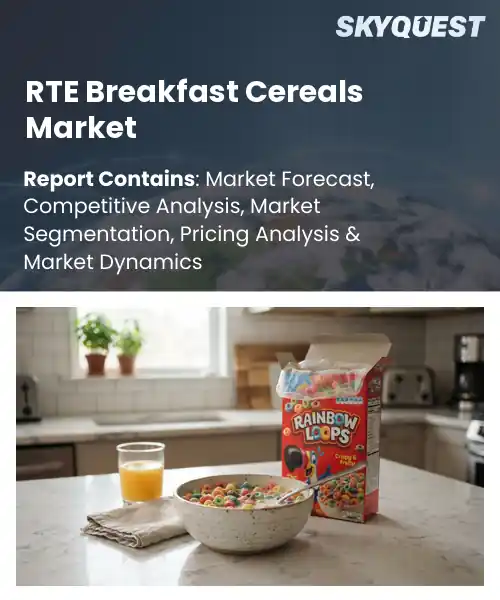
RTE Breakfast Cereals Market
Report ID: SQMIG30I3275
Report ID: SQMIG30I3275
[email protected]
USA +1 351-333-4748
Report ID:
SQMIG30I3275 |
Region:
Global |
Published Date: September, 2026
Pages:
157
|Tables:
124
|Figures:
77


Global Rte Breakfast Cereals Market size was valued at USD 36.8 Billion in 2024 and is poised to grow from USD 38.49 Billion in 2025 to USD 55.17 Billion by 2033, growing at a CAGR of 4.6% during the forecast period (2026-2033).
The ready‑to‑eat (RTE) breakfast cereals market comprises pre‑packaged grain‑based products that consumers can eat straight from the box, ranging from fortified flakes to high‑protein clusters. Its significance stems from the category’s role in daily nutrition, convenience for busy households, and its contribution to retail revenues that exceed $30 billion globally. Historically, the market emerged in the 1930s with corn‑flake pioneers, expanded rapidly during the post‑war boom as supermarkets proliferated, and has since diversified through health‑focused reformulations and premium snack‑style launches. Today, the sector is driven primarily by escalating consumer demand for convenient, nutrient‑dense options that fit fast‑paced lifestyles across urban regions. Building on that demand, product innovation and geographic expansion constitute the next pivotal growth engine. Manufacturers now leverage fortified formulas, plant‑based protein blends, and reduced‑sugar technologies to address health guidelines, prompting retailers to allocate more shelf space to these variants. The cause‑effect chain is evident: as governments tighten labeling standards, companies reformulate, which in turn cultivates consumer trust and boosts repeat purchases. Simultaneously, emerging markets in Asia‑Pacific and Latin America present untapped purchasing power; local partners adapt flavors to regional palates, enabling rapid market penetration. Consequently, revenue trajectories are projected to outpace inflation, creating lucrative opportunities for brands and start‑ups.
How is AI-driven automation influencing the RTE breakfast cereals market?
AI driven automation is reshaping the ready to eat breakfast cereals market by linking data insights to production. Manufacturers now use machine learning to fine tune ingredient blends, ensuring flavor consistency while reducing waste. Vision systems inspect each flake for size and coating uniformity, catching defects faster than human eyes. Robotics handle palletizing and case packing, freeing workers for higher value tasks. Predictive maintenance alerts keep lines running, cutting downtime. Demand forecasting models align output with retailer orders, lowering inventory risk. These advances make the supply chain more agile and help brands respond to shifting consumer tastes.Kellogg Company June 2023, launched an AI powered line optimization system that synchronizes mixing, baking and packaging in real time, boosting throughput and reducing energy use while preserving product quality. The rollout also enables faster response to seasonal demand spikes and helps retailers keep shelves stocked with fresh cereal varieties.
Market snapshot - (2026-2033)
Global Market Size
USD 36.8 Billion
Largest Segment
Flakes
Fastest Growth
Muesli & Granola
Growth Rate
4.6% CAGR
To get more insights on this market click here to Request a Free Sample Report
Global rte breakfast cereals market is segmented by product type, ingredient type, product positioning, distribution channel and region. Based on product type, the market is segmented into Flakes, Puffed Cereals, Muesli & Granola, Cereals-Based Clusters & Biscuits and Other RTE Cereals. Based on ingredient type, the market is segmented into Corn-Based, Wheat-Based, Oat-Based, Multigrain and Other Grains. Based on product positioning, the market is segmented into Conventional, Organic, Gluten-Free and Functional & Fortified. Based on distribution channel, the market is segmented into Supermarkets & Hypermarkets, Convenience Stores, Specialty Stores, Online Retail and Other Channels. Based on region, the market is segmented into North America, Europe, Asia Pacific, Latin America and Middle East & Africa.
Flakes segment dominates because its familiar shape and light texture align with traditional breakfast habits, making it a go to choice for families seeking quick, easy nutrition. The simplicity of preparation, broad flavor variety, and strong brand heritage reinforce consumer trust, driving repeat purchase. Shelf stability and cost effective production further embed flakes at the core of everyday grocery shelves, ensuring their continued market primacy. Its adaptability to fortified formulas also sustains relevance across health trends.
However, Puffed Cereals emerges as the most rapidly expanding area as consumer curiosity around airy textures and novel flavors fuels trial. Innovative processing techniques enable lower sugar profiles and incorporate functional ingredients, attracting health focused shoppers. This momentum broadens product lines and creates new growth avenues for manufacturers seeking differentiation.
Corn Based segment dominates because its sweet flavor and versatile grain base have long been embedded in classic breakfast formulations, appealing to a wide demographic. The established supply chain ensures consistent pricing, while its adaptability to extrusion and coating processes supports diverse product formats. Familiarity among consumers and strong brand portfolios reinforce loyalty, anchoring corn as the foundational ingredient across the market. Its role in delivering essential carbohydrates also sustains its appeal in energy focused meals.
Meanwhile, Oat Based experiences the strongest growth momentum as consumers pursue whole grain nutrition and sustainable sourcing. The natural creamy texture allows seamless integration into snackable clusters and fortified mixes, while rising awareness of heart healthy benefits fuels demand. This surge creates fresh product innovations and expands market reach for cereal makers.
To get detailed segments analysis, Request a Free Sample Report
North America leads the RTE breakfast cereals market through a mature retail ecosystem, high consumer openness to convenient nutrition, and a strong culture of brand loyalty. Continuous product innovation delivers a broad range of taste profiles and health‑focused formulations that meet diverse dietary preferences. Sophisticated distribution networks guarantee rapid shelf placement in both urban and suburban outlets, while integrated supply chains shorten time‑to‑market and support effective promotions. Robust marketing partnerships with health‑oriented media amplify consumer awareness and reinforce market leadership. Emphasis on sustainability drives manufacturers toward eco‑friendly packaging and responsible sourcing, aligning with environmentally conscious shoppers. E‑commerce platforms broaden accessibility, offering seamless ordering that complements traditional grocery channels. This combination of innovation, distribution efficiency, and consumer‑centric strategies sustains the region’s dominant position.
RTE Breakfast Cereals Market in United States thrives on a vibrant culture of convenience combined with health consciousness. Manufacturers prioritize diverse flavor portfolios and functional blends that cater to busy families and on‑the‑go professionals. Strong retail presence across super‑centers, mass merchants, and specialty stores ensures broad accessibility, while digital platforms enable direct consumer engagement. Nutrition labeling and clean‑label initiatives further drive trust, supporting sustained product adoption across varied demographic segments.
RTE Breakfast Cereals Market in Canada reflects a strong preference for quality and sustainability that shapes product development. Companies emphasize whole‑grain content, organic sourcing, and reduced sugar to align with health‑focused consumer expectations. Nationwide distribution through grocery chains and convenience outlets provides reach, while bilingual packaging supports diverse linguistic regions. Emerging interest in plant‑based cereals and functional ingredients drives innovation, reinforcing the market’s growth trajectory within a health‑aware consumer base.
Europe’s RTE breakfast cereals market expands swiftly, propelled by evolving consumer lifestyles that prioritize quick, nutritious meals and a heightened awareness of balanced diets. Cross‑border trade agreements facilitate seamless ingredient sourcing and product distribution across the continent, while regulatory frameworks support transparent labeling and clean‑label claims, reinforcing consumer trust. Manufacturers respond with localized flavor innovations that respect regional tastes, alongside fortified and plant‑based offerings that align with health and sustainability aspirations. Growing urbanization intensifies demand for on‑the‑go solutions, and digital retail channels amplify product visibility, enabling efficient market penetration. Collaborative efforts between producers and retailers to highlight functional benefits further accelerate adoption, cementing Europe’s position as a dynamic growth hub for ready‑to‑eat cereals. Growing attention to sustainability encourages manufacturers to adopt eco‑friendly packaging, resonating with environmentally conscious shoppers.
RTE Breakfast Cereals Market in Germany is characterized by a strong focus on product quality and functional nutrition that appeals to health‑aware consumers. Brands emphasize whole‑grain ingredients, added vitamins, and low‑sugar formulations to meet dietary preferences. Wide distribution through hypermarkets, discounters, and organic specialty stores ensures extensive reach, while digital commerce expands convenient purchasing options. Sustainability commitments, such as recyclable packaging, further strengthen consumer confidence and drive market growth overall.
RTE Breakfast Cereals Market in United Kingdom experiences growth driven by a shift toward convenient, health‑focused breakfast choices among professionals and demographics. Companies innovate with inspired flavors, fortified grains, and plant‑based alternatives that align with dietary trends. Strong presence in supermarkets, convenience stores, and online platforms ensures easy access, while influencers raise product awareness significantly. Commitment to reduced sugar content and sustainable packaging enhances brand appeal and fuels market momentum.
RTE Breakfast Cereals Market in France is emerging as an innovative segment, driven by consumer curiosity toward convenient yet wholesome breakfast solutions. Brands focus on incorporating traditional French flavors such as honey and dried fruit, while offering fortified cereals that address nutritional gaps. Distribution spans hypermarkets, local bakeries, and online retailers, ensuring widespread accessibility. Growing attention to clean‑label claims and sugar reduction resonates with health‑conscious shoppers, supporting gradual market expansion.
Asia Pacific is solidifying its role in the RTE breakfast cereals market through a confluence of rising urbanization, evolving consumer habits, and strategic product localization. Growing middle‑class populations across the region seek convenient yet nutritious options that fit fast‑paced mornings, prompting manufacturers to develop flavor profiles resonant with local palates, such as rice‑based or tropical fruit blends. Strong retail networks, from traditional supermarkets to rapidly expanding e‑commerce platforms, ensure widespread availability. Companies emphasize health‑forward attributes, including fortified grains and reduced sugar, aligning with increasing wellness awareness. Sustainable packaging initiatives and collaborations with regional distributors further enhance market penetration. As digital engagement and brand storytelling intensify, consumer affinity for ready‑to‑eat cereal solutions strengthens, positioning Asia Pacific as a pivotal growth engine for the global market.
RTE Breakfast Cereals Market in Japan blends convenience with taste preferences, catering to busy professionals and health‑conscious families. Products often incorporate local ingredients such as red bean, matcha, and rice, while delivering fortified nutrition to address dietary gaps. Distribution leverages extensive convenience store chains, supermarkets, and e‑commerce platforms, ensuring easy access across wide urban areas. Emphasis on low‑sugar formulations and eco‑friendly packaging resonates with consumer expectations for wellness and sustainability.
RTE Breakfast Cereals Market in South Korea combines convenience with flavor innovation, targeting on‑the‑go students and time‑pressured professionals. Localized variants often feature nutty, honey, and gochujang‑inspired notes while providing fortified nutrients to support lifestyles. The supply chain benefits from dense supermarket networks and a penetrated online grocery sector, guaranteeing broad market coverage. Focus on low‑calorie, high‑fiber options and recyclable packaging aligns with rising health awareness and environmental responsibility among consumers.
To know more about the market opportunities by region and country, click here to
Buy The Complete Report
Increasing Health Consciousness
Expansion Of Emerging Market Distribution
Sensitivity To Sugar Content Regulations
Fluctuating Raw Material Prices
Request Free Customization of this report to help us to meet your business objectives.
Intense rivalry drives product differentiation, with firms leveraging M&A, brand tie‑ups and digital formulation tools to capture snack‑seeking consumers. Kellanova’s 2020 acquisition of RXBAR expanded its protein‑rich segment, Post Holdings bought Weetabix in 2022 to deepen European reach, General Mills partnered with Disney in 2023 for limited‑edition movie cereals, and Kellogg’s deployed AI‑based flavor modeling in 2024 to accelerate new‑product cycles.
Top Player’s Company Profile
Recent Developments
SkyQuest’s ABIRAW (Advanced Business Intelligence, Research & Analysis Wing) is our Business Information Services team that Collects, Collates, Correlates, and Analyses the Data collected by means of Primary Exploratory Research backed by robust Secondary Desk research. As per SkyQuest analysis, the global RTE breakfast cereals market is being propelled primarily by rising health consciousness, with manufacturers fortifying products and cutting sugars to meet consumer demand for nutritious convenience; a second catalyst is the rapid expansion of modern retail and e‑commerce channels in emerging economies, which widens product reach and drives trial. However, strict sugar‑content regulations pose a notable restraint, forcing costly reformulations and potentially dampening appeal. North America remains the dominant region, supported by mature distribution networks and strong brand loyalty, while the flakes segment continues to lead the market thanks to its familiar format, broad appeal and ease of fortification.
| Report Metric | Details |
|---|---|
| Market size value in 2024 | USD 36.8 Billion |
| Market size value in 2033 | USD 55.17 Billion |
| Growth Rate | 4.6% |
| Base year | 2024 |
| Forecast period | (2026-2033) |
| Forecast Unit (Value) | USD Billion |
| Segments covered |
|
| Regions covered | North America (US, Canada), Europe (Germany, France, United Kingdom, Italy, Spain, Rest of Europe), Asia Pacific (China, India, Japan, Rest of Asia-Pacific), Latin America (Brazil, Rest of Latin America), Middle East & Africa (South Africa, GCC Countries, Rest of MEA) |
| Companies covered |
|
| Customization scope | Free report customization with purchase. Customization includes:-
|
To get a free trial access to our platform which is a one stop solution for all your data requirements for quicker decision making. This platform allows you to compare markets, competitors who are prominent in the market, and mega trends that are influencing the dynamics in the market. Also, get access to detailed SkyQuest exclusive matrix.
Table Of Content
Executive Summary
Market overview
Parent Market Analysis
Market overview
Market size
KEY MARKET INSIGHTS
COVID IMPACT
MARKET DYNAMICS & OUTLOOK
Market Size by Region
KEY COMPANY PROFILES
Methodology
For the RTE Breakfast Cereals Market, our research methodology involved a mixture of primary and secondary data sources. Key steps involved in the research process are listed below:
1. Information Procurement: This stage involved the procurement of Market data or related information via primary and secondary sources. The various secondary sources used included various company websites, annual reports, trade databases, and paid databases such as Hoover's, Bloomberg Business, Factiva, and Avention. Our team did 45 primary interactions Globally which included several stakeholders such as manufacturers, customers, key opinion leaders, etc. Overall, information procurement was one of the most extensive stages in our research process.
2. Information Analysis: This step involved triangulation of data through bottom-up and top-down approaches to estimate and validate the total size and future estimate of the RTE Breakfast Cereals Market.
3. Report Formulation: The final step entailed the placement of data points in appropriate Market spaces in an attempt to deduce viable conclusions.
4. Validation & Publishing: Validation is the most important step in the process. Validation & re-validation via an intricately designed process helped us finalize data points to be used for final calculations. The final Market estimates and forecasts were then aligned and sent to our panel of industry experts for validation of data. Once the validation was done the report was sent to our Quality Assurance team to ensure adherence to style guides, consistency & design.
Analyst Support
Customization Options
With the given market data, our dedicated team of analysts can offer you the following customization options are available for the RTE Breakfast Cereals Market:
Product Analysis: Product matrix, which offers a detailed comparison of the product portfolio of companies.
Regional Analysis: Further analysis of the RTE Breakfast Cereals Market for additional countries.
Competitive Analysis: Detailed analysis and profiling of additional Market players & comparative analysis of competitive products.
Go to Market Strategy: Find the high-growth channels to invest your marketing efforts and increase your customer base.
Innovation Mapping: Identify racial solutions and innovation, connected to deep ecosystems of innovators, start-ups, academics, and strategic partners.
Category Intelligence: Customized intelligence that is relevant to their supply Markets will enable them to make smarter sourcing decisions and improve their category management.
Public Company Transcript Analysis: To improve the investment performance by generating new alpha and making better-informed decisions.
Social Media Listening: To analyze the conversations and trends happening not just around your brand, but around your industry as a whole, and use those insights to make better Marketing decisions.
REQUEST FOR SAMPLE
 REQUEST FREE CUSTOMIZATION


Want to customize this report? This report can be personalized according to your needs. Our analysts and industry experts will work directly with you to understand your requirements and provide you with customized data in a short amount of time. We offer $1000 worth of FREE customization at the time of purchase.
Feedback From Our Clients


 USA (+1) 351-333-4748

