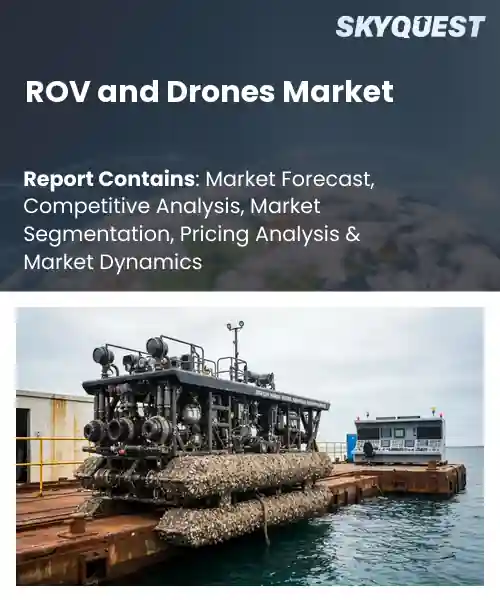
ROV and Drones Market
Report ID: SQMIG20A2791
Report ID: SQMIG20A2791
[email protected]
USA +1 351-333-4748
Report ID:
SQMIG20A2791 |
Region:
Global |
Published Date: July, 2026
Pages:
157
|Tables:
153
|Figures:
78


Global ROV And Drones Market size was valued at USD 624.3 Million in 2024 and is poised to grow from USD 660.51 Million in 2025 to USD 1036.97 Million by 2033, growing at a CAGR of 5.8% during the forecast period (2026-2033).
Rising adoption of automation across industries, increasing investments in offshore energy and infrastructure inspection, rising demand for precision agriculture and aerial surveying, advancements in battery and sensor technologies, and supportive regulatory developments are driving demand for the ROV and drones market.
Growing demand for safe, efficient, and cost-effective inspection and monitoring solutions across industries is expected to primarily drive the growth of the ROV and drones market. These systems are increasingly used in offshore oil and gas, renewable energy, agriculture, mining, construction, and defense to access hazardous or hard-to-reach environments while reducing operational risks and labor costs. Continuous improvements in battery performance, miniaturized sensors, and imaging technologies have expanded their capabilities and commercial adoption. Regulatory harmonization by authorities such as the FAA and IMO is reducing operational barriers, encouraging investments in advanced platforms, and supporting wider deployment across industries. Rising adoption of drones for precision farming, delivery services, infrastructure inspection, and offshore wind farm monitoring, along with growing use of data-driven analytics, is also expected to help bolster demand for ROVs and drones over the forecast period.
On the contrary, high acquisition and maintenance costs, stringent regulatory compliance requirements, limited battery life and operational range, cybersecurity and data privacy concerns, and technical challenges in harsh operating environments are anticipated to slow down ROV and drones market penetration across the study period and beyond.
How is AI driving innovation in the ROV and drone market?
Innovations through AI are changing the ROV and drones industry through improved navigation, automation, and decision making. Through machine learning technology, the ability of the robots to process sonar, camera, and other sensor information fast will help in mapping the underwater environment, avoidance of objects and carrying out missions without much input from humans. This will make ROVs and drones popular in applications including inspections, surveys, research, military and infrastructure surveillance. AI will ensure that there are reduced costs of operations, increased data accuracy and predictive maintenance.
Market snapshot - (2026-2033)
Global Market Size
USD 624.3 Million
Largest Segment
Remotely Operated Vehicles (ROVs)
Fastest Growth
Growth Rate
5.8% CAGR
To get more insights on this market click here to Request a Free Sample Report
Global ROV and drones market is segmented by product type, application, payload, end user, operation mode, and region. Based on product type, the market is segmented into Remotely Operated Vehicles (ROVs), Aerial Drones (UAVs), Surface Drones (USVs), hybrid robotic systems, and others. Based on application, the market is segmented into defense & security, oil & gas inspection, marine research, infrastructure inspection, and others. Based on payload, the market is segmented into imaging systems, manipulator arms, sensors & sonars, sampling equipment, and others. Based on end user, the market is segmented into defense organizations, energy companies, research institutes, commercial service providers, and others. Based on operation mode, the market is segmented into remotely operated, semi-autonomous, autonomous, and others. Based on region, the market is segmented into North America, Europe, Asia Pacific, Latin America, and Middle East & Africa.
The ROVs segment is projected to lead the global ROV and drones market revenue generation across the study period. They have unique underwater maneuverability and cargo capacity to facilitate complex inspections and actions in underwater environments. The reliability of the systems, their rugged design, and well-established control systems make operators feel comfortable, leading to continuous use in many different sectors. Their integration with sensor arrays and manipulators highlights their importance, and they continue to be the best tools for tough underwater tasks in the changing world of energy and science.
However, hybrid robotic systems are witnessing the strongest growth momentum as per this ROV and drones industry analysis as they combine abilities to operate both under and above water, enabling new cross-domain missions including surveillance of coastal areas and wind farms in the sea. This kind of flexibility makes these vehicles appealing to innovative people searching for comprehensive solutions, which helps in market development.
The defense & security segment is estimated to account for the highest global ROV and drones market share. The very stringent nature of its operations necessitates the development of highly reliable and secure ROVs and drones. It is because of the constant need for monitoring, fast response, and accurate targeting that the system continues receiving funding and technological upgrades. In addition, the integration of classified communication channels and hardening of parts makes such systems essential for critical infrastructure protection, hence becoming an anchor of demand in the market.
Meanwhile, infrastructure inspection is emerging as the key high‑growth subsegment as utilities and civil operators adopt drones and ROVs to assess bridges, pipelines, and offshore structures. The push for predictive maintenance fuels rapid uptake, encouraging manufacturers to tailor lightweight imaging solutions. This surge expands market reach and opens revenue streams.
To get detailed segments analysis, Request a Free Sample Report
North America is the leading market for ROVs and drones due to its combination of well-developed technological infrastructure and significant investment in research and development. Presence of innovative companies promotes fast development of the new products, and a well-integrated supply chain allows for swift transition from prototyping to implementation. A strong defense and energy sectors provide valuable use cases which spur the adoption rate, while a favorable regulatory regime encourages civilian applications. Availability of venture capital financing and skilled engineering workforce speed up the process of market penetration and reinforce the leading position due to the high level of performance and reliability. Collaboration between universities and industry players facilitates knowledge transfer and large-scale testing sites help with validation of technologies. The presence of large ports and offshore energy infrastructure provides natural testing ground for ROVs which reinforces their dual-use capabilities.
ROV and Drones Market in the United States is propelled by a synergistic blend of defense initiatives, commercial entrepreneurship, and academic research. Strong federal programs encourage early adoption across energy, agriculture and logistics, while a vibrant startup ecosystem continually introduces advanced autonomy features. Collaborative pilots between industry and research universities accelerate technology validation, and a proactive regulatory approach enables broader civilian use, fostering a dynamic environment for sustained expansion.
ROV and Drones Market in Canada benefits from a supportive policy climate and a strong emphasis on environmental stewardship. Federal and provincial programs prioritize marine monitoring, natural resource management and remote infrastructure inspection, creating demand for both underwater and aerial solutions. Close ties between research institutes and emerging firms encourage rapid prototyping, while investment in pilot projects across northern territories showcases the versatility of autonomous systems in challenging conditions, reinforcing Canada’s niche expertise.
The fast-paced demand for ROV and Drones in Europe is driven by the presence of well-integrated regulatory structures, sustainable initiatives, and an established industrial background. With standards harmonized within the member countries, the process of entering the market is simplified, allowing companies to scale their solutions in the area of energy, maritime monitoring, and precision agriculture. Low-emission drones and AUVs are incentivized by governments in line with their climate strategy. Innovation clusters bring together the engineering competencies of top-ranked universities and long-standing aerospace and marine companies, allowing for innovations in autonomy and sensing technologies. Data security and privacy focus of Europe, in addition to its efficient logistics infrastructure, further facilitate Europe’s leadership in this sector.
ROV and Drones Market in Germany is driven by a strong engineering tradition and a strategic focus on Industry 4.0 integration. Federal support emphasizes autonomous inspection for renewable energy installations and ports, while leading automotive and aerospace manufacturers extend their expertise to maritime and aerial platforms. Close cooperation between research institutes and established firms accelerates component miniaturization, and a robust certification regime ensures reliability, positioning Germany as a dominant force in high‑precision autonomous solutions.
ROV and Drones Market in the United Kingdom is experiencing the fastest growth thanks to aggressive government investment and a vibrant startup scene. Emphasis on maritime security, offshore wind maintenance and urban logistics fuels demand for both underwater and aerial autonomous systems. Partnerships between defense research agencies and private innovators accelerate technology transfer, while flexible regulatory sandboxes enable rapid testing in congested airspace. This ecosystem nurtures rapid scaling and reinforces the United Kingdom’s reputation as a hub for cutting‑edge autonomy.
ROV and Drones Market in France is emerging as a focal point for coastal surveillance and agricultural monitoring. National programs promote the deployment of lightweight aerial platforms for precision farming, while maritime agencies adopt autonomous underwater vehicles to safeguard territorial waters. Collaboration between leading aerospace clusters and marine research centers encourages cross‑technology innovation, and incentives aimed at green technology adoption accelerate market entry. These dynamics collectively shape France’s nascent yet promising role in the broader European ecosystem.
The strength of the Asia Pacific region in the ROV and Drones market comes from having extensive experience in manufacturing and forward-thinking government initiatives within important markets. The emphasis on securing the seas, energy extraction from offshore sites and logistics in smart cities ensures that there will be demand for autonomous technology that can navigate complex conditions. Extensive industrial chains allow for fast expansion of top performing products, while collaborations between educational institutions and leading electronics manufacturers speed up innovations in AI-based navigation. Standards in the area are being changed to allow for borderless use of the technology, and investments in test beds in coastal areas make this possible.
ROV and Drones Market in Japan is characterized by a strong emphasis on precision engineering and integration with advanced robotics. Government initiatives prioritize autonomous underwater inspection for offshore turbines and deep‑sea research, while urban applications focus on traffic monitoring and disaster response. Close collaboration between leading electronics manufacturers and maritime research institutes drives rapid miniaturization of sensor suites. This synergy, combined with rigorous safety standards, reinforces Japan’s reputation as a leader in high‑reliability autonomous platforms.
ROV and Drones Market in South Korea benefits from a dynamic technology ecosystem and aggressive export orientation. National policies incentivize autonomous inspection of offshore infrastructure and precision agriculture, fostering demand for compact, AI‑enabled platforms. Partnerships between major telecommunications firms and marine engineering companies accelerate the development of integrated communication and navigation solutions. Investment in coastal test facilities provides real‑world validation, while a supportive regulatory environment encourages rapid commercialization, positioning South Korea as a rising hub for innovative autonomous systems.
To know more about the market opportunities by region and country, click here to
Buy The Complete Report
Expanding Offshore Energy Exploration
Increasing Adoption Of Inspection Drones
Stringent Maritime Safety Regulations
High Initial Investment Costs
Request Free Customization of this report to help us to meet your business objectives.
The competitive landscape is shaped by intense rivalry among established manufacturers and fast‑moving newcomers, driving accelerated product cycles and strategic collaborations. DJI’s partnership with Hasselblad to integrate premium imaging, Autel Robotics’ launch of the EVO II Pro with advanced AI navigation, and Parrot’s alliance with Airbus for commercial service platforms illustrate how M&A, joint ventures and tech innovation are used to capture market share and meet rising demand for higher‑resolution sensors and autonomous capabilities.
SkyQuest’s ABIRAW (Advanced Business Intelligence, Research & Analysis Wing) is our Business Information Services team that Collects, Collates, Correlates, and Analyses the Data collected by means of Primary Exploratory Research backed by robust Secondary Desk research.
As per SkyQuest analysis, increasing investments in offshore energy and infrastructure inspection, and rising demand for precision agriculture and aerial surveying are anticipated to drive the demand for the ROV and drones market going forward. However, high acquisition costs, stringent regulatory compliance requirements, and limited battery life are slated to slow down the adoption of ROVs and drones in the future. North America is slated to spearhead the demand for the ROV and drones market owing to supportive regulatory frameworks, strong defense and aerospace investments, and the presence of leading drone and autonomous vehicle manufacturers. Development of AI-powered autonomous navigation, advanced imaging and sensor technologies, and integration of drones and ROVs with cloud-based analytics platforms are anticipated to be key trends driving the ROV and drones industry in the long run.
| Report Metric | Details |
|---|---|
| Market size value in 2024 | USD 624.3 Million |
| Market size value in 2033 | USD 1036.97 Million |
| Growth Rate | 5.8% |
| Base year | 2024 |
| Forecast period | (2026-2033) |
| Forecast Unit (Value) | USD Million |
| Segments covered |
|
| Regions covered | North America (US, Canada), Europe (Germany, France, United Kingdom, Italy, Spain, Rest of Europe), Asia Pacific (China, India, Japan, Rest of Asia-Pacific), Latin America (Brazil, Rest of Latin America), Middle East & Africa (South Africa, GCC Countries, Rest of MEA) |
| Companies covered |
|
| Customization scope | Free report customization with purchase. Customization includes:-
|
To get a free trial access to our platform which is a one stop solution for all your data requirements for quicker decision making. This platform allows you to compare markets, competitors who are prominent in the market, and mega trends that are influencing the dynamics in the market. Also, get access to detailed SkyQuest exclusive matrix.
Table Of Content
Executive Summary
Market overview
Parent Market Analysis
Market overview
Market size
KEY MARKET INSIGHTS
COVID IMPACT
MARKET DYNAMICS & OUTLOOK
Market Size by Region
KEY COMPANY PROFILES
Methodology
For the ROV and Drones Market, our research methodology involved a mixture of primary and secondary data sources. Key steps involved in the research process are listed below:
1. Information Procurement: This stage involved the procurement of Market data or related information via primary and secondary sources. The various secondary sources used included various company websites, annual reports, trade databases, and paid databases such as Hoover's, Bloomberg Business, Factiva, and Avention. Our team did 45 primary interactions Globally which included several stakeholders such as manufacturers, customers, key opinion leaders, etc. Overall, information procurement was one of the most extensive stages in our research process.
2. Information Analysis: This step involved triangulation of data through bottom-up and top-down approaches to estimate and validate the total size and future estimate of the ROV and Drones Market.
3. Report Formulation: The final step entailed the placement of data points in appropriate Market spaces in an attempt to deduce viable conclusions.
4. Validation & Publishing: Validation is the most important step in the process. Validation & re-validation via an intricately designed process helped us finalize data points to be used for final calculations. The final Market estimates and forecasts were then aligned and sent to our panel of industry experts for validation of data. Once the validation was done the report was sent to our Quality Assurance team to ensure adherence to style guides, consistency & design.
Analyst Support
Customization Options
With the given market data, our dedicated team of analysts can offer you the following customization options are available for the ROV and Drones Market:
Product Analysis: Product matrix, which offers a detailed comparison of the product portfolio of companies.
Regional Analysis: Further analysis of the ROV and Drones Market for additional countries.
Competitive Analysis: Detailed analysis and profiling of additional Market players & comparative analysis of competitive products.
Go to Market Strategy: Find the high-growth channels to invest your marketing efforts and increase your customer base.
Innovation Mapping: Identify racial solutions and innovation, connected to deep ecosystems of innovators, start-ups, academics, and strategic partners.
Category Intelligence: Customized intelligence that is relevant to their supply Markets will enable them to make smarter sourcing decisions and improve their category management.
Public Company Transcript Analysis: To improve the investment performance by generating new alpha and making better-informed decisions.
Social Media Listening: To analyze the conversations and trends happening not just around your brand, but around your industry as a whole, and use those insights to make better Marketing decisions.
REQUEST FOR SAMPLE
 REQUEST FREE CUSTOMIZATION
Global Rov And Drones Market size was valued at USD 624.3 Million in 2024 and is poised to grow from USD 660.51 Million in 2025 to USD 1036.97 Million by 2033, growing at a CAGR of 5.8% during the forecast period (2026-2033).
The competitive landscape is shaped by intense rivalry among established manufacturers and fast‑moving newcomers, driving accelerated product cycles and strategic collaborations. DJI’s partnership with Hasselblad to integrate premium imaging, Autel Robotics’ launch of the EVO II Pro with advanced AI navigation, and Parrot’s alliance with Airbus for commercial service platforms illustrate how M&A, joint ventures and tech innovation are used to capture market share and meet rising demand for higher‑resolution sensors and autonomous capabilities. 'Fugro N.V.', 'Oceaneering International, Inc.', 'Saab AB', 'Kongsberg Maritime AS', 'Forum Energy Technologies, Inc.', 'TechnipFMC plc', 'Teledyne Marine', 'VideoRay LLC', 'Deep Trekker Inc.', 'Blue Robotics Inc.', 'Greensea IQ', 'Exail Technologies', 'Nauticus Robotics, Inc.', 'QYSEA Technology Co., Ltd.', 'CHASING Innovation Technology Co., Ltd.', 'ECA Group', 'SeaBotix, Inc.', 'Sonardyne International Ltd.', 'EdgeTech', 'DeepOcean Group Holding BV'
The accelerating development of offshore oil, gas, and renewable installations creates a persistent demand for remote inspection, maintenance, and data collection, prompting operators to adopt advanced ROVs and aerial drones capable of operating in harsh marine environments. These systems provide safe access to submerged structures and hard‑to‑reach assets, reducing human risk and operational downtime while enhancing precision in task execution, thus reinforcing market expansion through sustained procurement cycles. Furthermore, the integration of real‑time analytics and autonomous navigation further empowers asset managers to make informed decisions, accelerating adoption across the sector.
Ai-Driven Autonomy Surge: Operators are increasingly integrating advanced artificial intelligence algorithms into ROVs and drones to enable real‑time decision making without human intervention. Machine‑learning models process sensor feeds, optimize flight paths, and predict equipment failures, dramatically extending mission endurance and reducing operational risk. This shift is prompting OEMs to prioritize software platforms over hardware differentiation, fostering a competitive landscape where rapid algorithm updates and cloud‑based enhancements become core value propositions for customers seeking flexible, future‑proofed autonomous solutions across offshore, inspection, and logistics applications.
Why does North America Dominate the Global ROV and Drones Market? |@12


Want to customize this report? This report can be personalized according to your needs. Our analysts and industry experts will work directly with you to understand your requirements and provide you with customized data in a short amount of time. We offer $1000 worth of FREE customization at the time of purchase.
Feedback From Our Clients


 USA (+1) 351-333-4748

