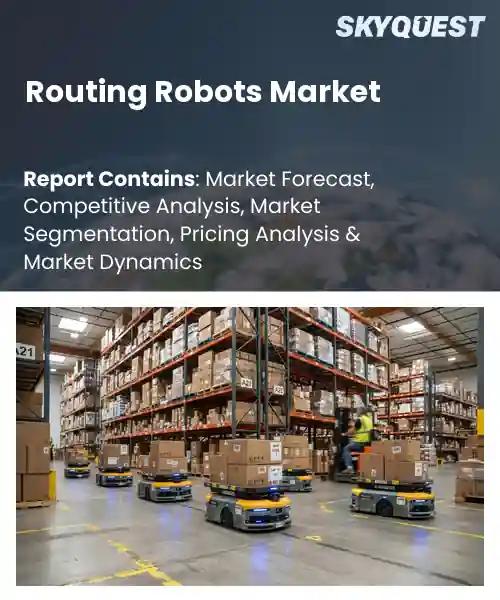
Routing Robots Market
Report ID: SQMIG45E3203
Report ID: SQMIG45E3203
[email protected]
USA +1 351-333-4748
Report ID:
SQMIG45E3203 |
Region:
Global |
Published Date: August, 2026
Pages:
157
|Tables:
174
|Figures:
79


Global Routing Robots Market size was valued at USD 842.6 Million in 2024 and is poised to grow from USD 967.3 Million in 2025 to USD 2918.09 Million by 2033, growing at a CAGR of 14.8% during the forecast period (2026-2033).
The routing robot market comprises autonomous mobile units that navigate indoor or outdoor environments to transport goods, documents, or equipment with minimal human oversight. Its significance lies in reducing labor costs, accelerating fulfillment cycles, and enhancing safety in sectors such as e‑commerce, healthcare, and manufacturing. The primary driver has been the rapid adoption of e‑commerce platforms, which forced warehouses to seek scalable, flexible solutions beyond conveyors. Early deployments in 2015, such as Kiva’s robotic shelves, demonstrated measurable gains in order‑picking speed, prompting a wave of investment that has since expanded to include multi‑modal robots handling irregular loads and dynamic routing. Another pivotal factor shaping the global routing robots market is the convergence of advanced sensor suites and AI‑driven navigation algorithms, which unlock flexibility. As warehouses become denser and product assortments more varied, robots that perceive obstacles, learn optimal paths, and adapt to real‑time demand directly increase throughput and cut errors. Amazon Robotics has used this capability to deploy fleets that autonomously reorganize inventory during peak seasons, reducing overtime labor by up to 30 percent. The efficiency gains attract pharmaceutical firms needing sterile material transport and municipal agencies exploring outdoor routing robots for last‑mile delivery, creating new revenue streams and expanding the market.
How is AI-driven automation impacting the efficiency of routing robots in logistics?
AI‑driven automation reshapes routing robots by uniting real‑time sensor data, dynamic path‑planning algorithms and machine‑learning insights. The core aspects are intelligent navigation, demand‑responsive scheduling and continuous performance learning, which together trim idle travel and boost pick‑to‑ship speed. Today logistics hubs deploy fleets that map warehouse layouts on the fly, adapt to congestion, and coordinate with inventory‑management systems. This shift is evident as more operators replace static conveyors with mobile bots that self‑optimise routes, leading to smoother flows and higher throughput. The market momentum reflects growing confidence in AI’s ability to streamline complex, time‑critical movements while reducing labor overhead.Figure AI, January 2026, unveiled an AI‑powered routing robot that learns optimal paths in real time, cutting travel distance and accelerating order fulfillment, a clear catalyst for efficiency gains in the routing robots market.
Market snapshot - (2026-2033)
Global Market Size
USD 842.6 Million
Largest Segment
Gantry Routing Robots
Fastest Growth
Articulated Routing Robots
Growth Rate
14.8% CAGR
To get more insights on this market click here to Request a Free Sample Report
Global routing robots market is segmented by robot type, application, end user, axis configuration, automation level, sales channel and region. Based on robot type, the market is segmented into Gantry Routing Robots, Articulated Routing Robots, SCARA Routing Robots and Others. Based on application, the market is segmented into Woodworking, Metal Fabrication, Composite Processing and Others. Based on end user, the market is segmented into Furniture Manufacturers, Automotive Manufacturers, Aerospace Manufacturers and Others. Based on axis configuration, the market is segmented into 3-Axis, 5-Axis, 6-Axis and Others. Based on automation level, the market is segmented into Semi-Automatic and Fully Automatic. Based on sales channel, the market is segmented into Direct Sales, System Integrators and Others. Based on region, the market is segmented into North America, Europe, Asia Pacific, Latin America and Middle East & Africa.
Gantry routing robots segment dominates because they provide unparalleled load capacity and linear precision, essential for large‑scale material handling in high‑throughput factories. Their structural rigidity reduces maintenance downtime, while the ease of integration with existing conveyor systems accelerates deployment. These attributes align with manufacturers’ demand for reliable, continuous operation, making gantry solutions the preferred choice for core automation strategies. Additionally, their scalability enables incremental expansion as production volumes grow, reinforcing long‑term ROI.
However, SCARA routing robots are witnessing the strongest growth momentum in the routing robots market as manufacturers pursue compact, high‑speed pick‑and‑place solutions for increasingly complex assemblies. Their reduced footprint and multi‑axis flexibility support rapid reconfiguration, attracting small‑to‑medium enterprises seeking cost‑effective automation, thereby fueling market expansion and new application opportunities across industries.
Fully automatic segment leads because it eliminates manual intervention, delivering consistent cycle times and higher throughput essential for competitive production environments. The technology integrates advanced sensor feedback and AI‑driven path planning, which reduces error rates and optimizes material flow. These capabilities align with manufacturers' pursuit of lean operations, making full automation the cornerstone of modern routing strategies. Additionally, the reduced reliance on skilled labor mitigates workforce shortages and enhances overall plant resilience.
Meanwhile, semi‑automatic routing robots are emerging as the key high‑growth area because they offer flexible deployment on legacy production lines while requiring lower capital outlay. Their hybrid control architecture allows operators to intervene during complex tasks, appealing to firms transitioning toward full automation, thereby accelerating adoption rates and creating new market niches.
To get detailed segments analysis, Request a Free Sample Report
North America leads the global Routing Robots market by leveraging a mature technology ecosystem, extensive research collaborations, and a high density of logistics hubs. The region benefits from strong venture capital involvement that accelerates product innovation and drives rapid integration of advanced sensors and AI capabilities. A robust regulatory environment encourages safe deployment while industry standards facilitate interoperability across platforms. Customer demand for efficiency in complex supply‑chain networks fuels continuous refinement of robot navigation and handling functions. The concentration of leading universities and specialized training programs supplies a pipeline of skilled engineers who drive iterative improvements and adapt solutions to emerging market needs. Enterprises across retail, e‑commerce and manufacturing sectors prioritize automation, reinforcing a feedback loop that incentivizes further research and development investments.
Routing Robots Market in United States thrives on a dense ecosystem of incubators and a culture of entrepreneurial risk‑taking that speeds deployment along major logistics corridors. Partnerships between leading retailers and robotics innovators produce tailored systems for high‑volume parcel sorting and last‑mile delivery. Emphasis on cybersecurity and open standards bolsters reliability, while academic research continuously feeds advanced algorithms into commercial platforms creating a robust environment for sustained growth and competitive advantage.
Routing Robots Market in Canada benefits from strong governmental support for automation and a well‑integrated transportation infrastructure that encourages early adoption. Collaborative initiatives between research institutes and logistics firms focus on developing robot solutions suited to cold‑chain handling and remote distribution centers. Emphasis on sustainability drives integration of energy‑efficient designs, while cross‑border trade ties with neighboring markets create opportunities for interoperable platforms that enhance overall supply‑chain resilience in the national logistics network.
Asia Pacific experiences rapid expansion of the Routing Robots market driven by a confluence of advanced manufacturing capabilities, burgeoning e‑commerce activity, and strategic investments in smart logistics. Nations such as Japan and South Korea leverage deep expertise in precision engineering and AI research to create highly adaptable robotic platforms. Growing consumer expectations for faster delivery push retailers to adopt autonomous routing solutions that optimize warehouse density and reduce handling time. Government initiatives encourage automation through supportive policies and collaborative research hubs, while a skilled technical workforce accelerates technology transfer and localization. The region’s emphasis on integration of robotics with emerging digital ecosystems further fuels adoption across diverse supply‑chain segments. Cross‑border collaborations between leading firms and emerging startups amplify innovation cycles, while increasing focus on sustainability guides the development of energy‑efficient robot designs that align with regional environmental goals.
Routing Robots Market in Japan leverages a heritage of precision manufacturing and a culture of continuous improvement. Automotive and electronics leaders drive demand for robots capable of complex component routing in high‑mix, low‑volume settings. University‑industry collaborations quicken the adoption of advanced sensors and AI algorithms. Focus on reliability and durability aligns deployments with stringent Japanese supply‑chain standards, encouraging acceptance across automotive, consumer‑goods, and healthcare logistics throughout the national distribution network.
Routing Robots Market in South Korea is propelled by strong government incentives for automation and a robust electronics manufacturing base that supplies sophisticated components. Leading parcel‑carrier firms partner with robotics developers to create end‑to‑end solutions that improve sorting speed and accuracy in densely packed fulfillment centers. The emphasis on rapid prototyping and agile development enables swift adaptation to shifting market demands, while a focus on integration with existing warehouse management systems ensures seamless operational rollout across multiple industry verticals.
Europe reinforces its position in the Routing Robots market through a blend of stringent regulatory frameworks, deep engineering expertise, and a collaborative innovation network that spans both established firms and emerging startups. The region’s commitment to sustainability drives the development of energy‑efficient robotic solutions that align with carbon‑reduction goals across logistics operations. Strong emphasis on standardization facilitates cross‑border interoperability, enabling manufacturers to deploy unified platforms throughout the continent. Investment in digital twins and advanced simulation tools accelerates design optimization, while a skilled labor pool ensures effective integration of robots into complex supply‑chain environments, collectively strengthening Europe’s competitive edge. Additionally, collaborative research programs funded by the European Union foster joint development of next‑generation navigation algorithms and safety standards, further solidifying the region’s reputation as a hub for cutting‑edge routing automation.
Routing Robots Market in Germany benefits from a strong industrial automation legacy and a network of research institutes that specialize in robotics and AI. Leading automotive suppliers and logistics providers collaborate to integrate routing robots that increase throughput and reduce manual handling in complex distribution networks. Emphasis on precision engineering ensures high reliability, while sustainability mandates encourage the adoption of energy‑saving designs that align with national environmental objectives for the.
Routing Robots Market in United Kingdom is driven by a vibrant fintech and e‑commerce sector that demands rapid, accurate order fulfillment. Collaboration between robotics firms and logistics operators focuses on modular robot designs that can be quickly reconfigured for varying warehouse layouts. Strong emphasis on health and safety standards promotes the development of robots equipped with advanced sensing and collision‑avoidance features, ensuring seamless integration within mixed‑human work environments in the.
Routing Robots Market in France leverages a strong emphasis on innovation and a supportive governmental framework that encourages automation across the logistics sector. Partnerships between automotive manufacturers, aerospace suppliers, and robotics startups generate solutions tailored to high‑precision part handling and inter‑facility transport. Commitment to circular economy principles drives the design of recyclable robot components, while rigorous safety certifications ensure that deployments meet the exacting standards of French supply‑chain operations.
To know more about the market opportunities by region and country, click here to
Buy The Complete Report
Adopting AI For Navigation
Growing Demand For Same‑Day Delivery
High Initial Capital Investment
Complex Integration With Legacy Systems
Request Free Customization of this report to help us to meet your business objectives.
The competitive landscape of the global routing robots market is shaped by aggressive capital raises, strategic partnerships and rapid technology integration, with firms leveraging large funding rounds to accelerate product development and secure distribution agreements, while incumbents pursue acquisitions to broaden portfolio breadth and enhance AI capabilities, intensifying competition for warehouse and hospital logistics contracts.
Top Player’s Company Profile
Recent Developments
SkyQuest’s ABIRAW (Advanced Business Intelligence, Research & Analysis Wing) is our Business Information Services team that Collects, Collates, Correlates, and Analyses the Data collected by means of Primary Exploratory Research backed by robust Secondary Desk research. As per SkyQuest analysis, the global routing robots market is being propelled primarily by the adoption of AI for navigation, which enables real‑time path optimization and boosts throughput, while the surge in same‑day delivery demand provides a second strong impetus for rapid deployment. The market is led by North America, where a mature tech ecosystem and strong logistics networks drive adoption, and the gantry routing robot segment remains dominant thanks to its high load capacity and precision. However, high initial capital investment continues to restrain many small and medium‑size enterprises, slowing broader uptake despite the clear efficiency benefits in the sector.
| Report Metric | Details |
|---|---|
| Market size value in 2024 | USD 842.6 Million |
| Market size value in 2033 | USD 2918.09 Million |
| Growth Rate | 14.8% |
| Base year | 2024 |
| Forecast period | (2026-2033) |
| Forecast Unit (Value) | USD Million |
| Segments covered |
|
| Regions covered | North America (US, Canada), Europe (Germany, France, United Kingdom, Italy, Spain, Rest of Europe), Asia Pacific (China, India, Japan, Rest of Asia-Pacific), Latin America (Brazil, Rest of Latin America), Middle East & Africa (South Africa, GCC Countries, Rest of MEA) |
| Companies covered |
|
| Customization scope | Free report customization with purchase. Customization includes:-
|
To get a free trial access to our platform which is a one stop solution for all your data requirements for quicker decision making. This platform allows you to compare markets, competitors who are prominent in the market, and mega trends that are influencing the dynamics in the market. Also, get access to detailed SkyQuest exclusive matrix.
Table Of Content
Executive Summary
Market overview
Parent Market Analysis
Market overview
Market size
KEY MARKET INSIGHTS
COVID IMPACT
MARKET DYNAMICS & OUTLOOK
Market Size by Region
KEY COMPANY PROFILES
Methodology
For the Routing Robots Market, our research methodology involved a mixture of primary and secondary data sources. Key steps involved in the research process are listed below:
1. Information Procurement: This stage involved the procurement of Market data or related information via primary and secondary sources. The various secondary sources used included various company websites, annual reports, trade databases, and paid databases such as Hoover's, Bloomberg Business, Factiva, and Avention. Our team did 45 primary interactions Globally which included several stakeholders such as manufacturers, customers, key opinion leaders, etc. Overall, information procurement was one of the most extensive stages in our research process.
2. Information Analysis: This step involved triangulation of data through bottom-up and top-down approaches to estimate and validate the total size and future estimate of the Routing Robots Market.
3. Report Formulation: The final step entailed the placement of data points in appropriate Market spaces in an attempt to deduce viable conclusions.
4. Validation & Publishing: Validation is the most important step in the process. Validation & re-validation via an intricately designed process helped us finalize data points to be used for final calculations. The final Market estimates and forecasts were then aligned and sent to our panel of industry experts for validation of data. Once the validation was done the report was sent to our Quality Assurance team to ensure adherence to style guides, consistency & design.
Analyst Support
Customization Options
With the given market data, our dedicated team of analysts can offer you the following customization options are available for the Routing Robots Market:
Product Analysis: Product matrix, which offers a detailed comparison of the product portfolio of companies.
Regional Analysis: Further analysis of the Routing Robots Market for additional countries.
Competitive Analysis: Detailed analysis and profiling of additional Market players & comparative analysis of competitive products.
Go to Market Strategy: Find the high-growth channels to invest your marketing efforts and increase your customer base.
Innovation Mapping: Identify racial solutions and innovation, connected to deep ecosystems of innovators, start-ups, academics, and strategic partners.
Category Intelligence: Customized intelligence that is relevant to their supply Markets will enable them to make smarter sourcing decisions and improve their category management.
Public Company Transcript Analysis: To improve the investment performance by generating new alpha and making better-informed decisions.
Social Media Listening: To analyze the conversations and trends happening not just around your brand, but around your industry as a whole, and use those insights to make better Marketing decisions.
REQUEST FOR SAMPLE
 REQUEST FREE CUSTOMIZATION


Want to customize this report? This report can be personalized according to your needs. Our analysts and industry experts will work directly with you to understand your requirements and provide you with customized data in a short amount of time. We offer $1000 worth of FREE customization at the time of purchase.
Feedback From Our Clients


 USA (+1) 351-333-4748

