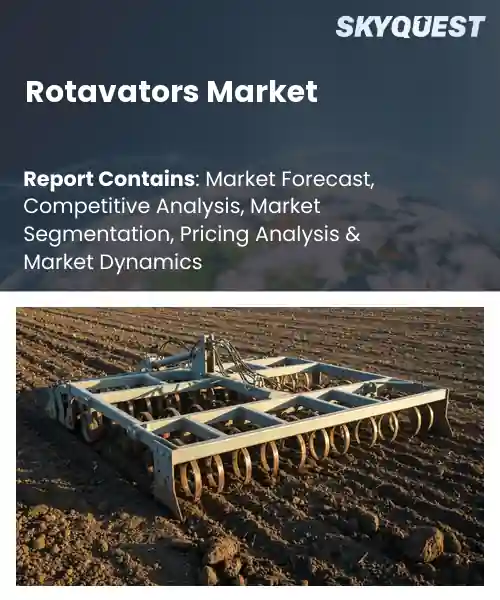
Rotavators Market
Report ID: SQMIG20H2114
Report ID: SQMIG20H2114
[email protected]
USA +1 351-333-4748
Report ID:
SQMIG20H2114 |
Region:
Global |
Published Date: July, 2026
Pages:
157
|Tables:
200
|Figures:
80


Global Rotavators Market size was valued at USD 1.62 Billion in 2024 and is poised to grow from USD 1.7 Billion in 2025 to USD 2.55 Billion by 2033, growing at a CAGR of 5.2% during the forecast period (2026-2033).
The global rotavators industry comprises manufacturers and suppliers of rotary tillage equipment used to prepare soil for planting, primarily in horticulture, vegetable farming, and large‑scale commercial agriculture. Its significance drives from the machine’s ability to reduce labor intensity and improve seed‑bed uniformity, which directly enhances crop yields and reduces production costs.
Recent advances in lightweight alloys and electric drive systems have refined performance, reinforcing the market’s steady expansion. Globally today. Looking ahead, the pivotal growth factor for the global rotavators market is the intensifying demand for sustainable intensification in food production, which drives farms to adopt efficient soil‑conditioning technologies. When growers replace manual tillage with rotavators, fuel consumption and greenhouse‑gas emissions fall, while faster field turnover enables multiple cropping cycles per year, directly boosting profitability. Regions such as India and Brazil illustrate this effect, where cooperative farms have integrated electric‑motor rotavators to meet both labor shortages and carbon‑reduction targets. Consequently, manufacturers are expanding into smart‑connected models equipped with telemetry, opening ancillary revenue streams through data‑analytics services and after‑market support globally.
How is IoT-enabled automation influencing the global rotavators market?
IoT enabled automation is reshaping the rotavators market by linking machines to cloud platforms and farm management systems. Sensors collect soil moisture, temperature and torque data, allowing operators to adjust depth and speed. Remote monitoring lets service teams schedule maintenance before failures occur, reducing downtime and extending equipment life. Data driven insights help farmers match tillage intensity to crop requirements, improving soil health and yield potential. Integration with GPS guidance ensures precise coverage and eliminates overlap, while mobile apps give users the ability to start, stop and monitor rotavators from the field office. These capabilities are driving higher adoption among growers and encouraging manufacturers to embed connectivity as a feature.
John Deere launched an IoT enabled rotavator in March 2024, adding cloud based diagnostics and remote control to its line. The new model lets farmers receive real time performance alerts on a mobile device, simplifying maintenance and improving field efficiency, which is accelerating adoption across the sector.
Market snapshot - (2026-2033)
Global Market Size
USD 1.62 Billion
Largest Segment
Standard Rotavators
Fastest Growth
Heavy-Duty Rotavators
Growth Rate
5.2% CAGR
To get more insights on this market click here to Request a Free Sample Report
Global rotavators market is segmented by type, blade type, working width, power source (tractor power), application, end user, distribution channel and region. Based on type, the market is segmented into Standard Rotavators and Heavy-Duty Rotavators. Based on blade type, the market is segmented into L-Type Blades, C-Type Blades, J-Type Blades and Others. Based on working width, the market is segmented into Up to 1.5 m, 1.5–2.0 m and Above 2.0 m. Based on power source (tractor power), the market is segmented into Up to 30 HP, 31–50 HP and Above 50 HP. Based on application, the market is segmented into Seedbed Preparation, Orchard & Vineyard Cultivation, Intercultural Operations, Residue & Stubble Management and Others. Based on end user, the market is segmented into Individual Farmers, Agricultural Contractors, Government & Institutional Farms and Others. Based on distribution channel, the market is segmented into OEM Sales and Aftermarket. Based on region, the market is segmented into North America, Europe, Asia Pacific, Latin America and Middle East & Africa.
L-type blades segment dominates because they provide superior soil penetration and smooth furrow formation, which are essential for seedbed preparation. Their geometric profile reduces draft force, enabling tractors with moderate power to operate efficiently. Growers favor this blade design for its consistency across varied soil textures, leading to higher seed placement accuracy and reduced fuel consumption. Consequently, manufacturers prioritize L-Type blades in product lines, reinforcing their market leadership.
However, C-type blades are witnessing the strongest growth momentum as they excel in heavy duty soil where deeper tillage is needed. Their robust curvature improves residue incorporation and soil aeration, attracting large farms adopting conservation practices. This rising preference expands demand and drives innovation, positioning C-Type blades as a key growth engine for the market.
As per rotavators market forecast, seedbed preparation segment dominates because rotavators are primarily valued for creating uniform seedbeds that maximize germination rates. The precise soil conditioning reduces seed depth variability, fostering consistent emergence and higher yields. Farmers prioritize equipment that delivers fine tilth, and rotavators excel in this role, establishing seedbed preparation as the core application driving market demand. This focus aligns with agronomic practices that emphasize early‑stage soil health, encouraging integration of rotavators into planting cycles.
As per rotavators market outlook, residue and stubble management is emerging as a high‑growth segment as farmers adopt sustainable practices and reduce post‑harvest waste. Rotavators with specialized blades enable efficient chopping and incorporation of residues, boosting soil organic matter and moisture retention. This aligns with environmental incentives, accelerating adoption and expanding market opportunities.
To get detailed segments analysis, Request a Free Sample Report
Asia Pacific commands leadership through a confluence of advanced manufacturing expertise, robust agricultural demand, and progressive policy frameworks that prioritize mechanization. Homegrown engineering talent fuels continuous product innovation, delivering equipment that aligns with diverse cropping systems and varying field sizes. Large-scale farming operations across the region seek efficiency gains, prompting widespread adoption of high‑performance rotavators. Government incentives and investment in modern farming infrastructure further accelerate market penetration, while established export channels extend the region’s influence into emerging economies. Combined, these strengths create a self‑reinforcing ecosystem that sustains dominant market share and sets industry benchmarks.
As per rotavators market regional outlook, Japan benefits from a strong tradition of precision engineering and a high degree of automation in agricultural practices. Local manufacturers integrate sophisticated electronic controls and ergonomic designs, catering to the nuanced needs of both smallholder and commercial farms. Collaborative research initiatives between academia and industry drive continual enhancements in soil conditioning efficiency, reinforcing Japan’s reputation as a hub for cutting‑edge agricultural equipment.
As per rotavators market regional forecast, South Korea is propelled by aggressive investment in smart farming technologies and a supportive regulatory environment. Domestic producers emphasize compact, energy‑efficient models that suit the country’s varied topography and intensive cropping patterns. Integration of IoT connectivity enables real‑time performance monitoring, aligning with the national focus on data‑driven agriculture and enhancing overall productivity.
Europe’s expansion is fueled by a strong emphasis on sustainable agriculture, rigorous environmental standards, and a well‑established network of research institutions. Farmers are adopting rotavators to reduce soil compaction and improve seedbed preparation, aligning with goals of conservation and yield optimization. Collaborative development programs and public‑private partnerships foster innovative designs that address diverse climate zones across the continent. Moreover, a mature distribution infrastructure and a focus on energy‑efficient machinery support the swift uptake of advanced rotavators, positioning Europe as a dynamic growth arena.
Germany reflects a mature ecosystem where engineering excellence meets stringent environmental directives. Manufacturers prioritize durable, low‑emission machines that integrate precision control systems, meeting the expectations of both large agribusinesses and precision farms. Strong collaboration between industry associations and research labs accelerates the introduction of features that enhance soil health while complying with sustainability mandates.
United Kingdom is characterized by rapid adoption driven by a focus on farm efficiency and adaptability to diverse regional soils. Companies emphasize lightweight, versatile units that complement the country's mix of arable and mixed farms. Government support for technology integration and a vibrant network of agritech innovators accelerate the rollout of next‑generation rotavators, reinforcing the market’s swift growth trajectory.
France is emerging amid a growing appetite for mechanized solutions that support organic and conventional farming alike. French manufacturers highlight modular designs that can be tailored to variable field conditions, aligning with the nation’s emphasis on crop diversification. Collaborative efforts with agricultural research bodies foster continuous improvement in soil management capabilities, positioning France as a developing hub for rotavator adoption.
North America reinforces its role through a blend of large‑scale farming operations, robust investment in agricultural technology, and a culture of innovation focused on efficiency and sustainability. Producers seek equipment that can handle extensive acreage while minimizing soil disturbance, leading to heightened interest in advanced rotavator designs. Strong extension services and industry consortia promote knowledge sharing, accelerating best‑practice adoption. Additionally, an entrenched supply chain and access to cutting‑edge component manufacturers enable rapid integration of smart features, further cementing the region’s strategic advantage.
United States is driven by vast row‑crop enterprises that demand high‑capacity, durable machines capable of handling diverse soil types. Leading firms incorporate precision guidance and telemetry, allowing operators to optimize tillage depth and reduce fuel consumption. Partnerships between equipment makers and agronomy experts ensure that rotavator technology aligns with evolving crop rotation strategies and conservation tillage practices.
Canada benefits from a focus on cold‑weather performance and adaptability to both extensive grain farms and specialized horticultural enterprises. Manufacturers prioritize rugged construction and enhanced torque to manage challenging terrain. Collaborative research with provincial agriculture agencies supports the development of rotavators that balance soil health preservation with the need for efficient field preparation across the nation.
To know more about the market opportunities by region and country, click here to
Buy The Complete Report
Increasing Adoption of Precision Agriculture
Growing Need for Soil Conservation
High Initial Capital Expenditure
Complex Maintenance Requirements
Request Free Customization of this report to help us to meet your business objectives.
The competitive landscape is shaped by major agritech manufacturers leveraging strategic M&A and partnerships to accelerate technology adoption, while new entrants focus on automation and sustainability; John Deere’s acquisition of Blue River Technology in 2020 and Kubota’s collaboration with Panasonic for electric‑drive rotavators exemplify how consolidation and joint innovation are driving market differentiation and expanding product portfolios.
SkyQuest’s ABIRAW (Advanced Business Intelligence, Research & Analysis Wing) is our Business Information Services team that Collects, Collates, Correlates, and Analyses the Data collected by means of Primary Exploratory Research backed by robust Secondary Desk research.
As per SkyQuest analysis, the global rotavators market growth is being propelled primarily by the increasing adoption of precision agriculture, which lets farmers fine‑tune tillage depth, reduce fuel use and boost yields, while a secondary boost comes from the growing need for soil‑conservation practices that favor low‑tillage designs and residue management. The market’s strongest growth engine remains the L‑Type blade segment, favored for its efficient seed‑bed preparation and lower draft force. Asia Pacific leads the market due to advanced manufacturing, supportive policies and large‑scale farming demand. However, high initial capital expenditure for high‑tech rotavators restrains adoption, especially among smallholders, tempering overall expansion. The global rotavators market trend driven by increasing agricultural mechanization, rising demand for efficient soil preparation equipment, and labor shortages in farming.
| Report Metric | Details |
|---|---|
| Market size value in 2024 | USD 1.62 Billion |
| Market size value in 2033 | USD 194.88 Billion |
| Growth Rate | 5.2% |
| Base year | 2024 |
| Forecast period | (2026-2033) |
| Forecast Unit (Value) | USD Billion |
| Segments covered |
|
| Regions covered | North America (US, Canada), Europe (Germany, France, United Kingdom, Italy, Spain, Rest of Europe), Asia Pacific (China, India, Japan, Rest of Asia-Pacific), Latin America (Brazil, Rest of Latin America), Middle East & Africa (South Africa, GCC Countries, Rest of MEA) |
| Companies covered |
|
| Customization scope | Free report customization with purchase. Customization includes:-
|
To get a free trial access to our platform which is a one stop solution for all your data requirements for quicker decision making. This platform allows you to compare markets, competitors who are prominent in the market, and mega trends that are influencing the dynamics in the market. Also, get access to detailed SkyQuest exclusive matrix.
Table Of Content
Executive Summary
Market overview
Parent Market Analysis
Market overview
Market size
KEY MARKET INSIGHTS
COVID IMPACT
MARKET DYNAMICS & OUTLOOK
Market Size by Region
KEY COMPANY PROFILES
Methodology
For the Rotavators Market, our research methodology involved a mixture of primary and secondary data sources. Key steps involved in the research process are listed below:
1. Information Procurement: This stage involved the procurement of Market data or related information via primary and secondary sources. The various secondary sources used included various company websites, annual reports, trade databases, and paid databases such as Hoover's, Bloomberg Business, Factiva, and Avention. Our team did 45 primary interactions Globally which included several stakeholders such as manufacturers, customers, key opinion leaders, etc. Overall, information procurement was one of the most extensive stages in our research process.
2. Information Analysis: This step involved triangulation of data through bottom-up and top-down approaches to estimate and validate the total size and future estimate of the Rotavators Market.
3. Report Formulation: The final step entailed the placement of data points in appropriate Market spaces in an attempt to deduce viable conclusions.
4. Validation & Publishing: Validation is the most important step in the process. Validation & re-validation via an intricately designed process helped us finalize data points to be used for final calculations. The final Market estimates and forecasts were then aligned and sent to our panel of industry experts for validation of data. Once the validation was done the report was sent to our Quality Assurance team to ensure adherence to style guides, consistency & design.
Analyst Support
Customization Options
With the given market data, our dedicated team of analysts can offer you the following customization options are available for the Rotavators Market:
Product Analysis: Product matrix, which offers a detailed comparison of the product portfolio of companies.
Regional Analysis: Further analysis of the Rotavators Market for additional countries.
Competitive Analysis: Detailed analysis and profiling of additional Market players & comparative analysis of competitive products.
Go to Market Strategy: Find the high-growth channels to invest your marketing efforts and increase your customer base.
Innovation Mapping: Identify racial solutions and innovation, connected to deep ecosystems of innovators, start-ups, academics, and strategic partners.
Category Intelligence: Customized intelligence that is relevant to their supply Markets will enable them to make smarter sourcing decisions and improve their category management.
Public Company Transcript Analysis: To improve the investment performance by generating new alpha and making better-informed decisions.
Social Media Listening: To analyze the conversations and trends happening not just around your brand, but around your industry as a whole, and use those insights to make better Marketing decisions.
REQUEST FOR SAMPLE
 REQUEST FREE CUSTOMIZATION
Global Rotavators Market size was valued at USD 1.62 Billion in 2024 and is poised to grow from USD 1.7 Billion in 2025 to USD 194.88 Billion by 2033, growing at a CAGR of 5.2% during the forecast period (2026-2033).
The competitive landscape is shaped by major agritech manufacturers leveraging strategic M&A and partnerships to accelerate technology adoption, while new entrants focus on automation and sustainability; John Deere’s acquisition of Blue River Technology in 2020 and Kubota’s collaboration with Panasonic for electric‑drive rotavators exemplify how consolidation and joint innovation are driving market differentiation and expanding product portfolios. 'Deere & Company', 'Kubota Corporation', 'Mahindra & Mahindra Limited', 'Maschio Gaspardo S p A', 'Kuhn Group', 'Alamo Group Inc', 'Agco Corporation', 'CNH Industrial NV', 'Yanmar Holdings Co Ltd', 'Sonalika Tractors', 'Tractors and Farm Equipment Limited', 'Escorts Kubota Limited', 'VST Tillers Tractors Limited', 'Shaktiman Agricultural Implements', 'Lemken GmbH & Co KG', 'Kverneland Group', 'Howard Rotavator', 'Celli S p A', 'Breviglieri S p A', 'Del Morino'
The integration of advanced sensors and GPS technology enables farmers to apply rotavators with exact depth and spacing, reducing waste and improving soil aeration. This precision reduces labor hours and fuel consumption, making rotavator operations more efficient and cost‑effective. Consequently, growers are more inclined to invest in modern rotavator equipment, driving demand across both large‑scale and fragmented agricultural operations, and supporting overall market expansion. The enhanced control also allows for better seedbed preparation, which improves germination rates and yields, reinforcing the value proposition of rotavator usage for sustainable crop production.
Sustainable Soil Management: The rotavator segment is increasingly aligning with environmental stewardship goals as manufacturers embed eco‑friendly designs, such as low‑emission power units and biodegradable component housings. Farmers are prioritizing equipment that minimizes soil disturbance while preserving organic matter, prompting producers to offer models with adjustable depth controls and precision‑cutting tines. This shift enables higher long‑term yields, reduces reliance on chemical inputs, and positions rotavators as integral tools in regenerative agriculture practices worldwide across diverse climatic zones and emerging markets.
Why does Asia Pacific Dominate the Global Rotavators Market? |@12


Want to customize this report? This report can be personalized according to your needs. Our analysts and industry experts will work directly with you to understand your requirements and provide you with customized data in a short amount of time. We offer $1000 worth of FREE customization at the time of purchase.
Feedback From Our Clients


 USA (+1) 351-333-4748

